Country exposure · AD

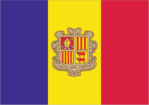
Flag of Andorra

Andorra

Europe · Andorra la Vella · parliamentary democracy (since March 1993) that retains its chiefs of state in the form of a co-principality; the two princes are the President of France and Bishop of Seu d'Urgell, Spain

What Andorra means for your money — the prices you pay, the tariffs in motion, and where U.S. policy could change both.
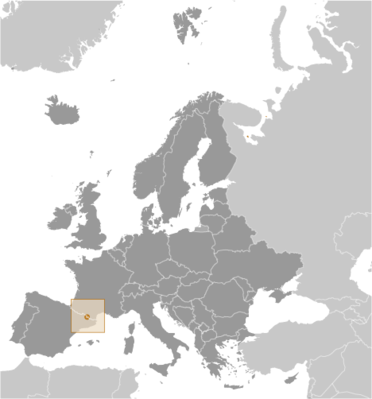
Map showing the location of Andorra

$7M

U.S. imports, 2025

+102.5%

change in one year

$8M

U.S. exports, 2025

85K

Population

$4.0B

GDP

In your house

What you buy that Andorra makes

America bought $7M in goods from Andorra in 2025 — up 102.5% in a single year. Of every $100 of it, here's where the money went.

Semiconductors

semiconductors and chips

$4M60.8%

U.s. goods returned, and reimports

$937K13.6%

Electric apparatus

$493K7.2%

Musical instruments

$239K3.5%

Artwork, antiques, stamps, etc.

$234K3.4%

Medicinal equipment

medical devices and equipment

$186K2.7%

Other foods

$99K1.4%

Toys, games, and sporting goods

toys, games, sporting goods

$73K1.1%

Industrial engines

$64K0.9%

Minimum value shipments

$58K0.8%

2026 so far (through April): $1M in imports. Source: U.S. Census Bureau, International Trade in Goods (customs basis).

The other direction

What America sells to Andorra

$8M in 2025 — a trade rupture cuts both ways, for American producers as well as American prices.

Artwork, antiques, stamps, etc.

$4M

Tapes, audio and visual

$1M

Books, printed matter

$543K

books and printed materials

Civilian aircraft, engines, equipment, and parts

$481K

Jewelry, etc.

$324K

jewelry

Pharmaceutical preparations

$273K

medicines and pharmacy items

Semiconductors

$250K

semiconductors and chips

Telecommunications equipment

$247K

phones, routers, networking gear

Computers

$218K

laptops, desktops, monitors

Where you stand

U.S. tariff posture toward Andorra

No U.S. tariff action singles this country out. Its goods face the universal 10% temporary import surcharge under Section 122 of the Trade Act (which replaced the IEEPA reciprocal baseline in February 2026) plus the sectoral Section 232 duties — steel and aluminum at 50% — that apply to all countries. The Section 122 surcharge is statutorily temporary — scheduled to lapse on or about July 23, 2026 (a 150-day cap) unless extended or replaced.

Reciprocal tariff (universal baseline)

10%

The universal 10% floor — a Section 122 import surcharge since February 2026, previously the EO 14257 reciprocal baseline — applies to nearly all U.S. imports. This country has no higher assigned rate of its own.

Policy in motion

Tariff status: a moving target

No U.S. tariff action names Andorra. These are the universal measures — applied to every country without a country-specific arrangement — that set its treatment.

  1. 2026-04-06

    Section 232 metals coverage expanded

    In effect

    The April 2026 proclamation strengthening Section 232 actions on aluminum, steel, and copper expanded derivative-product coverage for all countries, keeping the general metals rate at 50%.

    91 FR 18201
  2. 2026-02-24

    IEEPA reciprocal tariffs terminated — replaced by 10% Section 122 surcharge

    In effect

    Executive Order 14389 (Ending Certain Tariff Actions) terminated the IEEPA tariff duties — including the EO 14257 reciprocal baseline — effective February 24, 2026. A flat 10% Section 122 temporary import surcharge (Proclamation 11012 of February 20, 2026) replaced them, leaving the universal rate unchanged at 10% on a different statutory basis. Section 122 caps such surcharges at 150 days, so this 10% surcharge is scheduled to lapse on or about July 23, 2026 absent further action (the administration has signaled it could raise the rate toward the 15% statutory maximum).

    91 FR 9437
  3. 2025-11-13

    Agricultural products exempted from reciprocal tariffs

    In effect

    Executive Order 14360 of November 14, 2025 removed reciprocal duties from certain agricultural products listed in its annexes (coffee, cocoa, bananas, and other goods the U.S. does not produce in sufficient quantity), retroactive to November 13, 2025 — for all countries subject to the reciprocal tariff.

    90 FR 54091
  4. 2025-06-04

    Section 232 steel and aluminum duties doubled to 50%

    In effect

    The June 3, 2025 proclamation raised Section 232 duties on steel and aluminum articles and derivatives from 25% to 50% for all countries, effective June 4, 2025.

    90 FR 24199
  5. 2025-04-05

    Universal 10% reciprocal baseline takes effect

    In effect

    Executive Order 14257 (signed April 2, 2025) imposed a 10% ad valorem reciprocal duty on imports from all trading partners, effective April 5, 2025. Countries without a higher Annex I rate remain at this baseline.

    Federal Register · 2025-06063
  6. 2025-03-12

    Section 232 steel and aluminum duties set at 25% for all countries

    In effect

    Proclamations of February 10, 2025 terminated all country exemptions and quota arrangements and applied 25% Section 232 duties to steel and aluminum imports from every country, effective March 12, 2025.

    90 FR 9817

Reference

The country itself

Europe · Geography, people, economy, and government — public-domain data from the CIA World Factbook.

The landlocked Principality of Andorra -- one of the smallest states in Europe and nestled high in the Pyrenees between the French and Spanish borders -- is the last independent survivor of the Hispanic March states created by Frankish King Charlemagne in 795 after he halted the Moorish invasion of Spain. The March states were a series of buffer states to keep the Muslim Moors from advancing into Christian France. For 715 years, from 1278 to 1993, Andorrans lived under a unique co-principality, ruled by French and Spanish leaders (from 1607 onward, the French chief of state and the Bishop of Urgell). In 1993, this feudal system was modified with the introduction of a modern constitution; the co-princes remained as titular heads of state, but the government transformed into a parliamentary democracy. Andorra's winter sports, summer climate, and duty-free shopping attract approximately 8 million people each year. Andorra has also become a wealthy international commercial center because of its mature banking sector and low taxes. As part of the effort to modernize its economy, Andorra has opened to foreign investment and engaged in other reforms, such as tax initiatives aimed at supporting broader infrastructure. Although not a member of the EU, Andorra enjoys a special relationship with the bloc that is governed by various customs and cooperation agreements, and Andorra uses the euro as its national currency.
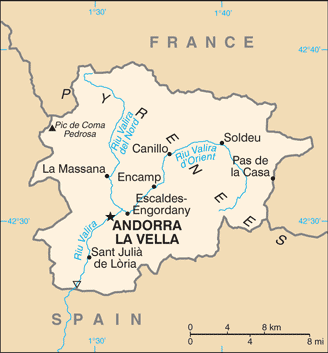
Regional map of Andorra

Geography

Location
Southwestern Europe, Pyrenees mountains, on the border between France and Spain
Area
468 sq km
Climate
temperate; snowy, cold winters and warm, dry summers
Terrain
rugged mountains dissected by narrow valleys
Natural resources
hydropower, mineral water, timber, iron ore, lead
Coastline
0 km (landlocked)
Natural hazards
avalanches

People & society

Population
85,370 (2024 est.)
Nationality
Andorran(s)
Ethnic groups
Spanish 34.3%, Andorran 32.1%, Portuguese 10%, French 5.6%, other 18% (2024 est.)
Languages
Catalan (official) 44.1%, Castilian 40.3%, Portuguese 13.5%, French 10%, English 3%, other 6.8% (2022 est.)
Religions
Christian (predominantly Roman Catholic) 89.5, other 8.8%, unaffiliated 1.7% (2020 est.)
Median age
49.4 years (2025 est.)
Life expectancy at birth
83.8 years (2024 est.)

Economy

Economic overview
high GDP; low unemployment; non-EU Euro user; co-principality duty-free area between Spain and France; tourist hub but hit hard by COVID-19; modern, non-tax haven financial sector; looking for big tech investments; new member of SEPA and IMF
Industries
tourism (particularly skiing), banking, timber, furniture
Agricultural products
small quantities of rye, wheat, barley, oats, vegetables, tobacco, sheep, cattle
Exports - partners
Spain 39%, USA 21%, France 11%, UK 5%, UAE 3% (2023)
Imports - partners
Spain 65%, France 11%, Germany 4%, China 3%, Italy 3% (2023)

Government

Government type
parliamentary democracy (since March 1993) that retains its chiefs of state in the form of a co-principality; the two princes are the President of France and Bishop of Seu d'Urgell, Spain
Capital
Andorra la Vella
Independence
1278 (formed under the joint sovereignty of the French Count of Foix and the Spanish Bishop of Urgell)
Constitution
drafted 1991, approved by referendum 14 March 1993, effective 28 April 1993
Executive branch
Co-prince Emmanuel MACRON (since 14 May 2017); represented by Patrick STROZDA (since 14 May 2017); and Co-prince Archbishop Joan-Enric VIVES i Sicilia (since 12 May 2003); represented by Eduard Ibanez PULIDO (since 27 November 2023)
Legislative branch
General Council (Consell General)

Full reference data

Every field, by section — CIA World Factbook. Open a topic to expand it.

Introduction
Background
The landlocked Principality of Andorra -- one of the smallest states in Europe and nestled high in the Pyrenees between the French and Spanish borders -- is the last independent survivor of the Hispanic March states created by Frankish King Charlemagne in 795 after he halted the Moorish invasion of Spain. The March states were a series of buffer states to keep the Muslim Moors from advancing into Christian France. For 715 years, from 1278 to 1993, Andorrans lived under a unique co-principality, ruled by French and Spanish leaders (from 1607 onward, the French chief of state and the Bishop of Urgell). In 1993, this feudal system was modified with the introduction of a modern constitution; the co-princes remained as titular heads of state, but the government transformed into a parliamentary democracy. Andorra's winter sports, summer climate, and duty-free shopping attract approximately 8 million people each year. Andorra has also become a wealthy international commercial center because of its mature banking sector and low taxes. As part of the effort to modernize its economy, Andorra has opened to foreign investment and engaged in other reforms, such as tax initiatives aimed at supporting broader infrastructure. Although not a member of the EU, Andorra enjoys a special relationship with the bloc that is governed by various customs and cooperation agreements, and Andorra uses the euro as its national currency.
Travel Facts
US State Dept Travel Advisory
For the latest travel advisories for this country, please consult the U.S. State Department's website, available through the link below. https://travel.state.gov/content/travel/en/traveladvisories/traveladvisories.html
Passport/Visa Requirements
For the latest passport and visa requirements for this country, please consult the U.S. State Department’s “Learn About Your Destination” search tool, available through the link below. https://travel.state.gov/content/travel/en/international-travel/International-Travel-Country-Information-Pages.html
US Embassy/Consulate
US does not have an embassy in Andorra; the US ambassador to Spain is accredited to Andorra; US interests in Andorra are represented by the US Consulate General's office in Barcelona (Spain); mailing address: Paseo Reina Elisenda de Montcada, 23, 08034 Barcelona, Spain; telephone: [34] (93) 280-2227; US citizens may call US Dept of State (202)-501-4444 for emergencies; Barcelonaacs@state.gov
LGBTQIA+, Women, and Special Needs Travelers
Additional travel considerations can be found on the US State Department's International Travel page. https://travel.state.gov/content/travel/en/international-travel/before-you-go/travelers-with-special-considerations.html
Telephone Code
376
Local Emergency Phone
Europe-wide emergency response number 112; Ambulance: 118; Fire: 118; Police: 110
Vaccinations
For the latest information on required or recommended vaccines, please visit the CDC's website, available through the link below. https://wwwnc.cdc.gov/travel/destinations/list
Climate
Temperate; snowy, cold winters and warm, dry summers
Currency (Code)
Euros (EUR)
Electricity/Voltage/Plug Type(s)
230 V / 50 Hz / plug types(s): C, F
Major Languages
Catalan (official), French, Castilian, Portuguese
Time Difference
UTC+1 (6 hours ahead of Washington, DC during Standard Time); daylight saving time: +1hr, begins last Sunday in March, ends last Sunday in October
Potable Water
Opt for bottled water
International Driving Permit
Suggested
Road Driving Side
Right
Souvenirs
Wood, leather, and metal carved "musicature"; ironwork; pinewood furniture; glazed pottery
Traditional Cuisine
Escudella i carn d'olla — a traditional Catalan meat and vegetable stew and soup
CIA source last updated
Wednesday, June 19, 2024
Travel resources

Please visit the following links to find further information about your desired destination.

CDC - To learn what vaccines and health precautions to take while visiting your destination.

US State Dept Travel Information - Overall information about foreign travel for US citizens.

To obtain an international driving permit (IDP). Only two organizations in the US issue IDPs: American Automobile Association (AAA) and American Automobile Touring Alliance (AATA)

How to get help in an emergency? Contact the nearest US embassy or consulate, or call one of these numbers: from the US or Canada - 1-888-407-4747 or from Overseas - +1 202-501-4444

Page last updated: Wednesday, June 19, 2024

Geography
Location
Southwestern Europe, Pyrenees mountains, on the border between France and Spain
Geographic coordinates
42 30 N, 1 30 E
Map references
Europe
Area - total
468 sq km
Area - land
468 sq km
Area - water
0 sq km
Area - comparative
2.5 times the size of Washington, D.C.
Land boundaries - total
118 km
Land boundaries - border countries
France 55 km; Spain 63 km
Coastline
0 km (landlocked)
Maritime claims
none (landlocked)
Climate
temperate; snowy, cold winters and warm, dry summers
Terrain
rugged mountains dissected by narrow valleys
Elevation - highest point
Pic de Coma Pedrosa 2,946 m
Elevation - lowest point
Riu Runer 840 m
Elevation - mean elevation
1,996 m
Natural resources
hydropower, mineral water, timber, iron ore, lead
Land use - agricultural land
39.9% (2023 est.)
Land use - agricultural land: arable land
arable land: 1.6% (2023 est.)
Land use - agricultural land: permanent crops
permanent crops: 0% (2023 est.)
Land use - agricultural land: permanent pasture
permanent pasture: 38.3% (2023 est.)
Land use - forest
38.7% (2023 est.)
Land use - other
21.4% (2023 est.)
Irrigated land
0 sq km (2022)
Population distribution
population is unevenly distributed and is concentrated in the seven urbanized valleys that make up the country's parishes (political administrative divisions)
Natural hazards
avalanches
Geography - note
landlocked; straddles a number of important crossroads in the Pyrenees
People and Society
Population - total
85,370 (2024 est.)
Population - male
43,652
Population - female
41,718
Nationality - noun
Andorran(s)
Nationality - adjective
Andorran
Ethnic groups
Spanish 34.3%, Andorran 32.1%, Portuguese 10%, French 5.6%, other 18% (2024 est.)
Ethnic groups - note
note: data represent population by country of birth
Languages
Catalan (official) 44.1%, Castilian 40.3%, Portuguese 13.5%, French 10%, English 3%, other 6.8% (2022 est.)
Languages - note
note: data represent mother tongue
Religions
Christian (predominantly Roman Catholic) 89.5, other 8.8%, unaffiliated 1.7% (2020 est.)
Age structure - 0-14 years
12% (male 5,276/female 4,954)
Age structure - 15-64 years
67.7% (male 29,562/female 28,201)
Age structure - 65 years and over
20.4% (2024 est.) (male 8,814/female 8,563)
Dependency ratios - total dependency ratio
47.8 (2024 est.)
Dependency ratios - youth dependency ratio
17.7 (2024 est.)
Dependency ratios - elderly dependency ratio
30.1 (2024 est.)
Dependency ratios - potential support ratio
3.3 (2024 est.)
Median age - total
49.4 years (2025 est.)
Median age - male
48.7 years
Median age - female
48.8 years
Population growth rate
-0.12% (2025 est.)
Birth rate
6.88 births/1,000 population (2025 est.)
Death rate
8.14 deaths/1,000 population (2025 est.)
Net migration rate
0 migrant(s)/1,000 population (2025 est.)
Population distribution
population is unevenly distributed and is concentrated in the seven urbanized valleys that make up the country's parishes (political administrative divisions)
Urbanization - urban population
87.8% of total population (2023)
Urbanization - rate of urbanization
0.11% annual rate of change (2020-25 est.)
Major urban areas - population
23,000 ANDORRA LA VELLA (capital) (2018)
Sex ratio - at birth
1.06 male(s)/female
Sex ratio - 0-14 years
1.06 male(s)/female
Sex ratio - 15-64 years
1.05 male(s)/female
Sex ratio - 65 years and over
1.03 male(s)/female
Sex ratio - total population
1.05 male(s)/female (2024 est.)
Mother's mean age at first birth
32.8 years (2019)
Maternal mortality ratio
11 deaths/100,000 live births (2023 est.)
Infant mortality rate - total
3.3 deaths/1,000 live births (2025 est.)
Infant mortality rate - male
3.4 deaths/1,000 live births
Infant mortality rate - female
3.2 deaths/1,000 live births
Life expectancy at birth - total population
83.8 years (2024 est.)
Life expectancy at birth - male
81.6 years
Life expectancy at birth - female
86.2 years
Total fertility rate
1.47 children born/woman (2025 est.)
Gross reproduction rate
0.71 (2025 est.)
Drinking water source - improved: urban
urban: 100% of population (2022 est.)
Drinking water source - improved: rural
rural: 100% of population (2022 est.)
Drinking water source - improved: total
total: 100% of population (2022 est.)
Drinking water source - unimproved: urban
urban: 0% of population (2022 est.)
Drinking water source - unimproved: rural
rural: 0% of population (2022 est.)
Drinking water source - unimproved: total
total: 0% of population (2022 est.)
Health expenditure - Health expenditure (as % of GDP)
8.3% of GDP (2021)
Health expenditure - Health expenditure (as % of national budget)
15.9% of national budget (2022 est.)
Physician density
5.07 physicians/1,000 population (2023)
Sanitation facility access - improved: urban
urban: 100% of population (2022 est.)
Sanitation facility access - improved: rural
rural: 100% of population (2022 est.)
Sanitation facility access - improved: total
total: 100% of population (2022 est.)
Sanitation facility access - unimproved: urban
urban: 0% of population (2022 est.)
Sanitation facility access - unimproved: rural
rural: 0% of population (2022 est.)
Sanitation facility access - unimproved: total
total: 0% of population (2022 est.)
Obesity - adult prevalence rate
25.6% (2016)
Alcohol consumption per capita - total
10.99 liters of pure alcohol (2019 est.)
Alcohol consumption per capita - beer
3.59 liters of pure alcohol (2019 est.)
Alcohol consumption per capita - wine
4.98 liters of pure alcohol (2019 est.)
Alcohol consumption per capita - spirits
2.32 liters of pure alcohol (2019 est.)
Alcohol consumption per capita - other alcohols
0 liters of pure alcohol (2019 est.)
Tobacco use - total
33% (2025 est.)
Tobacco use - male
31.7% (2025 est.)
Tobacco use - female
34.4% (2025 est.)
Education expenditure - Education expenditure (% GDP)
1.9% of GDP (2023 est.)
Education expenditure - Education expenditure (% national budget)
12.1% national budget (2025 est.)
School life expectancy (primary to tertiary education) - total
14 years (2023 est.)
School life expectancy (primary to tertiary education) - male
14 years (2023 est.)
School life expectancy (primary to tertiary education) - female
15 years (2023 est.)
Government
Country name - conventional long form
Principality of Andorra
Country name - conventional short form
Andorra
Country name - local long form
Principat d'Andorra
Country name - local short form
Andorra
Country name - etymology
the origin of the country's name is obscure; may originate from the Navarrese word andurrial, meaning "shrub-covered land;" alternatively, may derive from the Arabic ad-darra meaning "the forest," a reference to its location; many other theories exist
Government type
parliamentary democracy (since March 1993) that retains its chiefs of state in the form of a co-principality; the two princes are the President of France and Bishop of Seu d'Urgell, Spain
Capital - name
Andorra la Vella
Capital - geographic coordinates
42 30 N, 1 31 E
Capital - time difference
UTC+1 (6 hours ahead of Washington, DC during Standard Time)
Capital - daylight saving time
+1hr, begins last Sunday in March; ends last Sunday in October
Capital - etymology
translates as "Andorra the Old" in Catalan
Administrative divisions
7 parishes ( parroquies , singular - parroquia ); Andorra la Vella, Canillo, Encamp, Escaldes-Engordany, La Massana, Ordino, Sant Julia de Loria
Legal system
mixed legal system of civil and customary law with the influence of canon (religious) law
Constitution - history
drafted 1991, approved by referendum 14 March 1993, effective 28 April 1993
Constitution - amendment process
proposed by the co-princes jointly or by the General Council; passage requires at least a two-thirds majority vote by the General Council, ratification in a referendum, and sanctioning by the co-princes
International law organization participation
has not submitted an ICJ jurisdiction declaration; accepts ICCt jurisdiction
Citizenship - citizenship by birth
no
Citizenship - citizenship by descent only
the mother must be an Andorran citizen or the father must have been born in Andorra and both parents maintain permanent residence in Andorra
Citizenship - dual citizenship recognized
no
Citizenship - residency requirement for naturalization
25 years
Suffrage
18 years of age; universal
Executive branch - chief of state
Co-prince Emmanuel MACRON (since 14 May 2017); represented by Patrick STROZDA (since 14 May 2017); and Co-prince Archbishop Joan-Enric VIVES i Sicilia (since 12 May 2003); represented by Eduard Ibanez PULIDO (since 27 November 2023)
Executive branch - head of government
Prime Minister Xavier Espot ZAMORA (since 16 May 2019)
Executive branch - cabinet
Executive Council composed of head of government and 11 ministers designated by the head of government
Executive branch - election/appointment process
head of government indirectly elected by the General Council (Andorran parliament), formally appointed by the co-princes for a 4-year term; the leader of the majority party in the General Council is usually elected head of government
Executive branch - most recent election date
2 April 2023
Executive branch - election results
2023: Xaviar Espot ZAMORA (DA) reelected head of government; percent of General Council vote - 57.1% 2019: Xaviar Espot ZAMORA (DA) elected head of government; percent of General Council vote - 60.7
Executive branch - expected date of next election
April 2027
Legislative branch - legislature name
General Council (Consell General)
Legislative branch - legislative structure
unicameral
Legislative branch - number of seats
28 (all directly elected)
Legislative branch - electoral system
mixed system
Legislative branch - scope of elections
full renewal
Legislative branch - term in office
4 years
Legislative branch - most recent election date
4/2/2023
Legislative branch - parties elected and seats per party
Democrats for Andorra (DA) and its allies (17); Concordia (Concòrdia) and its allies (5); Andorra Forward (Andorra Endavant) (3); Social Democrat Party (PS) - Social Democracy and Progress (SDP) (3)
Legislative branch - percentage of women in chamber
50%
Legislative branch - expected date of next election
April 2027
Legislative branch - note
note: voters cast two separate ballots -- one for the national election and one for their parish
Judicial branch - highest court(s)
Supreme Court of Justice of Andorra or Tribunal Superior de la Justicia d'Andorra (consists of the court president and 8 judges organized into civil, criminal, and administrative chambers); Constitutional Court or Tribunal Constitucional (consists of 4 magistrates)
Judicial branch - judge selection and term of office
Supreme Court president and judges appointed by the Supreme Council of Justice, a 5-member judicial policy and administrative body appointed 1 each by the co-princes, 1 by the General Council, 1 by the executive council president, and 1 by the courts; judges serve 6-year renewable terms; Constitutional magistrates - 2 appointed by the co-princes and 2 by the General Council; magistrates' appointments limited to 2 consecutive 8-year terms
Judicial branch - subordinate courts
Tribunal of Judges or Tribunal de Batlles; Tribunal of the Courts or Tribunal de Corts
Political parties
Concordia or C Democrats for Andorra or DA Forward Andorra or AE Liberals of Andorra or L'A Social Democratic Party or PS Social Democracy and Progress or SDP
Diplomatic representation in the US - chief of mission
Ambassador Joan FORNER ROVIRA (since 13 January 2025); note - also Permanent Representative to the UN
Diplomatic representation in the US - chancery
2 United Nations Plaza, 27th Floor, New York, NY 10017
Diplomatic representation in the US - telephone
[1] (212) 750-8064
Diplomatic representation in the US - FAX
[1] (212) 750-6630
Diplomatic representation in the US - email address and website
Diplomatic representation from the US - embassy
the US does not have an embassy in Andorra; the US ambassador to Spain is accredited to Andorra; US interests in Andorra are represented by the US Consulate General's office in Barcelona (Spain); mailing address: Paseo Reina Elisenda de Montcada, 23, 08034 Barcelona, Espana; telephone: [34] (93) 280-22-27; FAX: [34] (93) 280-61-75; email address: Barcelonaacs@state.gov
International organization participation
CE, FAO, ICAO, ICC (NGOs), ICCt, ICRM, IFRCS, Interpol, IOC, IPU, ITU, OIF, OPCW, OSCE, UN, UNCTAD, UNESCO, Union Latina, UNWTO, WCO, WHO, WIPO, WTO (observer)
Independence
1278 (formed under the joint sovereignty of the French Count of Foix and the Spanish Bishop of Urgell)
National holiday
Our Lady of Meritxell Day, 8 September (1278)
Flag
description: three vertical bands of blue (left side), yellow, and red, with the national coat of arms centered in the yellow band, which is slightly wider than the other two; the coat of arms features a quartered shield with the emblems of Urgell, Foix, Bearn, and Catalonia; the motto reads VIRTUS UNITA FORTIOR (Strength United is Stronger) meaning: the flag combines the blue and red French colors with the red and yellow of Spain to symbolize Franco-Spanish protection
Flag - note
note: similar to the flags of Chad and Romania, which do not have a national coat of arms in the center, and the flag of Moldova, which does bear a national emblem
National symbol(s)
red cow (breed unspecified)
National color(s)
blue, yellow, red
National anthem(s) - title
"El Gran Carlemany" (The Great Charlemagne)
National anthem(s) - lyrics/music
Joan BENLLOCH i VIVO/Enric MARFANY BONS
National anthem(s) - history
adopted 1921; the anthem provides a brief history of Andorra in a first-person narrative
National heritage - total World Heritage Sites
1 (cultural)
National heritage - selected World Heritage Site locales
Madriu-Perafita-Claror Valley
Economy
Economic overview
high GDP; low unemployment; non-EU Euro user; co-principality duty-free area between Spain and France; tourist hub but hit hard by COVID-19; modern, non-tax haven financial sector; looking for big tech investments; new member of SEPA and IMF
Real GDP (purchasing power parity) - Real GDP (purchasing power parity) 2024
$5.402 billion (2024 est.)
Real GDP (purchasing power parity) - Real GDP (purchasing power parity) 2023
$5.226 billion (2023 est.)
Real GDP (purchasing power parity) - Real GDP (purchasing power parity) 2022
$5.094 billion (2022 est.)
Real GDP (purchasing power parity) - note
note: data in 2021 dollars
Real GDP growth rate - Real GDP growth rate 2024
3.4% (2024 est.)
Real GDP growth rate - Real GDP growth rate 2023
2.6% (2023 est.)
Real GDP growth rate - Real GDP growth rate 2022
9.6% (2022 est.)
Real GDP growth rate - note
note: annual GDP % growth based on constant local currency
Real GDP per capita - Real GDP per capita 2024
$65,900 (2024 est.)
Real GDP per capita - Real GDP per capita 2023
$64,600 (2023 est.)
Real GDP per capita - Real GDP per capita 2022
$63,900 (2022 est.)
Real GDP per capita - note
note: data in 2021 dollars
GDP (official exchange rate)
$4.04 billion (2024 est.)
GDP (official exchange rate) - note
note: data in current dollars at official exchange rate
Inflation rate (consumer prices) - Inflation rate (consumer prices) 2022
6.2% (2022 est.)
Inflation rate (consumer prices) - Inflation rate (consumer prices) 2021
1.7% (2021 est.)
Inflation rate (consumer prices) - Inflation rate (consumer prices) 2020
0.1% (2020 est.)
Inflation rate (consumer prices) - note
note: annual % change based on consumer prices
GDP - composition, by sector of origin - agriculture
0.5% (2024 est.)
GDP - composition, by sector of origin - industry
12.8% (2024 est.)
GDP - composition, by sector of origin - services
77.6% (2024 est.)
GDP - composition, by sector of origin - note
note: figures may not total 100% due to non-allocated consumption not captured in sector-reported data
Agricultural products
small quantities of rye, wheat, barley, oats, vegetables, tobacco, sheep, cattle
Industries
tourism (particularly skiing), banking, timber, furniture
Industrial production growth rate
6% (2024 est.)
Industrial production growth rate - note
note: annual % change in industrial value added based on constant local currency
Remittances - Remittances 2023
1.3% of GDP (2023 est.)
Remittances - Remittances 2022
1.3% of GDP (2022 est.)
Remittances - Remittances 2021
1.6% of GDP (2021 est.)
Remittances - note
note: personal transfers and compensation between resident and non-resident individuals/households/entities
Budget - revenues
$1.054 billion (2023 est.)
Budget - expenditures
$989.38 million (2023 est.)
Budget - note
note: central government revenues (excluding grants) and expenditures converted to US dollars at average official exchange rate for year indicated
Public debt - Public debt 2013
41.4% of GDP (2013 est.)
Current account balance - Current account balance 2023
$538.287 million (2023 est.)
Current account balance - Current account balance 2022
$393.62 million (2022 est.)
Current account balance - Current account balance 2021
$499.422 million (2021 est.)
Current account balance - note
note: balance of payments - net trade and primary/secondary income in current dollars
Exports - Exports 2023
$3.169 billion (2023 est.)
Exports - Exports 2022
$2.736 billion (2022 est.)
Exports - Exports 2021
$2.446 billion (2021 est.)
Exports - note
note: balance of payments - exports of goods and services in current dollars
Exports - partners
Spain 39%, USA 21%, France 11%, UK 5%, UAE 3% (2023)
Exports - partners - note
note: top five export partners based on percentage share of exports
Exports - commodities
paintings, integrated circuits, cars, orthopedic appliances, garments (2023)
Exports - commodities - note
note: top five export commodities based on value in dollars
Imports - Imports 2023
$2.716 billion (2023 est.)
Imports - Imports 2022
$2.44 billion (2022 est.)
Imports - Imports 2021
$2.143 billion (2021 est.)
Imports - note
note: balance of payments - imports of goods and services in current dollars
Imports - partners
Spain 65%, France 11%, Germany 4%, China 3%, Italy 3% (2023)
Imports - partners - note
note: top five import partners based on percentage share of imports
Imports - commodities
cars, refined petroleum, garments, perfumes, electricity (2023)
Imports - commodities - note
note: top five import commodities based on value in dollars
Exchange rates - Currency
euros (EUR) per US dollar -
Exchange rates - Exchange rates 2024
0.924 (2024 est.)
Exchange rates - Exchange rates 2023
0.925 (2023 est.)
Exchange rates - Exchange rates 2022
0.951 (2022 est.)
Exchange rates - Exchange rates 2021
0.845 (2021 est.)
Exchange rates - Exchange rates 2020
0.876 (2020 est.)
Exchange rates - note
note: while not an EU member state, Andorra has a 2011 monetary agreement with the EU to produce limited euro coinage—but not banknotes—that began enforcement in April 2012
Energy
Electricity access - electrification - total population
100% (2022 est.)
Communications
Telephones - fixed lines - total subscriptions
52,000 (2023 est.)
Telephones - fixed lines - subscriptions per 100 inhabitants
64 (2023 est.)
Telephones - mobile cellular - total subscriptions
126,214 (2023 est.)
Telephones - mobile cellular - subscriptions per 100 inhabitants
156 (2024 est.)
Broadcast media
the media scene is partly shaped by the proximity to France and Spain; Andorrans have access to broadcasts from both countries (2023)
Internet country code
.ad
Internet users - percent of population
95% (2023 est.)
Broadband - fixed subscriptions - total
42,000 (2023 est.)
Broadband - fixed subscriptions - subscriptions per 100 inhabitants
52 (2023 est.)
Transportation
Civil aircraft registration country code prefix
C3
Heliports
2 (2025)
Military and Security
Military and security forces
no regular military forces; Police Corps of Andorra (under the Ministry of Justice and Interior)
Military - note
defense is the responsibility of France and Spain
Environment
Environmental issues
deforestation; soil erosion from overgrazing; air pollution; wastewater treatment and solid waste disposal
International environmental agreements - party to
Biodiversity, Climate Change, Climate Change-Paris Agreement, Comprehensive Nuclear Test Ban, Desertification, Hazardous Wastes, Ozone Layer Protection, Wetlands
International environmental agreements - signed, but not ratified
none of the selected agreements
Climate
temperate; snowy, cold winters and warm, dry summers
Land use - agricultural land
39.9% (2023 est.)
Land use - agricultural land: arable land
arable land: 1.6% (2023 est.)
Land use - agricultural land: permanent crops
permanent crops: 0% (2023 est.)
Land use - agricultural land: permanent pasture
permanent pasture: 38.3% (2023 est.)
Land use - forest
38.7% (2023 est.)
Land use - other
21.4% (2023 est.)
Urbanization - urban population
87.8% of total population (2023)
Urbanization - rate of urbanization
0.11% annual rate of change (2020-25 est.)
Particulate matter emissions
8.5 micrograms per cubic meter (2019 est.)
Waste and recycling - municipal solid waste generated annually
43,000 tons (2024 est.)
Total renewable water resources
315.6 million cubic meters (2022 est.)