
Country exposure · BO
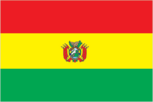
Bolivia
South America · La Paz (administrative capital); Sucre (constitutional [legislative and judicial] capital) · presidential republic
What Bolivia means for your money, the prices you pay, the tariffs in motion, and where U.S. policy could change both.
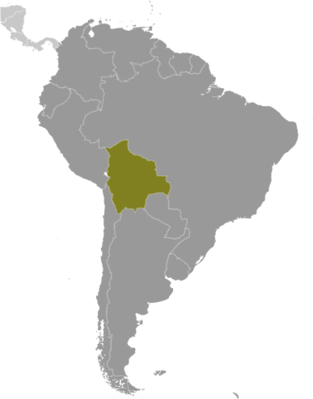
$618M
U.S. imports, 2025
+23%
change in one year
$349M
U.S. exports, 2025
12M
Population
$49.7B
GDP
In your house
What you buy that Bolivia makes
America bought $618M in goods from Bolivia in 2025, up 23% in a single year. Of every $100 of it, here's where the money went.
Tin
Nonmonetary gold
Chemicals-inorganic
Nuts
nuts
Steelmaking materials
Feedstuff and foodgrains
Sulfur, nonmetallic minerals
Shingles, wallboard
U.s. goods returned, and reimports
Lumber
lumber for homebuilding
2026 so far (through July): $366M in imports. Source: U.S. Census Bureau, International Trade in Goods (customs basis).
The other direction
What America sells to Bolivia
$349M in 2025, a trade rupture cuts both ways, for American producers as well as American prices.
Civilian aircraft, engines, equipment, and parts
$39MPlastic materials
$25Mplastics for packaging and goods
Petroleum products, other
$20MIndustrial engines
$20MOther foods
$17MIndustrial machines, other
$14MPassenger cars, new and used
$14Mnew and used cars
Telecommunications equipment
$12Mphones, routers, networking gear
Chemicals-other
$12MWhere you stand
U.S. tariff posture toward Bolivia
No U.S. tariff action singles this country out. Its goods face the universal 10% temporary import surcharge under Section 122 of the Trade Act (which replaced the IEEPA reciprocal baseline in February 2026) plus the sectoral Section 232 duties — steel and aluminum at 50% — that apply to all countries. The Section 122 surcharge is statutorily temporary — scheduled to lapse on or about July 23, 2026 (a 150-day cap) unless extended or replaced.
Reciprocal tariff (universal baseline)
10%
The universal 10% floor, a Section 122 import surcharge since February 2026, previously the EO 14257 reciprocal baseline, applies to nearly all U.S. imports. This country has no higher assigned rate of its own.
Policy in motion
Tariff status: a moving target
No U.S. tariff action names Bolivia. These are the universal measures, applied to every country without a country-specific arrangement, that set its treatment.
2026-04-06
Section 232 metals coverage expanded
In effectThe April 2026 proclamation strengthening Section 232 actions on aluminum, steel, and copper expanded derivative-product coverage for all countries, keeping the general metals rate at 50%.
91 FR 18201 →2026-02-24
IEEPA reciprocal tariffs terminated — replaced by 10% Section 122 surcharge
In effectExecutive Order 14389 (Ending Certain Tariff Actions) terminated the IEEPA tariff duties — including the EO 14257 reciprocal baseline — effective February 24, 2026. A flat 10% Section 122 temporary import surcharge (Proclamation 11012 of February 20, 2026) replaced them, leaving the universal rate unchanged at 10% on a different statutory basis. Section 122 caps such surcharges at 150 days, so this 10% surcharge is scheduled to lapse on or about July 23, 2026 absent further action (the administration has signaled it could raise the rate toward the 15% statutory maximum).
91 FR 9437 →2025-11-13
Agricultural products exempted from reciprocal tariffs
In effectExecutive Order 14360 of November 14, 2025 removed reciprocal duties from certain agricultural products listed in its annexes (coffee, cocoa, bananas, and other goods the U.S. does not produce in sufficient quantity), retroactive to November 13, 2025 — for all countries subject to the reciprocal tariff.
90 FR 54091 →2025-06-04
Section 232 steel and aluminum duties doubled to 50%
In effectThe June 3, 2025 proclamation raised Section 232 duties on steel and aluminum articles and derivatives from 25% to 50% for all countries, effective June 4, 2025.
90 FR 24199 →2025-04-05
Universal 10% reciprocal baseline takes effect
In effectExecutive Order 14257 (signed April 2, 2025) imposed a 10% ad valorem reciprocal duty on imports from all trading partners, effective April 5, 2025. Countries without a higher Annex I rate remain at this baseline.
Federal Register · 2025-06063 →2025-03-12
Section 232 steel and aluminum duties set at 25% for all countries
In effectProclamations of February 10, 2025 terminated all country exemptions and quota arrangements and applied 25% Section 232 duties to steel and aluminum imports from every country, effective March 12, 2025.
90 FR 9817 →
Made for America
What Bolivia makes for America
Bolivia is a direct U.S. source of 3 essential goods Americans rely on, the items themselves, shipped finished off the line.
Go deeper
The supply chain view
Bolivia sits upstream of 6 essential American goods through 6 tracked inputs.
mineral
6%Float Bath Tin (refined tin metal)
mineral
4%Antimony Metal (Bullet Core Hardener)
mineral
4%Iron (Fe) and Ferroboron (FeB)
mineral
3%Refined Tin
agricultural
1%Natural Hog Gut Casings (Weasands, Runners, Rounds)
mineral
0%Lithium Carbonate
Reference
The country itself
South America · Geography, people, economy, and government, public-domain data from the CIA World Factbook.
Bolivia, named after independence fighter Simón BOLÍVAR, broke away from Spanish rule in 1825. Much of its subsequent history has consisted of a series of coups and countercoups, with the last coup occurring in 1980. Democratic civilian rule was established in 1982, but leaders have faced problems of deep-seated poverty, social unrest, and illegal drug production. In 2005, Bolivians elected Movement Toward Socialism leader Evo MORALES as president -- by the widest margin of any leader since 1982 -- after he ran on a promise to change the country's traditional political class and empower the poor and indigenous majority. In 2009 and 2014, MORALES easily won reelection, and his party maintained control of the legislative branch. In 2016, MORALES narrowly lost a referendum to approve a constitutional amendment that would have allowed him to compete in the 2019 presidential election. A subsequent Supreme Court ruling stating that term limits violate human rights provided the justification for MORALES to run despite the referendum, but rising violence, pressure from the military, and widespread allegations of electoral fraud ultimately forced him to flee the country. An interim government, led by President Jeanine AÑEZ Chávez, held new elections in 2020, and Luis Alberto ARCE Catacora was elected president.
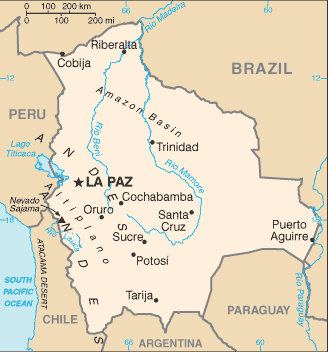
Geography
- Location
- Central South America, southwest of Brazil
- Area
- 1,098,581 sq km
- Climate
- varies with altitude; humid and tropical to cold and semiarid
- Terrain
- rugged Andes Mountains with a highland plateau (Altiplano), hills, lowland plains of the Amazon Basin
- Natural resources
- lithium, tin, natural gas, petroleum, zinc, tungsten, antimony, silver, iron, lead, gold, timber, hydropower
- Coastline
- 0 km (landlocked)
- Natural hazards
- flooding in the northeast (March to April) volcanism: volcanic activity in Andes Mountains on the border with Chile; historically active volcanoes in this region are Irruputuncu (5,163 m), which last erupted in 1995, and the Olca-Paruma volcanic complex (5,762 m to 5,167 m)
People & society
- Population
- 12,436,103 (2025 est.)
- Nationality
- Bolivian(s)
- Ethnic groups
- Mestizo (mixed White and Indigenous ancestry) 68%, Indigenous 20%, White 5%, Cholo/Chola 2%, African descent 1%, other 1%, unspecified 3%; 44% other Indigenous group, predominantly Quechua or Aymara (2009 est.)
- Languages
- Spanish (official) 68.1%, Quechua (official) 17.2%, Aymara (official) 10.5%, Guarani (official) 0.6%, other 1.5%, unspecified 2.1%; note - Spanish and all Indigenous languages are official (2012 est.)
- Religions
- Roman Catholic 65%, Protestant 19.6% (Evangelical (non-specific) 11.9%, Evangelical Baptist 2.1%, Evangelical Pentecostal 1.8%, Evangelical Methodist 0.7%, Adventist 2.8%, Protestant (non-specific) 0.3%), Believer (not belonging to the church) 0.9%, other 4.8%, atheist 1.7%, agnostic 0.6%, none 6.1%, unspecified 1.3% (2023 est.)
- Median age
- 27 years (2025 est.)
- Life expectancy at birth
- 72.5 years (2024 est.)
- Literacy
- 95.6% (2023 est.)
Economy
- Economic overview
- resource-rich economy benefits during commodity booms; has bestowed juridical rights to Mother Earth, impacting extraction industries; increasing Chinese lithium mining trade relations; hard hit by COVID-19; increased fiscal spending amid poverty increases; rampant banking and finance corruption
- Industries
- mining, smelting, electricity, petroleum, food and beverages, handicrafts, clothing, jewelry
- Agricultural products
- sugarcane, soybeans, maize, potatoes, sorghum, rice, milk, chicken, plantains, beef (2023)
- Exports - partners
- Brazil 15%, India 13%, China 11%, Argentina 11%, UAE 8% (2023)
- Imports - partners
- China 22%, Brazil 18%, Chile 13%, USA 7%, Peru 5% (2023)
Government
- Government type
- presidential republic
- Capital
- La Paz (administrative capital); Sucre (constitutional [legislative and judicial] capital)
- Independence
- 6 August 1825 (from Spain)
- Constitution
- many previous; latest drafted 6 August 2006 to 9 December 2008, approved by referendum 25 January 2009, effective 7 February 2009
- Executive branch
- President Rodrigo PAZ Pereira (since 8 November 2025)
- Legislative branch
- Plurinational Legislative Assembly (Asamblea Legislativa Plurinacional)
Full reference data
Every field, by section, CIA World Factbook. Open a topic to expand it.
Introduction
Travel Facts
Please visit the following links to find further information about your desired destination.
World Health Organization (WHO) - To learn what vaccines and health precautions to take while visiting your destination.
US State Dept Travel Information - Overall information about foreign travel for US citizens.
To obtain an international driving permit (IDP). Only two organizations in the US issue IDPs: American Automobile Association (AAA) and American Automobile Touring Alliance (AATA)
How to get help in an emergency? Contact the nearest US embassy or consulate, or call one of these numbers: from the US or Canada - 1-888-407-4747 or from Overseas - +1 202-501-4444
Page last updated: Wednesday, October 05, 2022