Country exposure · BT

Flag of Bhutan

Bhutan

South Asia · Thimphu · constitutional monarchy

What Bhutan means for your money — the prices you pay, the tariffs in motion, and where U.S. policy could change both.
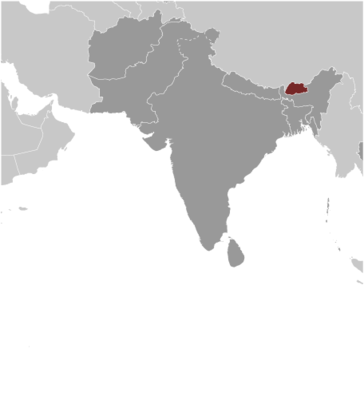
Map showing the location of Bhutan

$6M

U.S. imports, 2025

+85.2%

change in one year

$5M

U.S. exports, 2025

893K

Population

$3.0B

GDP

In your house

What you buy that Bhutan makes

America bought $6M in goods from Bhutan in 2025 — up 85.2% in a single year. Of every $100 of it, here's where the money went.

Steelmaking materials

$6M97.2%

Artwork, antiques, stamps, etc.

$81K1.3%

Other foods

$30K0.5%

Tea, spices, etc.

tea and spices

$14K0.2%

Jewelry

jewelry

$14K0.2%

Minimum value shipments

$13K0.2%

Apparel, textiles, nonwool or cotton

synthetic and performance apparel

$9K0.1%

Hair, waste materials

$4K0.1%

Paper and paper products

$3K0.1%

Apparel, household goods - cotton

cotton clothing and linens

$1K0%

2026 so far (through April): $6M in imports. Source: U.S. Census Bureau, International Trade in Goods (customs basis).

The other direction

What America sells to Bhutan

$5M in 2025 — a trade rupture cuts both ways, for American producers as well as American prices.

Toys, games, and sporting goods

$2M

toys, games, sporting goods

Civilian aircraft, engines, equipment, and parts

$523K

Medicinal equipment

$414K

medical devices and equipment

Computer accessories

$335K

keyboards, drives, computer parts

Agric. farming-unmanufactured

$232K

Musical instruments

$167K

Measuring, testing, control instruments

$158K

Apparel, household goods - textile

$134K

cotton clothing and linens

Laboratory testing instruments

$129K

Where you stand

U.S. tariff posture toward Bhutan

No U.S. tariff action singles this country out. Its goods face the universal 10% temporary import surcharge under Section 122 of the Trade Act (which replaced the IEEPA reciprocal baseline in February 2026) plus the sectoral Section 232 duties — steel and aluminum at 50% — that apply to all countries. The Section 122 surcharge is statutorily temporary — scheduled to lapse on or about July 23, 2026 (a 150-day cap) unless extended or replaced.

Reciprocal tariff (universal baseline)

10%

The universal 10% floor — a Section 122 import surcharge since February 2026, previously the EO 14257 reciprocal baseline — applies to nearly all U.S. imports. This country has no higher assigned rate of its own.

Policy in motion

Tariff status: a moving target

No U.S. tariff action names Bhutan. These are the universal measures — applied to every country without a country-specific arrangement — that set its treatment.

  1. 2026-04-06

    Section 232 metals coverage expanded

    In effect

    The April 2026 proclamation strengthening Section 232 actions on aluminum, steel, and copper expanded derivative-product coverage for all countries, keeping the general metals rate at 50%.

    91 FR 18201
  2. 2026-02-24

    IEEPA reciprocal tariffs terminated — replaced by 10% Section 122 surcharge

    In effect

    Executive Order 14389 (Ending Certain Tariff Actions) terminated the IEEPA tariff duties — including the EO 14257 reciprocal baseline — effective February 24, 2026. A flat 10% Section 122 temporary import surcharge (Proclamation 11012 of February 20, 2026) replaced them, leaving the universal rate unchanged at 10% on a different statutory basis. Section 122 caps such surcharges at 150 days, so this 10% surcharge is scheduled to lapse on or about July 23, 2026 absent further action (the administration has signaled it could raise the rate toward the 15% statutory maximum).

    91 FR 9437
  3. 2025-11-13

    Agricultural products exempted from reciprocal tariffs

    In effect

    Executive Order 14360 of November 14, 2025 removed reciprocal duties from certain agricultural products listed in its annexes (coffee, cocoa, bananas, and other goods the U.S. does not produce in sufficient quantity), retroactive to November 13, 2025 — for all countries subject to the reciprocal tariff.

    90 FR 54091
  4. 2025-06-04

    Section 232 steel and aluminum duties doubled to 50%

    In effect

    The June 3, 2025 proclamation raised Section 232 duties on steel and aluminum articles and derivatives from 25% to 50% for all countries, effective June 4, 2025.

    90 FR 24199
  5. 2025-04-05

    Universal 10% reciprocal baseline takes effect

    In effect

    Executive Order 14257 (signed April 2, 2025) imposed a 10% ad valorem reciprocal duty on imports from all trading partners, effective April 5, 2025. Countries without a higher Annex I rate remain at this baseline.

    Federal Register · 2025-06063
  6. 2025-03-12

    Section 232 steel and aluminum duties set at 25% for all countries

    In effect

    Proclamations of February 10, 2025 terminated all country exemptions and quota arrangements and applied 25% Section 232 duties to steel and aluminum imports from every country, effective March 12, 2025.

    90 FR 9817

Reference

The country itself

South Asia · Geography, people, economy, and government — public-domain data from the CIA World Factbook.

After Britain’s victory in the 1865 Duar War, Britain and Bhutan signed the Treaty of Sinchulu, under which Bhutan would receive an annual subsidy in exchange for ceding land to British India. Ugyen WANGCHUCK -- who had served as the de facto ruler of an increasingly unified Bhutan and had improved relations with the British toward the end of the 19th century -- was named king in 1907. Three years later, a treaty was signed whereby the British agreed not to interfere in Bhutanese internal affairs, and Bhutan allowed Britain to direct its foreign affairs. Bhutan negotiated a similar arrangement with independent India in 1949. The Indo-Bhutanese Treaty of Friendship returned to Bhutan a small piece of the territory annexed by the British, formalized the annual subsidies the country received, and defined India's responsibilities in defense and foreign relations. Under a succession of modernizing monarchs beginning in the 1950s, Bhutan joined the UN in 1971 and slowly continued its engagement beyond its borders. In 2005, King Jigme Singye WANGCHUCK unveiled the draft of Bhutan's first constitution -- which introduced major democratic reforms -- and held a national referendum for its approval. The King abdicated the throne in 2006 in favor of his son, Jigme Khesar Namgyel WANGCHUCK. In 2007, India and Bhutan renegotiated their treaty, eliminating the clause that stated that Bhutan would be "guided by" India in conducting its foreign policy, although Thimphu continues to coordinate closely with New Delhi. In 2008, Bhutan held its first parliamentary election in accordance with the constitution. Bhutan experienced a peaceful turnover of power following a parliamentary election in 2013, which resulted in the defeat of the incumbent party. In 2018, the incumbent party again lost the parliamentary election. In 2024, of the more than 100,000 ethnic Nepali -- predominantly Lhotshampa -- refugees who fled or were forced out of Bhutan in the 1990s, about 6,500 remain displaced in Nepal.
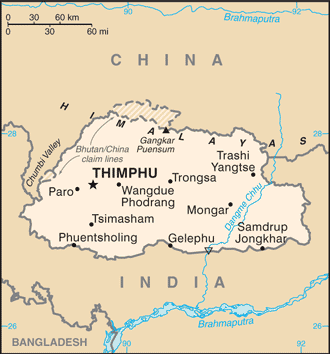
Regional map of Bhutan

Geography

Location
Southern Asia, between China and India
Area
38,394 sq km
Climate
varies; tropical in southern plains; cool winters and hot summers in central valleys; severe winters and cool summers in Himalayas
Terrain
mostly mountainous with some fertile valleys and savanna
Natural resources
timber, hydropower, gypsum, calcium carbonate
Coastline
0 km (landlocked)
Natural hazards
violent storms from the Himalayas are the source of the country's Bhutanese name, which translates as Land of the Thunder Dragon; frequent landslides during the rainy season

People & society

Population
892,877 (2025 est.)
Nationality
Bhutanese (singular and plural)
Ethnic groups
Ngalop (also known as Bhote) 50%, ethnic Nepali 35% (predominantly Lhotshampas), indigenous or migrant tribes 15%
Languages
Sharchopkha 28%, Dzongkha (official) 24%, Lhotshamkha 22%, other 26% (includes foreign languages) (2005 est.)
Religions
Lamaistic Buddhist 75.3%, Indian- and Nepali-influenced Hinduism 22.1%, other 2.6% (2005 est.)
Median age
31.2 years (2025 est.)
Life expectancy at birth
73.7 years (2024 est.)
Literacy
64.9% (2022 est.)

Economy

Economic overview
hydropower investments spurring economic development; Gross National Happiness economy; sharp poverty declines; low inflation; strong monetary and fiscal policies; stable currency; fairly resilient response to COVID-19; key economic and strategic relations with India; climate vulnerabilities
Industries
cement, wood products, processed fruits, alcoholic beverages, calcium carbide, tourism
Agricultural products
rice, milk, potatoes, root vegetables, maize, oranges, areca nuts, chillies/peppers, pumpkins/squash, carrots/turnips (2023)
Exports - partners
India 92%, Italy 4%, Indonesia 1%, China 1%, Singapore 0% (2023)
Imports - partners
India 82%, Singapore 8%, China 5%, Thailand 2%, Indonesia 1% (2023)

Government

Government type
constitutional monarchy
Capital
Thimphu
Independence
17 December 1907 (became a unified kingdom under its first hereditary king); 8 August 1949 (Treaty of Friendship with India maintains Bhutanese independence)
Constitution
previous governing documents were various royal decrees; first constitution drafted November 2001 to March 2005, ratified 18 July 2008
Executive branch
King Jigme Khesar Namgyel WANGCHUCK (since 14 December 2006)
Legislative branch
Parliament (Chi Tshog)

Full reference data

Every field, by section — CIA World Factbook. Open a topic to expand it.

Introduction
Background
After Britain’s victory in the 1865 Duar War, Britain and Bhutan signed the Treaty of Sinchulu, under which Bhutan would receive an annual subsidy in exchange for ceding land to British India. Ugyen WANGCHUCK -- who had served as the de facto ruler of an increasingly unified Bhutan and had improved relations with the British toward the end of the 19th century -- was named king in 1907. Three years later, a treaty was signed whereby the British agreed not to interfere in Bhutanese internal affairs, and Bhutan allowed Britain to direct its foreign affairs. Bhutan negotiated a similar arrangement with independent India in 1949. The Indo-Bhutanese Treaty of Friendship returned to Bhutan a small piece of the territory annexed by the British, formalized the annual subsidies the country received, and defined India's responsibilities in defense and foreign relations. Under a succession of modernizing monarchs beginning in the 1950s, Bhutan joined the UN in 1971 and slowly continued its engagement beyond its borders. In 2005, King Jigme Singye WANGCHUCK unveiled the draft of Bhutan's first constitution -- which introduced major democratic reforms -- and held a national referendum for its approval. The King abdicated the throne in 2006 in favor of his son, Jigme Khesar Namgyel WANGCHUCK. In 2007, India and Bhutan renegotiated their treaty, eliminating the clause that stated that Bhutan would be "guided by" India in conducting its foreign policy, although Thimphu continues to coordinate closely with New Delhi. In 2008, Bhutan held its first parliamentary election in accordance with the constitution. Bhutan experienced a peaceful turnover of power following a parliamentary election in 2013, which resulted in the defeat of the incumbent party. In 2018, the incumbent party again lost the parliamentary election. In 2024, of the more than 100,000 ethnic Nepali -- predominantly Lhotshampa -- refugees who fled or were forced out of Bhutan in the 1990s, about 6,500 remain displaced in Nepal.
Travel Facts
US State Dept Travel Advisory
The US Department of State currently recommends US citizens exercise normal precautions in Bhutan. Consult its website via the link below for updates to travel advisories and statements on safety, security, local laws, and special circumstances in this country. https://travel.state.gov/content/travel/en/traveladvisories/traveladvisories.html
Passport/Visa Requirements
US citizens should make sure their passport will not expire for at least 6 months after they enter the country even if they do not intend to stay that long. They should also make sure they have at least 1 blank page in their passport for any entry stamp and or visa that will be required. A visa is required. US citizens will need to get in touch with the country’s embassy or nearest consulate to obtain a visa prior to visiting the country.
US Embassy/Consulate
None; frequent informal contact is maintained via the US embassy in New Delhi (India) and Bhutan's Permanent Mission to the UN; US citizens may call US Dept of State (202)-501-4444 for emergencies; alternate contact is the US Embassy in India [91] (11) 2419-8000; US Embassy in New Delhi, Shantipath, Chanakyapuri, New Delhi – 110021, India
Telephone Code
975
Local Emergency Phone
Ambulance: 110; Fire: 112; Police: 113
Vaccinations
An International Certificate of Vaccination for yellow fever is required for travelers arriving from countries with a risk of yellow fever transmission and for travelers having transited through the airport of a country with risk of yellow fever transmission. See WHO recommendations. http://www.who.int/
Climate
Varies; tropical in southern plains; cool winters and hot summers in central valleys; severe winters and cool summers in Himalayas
Currency (Code)
Ngultrum (BTN)
Electricity/Voltage/Plug Type(s)
230 V / 50 Hz / plug types(s): C, D, G
Major Languages
Sharchhopka, Dzongkha, Lhotshamkha
Major Religions
Lamaistic Buddhist 75.3%, Indian-and Nepali-influenced Hinduism 22.1%, other 2.6%
Time Difference
UTC+6 (11 hours ahead of Washington, DC, during Standard Time)
Potable Water
Opt for bottled water
International Driving Permit
Suggested
Road Driving Side
Left
Tourist Destinations
Rinpung Dzong; Chele La Pass; Buddha Dordenma Statue; Dochu La Pass; Paro Taktsang (Tiger's Nest); Phobjikha Valley
Major Sports
Archery, digor (resembles shot put and horseshoe throwing)
Cultural Practices
The Bhutanese follow a structure of etiquette called "driglam namzha." This code of conduct governs how to send and receive gifts, speak to those in authority, serve and eat food at public occasions, and dress.
Tipping Guidelines
A 10% tip is common at restaurants and bars unless a 10% service charge is already added. If hiring a taxi for the day, a tip of 300-500 ngultrums is common. It is also common to tip porters $1-2 (USD) per bag and to tip tour staff $50-80 (USD) at the end of a tour.
Souvenirs
Carved wooden masks, Thangkas art, woven woolen cloth and native garments, prayer flags, handmade paper
Traditional Cuisine
Ema datshi — hot chili peppers and cheese curd made from cow or yak's milk; often served with rice
CIA source last updated
Wednesday, July 20, 2022
Travel resources

Please visit the following links to find further information about your desired destination.

World Health Organization (WHO) - To learn what vaccines and health precautions to take while visiting your destination.

US State Dept Travel Information - Overall information about foreign travel for US citizens.

To obtain an international driving permit (IDP). Only two organizations in the US issue IDPs: American Automobile Association (AAA) and American Automobile Touring Alliance (AATA)

How to get help in an emergency? Contact the nearest US embassy or consulate, or call one of these numbers: from the US or Canada - 1-888-407-4747 or from Overseas - +1 202-501-4444

Page last updated: Wednesday, July 20, 2022

Geography
Location
Southern Asia, between China and India
Geographic coordinates
27 30 N, 90 30 E
Map references
Asia
Area - total
38,394 sq km
Area - land
38,394 sq km
Area - water
0 sq km
Area - comparative
slightly larger than Maryland; about one-half the size of Indiana
Land boundaries - total
1,136 km
Land boundaries - border countries
China 477 km; India 659 km
Coastline
0 km (landlocked)
Maritime claims
none (landlocked)
Climate
varies; tropical in southern plains; cool winters and hot summers in central valleys; severe winters and cool summers in Himalayas
Terrain
mostly mountainous with some fertile valleys and savanna
Elevation - highest point
Gangkar Puensum 7,570 m
Elevation - lowest point
Drangeme Chhu 97 m
Elevation - mean elevation
2,220 m
Natural resources
timber, hydropower, gypsum, calcium carbonate
Land use - agricultural land
13.8% (2023 est.)
Land use - agricultural land: arable land
arable land: 2.6% (2023 est.)
Land use - agricultural land: permanent crops
permanent crops: 0.4% (2023 est.)
Land use - agricultural land: permanent pasture
permanent pasture: 10.8% (2023 est.)
Land use - forest
70.6% (2023 est.)
Land use - other
15.6% (2023 est.)
Irrigated land
320 sq km (2012)
Natural hazards
violent storms from the Himalayas are the source of the country's Bhutanese name, which translates as Land of the Thunder Dragon; frequent landslides during the rainy season
Geography - note
landlocked; strategic location between China and India; controls several key Himalayan mountain passes
People and Society
Population - total
892,877 (2025 est.)
Population - male
461,679
Population - female
431,198
Nationality - noun
Bhutanese (singular and plural)
Nationality - adjective
Bhutanese
Ethnic groups
Ngalop (also known as Bhote) 50%, ethnic Nepali 35% (predominantly Lhotshampas), indigenous or migrant tribes 15%
Languages
Sharchopkha 28%, Dzongkha (official) 24%, Lhotshamkha 22%, other 26% (includes foreign languages) (2005 est.)
Religions
Lamaistic Buddhist 75.3%, Indian- and Nepali-influenced Hinduism 22.1%, other 2.6% (2005 est.)
Age structure - 0-14 years
23.1% (male 104,771/female 99,981)
Age structure - 15-64 years
70.2% (male 322,497/female 298,324)
Age structure - 65 years and over
6.7% (2024 est.) (male 30,397/female 28,576)
Dependency ratios - total dependency ratio
42.1 (2025 est.)
Dependency ratios - youth dependency ratio
32.4 (2025 est.)
Dependency ratios - elderly dependency ratio
9.7 (2025 est.)
Dependency ratios - potential support ratio
10.3 (2025 est.)
Median age - total
31.2 years (2025 est.)
Median age - male
31.1 years
Median age - female
30.3 years
Population growth rate
0.93% (2025 est.)
Birth rate
15.05 births/1,000 population (2025 est.)
Death rate
5.75 deaths/1,000 population (2025 est.)
Net migration rate
0 migrant(s)/1,000 population (2025 est.)
Urbanization - urban population
44.4% of total population (2023)
Urbanization - rate of urbanization
2.52% annual rate of change (2020-25 est.)
Major urban areas - population
203,000 THIMPHU (capital) (2018)
Sex ratio - at birth
1.05 male(s)/female
Sex ratio - 0-14 years
1.05 male(s)/female
Sex ratio - 15-64 years
1.08 male(s)/female
Sex ratio - 65 years and over
1.06 male(s)/female
Sex ratio - total population
1.07 male(s)/female (2024 est.)
Maternal mortality ratio
47 deaths/100,000 live births (2023 est.)
Infant mortality rate - total
23 deaths/1,000 live births (2025 est.)
Infant mortality rate - male
24.6 deaths/1,000 live births
Infant mortality rate - female
23.9 deaths/1,000 live births
Life expectancy at birth - total population
73.7 years (2024 est.)
Life expectancy at birth - male
72.5 years
Life expectancy at birth - female
75 years
Total fertility rate
1.75 children born/woman (2025 est.)
Gross reproduction rate
0.85 (2025 est.)
Drinking water source - improved: urban
urban: 99.5% of population (2022 est.)
Drinking water source - improved: rural
rural: 98.8% of population (2022 est.)
Drinking water source - improved: total
total: 99.1% of population (2022 est.)
Drinking water source - unimproved: urban
urban: 0.5% of population (2022 est.)
Drinking water source - unimproved: rural
rural: 1.2% of population (2022 est.)
Drinking water source - unimproved: total
total: 0.9% of population (2022 est.)
Health expenditure - Health expenditure (as % of GDP)
3.8% of GDP (2021)
Health expenditure - Health expenditure (as % of national budget)
6.7% of national budget (2022 est.)
Physician density
0.55 physicians/1,000 population (2022)
Hospital bed density
2.2 beds/1,000 population (2021 est.)
Sanitation facility access - improved: urban
urban: 91.1% of population (2022 est.)
Sanitation facility access - improved: rural
rural: 85.5% of population (2022 est.)
Sanitation facility access - improved: total
total: 87.9% of population (2022 est.)
Sanitation facility access - unimproved: urban
urban: 8.9% of population (2022 est.)
Sanitation facility access - unimproved: rural
rural: 14.5% of population (2022 est.)
Sanitation facility access - unimproved: total
total: 12.1% of population (2022 est.)
Obesity - adult prevalence rate
6.4% (2016)
Alcohol consumption per capita - total
0.07 liters of pure alcohol (2019 est.)
Alcohol consumption per capita - beer
0.01 liters of pure alcohol (2019 est.)
Alcohol consumption per capita - wine
0.05 liters of pure alcohol (2019 est.)
Alcohol consumption per capita - spirits
0 liters of pure alcohol (2019 est.)
Alcohol consumption per capita - other alcohols
0 liters of pure alcohol (2019 est.)
Tobacco use - total
18.5% (2025 est.)
Tobacco use - male
26.1% (2025 est.)
Tobacco use - female
9.8% (2025 est.)
Children under the age of 5 years underweight
8.7% (2023 est.)
Currently married women (ages 15-49)
62% (2022 est.)
Education expenditure - Education expenditure (% GDP)
5.8% of GDP (2023 est.)
Education expenditure - Education expenditure (% national budget)
22.2% national budget (2025 est.)
Literacy - total population
64.9% (2022 est.)
Literacy - male
73.4% (2022 est.)
Literacy - female
57% (2022 est.)
School life expectancy (primary to tertiary education) - total
13 years (2022 est.)
School life expectancy (primary to tertiary education) - male
12 years (2022 est.)
School life expectancy (primary to tertiary education) - female
14 years (2022 est.)
Government
Country name - conventional long form
Kingdom of Bhutan
Country name - conventional short form
Bhutan
Country name - local long form
Druk Gyalkhap
Country name - local short form
Druk Yul
Country name - etymology
name may derive from the Sanskrit words bhoṭa , the name for Tibet, and anta , meaning "end" -- a reference to Bhutan's location at the southernmost end of Tibet; the local Dzongkha name Druk Yul means "Land of the Dragon"
Government type
constitutional monarchy
Capital - name
Thimphu
Capital - geographic coordinates
27 28 N, 89 38 E
Capital - time difference
UTC+6 (11 hours ahead of Washington, DC, during Standard Time)
Capital - etymology
the origins of the name are unclear; the traditional explanation, dating to the 14th century, is that thim means "dissolve" and phu means "rock," in reference to a local deity who dissolved before a traveler's eyes, becoming a part of the rock on which the present city stands
Administrative divisions
20 districts ( dzongkhag , singular and plural); Bumthang, Chhukha, Dagana, Gasa, Haa, Lhuentse, Mongar, Paro, Pemagatshel, Punakha, Samdrup Jongkhar, Samtse, Sarpang, Thimphu, Trashigang, Trashi Yangtse, Trongsa, Tsirang, Wangdue Phodrang, Zhemgang
Legal system
civil law based on Buddhist religious law
Constitution - history
previous governing documents were various royal decrees; first constitution drafted November 2001 to March 2005, ratified 18 July 2008
Constitution - amendment process
proposed as a motion by simple majority vote in a joint session of Parliament; passage requires at least a three-fourths majority vote in a joint session of the next Parliament and assent by the king
International law organization participation
has not submitted an ICJ jurisdiction declaration; non-party state to the ICCt
Citizenship - citizenship by birth
no
Citizenship - citizenship by descent only
the father must be a citizen of Bhutan
Citizenship - dual citizenship recognized
no
Citizenship - residency requirement for naturalization
10 years
Suffrage
18 years of age; universal
Executive branch - chief of state
King Jigme Khesar Namgyel WANGCHUCK (since 14 December 2006)
Executive branch - head of government
Prime Minister Tshering TOBGAY (since 28 January 2024)
Executive branch - cabinet
Council of Ministers or Lhengye Zhungtshog members nominated by the monarch in consultation with the prime minister and approved by the National Assembly; members serve 5-year terms
Executive branch - election/appointment process
the monarchy is hereditary but can be removed by a two-thirds vote of Parliament; leader of the majority party in Parliament is nominated as the prime minister, appointed by the monarch
Legislative branch - legislature name
Parliament (Chi Tshog)
Legislative branch - legislative structure
bicameral
Legislative branch - lower chamber - chamber name
National Assembly (Tshogdu)
Legislative branch - lower chamber - number of seats
47 (all directly elected)
Legislative branch - lower chamber - electoral system
plurality/majority
Legislative branch - lower chamber - scope of elections
full renewal
Legislative branch - lower chamber - term in office
5 years
Legislative branch - lower chamber - most recent election date
1/9/2024
Legislative branch - lower chamber - parties elected and seats per party
People's Democratic Party (PDP) (30); Bhutan Tendrel Party (BTP) (17)
Legislative branch - lower chamber - percentage of women in chamber
4.3%
Legislative branch - lower chamber - expected date of next election
January 2029
Legislative branch - upper chamber - chamber name
National Council (Gyelyong Tshogde)
Legislative branch - upper chamber - number of seats
25 (20 directly elected; 5 appointed)
Legislative branch - upper chamber - electoral system
plurality/majority
Legislative branch - upper chamber - scope of elections
full renewal
Legislative branch - upper chamber - term in office
0 years
Legislative branch - upper chamber - most recent election date
4/20/2023
Legislative branch - upper chamber - parties elected and seats per party
N/A; note - the National Council is not party-based
Legislative branch - upper chamber - percentage of women in chamber
12%
Legislative branch - upper chamber - expected date of next election
April 2028
Judicial branch - highest court(s)
Supreme Court (consists of the chief justice and 4 associate justices)
Judicial branch - judge selection and term of office
Supreme Court chief justice appointed by the monarch on the advice of the National Judicial Commission, a 4-member body to include the Legislative Committee of the National Assembly, the attorney general, the Chief Justice of Bhutan and the senior Associate Justice of the Supreme Court; other judges (drangpons) appointed by the monarch from among the High Court judges selected by the National Judicial Commission; chief justice serves a 5-year term or until reaching age 65 years, whichever is earlier; the 4 other judges serve 10-year terms or until age 65, whichever is earlier
Judicial branch - subordinate courts
High Court (first appellate court); District or Dzongkhag Courts; sub-district or Dungkhag Courts
Judicial branch - note
note: the Supreme Court has sole jurisdiction in constitutional matters
Political parties
Bhutan Peace and Prosperity Party (Druk Phuensum Tshogpa) or DPT Bhutan Tendrel Party or BTP Druk Thuendrel Tshogpa or DTT People's Democratic Party or PDP United Party of Bhutan (Druk Nyamrup Tshogpa) or DNT
Diplomatic representation in the US - consulate(s) general
343 East, 43rd Street, New York, NY 10017 telephone: [1] (212) 682-2371 FAX: [1] (212) 661-0551 email address and website: consulate.pmbny@mfa.gov.bt https://www.mfa.gov.bt/pmbny/
Diplomatic representation in the US - note
note: Bhutan and the United States do not have diplomatic relations, but the two countries established consular relations on 23 July 1986; the Consulate General of the Kingdom of Bhutan was established in New York with an officer from the Permanent Mission of the Kingdom of Bhutan to the United Nations holding dual accreditation as the Consul General with consular jurisdiction in the US; Phuntsho NORBU has served as the Consul General since October 2022 and is the Deputy Permanent Representative to the UN
Diplomatic representation from the US
note: Although Bhutan and the United States have never established formal diplomatic relations, the two countries maintain informal relations via the U.S. Embassy in New Delhi, India, and Bhutan’s Mission to the United Nations in New York
International organization participation
ADB, BIMSTEC, CP, FAO, G-77, IBRD, ICAO, IDA, IFAD, IFC, IMF, Interpol, IOC, IOM (observer), IPU, ISO (correspondent), ITSO, ITU, MIGA, NAM, OPCW, SAARC, SACEP, UN, UNCTAD, UNESCO, UNIDO, UNISFA, UNTSO, UNWTO, UPU, WCO, WHO, WIPO, WMO, WTO (observer)
Independence
17 December 1907 (became a unified kingdom under its first hereditary king); 8 August 1949 (Treaty of Friendship with India maintains Bhutanese independence)
National holiday
National Day (Ugyen WANGCHUCK became first hereditary king), 17 December (1907)
Flag
description: divided diagonally from the lower-left corner to the upper-right corner; the upper triangle is yellow, and the lower triangle is dark orange; centered along the dividing line is a large, stylized black-and-white dragon facing to the right; the dragon is called the Druk (Thunder Dragon) and is the national emblem meaning: white stands for purity, and the jewels in the dragon's claws symbolize wealth; the background colors represent the spiritual and secular powers in Bhutan, with orange standing for Buddhism and yellow for the ruling dynasty
National symbol(s)
mythical thunder dragon ( druk )
National color(s)
orange, yellow
National anthem(s) - title
"Druk tsendhen" (The Thunder Dragon Kingdom)
National anthem(s) - lyrics/music
Gyaldun Dasho Thinley DORJI/Aku TONGMI
National anthem(s) - history
adopted 1953
Economy
Economic overview
hydropower investments spurring economic development; Gross National Happiness economy; sharp poverty declines; low inflation; strong monetary and fiscal policies; stable currency; fairly resilient response to COVID-19; key economic and strategic relations with India; climate vulnerabilities
Real GDP (purchasing power parity) - Real GDP (purchasing power parity) 2023
$11.517 billion (2023 est.)
Real GDP (purchasing power parity) - Real GDP (purchasing power parity) 2022
$10.981 billion (2022 est.)
Real GDP (purchasing power parity) - Real GDP (purchasing power parity) 2021
$10.437 billion (2021 est.)
Real GDP (purchasing power parity) - note
note: data in 2021 dollars
Real GDP growth rate - Real GDP growth rate 2023
4.9% (2023 est.)
Real GDP growth rate - Real GDP growth rate 2022
5.2% (2022 est.)
Real GDP growth rate - Real GDP growth rate 2021
4.4% (2021 est.)
Real GDP growth rate - note
note: annual GDP % growth based on constant local currency
Real GDP per capita - Real GDP per capita 2023
$14,600 (2023 est.)
Real GDP per capita - Real GDP per capita 2022
$14,100 (2022 est.)
Real GDP per capita - Real GDP per capita 2021
$13,500 (2021 est.)
Real GDP per capita - note
note: data in 2021 dollars
GDP (official exchange rate)
$3.019 billion (2023 est.)
GDP (official exchange rate) - note
note: data in current dollars at official exchange rate
Inflation rate (consumer prices) - Inflation rate (consumer prices) 2024
2.8% (2024 est.)
Inflation rate (consumer prices) - Inflation rate (consumer prices) 2023
4.2% (2023 est.)
Inflation rate (consumer prices) - Inflation rate (consumer prices) 2022
5.6% (2022 est.)
Inflation rate (consumer prices) - note
note: annual % change based on consumer prices
GDP - composition, by sector of origin - agriculture
15% (2023 est.)
GDP - composition, by sector of origin - industry
29.6% (2023 est.)
GDP - composition, by sector of origin - services
52.7% (2023 est.)
GDP - composition, by sector of origin - note
note: figures may not total 100% due to non-allocated consumption not captured in sector-reported data
GDP - composition, by end use - household consumption
59.4% (2023 est.)
GDP - composition, by end use - government consumption
20.3% (2023 est.)
GDP - composition, by end use - investment in fixed capital
44.5% (2023 est.)
GDP - composition, by end use - investment in inventories
0.7% (2023 est.)
GDP - composition, by end use - exports of goods and services
28.3% (2023 est.)
GDP - composition, by end use - imports of goods and services
-53.2% (2023 est.)
GDP - composition, by end use - note
note: figures may not total 100% due to rounding or gaps in data collection
Agricultural products
rice, milk, potatoes, root vegetables, maize, oranges, areca nuts, chillies/peppers, pumpkins/squash, carrots/turnips (2023)
Agricultural products - note
note: top ten agricultural products based on tonnage
Industries
cement, wood products, processed fruits, alcoholic beverages, calcium carbide, tourism
Industrial production growth rate
0% (2023 est.)
Industrial production growth rate - note
note: annual % change in industrial value added based on constant local currency
Labor force
406,500 (2024 est.)
Labor force - note
note: number of people ages 15 or older who are employed or seeking work
Unemployment rate - Unemployment rate 2024
2.9% (2024 est.)
Unemployment rate - Unemployment rate 2023
3.2% (2023 est.)
Unemployment rate - Unemployment rate 2022
6% (2022 est.)
Unemployment rate - note
note: % of labor force seeking employment
Youth unemployment rate (ages 15-24) - total
13.8% (2024 est.)
Youth unemployment rate (ages 15-24) - male
11.2% (2024 est.)
Youth unemployment rate (ages 15-24) - female
16.5% (2024 est.)
Youth unemployment rate (ages 15-24) - note
note: % of labor force ages 15-24 seeking employment
Population below poverty line
12.4% (2022 est.)
Population below poverty line - note
note: % of population with income below national poverty line
Gini Index coefficient - distribution of family income - Gini Index coefficient - distribution of family income 2022
28.5 (2022 est.)
Gini Index coefficient - distribution of family income - note
note: index (0-100) of income distribution; higher values represent greater inequality
Household income or consumption by percentage share - lowest 10%
3.6% (2022 est.)
Household income or consumption by percentage share - highest 10%
22.7% (2022 est.)
Household income or consumption by percentage share - note
note: % share of income accruing to lowest and highest 10% of population
Remittances - Remittances 2023
3.6% of GDP (2023 est.)
Remittances - Remittances 2022
3.3% of GDP (2022 est.)
Remittances - Remittances 2021
2.6% of GDP (2021 est.)
Remittances - note
note: personal transfers and compensation between resident and non-resident individuals/households/entities
Budget - revenues
$740.328 million (2020 est.)
Budget - expenditures
$802.177 million (2020 est.)
Budget - note
note: central government revenues and expenses (excluding grants/extrabudgetary units/social security funds) converted to US dollars at average official exchange rate for year indicated
Public debt - Public debt 2020
111% of GDP (2020 est.)
Public debt - note
note: central government debt as a % of GDP
Taxes and other revenues
12.3% (of GDP) (2020 est.)
Taxes and other revenues - note
note: central government tax revenue as a % of GDP
Current account balance - Current account balance 2024
-$669.766 million (2024 est.)
Current account balance - Current account balance 2023
-$963.122 million (2023 est.)
Current account balance - Current account balance 2022
-$805.723 million (2022 est.)
Current account balance - note
note: balance of payments - net trade and primary/secondary income in current dollars
Exports - Exports 2024
$944.391 million (2024 est.)
Exports - Exports 2023
$867.871 million (2023 est.)
Exports - Exports 2022
$791.342 million (2022 est.)
Exports - note
note: balance of payments - exports of goods and services in current dollars
Exports - partners
India 92%, Italy 4%, Indonesia 1%, China 1%, Singapore 0% (2023)
Exports - partners - note
note: top five export partners based on percentage share of exports
Exports - commodities
iron alloys, aircraft, dolomite, semi-finished iron, cement (2023)
Exports - commodities - note
note: top five export commodities based on value in dollars
Imports - Imports 2024
$1.513 billion (2024 est.)
Imports - Imports 2023
$1.77 billion (2023 est.)
Imports - Imports 2022
$1.581 billion (2022 est.)
Imports - note
note: balance of payments - imports of goods and services in current dollars
Imports - partners
India 82%, Singapore 8%, China 5%, Thailand 2%, Indonesia 1% (2023)
Imports - partners - note
note: top five import partners based on percentage share of imports
Imports - commodities
refined petroleum, gold, plastics, broadcasting equipment, iron reductions (2023)
Imports - commodities - note
note: top five import commodities based on value in dollars
Reserves of foreign exchange and gold - Reserves of foreign exchange and gold 2024
$941.018 million (2024 est.)
Reserves of foreign exchange and gold - Reserves of foreign exchange and gold 2023
$654.481 million (2023 est.)
Reserves of foreign exchange and gold - Reserves of foreign exchange and gold 2022
$825.755 million (2022 est.)
Reserves of foreign exchange and gold - note
note: holdings of gold (year-end prices)/foreign exchange/special drawing rights in current dollars
Debt - external - Debt - external 2023
$2.827 billion (2023 est.)
Debt - external - note
note: present value of external debt in current US dollars
Exchange rates - Currency
ngultrum (BTN) per US dollar -
Exchange rates - Exchange rates 2024
83.669 (2024 est.)
Exchange rates - Exchange rates 2023
82.599 (2023 est.)
Exchange rates - Exchange rates 2022
78.604 (2022 est.)
Exchange rates - Exchange rates 2021
73.918 (2021 est.)
Exchange rates - Exchange rates 2020
74.1 (2020 est.)
Energy
Electricity access - electrification - total population
100% (2022 est.)
Electricity - installed generating capacity
2.344 million kW (2023 est.)
Electricity - consumption
11.914 billion kWh (2023 est.)
Electricity - exports
6 billion kWh (2020 est.)
Electricity - imports
834.7 million kWh (2023 est.)
Electricity - transmission/distribution losses
86.681 million kWh (2023 est.)
Electricity generation sources - hydroelectricity
100% of total installed capacity (2023 est.)
Coal - production
4,000 metric tons (2023 est.)
Coal - consumption
105,000 metric tons (2023 est.)
Coal - exports
54 metric tons (2023 est.)
Coal - imports
122,000 metric tons (2023 est.)
Petroleum - refined petroleum consumption
4,000 bbl/day (2023 est.)
Energy consumption per capita - Total energy consumption per capita 2023
64.082 million Btu/person (2023 est.)
Communications
Telephones - fixed lines - total subscriptions
0 (2024 est.) no service
Telephones - fixed lines - subscriptions per 100 inhabitants
0 (2024 est.) no service
Telephones - mobile cellular - total subscriptions
790,000 (2024 est.)
Telephones - mobile cellular - subscriptions per 100 inhabitants
100 (2024 est.)
Broadcast media
state-owned TV station established in 1999; cable TV service offers dozens of Indian and other international channels; first radio station, privately launched in 1973, is now state-owned; 5 private radio stations are currently broadcasting (2012)
Internet country code
.bt
Internet users - percent of population
88% (2023 est.)
Broadband - fixed subscriptions - total
10,000 (2023 est.)
Broadband - fixed subscriptions - subscriptions per 100 inhabitants
1 (2023 est.)
Transportation
Civil aircraft registration country code prefix
A5
Airports
4 (2025)
Heliports
8 (2025)
Military and Security
Military and security forces
Royal Bhutan Army (RBA; includes Royal Bodyguard of Bhutan, or RBG, and an air wing); National Militia Ministry of Home and Cultural Affairs: Royal Bhutan Police (2025)
Military and security service personnel strengths
estimated 7-8,000 active Royal Bhutan Army (2025)
Military equipment inventories and acquisitions
the Royal Bhutan Army is lightly armed; it has a small amount of heavy equipment, such as armored cars and helicopters, originating from the former Soviet Union, India, and Thailand (2025)
Military service age and obligation
18 years of age for voluntary military service for men and women; militia training is compulsory for men aged 20-25 over a 3-year period (2025)
Military deployments
180 Central African Republic (MINUSCA) (2025)
Military - note
the Army is responsible for external threats but also has some internal security functions such as conducting counterinsurgency operations, guarding forests, and providing security for prominent persons; Bhutan's closest security partner is India; under the 2007 India-Bhutan Friendship Treaty, both countries agreed to cooperate closely on issues relating to their national interests (2025)
Transnational Issues
Refugees and internally displaced persons - IDPs
138 (2024 est.)
Environment
Environmental issues
soil erosion; limited access to potable water; wildlife conservation; industrial pollution; waste disposal
International environmental agreements - party to
Biodiversity, Climate Change, Climate Change-Kyoto Protocol, Climate Change-Paris Agreement, Desertification, Endangered Species, Hazardous Wastes, Nuclear Test Ban, Ozone Layer Protection, Wetlands
International environmental agreements - signed, but not ratified
Law of the Sea
Climate
varies; tropical in southern plains; cool winters and hot summers in central valleys; severe winters and cool summers in Himalayas
Land use - agricultural land
13.8% (2023 est.)
Land use - agricultural land: arable land
arable land: 2.6% (2023 est.)
Land use - agricultural land: permanent crops
permanent crops: 0.4% (2023 est.)
Land use - agricultural land: permanent pasture
permanent pasture: 10.8% (2023 est.)
Land use - forest
70.6% (2023 est.)
Land use - other
15.6% (2023 est.)
Urbanization - urban population
44.4% of total population (2023)
Urbanization - rate of urbanization
2.52% annual rate of change (2020-25 est.)
Carbon dioxide emissions - total emissions
733,000 metric tonnes of CO2 (2023 est.)
Carbon dioxide emissions - from coal and metallurgical coke
241,000 metric tonnes of CO2 (2023 est.)
Carbon dioxide emissions - from petroleum and other liquids
492,000 metric tonnes of CO2 (2023 est.)
Particulate matter emissions
26.4 micrograms per cubic meter (2019 est.)
Waste and recycling - municipal solid waste generated annually
111,300 tons (2024 est.)
Waste and recycling - percent of municipal solid waste recycled
1.7% (2022 est.)
Total water withdrawal - municipal
17 million cubic meters (2022 est.)
Total water withdrawal - industrial
3 million cubic meters (2022 est.)
Total water withdrawal - agricultural
318 million cubic meters (2022 est.)
Total renewable water resources
78 billion cubic meters (2022 est.)