
Country exposure · BW

Botswana
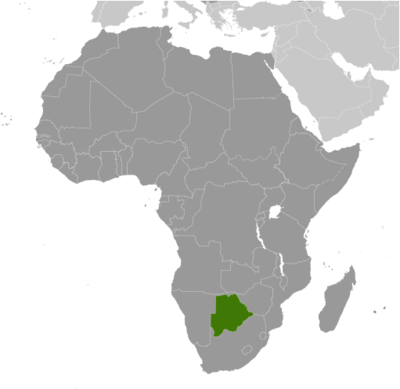
Africa · Gaborone · parliamentary republic
What Botswana means for your money, the prices you pay, the tariffs in motion, and where U.S. policy could change both.
$229M
U.S. imports, 2025
-43.6%
change in one year
$64M
U.S. exports, 2025
3M
Population
$19.4B
GDP
In your house
What you buy that Botswana makes
America bought $229M in goods from Botswana in 2025, down 43.6% in a single year. Of every $100 of it, here's where the money went.
Gem diamonds
U.s. goods returned, and reimports
Gem stones, other
Sulfur, nonmetallic minerals
Telecommunications equipment
phones, routers, networking gear
Minimum value shipments
Industrial machines, other
Artwork, antiques, stamps, etc.
Furniture, household goods, etc.
furniture, mattresses, lamps
Other parts and accessories of vehicles
car parts and accessories
2026 so far (through July): $89M in imports. Source: U.S. Census Bureau, International Trade in Goods (customs basis).
The other direction
What America sells to Botswana
$64M in 2025, a trade rupture cuts both ways, for American producers as well as American prices.
Civilian aircraft, engines, equipment, and parts
$21MMinimum value shipments
$16MGem diamonds
$8MTelecommunications equipment
$7Mphones, routers, networking gear
Parts for military-type goods
$3MComputers
$1Mlaptops, desktops, monitors
Engines and engine parts
$608KIron and steel products, other
$566KSteelmaking materials
$519KWhere you stand
U.S. tariff posture toward Botswana
Botswana — the world's second-largest diamond producer — was assigned 37% in April 2025, threatening its roughly $500 million in annual mineral exports to the U.S., which had previously entered duty-free. The rate was negotiated down to 15% effective August 7, 2025. Botswana offered the U.S. priority access to its critical minerals in exchange for duty-free diamond treatment, but no final agreement was signed before the regime changed. Executive Order 14389 (Ending Certain Tariff Actions, Feb 20, 2026) terminated the IEEPA reciprocal duties, and Proclamation 11012 replaced it with a 10% Section 122 temporary import surcharge effective February 24, 2026. Botswana has no Section 232 steel/aluminum exposure.
Reciprocal tariff (assigned, terminated)
37%
The rate this country was assigned under the EO 14257 reciprocal Annex, no longer in force. The Supreme Court struck down the IEEPA tariffs and they were terminated February 24, 2026 (EO 14389), replaced by a universal ~10% Section 122 surcharge. See the timeline below for the current effective rate.
Policy in motion
Tariff status: a moving target
U.S. tariff policy toward Botswana has changed 4 times since 2025. This page tracks it.
2026-02-24
IEEPA reciprocal tariffs terminated — replaced by 10% Section 122
In effectExecutive Order 14389 (Ending Certain Tariff Actions) terminated the IEEPA tariff duties effective February 24, 2026, replacing Botswana's 15% reciprocal rate with a 10% Section 122 temporary import surcharge under Proclamation 11012 (capped at 150 days).
91 FR 9437 →2025-08-07
Rate reduced to 15%
In effectExecutive Order 14326 set the post-pause Annex I reciprocal rates; Botswana's rate was negotiated down from 37% to 15% effective August 7, 2025, with talks continuing toward duty-free diamond access in exchange for U.S. priority access to critical minerals.
90 FR 37963 →2025-04-10
Elevated reciprocal rates paused to 10% for 90 days
In effectExecutive Order 14266 suspended the higher country-specific reciprocal rates — including Botswana's 37% — back to the 10% baseline for 90 days to allow negotiations.
90 FR 15625 →2025-04-05
Reciprocal tariff regime begins — Botswana assigned 37%
In effectExecutive Order 14257 imposed a 10% universal reciprocal duty effective April 5 and a 37% country-specific rate for Botswana scheduled to take effect April 9, hitting diamond exports that had previously entered the U.S. duty-free.
90 FR 15041 →
Made for America
What Botswana makes for America
Botswana is a direct U.S. source of 1 essential good Americans rely on, the items themselves, shipped finished off the line.
Go deeper
The supply chain view
Botswana sits upstream of 1 essential American goods through 1 tracked inputs.
Full supply-map profile →Reference
The country itself
Africa · Geography, people, economy, and government, public-domain data from the CIA World Factbook.
In the early 1800s, multiple political entities in what is now Botswana were destabilized or destroyed by a series of conflicts and population movements in southern Africa. By the end of this period, the Tswana ethnic group, who also live across the border in South Africa, had become the most prominent group in the area. In 1852, Tswana forces halted the expansion of white Afrikaner settlers who were seeking to expand their territory northwards into what is now Botswana. In 1885, Great Britain claimed territory that roughly corresponds with modern day Botswana as a protectorate called Bechuanaland. Upon independence in 1966, the British protectorate of Bechuanaland adopted the new name of Botswana, which means "land of the Tswana." More than five decades of uninterrupted civilian leadership, progressive social policies, and significant capital investment have created an enduring democracy and upper-middle-income economy. The ruling Botswana Democratic Party has won every national election since independence; President Mokgweetsi Eric Keabetswe MASISI assumed the presidency in 2018 after the retirement of former President Ian KHAMA due to constitutional term limits. MASISI won his first election as president in 2019, and he is Botswana’s fifth president since independence. Mineral extraction, principally diamond mining, dominates economic activity, though tourism is a growing sector due to the country's conservation practices and extensive nature preserves. Botswana has one of the world's highest rates of HIV/AIDS infection but also one of Africa's most progressive and comprehensive programs for dealing with the disease.
Geography
- Location
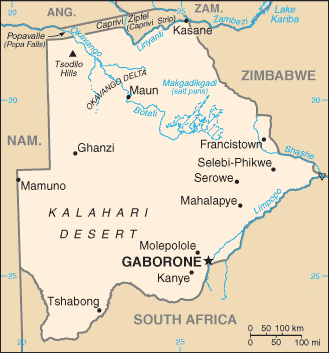
- Southern Africa, north of South Africa
- Area
- 581,730 sq km
- Climate
- semiarid; warm winters and hot summers
- Terrain
- predominantly flat to gently rolling tableland; Kalahari Desert in southwest
- Natural resources
- diamonds, copper, nickel, salt, soda ash, potash, coal, iron ore, silver
- Coastline
- 0 km (landlocked)
- Natural hazards
- periodic droughts; seasonal August winds blow from the west, carrying sand and dust across the country, which can obscure visibility
People & society
- Population
- 2,521,534 (2025 est.)
- Nationality
- Motswana (singular), Batswana (plural)
- Ethnic groups
- Tswana (or Setswana) 79%, Kalanga 11%, Basarwa 3%, other, including Kgalagadi and people of European ancestry 7%
- Languages
- Setswana 77.3%, Sekalanga 7.4%, Shekgalagadi 3.4%, English (official) 2.8%, Zezuru/Shona 2%, Sesarwa 1.7%, Sembukushu 1.6%, Ndebele 1%, other 2.8% (2011 est.)
- Religions
- Christian 79.1%, Badimo 4.1%, other 1.4% (includes Baha'i, Hindu, Muslim, Rastafarian), none 15.2%, unspecified 0.3% (2011 est.)
- Median age
- 25.8 years (2025 est.)
- Life expectancy at birth
- 66.4 years (2024 est.)
Economy
- Economic overview
- good economic governance and financial management; diamond-driven growth model declining; rapid poverty reductions; high unemployment, particularly among youth; COVID-19 sharply contracted the economy and recovery is slow; public sector wages have posed fiscal challenges
- Industries
- diamonds, copper, nickel, salt, soda ash, potash, coal, iron ore, silver; beef processing; textiles
- Agricultural products
- root vegetables, beef, vegetables, sorghum, maize, game meat, milk, watermelons, goat milk, sunflower seeds (2023)
- Exports - partners
- UAE 27%, India 17%, Belgium 16%, South Africa 8%, USA 7% (2023)
- Imports - partners
- South Africa 65%, Namibia 8%, Canada 5%, China 3%, India 3% (2023)
Government
- Government type
- parliamentary republic
- Capital
- Gaborone
- Independence
- 30 September 1966 (from the UK)
- Constitution
- previous 1960 (pre-independence); latest adopted March 1965, effective 30 September 1966
- Executive branch
- President Duma BOKO (since 1 November 2024)
- Legislative branch
- Parliament
Full reference data
Every field, by section, CIA World Factbook. Open a topic to expand it.
Introduction
Travel Facts
Please visit the following links to find further information about your desired destination.
CDC - To learn what vaccines and health precautions to take while visiting your destination.
US State Dept Travel Information - Overall information about foreign travel for US citizens.
To obtain an international driving permit (IDP). Only two organizations in the US issue IDPs: American Automobile Association (AAA) and American Automobile Touring Alliance (AATA)
How to get help in an emergency? Contact the nearest US embassy or consulate, or call one of these numbers: from the US or Canada - 1-888-407-4747 or from Overseas - +1 202-501-4444
Page last updated: Wednesday, June 19, 2024