
Country exposure · CC
Cocos (Keeling) Islands
Australia Oceania · West Island · non-self-governing overseas territory of Australia
What Cocos (Keeling) Islands means for your money, the prices you pay, the tariffs in motion, and where U.S. policy could change both.
$207K
U.S. imports, 2025
-80.6%
change in one year
$2M
U.S. exports, 2025
593
Population
In your house
What you buy that Cocos (Keeling) Islands makes
America bought $207K in goods from Cocos (Keeling) Islands in 2025, down 80.6% in a single year. Of every $100 of it, here's where the money went.
Other parts and accessories of vehicles
car parts and accessories
Computer accessories
keyboards, drives, computer parts
Plastic materials
plastics for packaging and goods
Other consumer nondurables
Minimum value shipments
Apparel, textiles, nonwool or cotton
synthetic and performance apparel
Industrial supplies, other
Cookware, cutlery, tools
cookware, cutlery, hand tools
Cell phones and other household goods, n.e.c.
cell phones and home electronics
2026 so far (through July): $7K in imports. Source: U.S. Census Bureau, International Trade in Goods (customs basis).
The other direction
What America sells to Cocos (Keeling) Islands
$2M in 2025, a trade rupture cuts both ways, for American producers as well as American prices.
Chemicals-other
$2MIndustrial engines
$42KMedicinal equipment
$6Kmedical devices and equipment
Musical instruments
$4KMinimum value shipments
$3KWhere you stand
U.S. tariff posture toward Cocos (Keeling) Islands
No U.S. tariff action singles this country out. Its goods face the universal 10% temporary import surcharge under Section 122 of the Trade Act (which replaced the IEEPA reciprocal baseline in February 2026) plus the sectoral Section 232 duties — steel and aluminum at 50% — that apply to all countries. The Section 122 surcharge is statutorily temporary — scheduled to lapse on or about July 23, 2026 (a 150-day cap) unless extended or replaced.
Reciprocal tariff (universal baseline)
10%
The universal 10% floor, a Section 122 import surcharge since February 2026, previously the EO 14257 reciprocal baseline, applies to nearly all U.S. imports. This country has no higher assigned rate of its own.
Policy in motion
Tariff status: a moving target
No U.S. tariff action names Cocos (Keeling) Islands. These are the universal measures, applied to every country without a country-specific arrangement, that set its treatment.
2026-04-06
Section 232 metals coverage expanded
In effectThe April 2026 proclamation strengthening Section 232 actions on aluminum, steel, and copper expanded derivative-product coverage for all countries, keeping the general metals rate at 50%.
91 FR 18201 →2026-02-24
IEEPA reciprocal tariffs terminated — replaced by 10% Section 122 surcharge
In effectExecutive Order 14389 (Ending Certain Tariff Actions) terminated the IEEPA tariff duties — including the EO 14257 reciprocal baseline — effective February 24, 2026. A flat 10% Section 122 temporary import surcharge (Proclamation 11012 of February 20, 2026) replaced them, leaving the universal rate unchanged at 10% on a different statutory basis. Section 122 caps such surcharges at 150 days, so this 10% surcharge is scheduled to lapse on or about July 23, 2026 absent further action (the administration has signaled it could raise the rate toward the 15% statutory maximum).
91 FR 9437 →2025-11-13
Agricultural products exempted from reciprocal tariffs
In effectExecutive Order 14360 of November 14, 2025 removed reciprocal duties from certain agricultural products listed in its annexes (coffee, cocoa, bananas, and other goods the U.S. does not produce in sufficient quantity), retroactive to November 13, 2025 — for all countries subject to the reciprocal tariff.
90 FR 54091 →2025-06-04
Section 232 steel and aluminum duties doubled to 50%
In effectThe June 3, 2025 proclamation raised Section 232 duties on steel and aluminum articles and derivatives from 25% to 50% for all countries, effective June 4, 2025.
90 FR 24199 →2025-04-05
Universal 10% reciprocal baseline takes effect
In effectExecutive Order 14257 (signed April 2, 2025) imposed a 10% ad valorem reciprocal duty on imports from all trading partners, effective April 5, 2025. Countries without a higher Annex I rate remain at this baseline.
Federal Register · 2025-06063 →2025-03-12
Section 232 steel and aluminum duties set at 25% for all countries
In effectProclamations of February 10, 2025 terminated all country exemptions and quota arrangements and applied 25% Section 232 duties to steel and aluminum imports from every country, effective March 12, 2025.
90 FR 9817 →
Reference
The country itself
Australia Oceania · Geography, people, economy, and government, public-domain data from the CIA World Factbook.
British sea captain William KEELING discovered the Cocos (Keeling) Islands in 1609, and they were named for their coconut trees in 1622. Some maps began referring to them as the Keeling Islands in 1703. In 1825, Scottish trader John CLUNIES-ROSS was trying to get to Christmas Island but was blown off course and landed on Cocos (Keeling) Islands. The next year, a British trader hired CLUNIES-ROSS's brother to bring slaves and a harem of Malay women to create the first permanent settlement on the island. By the 1830s, the Clunies-Ross family had firmly established themselves as the leaders of the islands, and they ruled Cocos (Keeling) Islands in a feudal style until 1978. The UK annexed the islands in 1857 and administered them from Ceylon after 1878 and from Singapore after 1886. The Cocos (Keeling) Islands hosted a cable relaying station and was attacked by the Germans in World War I. The Japanese similarly attacked the islands in World War II. The UK transferred the islands to Australia in 1955, when they were officially named the Cocos (Keeling) Islands, and in 1978, Australia bought all the land held by the Clunies-Ross family, ending their control of the islands. In a referendum in 1984, most islanders voted to integrate with Australia, and Western Australian laws have applied on the islands since 1992.
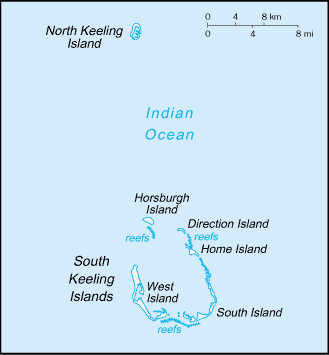
Geography
- Location
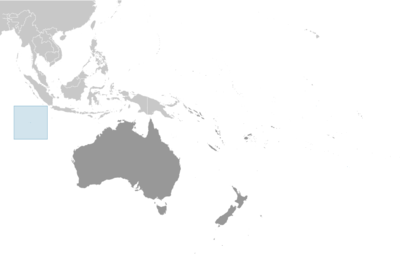
- Southeastern Asia, group of islands in the Indian Ocean, southwest of Indonesia, about halfway between Australia and Sri Lanka
- Area
- 14 sq km
- Climate
- tropical with high humidity, moderated by the southeast trade winds for about nine months of the year
- Terrain
- flat, low-lying coral atolls
- Natural resources
- fish
- Coastline
- 26 km
- Natural hazards
- cyclone season is October to April
People & society
- Population
- 593 (2021 est.)
- Nationality
- Cocos Islander(s)
- Ethnic groups
- Europeans, Cocos Malays
- Languages
- Malay (Cocos dialect) 68.8%, English 22.3%, unspecified 8.9%; note - data represent language spoken at home (2016 est.)
- Religions
- Muslim (predominantly Sunni) 75%, Anglican 3.5%, Roman Catholic 2.2%, none 12.9%, unspecified 6.3% (2016 est.)
- Median age
- 40 years (2021 est.)
Economy
- Industries
- copra products, tourism
- Agricultural products
- vegetables, bananas, pawpaws, coconuts
- Exports - partners
- USA 31%, Singapore 29%, UK 12%, Australia 3%, Brazil 3% (2023)
- Imports - partners
- Australia 87%, USA 3%, Philippines 2%, Sweden 2%, Brazil 1% (2023)
Government
- Government type
- non-self-governing overseas territory of Australia
- Capital
- West Island
- Independence
- none (territory of Australia)
- Constitution
- 23 November 1955 (Cocos (Keeling) Islands Act 1955)
- Executive branch
- King CHARLES III (since 8 September 2022); represented by Governor-General of the Commonwealth of Australia General Sam MOSTYN (since 1 July 2024)
- Legislative branch
- Cocos (Keeling) Islands Shire Council
Full reference data
Every field, by section, CIA World Factbook. Open a topic to expand it.