
Country exposure · CF
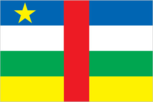
Central African Republic
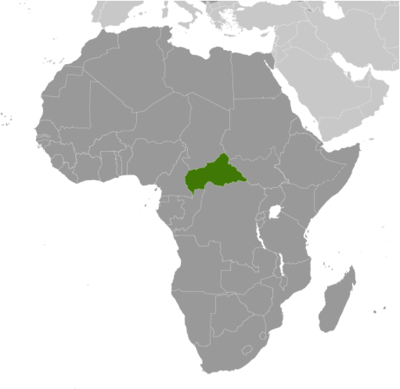
Africa · Bangui · presidential republic
What Central African Republic means for your money, the prices you pay, the tariffs in motion, and where U.S. policy could change both.
$1M
U.S. imports, 2025
-24.2%
change in one year
$14M
U.S. exports, 2025
6M
Population
$2.8B
GDP
In your house
What you buy that Central African Republic makes
America bought $1M in goods from Central African Republic in 2025, down 24.2% in a single year. Of every $100 of it, here's where the money went.
U.s. goods returned, and reimports
Lumber
lumber for homebuilding
Nuts
nuts
Measuring, testing, control instruments
Minimum value shipments
Passenger cars, new and used
new and used cars
Plywood and veneers
Generators, accessories
Numismatic coins
2026 so far (through July): $149K in imports. Source: U.S. Census Bureau, International Trade in Goods (customs basis).
The other direction
What America sells to Central African Republic
$14M in 2025, a trade rupture cuts both ways, for American producers as well as American prices.
Natural gas liquids
$5MTelecommunications equipment
$2Mphones, routers, networking gear
Other foods
$1MPharmaceutical preparations
$706Kmedicines and pharmacy items
Toiletries and cosmetics
$672Ktoiletries and cosmetics
Minimum value shipments
$566KIndustrial machines, other
$401KFish and shellfish
$379Kfish, shrimp, shellfish
Apparel, household goods - textile
$349Kcotton clothing and linens
Where you stand
U.S. tariff posture toward Central African Republic
No U.S. tariff action singles this country out. Its goods face the universal 10% temporary import surcharge under Section 122 of the Trade Act (which replaced the IEEPA reciprocal baseline in February 2026) plus the sectoral Section 232 duties — steel and aluminum at 50% — that apply to all countries. The Section 122 surcharge is statutorily temporary — scheduled to lapse on or about July 23, 2026 (a 150-day cap) unless extended or replaced.
Reciprocal tariff (universal baseline)
10%
The universal 10% floor, a Section 122 import surcharge since February 2026, previously the EO 14257 reciprocal baseline, applies to nearly all U.S. imports. This country has no higher assigned rate of its own.
Policy in motion
Tariff status: a moving target
No U.S. tariff action names Central African Republic. These are the universal measures, applied to every country without a country-specific arrangement, that set its treatment.
2026-04-06
Section 232 metals coverage expanded
In effectThe April 2026 proclamation strengthening Section 232 actions on aluminum, steel, and copper expanded derivative-product coverage for all countries, keeping the general metals rate at 50%.
91 FR 18201 →2026-02-24
IEEPA reciprocal tariffs terminated — replaced by 10% Section 122 surcharge
In effectExecutive Order 14389 (Ending Certain Tariff Actions) terminated the IEEPA tariff duties — including the EO 14257 reciprocal baseline — effective February 24, 2026. A flat 10% Section 122 temporary import surcharge (Proclamation 11012 of February 20, 2026) replaced them, leaving the universal rate unchanged at 10% on a different statutory basis. Section 122 caps such surcharges at 150 days, so this 10% surcharge is scheduled to lapse on or about July 23, 2026 absent further action (the administration has signaled it could raise the rate toward the 15% statutory maximum).
91 FR 9437 →2025-11-13
Agricultural products exempted from reciprocal tariffs
In effectExecutive Order 14360 of November 14, 2025 removed reciprocal duties from certain agricultural products listed in its annexes (coffee, cocoa, bananas, and other goods the U.S. does not produce in sufficient quantity), retroactive to November 13, 2025 — for all countries subject to the reciprocal tariff.
90 FR 54091 →2025-06-04
Section 232 steel and aluminum duties doubled to 50%
In effectThe June 3, 2025 proclamation raised Section 232 duties on steel and aluminum articles and derivatives from 25% to 50% for all countries, effective June 4, 2025.
90 FR 24199 →2025-04-05
Universal 10% reciprocal baseline takes effect
In effectExecutive Order 14257 (signed April 2, 2025) imposed a 10% ad valorem reciprocal duty on imports from all trading partners, effective April 5, 2025. Countries without a higher Annex I rate remain at this baseline.
Federal Register · 2025-06063 →2025-03-12
Section 232 steel and aluminum duties set at 25% for all countries
In effectProclamations of February 10, 2025 terminated all country exemptions and quota arrangements and applied 25% Section 232 duties to steel and aluminum imports from every country, effective March 12, 2025.
90 FR 9817 →
Reference
The country itself
Africa · Geography, people, economy, and government, public-domain data from the CIA World Factbook.
The Central African Republic (CAR) is a perennially weak state that sits at the crossroads of ethnic and linguistic groups in the center of the African continent. Among the last areas of Sub-Saharan Africa to be drawn into the world economy, its introduction into trade networks around the early 1700s fostered significant competition among its population. The local population sought to benefit from the lucrative Atlantic, trans-Saharan, and Indian Ocean trade in enslaved people and ivory. Slave raids aided by the local populations fostered animosity between ethnic groups that remains today. The territory was established as a French colony named Ubangui-Shari in 1903, and France modeled its administration of the colony after the Belgian Congo, subcontracting control of the territory to private companies that collected rubber and ivory. Although France banned the domestic slave trade in CAR in the 1910s, the private companies continued to exploit the population through forced labor. The colony of Ubangi-Shari gained independence from France as the Central African Republic in 1960, but the death of independence leader Barthelemy BOGANDA six months prior led to an immediate struggle for power. CAR’s political history has since been marred by a series of coups, the first of which brought Jean-Bedel BOKASSA to power in 1966. Widespread corruption and intolerance for any political opposition characterized his regime. In an effort to prolong his mandate, BOKASSA named himself emperor in 1976 and changed the country’s name to the Central African Empire. His regime’s economic mismanagement culminated in widespread student protests in 1979 that were violently suppressed by security forces. BOKASSA fell out of favor with the international community and was overthrown in a French-backed coup in 1979. After BOKASSA’s departure, the country’s name once again became the Central African Republic. CAR’s fifth coup in 2013 unseated President Francois BOZIZE after the Seleka, a mainly Muslim rebel coalition, seized the capital and forced BOZIZE to flee the country. The Seleka's widespread abuses spurred the formation of mainly Christian self-defense groups that called themselves the anti-Balaka, which have also committed human rights abuses against Muslim populations in retaliation. Since the rise of these groups, conflict in CAR has become increasingly ethnoreligious, although focused on identity rather than religious ideology. Elections in 2016 installed independent candidate Faustin-Archange TOUADERA as president; he was reelected in 2020. A peace agreement signed in 2019 between the government and the main armed factions has had little effect, and armed groups remain in control of large swaths of the country's territory. TOUADERA's United Hearts Movement has governed the country since 2016, and a new constitution approved by referendum on 30 July 2023 effectively ended term limits, creating the potential for TOUADERA to extend his rule.
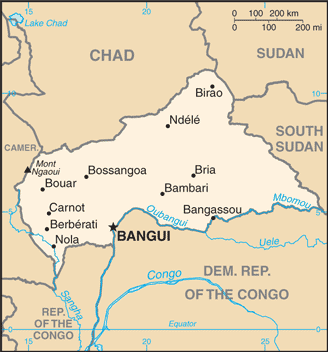
Geography
- Location
- Central Africa, north of Democratic Republic of the Congo
- Area
- 622,984 sq km
- Climate
- tropical; hot, dry winters; mild to hot, wet summers
- Terrain
- vast, flat to rolling plateau; scattered hills in northeast and southwest
- Natural resources
- diamonds, uranium, timber, gold, oil, hydropower
- Coastline
- 0 km (landlocked)
- Natural hazards
- hot, dry, dusty harmattan winds affect northern areas; floods are common
People & society
- Population
- 5,750,570 (2025 est.)
- Nationality
- Central African(s)
- Ethnic groups
- Baya 28.8%, Banda 22.9%, Mandjia 9.9%, Sara 7.9%, M'Baka-Bantu 7.9%, Arab-Fulani (Peuhl) 6%, Mbum 6%, Ngbanki 5.5%, Zande-Nzakara 3%, other Central African Republic ethnic groups 2%, non-Central African Republic ethnic groups .1% (2003 est.)
- Languages
- French (official), Sangho (lingua franca and national language), tribal languages
- Religions
- Roman Catholic 34.6%, Protestant 15.7%, other Christian 22.9%, Muslim 13.8%, ethnic religionist 12%, Baha'i 0.2%, agnostic/atheist 0.7% (2020 est.)
- Median age
- 20.6 years (2025 est.)
- Life expectancy at birth
- 56.4 years (2024 est.)
- Literacy
- 42.4% (2019 est.)
Economy
- Economic overview
- enormous natural resources; extreme poverty; weak public institutions and infrastructure; political and gender-based violence have led to displacement of roughly 25% of population; Bangui-Douala corridor blockade reduced activity and tax collection; strong agricultural performance offset COVID-19 downturn
- Industries
- gold and diamond mining, logging, brewing, sugar refining
- Agricultural products
- cassava, groundnuts, yams, coffee, maize, sesame seeds, taro, sugarcane, beef, milk (2023)
- Exports - partners
- UAE 54%, China 14%, France 6%, Turkey 5%, Belgium 4% (2023)
- Imports - partners
- China 16%, Cameroon 14%, France 8%, Belgium 6%, Cote d'Ivoire 5% (2023)
Government
- Government type
- presidential republic
- Capital
- Bangui
- Independence
- 13 August 1960 (from France)
- Constitution
- several previous; latest constitution passed by a national referendum on 30 July 2023 and validated by the Constitutional Court on 30 August 2023
- Executive branch
- President Faustin-Archange TOUADéRA (since 30 March 2016)
- Legislative branch
- National Assembly (Assemblée nationale)
Full reference data
Every field, by section, CIA World Factbook. Open a topic to expand it.
Introduction
Travel Facts
Please visit the following links to find further information about your desired destination.
World Health Organization (WHO) - To learn what vaccines and health precautions to take while visiting your destination.
US State Dept Travel Information - Overall information about foreign travel for US citizens.
To obtain an international driving permit (IDP). Only two organizations in the US issue IDPs: American Automobile Association (AAA) and American Automobile Touring Alliance (AATA)
How to get help in an emergency? Contact the nearest US embassy or consulate, or call one of these numbers: from the US or Canada - 1-888-407-4747 or from Overseas - +1 202-501-4444
Page last updated: Wednesday, October 05, 2022