Country exposure · CK

Flag of Cook Islands

Cook Islands

Australia Oceania · Avarua · parliamentary democracy

What Cook Islands means for your money — the prices you pay, the tariffs in motion, and where U.S. policy could change both.
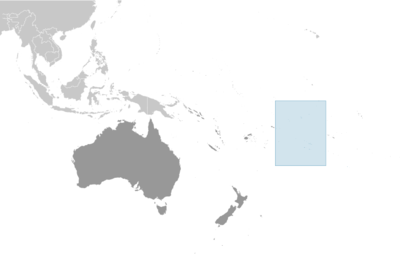
Map showing the location of Cook Islands

$321K

U.S. imports, 2025

-64%

change in one year

$7M

U.S. exports, 2025

8K

Population

$409M

GDP

In your house

What you buy that Cook Islands makes

America bought $321K in goods from Cook Islands in 2025 — down 64% in a single year. Of every $100 of it, here's where the money went.

U.s. goods returned, and reimports

$167K52.1%

Apparel, household goods - cotton

cotton clothing and linens

$74K23%

Industrial supplies, other

$24K7.5%

Metalworking machine tools

$21K6.6%

Tea, spices, etc.

tea and spices

$13K4%

Minimum value shipments

$8K2.4%

Toys, games, and sporting goods

toys, games, sporting goods

$6K1.9%

Camping apparel and gear

camping gear and outdoor apparel

$6K1.8%

Apparel, textiles, nonwool or cotton

synthetic and performance apparel

$2K0.7%

2026 so far (through April): $73K in imports. Source: U.S. Census Bureau, International Trade in Goods (customs basis).

The other direction

What America sells to Cook Islands

$7M in 2025 — a trade rupture cuts both ways, for American producers as well as American prices.

Meat, poultry, etc.

$3M

Civilian aircraft, engines, equipment, and parts

$963K

Minimum value shipments

$842K

Other foods

$617K

Medicinal equipment

$346K

medical devices and equipment

Cell phones and other household goods, n.e.c.

$298K

cell phones and home electronics

Electric apparatus

$201K

Televisions and video equipment

$160K

TVs and video equipment

Measuring, testing, control instruments

$82K

Where you stand

U.S. tariff posture toward Cook Islands

No U.S. tariff action singles this country out. Its goods face the universal 10% temporary import surcharge under Section 122 of the Trade Act (which replaced the IEEPA reciprocal baseline in February 2026) plus the sectoral Section 232 duties — steel and aluminum at 50% — that apply to all countries. The Section 122 surcharge is statutorily temporary — scheduled to lapse on or about July 23, 2026 (a 150-day cap) unless extended or replaced.

Reciprocal tariff (universal baseline)

10%

The universal 10% floor — a Section 122 import surcharge since February 2026, previously the EO 14257 reciprocal baseline — applies to nearly all U.S. imports. This country has no higher assigned rate of its own.

Policy in motion

Tariff status: a moving target

No U.S. tariff action names Cook Islands. These are the universal measures — applied to every country without a country-specific arrangement — that set its treatment.

  1. 2026-04-06

    Section 232 metals coverage expanded

    In effect

    The April 2026 proclamation strengthening Section 232 actions on aluminum, steel, and copper expanded derivative-product coverage for all countries, keeping the general metals rate at 50%.

    91 FR 18201
  2. 2026-02-24

    IEEPA reciprocal tariffs terminated — replaced by 10% Section 122 surcharge

    In effect

    Executive Order 14389 (Ending Certain Tariff Actions) terminated the IEEPA tariff duties — including the EO 14257 reciprocal baseline — effective February 24, 2026. A flat 10% Section 122 temporary import surcharge (Proclamation 11012 of February 20, 2026) replaced them, leaving the universal rate unchanged at 10% on a different statutory basis. Section 122 caps such surcharges at 150 days, so this 10% surcharge is scheduled to lapse on or about July 23, 2026 absent further action (the administration has signaled it could raise the rate toward the 15% statutory maximum).

    91 FR 9437
  3. 2025-11-13

    Agricultural products exempted from reciprocal tariffs

    In effect

    Executive Order 14360 of November 14, 2025 removed reciprocal duties from certain agricultural products listed in its annexes (coffee, cocoa, bananas, and other goods the U.S. does not produce in sufficient quantity), retroactive to November 13, 2025 — for all countries subject to the reciprocal tariff.

    90 FR 54091
  4. 2025-06-04

    Section 232 steel and aluminum duties doubled to 50%

    In effect

    The June 3, 2025 proclamation raised Section 232 duties on steel and aluminum articles and derivatives from 25% to 50% for all countries, effective June 4, 2025.

    90 FR 24199
  5. 2025-04-05

    Universal 10% reciprocal baseline takes effect

    In effect

    Executive Order 14257 (signed April 2, 2025) imposed a 10% ad valorem reciprocal duty on imports from all trading partners, effective April 5, 2025. Countries without a higher Annex I rate remain at this baseline.

    Federal Register · 2025-06063
  6. 2025-03-12

    Section 232 steel and aluminum duties set at 25% for all countries

    In effect

    Proclamations of February 10, 2025 terminated all country exemptions and quota arrangements and applied 25% Section 232 duties to steel and aluminum imports from every country, effective March 12, 2025.

    90 FR 9817

Reference

The country itself

Australia Oceania · Geography, people, economy, and government — public-domain data from the CIA World Factbook.

Polynesians from Tahiti were probably the first people to settle Rarotonga -- the largest of the Cook Islands -- around A.D. 900. Over time, Samoans and Tongans also settled in Rarotonga, and Rarotongans voyaged to the northern Cook Islands, settling Manihiki and Rakahanga. Pukapuka and Penrhyn in the northern Cook Islands were settled directly from Samoa. Prior to European contact, there was considerable travel and trade between inhabitants of the different islands and atolls, but they were not united in a single political entity. Spanish navigators were the first Europeans to spot the northern Cook Islands in 1595, followed by the first landing in 1606, but no further European contact occurred until the 1760s. In 1773, British explorer James COOK spotted Manuae in the southern Cook Islands, and Russian mapmakers named the islands after COOK in the 1820s. Fearing France would militarily occupy the islands as it did in Tahiti, Rarotongans asked the UK for protectorate status in the 1840s and 1860s, a request the UK ignored. In 1888, Queen MAKEA TAKAU of Rarotonga formally petitioned for protectorate status, to which the UK reluctantly agreed. In 1901, the UK placed Rarotonga and the rest of the islands in the New Zealand Colony, and in 1915, the Cook Islands Act organized the islands into one political entity. It remained a protectorate until 1965, when New Zealand granted the Cook Islands self-governing status. The Cook Islands has a great deal of local autonomy and is an independent member of international organizations, but it is in free association with New Zealand, which is responsible for its defense and foreign affairs. In September 2023, the US recognized the Cook Islands as a sovereign and independent state.
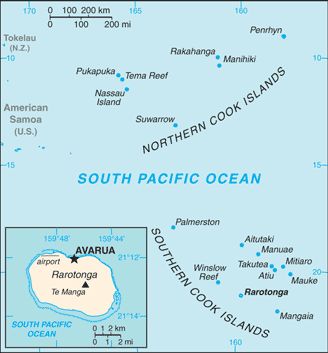
Regional map of Cook Islands

Geography

Location
Oceania, group of islands in the South Pacific Ocean, about halfway between Hawaii and New Zealand
Area
236 sq km
Climate
tropical oceanic; moderated by trade winds; a dry season from April to November and a more humid season from December to March
Terrain
low coral atolls in north; volcanic, hilly islands in south
Natural resources
coconuts (copra)
Coastline
120 km
Natural hazards
tropical cyclones (November to March)

People & society

Population
7,592 (2025 est.)
Nationality
Cook Islander(s)
Ethnic groups
Cook Island Maori 77.4%, part Cook Island Maori 8.3%, Fijian 3.6%, New Zealand Maori/European 3.4%, Filipino 2.9%, other Pacific Islands 1.8%, other 2.6% (2021 est.)
Languages
English (official) 86.4%, Cook Islands Maori (Rarotongan) (official) 76.2%, other 8.3% (2011 est.)
Religions
Protestant 55% (Cook Islands Christian Church 43.1%, Seventh Day Adventist 8.3%, Assemblies of God 3.6%), Roman Catholic 16.7%, Church of Jesus Christ 3.9%, Jehovah's Witness 2.2%, Apostolic Church 2.1%, other 4.5%, none/unspecified 15.6% (2021 est.)
Median age
41.5 years (2025 est.)
Life expectancy at birth
77.6 years (2024 est.)

Economy

Economic overview
high-income self-governing New Zealand territorial economy; tourism-based activity but diversifying; severely curtailed by COVID-19 pandemic; copra and tropical fruit exporter; Asian Development Bank aid recipient
Industries
fishing, fruit processing, tourism, clothing, handicrafts
Agricultural products
coconuts, vegetables, papayas, pork, sweet potatoes, tomatoes, fruits, mangoes/guavas, watermelons, chicken (2023)
Exports - partners
Japan 33%, Thailand 15%, Greece 15%, France 11%, China 8% (2023)
Imports - partners
NZ 44%, Italy 26%, Fiji 9%, China 7%, Australia 3% (2023)

Government

Government type
parliamentary democracy
Capital
Avarua
Independence
4 August 1965 (Cook Islands became self-governing state in free association with New Zealand)
Constitution
4 August 1965 (Cook Islands Constitution Act 1964)
Executive branch
King CHARLES III (since 8 September 2022); represented by Sir Tom J. MARSTERS (since 9 August 2013); New Zealand High Commissioner Catherine GRAHAM (since 8 September 2024)
Legislative branch
Parliament

Full reference data

Every field, by section — CIA World Factbook. Open a topic to expand it.

Introduction
Background
Polynesians from Tahiti were probably the first people to settle Rarotonga -- the largest of the Cook Islands -- around A.D. 900. Over time, Samoans and Tongans also settled in Rarotonga, and Rarotongans voyaged to the northern Cook Islands, settling Manihiki and Rakahanga. Pukapuka and Penrhyn in the northern Cook Islands were settled directly from Samoa. Prior to European contact, there was considerable travel and trade between inhabitants of the different islands and atolls, but they were not united in a single political entity. Spanish navigators were the first Europeans to spot the northern Cook Islands in 1595, followed by the first landing in 1606, but no further European contact occurred until the 1760s. In 1773, British explorer James COOK spotted Manuae in the southern Cook Islands, and Russian mapmakers named the islands after COOK in the 1820s. Fearing France would militarily occupy the islands as it did in Tahiti, Rarotongans asked the UK for protectorate status in the 1840s and 1860s, a request the UK ignored. In 1888, Queen MAKEA TAKAU of Rarotonga formally petitioned for protectorate status, to which the UK reluctantly agreed. In 1901, the UK placed Rarotonga and the rest of the islands in the New Zealand Colony, and in 1915, the Cook Islands Act organized the islands into one political entity. It remained a protectorate until 1965, when New Zealand granted the Cook Islands self-governing status. The Cook Islands has a great deal of local autonomy and is an independent member of international organizations, but it is in free association with New Zealand, which is responsible for its defense and foreign affairs. In September 2023, the US recognized the Cook Islands as a sovereign and independent state.
Travel Facts
US State Dept Travel Advisory
The US Department of State currently recommends US citizens consult its website daily via the link below for updates to travel advisories and statements on safety, security, local laws, and special circumstances about visiting United Kingdom and Cook Islands. https://travel.state.gov/content/travel/en/traveladvisories/traveladvisories.html
Passport/Visa Requirements
US citizens should make sure their passport is valid at the date of their entering the country and during the length of their entire visit. They should also make sure they have at least 1 blank page in their passport for any entry stamp that will be required. A visa is not required for stays of less than 30 days. It is possible to extend visit up to 5 months.
US Embassy/Consulate
None (self-governing in free association with New Zealand); US citizens may call US Dept of State (202)-501-4444 for emergencies; alternate contact is the Embassy in New Zealand [64] (4) 462-6000; United States Embassy Wellington, 29 Fitzherbert Terrace, Thorndon, Wellington 6011, New Zealand
Telephone Code
682
Local Emergency Phone
Ambulance: 998; Fire: 996; Police: 999
Vaccinations
See WHO recommendations http://www.who.int/
Climate
Tropical oceanic; moderated by trade winds; a dry season (April to November) and a more humid season (December to March)
Currency (Code)
New Zealand dollars (NZD)
Electricity/Voltage/Plug Type(s)
240 V / 50 Hz / plug types(s): I
Major Languages
English 86.4%, Cook Islands Maori (Rarotongan) 76.2%, other 8.3%; note: shares sum to more than 100% because some respondents gave more than one answer on the census
Major Religions
Protestant 62.8%, Roman Catholic 17%, Mormon 4.4%
Time Difference
UTC-10 (5 hours behind Washington, DC, during Standard Time)
Potable Water
Opt for bottled water
International Driving Permit
A local license is required.
Road Driving Side
Left
Tourist Destinations
Tapuaetai (One Foot Island); Muri Beach; Titikaveka Beach; Te Vara Nui Village; cross-island hike to Te Rua Manga (The Needle); Aroa Marine Reserve
Major Sports
Netball, rugby, soccer
Cultural Practices
Swimwear should be confined to the beach and resort pool areas.
Tipping Guidelines
Don't feel that you need to leave a tip, unless you believe that you have received outstanding service.
Souvenirs
Pareu cloth and quilted items, woven hats and baskets, carved wooden instruments and decorative items, pearl and shell items, collectible coins and stamps
Traditional Cuisine
Ika Mata — freshly caught fish cooked in lemon juice and then combined with fresh coconut cream, onion, and chilis; typically served with a side salad
CIA source last updated
Wednesday, July 20, 2022
Travel resources

Please visit the following links to find further information about your desired destination.

World Health Organization (WHO) - To learn what vaccines and health precautions to take while visiting your destination.

US State Dept Travel Information - Overall information about foreign travel for US citizens.

To obtain an international driving permit (IDP). Only two organizations in the US issue IDPs: American Automobile Association (AAA) and American Automobile Touring Alliance (AATA)

How to get help in an emergency? Contact the nearest US embassy or consulate, or call one of these numbers: from the US or Canada - 1-888-407-4747 or from Overseas - +1 202-501-4444

Page last updated: Wednesday, July 20, 2022

Geography
Location
Oceania, group of islands in the South Pacific Ocean, about halfway between Hawaii and New Zealand
Geographic coordinates
21 14 S, 159 46 W
Map references
Oceania
Area - total
236 sq km
Area - land
236 sq km
Area - water
0 sq km
Area - comparative
1.3 times the size of Washington, D.C.
Land boundaries - total
0 km
Coastline
120 km
Maritime claims - territorial sea
12 nm
Maritime claims - exclusive economic zone
200 nm
Maritime claims - continental shelf
200 nm or to the edge of the continental margin
Climate
tropical oceanic; moderated by trade winds; a dry season from April to November and a more humid season from December to March
Terrain
low coral atolls in north; volcanic, hilly islands in south
Elevation - highest point
Te Manga 652 m
Elevation - lowest point
Pacific Ocean 0 m
Natural resources
coconuts (copra)
Land use - agricultural land
7.9% (2023 est.)
Land use - agricultural land: arable land
arable land: 2.1% (2023 est.)
Land use - agricultural land: permanent crops
permanent crops: 5.8% (2023 est.)
Land use - agricultural land: permanent pasture
permanent pasture: 0% (2022 est.)
Land use - forest
65% (2023 est.)
Land use - other
27.1% (2023 est.)
Irrigated land
NA
Population distribution
most of the population is found on the island of Rarotonga
Natural hazards
tropical cyclones (November to March)
Geography - note
the northern Cook Islands are seven low-lying, sparsely populated, coral atolls; the southern Cook Islands, where most of the population lives, consist of eight elevated, fertile, volcanic isles, including the largest, Rarotonga, at 67 sq km
People and Society
Population - total
7,592 (2025 est.)
Population - male
3,890
Population - female
3,702
Nationality - noun
Cook Islander(s)
Nationality - adjective
Cook Islander
Ethnic groups
Cook Island Maori 77.4%, part Cook Island Maori 8.3%, Fijian 3.6%, New Zealand Maori/European 3.4%, Filipino 2.9%, other Pacific Islands 1.8%, other 2.6% (2021 est.)
Languages
English (official) 86.4%, Cook Islands Maori (Rarotongan) (official) 76.2%, other 8.3% (2011 est.)
Languages - note
note: shares sum to more than 100% because some respondents gave more than one answer on the census
Religions
Protestant 55% (Cook Islands Christian Church 43.1%, Seventh Day Adventist 8.3%, Assemblies of God 3.6%), Roman Catholic 16.7%, Church of Jesus Christ 3.9%, Jehovah's Witness 2.2%, Apostolic Church 2.1%, other 4.5%, none/unspecified 15.6% (2021 est.)
Age structure - 0-14 years
18.2% (male 738/female 671)
Age structure - 15-64 years
65.9% (male 2,634/female 2,479)
Age structure - 65 years and over
16% (2024 est.) (male 608/female 631)
Dependency ratios - total dependency ratio
53 (2025 est.)
Dependency ratios - youth dependency ratio
27.4 (2025 est.)
Dependency ratios - elderly dependency ratio
25.5 (2025 est.)
Dependency ratios - potential support ratio
3.9 (2025 est.)
Median age - total
41.5 years (2025 est.)
Median age - male
40.7 years
Median age - female
41.4 years
Population growth rate
-2.15% (2025 est.)
Birth rate
11.85 births/1,000 population (2025 est.)
Death rate
9.48 deaths/1,000 population (2025 est.)
Net migration rate
-23.84 migrant(s)/1,000 population (2025 est.)
Population distribution
most of the population is found on the island of Rarotonga
Urbanization - urban population
76.2% of total population (2023)
Urbanization - rate of urbanization
0.52% annual rate of change (2020-25 est.)
Sex ratio - at birth
1.04 male(s)/female
Sex ratio - 0-14 years
1.1 male(s)/female
Sex ratio - 15-64 years
1.06 male(s)/female
Sex ratio - 65 years and over
0.96 male(s)/female
Sex ratio - total population
1.05 male(s)/female (2024 est.)
Maternal mortality ratio
0 deaths/100,000 live births (2023 est.)
Infant mortality rate - total
14.8 deaths/1,000 live births (2025 est.)
Infant mortality rate - male
19 deaths/1,000 live births
Infant mortality rate - female
11.1 deaths/1,000 live births
Life expectancy at birth - total population
77.6 years (2024 est.)
Life expectancy at birth - male
74.8 years
Life expectancy at birth - female
80.6 years
Total fertility rate
1.99 children born/woman (2025 est.)
Gross reproduction rate
0.97 (2025 est.)
Drinking water source - improved: urban
urban: NA
Drinking water source - improved: rural
rural: NA
Drinking water source - improved: total
total: 100% of population (2022 est.)
Drinking water source - unimproved: urban
urban: NA
Drinking water source - unimproved: rural
rural: NA
Drinking water source - unimproved: total
total: 0% of population (2022 est.)
Health expenditure - Health expenditure (as % of GDP)
3.2% of GDP (2020)
Health expenditure - Health expenditure (as % of national budget)
11.9% of national budget (2022 est.)
Physician density
1.67 physicians/1,000 population (2020)
Hospital bed density
8.2 beds/1,000 population (2021 est.)
Sanitation facility access - improved: total
total: 96.8% of population (2022 est.)
Sanitation facility access - unimproved: total
total: 3.2% of population (2022 est.)
Obesity - adult prevalence rate
55.9% (2016)
Alcohol consumption per capita - total
12.97 liters of pure alcohol (2019 est.)
Alcohol consumption per capita - beer
3.62 liters of pure alcohol (2019 est.)
Alcohol consumption per capita - wine
2.28 liters of pure alcohol (2019 est.)
Alcohol consumption per capita - spirits
7.07 liters of pure alcohol (2019 est.)
Alcohol consumption per capita - other alcohols
0 liters of pure alcohol (2019 est.)
Tobacco use - total
24% (2025 est.)
Tobacco use - male
28.6% (2025 est.)
Tobacco use - female
20.1% (2025 est.)
Currently married women (ages 15-49)
53.2% (2021 est.)
Education expenditure - Education expenditure (% GDP)
3.4% of GDP (2024 est.)
Education expenditure - Education expenditure (% national budget)
9.2% national budget (2025 est.)
School life expectancy (primary to tertiary education) - total
15 years (2023 est.)
School life expectancy (primary to tertiary education) - male
15 years (2023 est.)
School life expectancy (primary to tertiary education) - female
15 years (2023 est.)
Government
Country name - conventional long form
none
Country name - conventional short form
Cook Islands
Country name - former
Hervey Islands
Country name - etymology
named after Captain James COOK, the British explorer who visited the islands in 1773 and 1777
Government type
parliamentary democracy
Dependency status
self-governing in free association with New Zealand; Cook Islands is fully responsible for internal affairs and conducts its own international relations, including establishing diplomatic relationships with foreign countries; New Zealand has a constitutional responsibility to respond to requests for assistance with foreign affairs, disasters, and defense
Capital - name
Avarua
Capital - geographic coordinates
21 12 S, 159 46 W
Capital - time difference
UTC-10 (5 hours behind Washington, DC, during Standard Time)
Capital - etymology
translates as "two harbors" in Maori
Legal system
common law similar to New Zealand common law
Constitution - history
4 August 1965 (Cook Islands Constitution Act 1964)
Constitution - amendment process
proposed by Parliament; passage requires at least two-thirds majority vote by the Parliament membership in each of several readings and assent of the chief of state’s representative; passage of amendments relating to the chief of state also requires two-thirds majority approval in a referendum
International law organization participation
has not submitted an ICJ jurisdiction declaration (New Zealand normally retains responsibility for external affairs); accepts ICCt jurisdiction
Suffrage
18 years of age; universal
Executive branch - chief of state
King CHARLES III (since 8 September 2022); represented by Sir Tom J. MARSTERS (since 9 August 2013); New Zealand High Commissioner Catherine GRAHAM (since 8 September 2024)
Executive branch - head of government
Prime Minister Mark BROWN (since 1 October 2020)
Executive branch - cabinet
Cabinet chosen by the prime minister
Executive branch - election/appointment process
the monarchy is hereditary; UK representative appointed by the monarch; New Zealand high commissioner appointed by the New Zealand Government; following legislative elections, the leader of the majority party or majority coalition usually becomes prime minister
Legislative branch - legislature name
Parliament
Legislative branch - legislative structure
unicameral
Legislative branch - number of seats
24 (directly elected)
Legislative branch - electoral system
plurality/majority
Legislative branch - scope of elections
full renewal
Legislative branch - term in office
4 years
Legislative branch - most recent election date
8/1/2022
Legislative branch - parties elected and seats per party
CIP (12); Demo (5); Cook Islands United Party (3); OCI (1); independent (3)
Legislative branch - percentage of women in chamber
25%
Legislative branch - expected date of next election
2026
Legislative branch - note
note: the House of Ariki, a 24-member parliamentary body of traditional leaders appointed by the King's representative, serves as a consultative body to the Parliament
Judicial branch - highest court(s)
Court of Appeal (consists of the chief justice and 3 judges of the High Court); High Court (consists of the chief justice and at least 4 judges and organized into civil, criminal, and land divisions)
Judicial branch - judge selection and term of office
High Court chief justice appointed by the Queen's Representative on the advice of the Executive Council tendered by the prime minister; other judges appointed by the Queen's Representative, on the advice of the Executive Council tendered by the chief justice, High Court chief justice, and the minister of justice; chief justice and judges appointed for 3-year renewable terms
Judicial branch - subordinate courts
justices of the peace
Judicial branch - note
note: appeals beyond the Cook Islands Court of Appeal are heard by the Judicial Committee of the Privy Council (in London)
Political parties
Cook Islands Party or CIP Democratic Party or Demo One Cook Islands or OCI
Diplomatic representation in the US
none (self-governing in free association with New Zealand)
Diplomatic representation from the US - embassy
none (self-governing in free association with New Zealand)
Diplomatic representation from the US - note
note: on 25 September 2023, the US officially established diplomatic relations with Cook Islands
International organization participation
ACP, ADB, AOSIS, FAO, ICAO, ICCt, ICRM, IFAD, IFRCS, IMO, IMSO, IOC, ITUC (NGOs), OPCW, PIF, Sparteca, SPC, UNESCO, UPU, WHO, WMO
Independence
4 August 1965 (Cook Islands became self-governing state in free association with New Zealand)
National holiday
Constitution Day, the first Monday in August (1965)
Flag
description: blue with the UK flag in the upper-left quadrant and a large circle of 15 five-pointed white stars (one for each island) centered in the right half of the flag
National symbol(s)
a circle of 15 five-pointed white stars on a blue field, tiare maori flower ( Gardenia taitensis )
National color(s)
green, white
National coat of arms
the coat of arms was designed by Papa Motu Kora, a mataiapo (traditional chief) from the Matavera village in Rarotonga; the shield with a circle of 15 five-pointed white stars represents the protection of the people and the country; on each side of the shield is a flying fish ( maroro ) and a white tern ( kakaia ); a Rarotongan orator club above the fish represents local traditions, and a cross above the tern symbolizes Christianity; a red-feathered Ariki headdress ( pare kura ) at the top of the shield represents the country’s traditional ranking system
National anthem(s) - title
"God Save the King"
National anthem(s) - lyrics/music
unknown
National anthem(s) - history
royal anthem
Economy
Economic overview
high-income self-governing New Zealand territorial economy; tourism-based activity but diversifying; severely curtailed by COVID-19 pandemic; copra and tropical fruit exporter; Asian Development Bank aid recipient
Real GDP (purchasing power parity) - Real GDP (purchasing power parity) 2024
$401.155 million (2024 est.)
Real GDP (purchasing power parity) - Real GDP (purchasing power parity) 2023
$364.686 million (2023 est.)
Real GDP (purchasing power parity) - Real GDP (purchasing power parity) 2022
$306.285 million (2022 est.)
Real GDP (purchasing power parity) - note
note: data are in 2015 dollars
Real GDP growth rate - Real GDP growth rate 2022
10.5% (2022 est.)
Real GDP growth rate - Real GDP growth rate 2021
-24.5% (2021 est.)
Real GDP growth rate - Real GDP growth rate 2020
-5.2% (2020 est.)
Real GDP per capita - Real GDP per capita 2024
$29,800 (2024 est.)
Real GDP per capita - Real GDP per capita 2023
$25,700 (2023 est.)
Real GDP per capita - Real GDP per capita 2022
$19,700 (2022 est.)
Real GDP per capita - note
note: data in 2015 dollars
GDP (official exchange rate)
$409.077 million (2024 est.)
GDP (official exchange rate) - note
note: data in current dollars at official exchange rate
Inflation rate (consumer prices) - Inflation rate (consumer prices) 2022
10.6% (2022 est.)
Inflation rate (consumer prices) - Inflation rate (consumer prices) 2021
1.9% (2021 est.)
Inflation rate (consumer prices) - Inflation rate (consumer prices) 2020
1% (2020 est.)
Inflation rate (consumer prices) - note
note: annual % change based on consumer prices
Agricultural products
coconuts, vegetables, papayas, pork, sweet potatoes, tomatoes, fruits, mangoes/guavas, watermelons, chicken (2023)
Agricultural products - note
note: top ten agricultural products based on tonnage
Industries
fishing, fruit processing, tourism, clothing, handicrafts
Budget - revenues
$113.687 million (2022 est.)
Budget - expenditures
$143.391 million (2022 est.)
Budget - note
note: central government revenues and expenses (excluding grants/extrabudgetary units/social security funds) converted to US dollars at average official exchange rate for year indicated
Exports - partners
Japan 33%, Thailand 15%, Greece 15%, France 11%, China 8% (2023)
Exports - partners - note
note: top five export partners based on percentage share of exports
Exports - commodities
fish, ships, garments, shellfish (2023)
Exports - commodities - note
note: top export commodities based on value in dollars over $500,000
Imports - partners
NZ 44%, Italy 26%, Fiji 9%, China 7%, Australia 3% (2023)
Imports - partners - note
note: top five import partners based on percentage share of imports
Imports - commodities
ships, refined petroleum, cars, plastic products, additive manufacturing machines (2023)
Imports - commodities - note
note: top five import commodities based on value in dollars
Exchange rates - Currency
New Zealand dollars (NZD) per US dollar -
Exchange rates - Exchange rates 2024
1.652 (2024 est.)
Exchange rates - Exchange rates 2023
1.628 (2023 est.)
Exchange rates - Exchange rates 2022
1.577 (2022 est.)
Exchange rates - Exchange rates 2021
1.414 (2021 est.)
Exchange rates - Exchange rates 2020
1.542 (2020 est.)
Energy
Electricity - installed generating capacity
17,000 kW (2023 est.)
Electricity - consumption
37.5 million kWh (2023 est.)
Electricity - transmission/distribution losses
3.2 million kWh (2023 est.)
Electricity generation sources - fossil fuels
60.9% of total installed capacity (2023 est.)
Electricity generation sources - solar
39.1% of total installed capacity (2023 est.)
Coal - imports
1 metric tons (2022 est.)
Petroleum - refined petroleum consumption
700 bbl/day (2023 est.)
Communications
Telephones - fixed lines - total subscriptions
6,990 (2022 est.)
Telephones - fixed lines - subscriptions per 100 inhabitants
48 (2022 est.)
Telephones - mobile cellular - total subscriptions
18,100 (2022 est.)
Telephones - mobile cellular - subscriptions per 100 inhabitants
123 (2022 est.)
Broadcast media
1 privately owned TV station in Rarotonga provides a mix of local news and overseas-sourced programs (2019)
Internet country code
.ck
Internet users - percent of population
64.8% (2021 est.)
Broadband - fixed subscriptions - total
2,700 (2018 est.)
Broadband - fixed subscriptions - subscriptions per 100 inhabitants
15 (2018 est.)
Transportation
Civil aircraft registration country code prefix
E5
Airports
10 (2025)
Merchant marine - total
190 (2023)
Merchant marine - by type
bulk carrier 19, general cargo 44, oil tanker 58, other 69
Ports - total ports
1 (2024)
Ports - large
0
Ports - medium
0
Ports - small
0
Ports - very small
1
Ports - ports with oil terminals
1
Ports - key ports
Avatiu
Military and Security
Military and security forces
no regular military forces; Cook Islands Police Service
Military - note
defense is the responsibility of New Zealand in consultation with the Cook Islands and at its request the Cook Islands have a "shiprider" agreement with the US, which allows local maritime law enforcement officers to embark on US Coast Guard (USCG) and US Navy (USN) vessels, including to board and search vessels suspected of violating laws or regulations within its designated exclusive economic zone (EEZ) or on the high seas; "shiprider" agreements also enable USCG personnel and USN vessels with embarked USCG law enforcement personnel to work with host nations to protect critical regional resources (2025)
Environment
Environmental issues
solid- and liquid-waste disposal; soil degradation; deforestation; use of pesticides; improper disposal of pollutants; overfishing and destructive fishing practices; over-dredging of lagoons and coral rubble beds; unregulated building
International environmental agreements - party to
Antarctic-Marine Living Resources, Biodiversity, Climate Change, Climate Change-Kyoto Protocol, Climate Change-Paris Agreement, Comprehensive Nuclear Test Ban, Desertification, Hazardous Wastes, Law of the Sea, Ozone Layer Protection, Ship Pollution
International environmental agreements - signed, but not ratified
none of the selected agreements
Climate
tropical oceanic; moderated by trade winds; a dry season from April to November and a more humid season from December to March
Land use - agricultural land
7.9% (2023 est.)
Land use - agricultural land: arable land
arable land: 2.1% (2023 est.)
Land use - agricultural land: permanent crops
permanent crops: 5.8% (2023 est.)
Land use - agricultural land: permanent pasture
permanent pasture: 0% (2022 est.)
Land use - forest
65% (2023 est.)
Land use - other
27.1% (2023 est.)
Urbanization - urban population
76.2% of total population (2023)
Urbanization - rate of urbanization
0.52% annual rate of change (2020-25 est.)
Carbon dioxide emissions - total emissions
103,000 metric tonnes of CO2 (2023 est.)
Carbon dioxide emissions - from petroleum and other liquids
103,000 metric tonnes of CO2 (2023 est.)
Particulate matter emissions
7.8 micrograms per cubic meter (2019 est.)