
Country exposure · CM
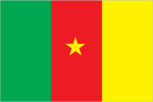
Cameroon
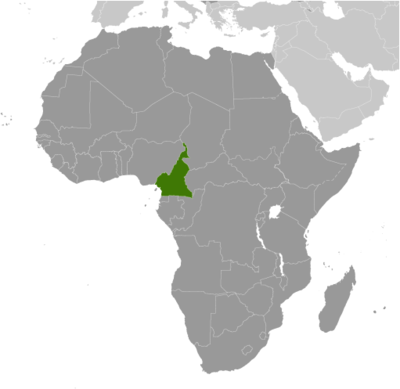
Africa · Yaounde · presidential republic
What Cameroon means for your money, the prices you pay, the tariffs in motion, and where U.S. policy could change both.
$287M
U.S. imports, 2025
+16.3%
change in one year
$169M
U.S. exports, 2025
32M
Population
$51.3B
GDP
In your house
What you buy that Cameroon makes
America bought $287M in goods from Cameroon in 2025, up 16.3% in a single year. Of every $100 of it, here's where the money went.
Bakery products
Crude oil
Lumber
lumber for homebuilding
Tobacco, waxes, etc.
Plywood and veneers
Natural rubber
natural rubber for tires
U.s. goods returned, and reimports
Minimum value shipments
Fruits, frozen juices
fruit and frozen juices
Industrial supplies, other
2026 so far (through July): $269M in imports. Source: U.S. Census Bureau, International Trade in Goods (customs basis).
The other direction
What America sells to Cameroon
$169M in 2025, a trade rupture cuts both ways, for American producers as well as American prices.
Plastic materials
$20Mplastics for packaging and goods
Tobacco, manufactured
$15MCivilian aircraft, engines, equipment, and parts
$12MPassenger cars, new and used
$10Mnew and used cars
Petroleum products, other
$9MCommercial vessels, other
$7MSports apparel and gear
$6Mcamping gear and outdoor apparel
Drilling & oilfield equipment
$5MTrucks, buses, and special purpose vehicles
$5Mtrucks, buses, SUVs
Where you stand
U.S. tariff posture toward Cameroon
Cameroon was assigned 11% in April 2025, raised to 15% in August, disrupting its main U.S. exports — cocoa paste, sawn timber, and natural rubber — and cutting export revenues even as volumes rose (oil, also a major export, is exempt under the energy carve-out). A November 2025 order exempting certain agricultural products the U.S. cannot produce domestically eased the burden on its cocoa. Cameroon was ineligible for AGOA in 2025 over human-rights concerns. Executive Order 14389 (Ending Certain Tariff Actions, Feb 20, 2026) terminated the IEEPA reciprocal duties, and Proclamation 11012 replaced it with a 10% Section 122 temporary import surcharge effective February 24, 2026. Cameroon has no Section 232 steel/aluminum exposure.
Reciprocal tariff (assigned, terminated)
11%
The rate this country was assigned under the EO 14257 reciprocal Annex, no longer in force. The Supreme Court struck down the IEEPA tariffs and they were terminated February 24, 2026 (EO 14389), replaced by a universal ~10% Section 122 surcharge. See the timeline below for the current effective rate.
Policy in motion
Tariff status: a moving target
U.S. tariff policy toward Cameroon has changed 5 times since 2025. This page tracks it.
2026-02-24
IEEPA reciprocal tariffs terminated — replaced by 10% Section 122
In effectExecutive Order 14389 (Ending Certain Tariff Actions) terminated the IEEPA tariff duties effective February 24, 2026, replacing Cameroon's 15% reciprocal rate with a 10% Section 122 temporary import surcharge under Proclamation 11012 (capped at 150 days).
91 FR 9437 →2025-11-13
Certain agricultural products exempted — eases cocoa
EndedExecutive Order 14360 modified the scope of the reciprocal tariffs to exempt certain agricultural products the U.S. cannot produce domestically, easing the burden on Cameroon's cocoa exports.
Federal Register · 2025-21203 →2025-08-07
Rate set at 15% — no deal reached
In effectExecutive Order 14326 set the post-pause Annex I reciprocal rates; Cameroon's rate was set at 15% effective August 7, 2025 with no bilateral agreement, cutting cocoa, timber, and rubber export revenues even as shipment volumes rose.
90 FR 37963 →2025-04-10
Elevated reciprocal rates paused to 10% for 90 days
In effectExecutive Order 14266 suspended the higher country-specific reciprocal rates — including Cameroon's 11% — back to the 10% baseline for 90 days.
90 FR 15625 →2025-04-05
Reciprocal tariff regime begins — Cameroon assigned 11%
In effectExecutive Order 14257 imposed a 10% universal reciprocal duty effective April 5 and an 11% country-specific rate for Cameroon scheduled to take effect April 9, hitting cocoa paste, timber, and rubber while oil fell under the energy carve-out.
90 FR 15041 →
Made for America
What Cameroon makes for America
Cameroon is a direct U.S. source of 1 essential good Americans rely on, the items themselves, shipped finished off the line.
Go deeper
The supply chain view
Cameroon sits upstream of 4 essential American goods through 4 tracked inputs.
agricultural
7%Tonewood (Rosewood/Ebony/Spruce/Maple)
agricultural
7%Cocoa Beans
agricultural
5%Cocoa Beans (Theobroma cacao)
agricultural
2%Green Coffee Beans — Robusta
Reference
The country itself
Africa · Geography, people, economy, and government, public-domain data from the CIA World Factbook.
Powerful chiefdoms ruled much of the area of present-day Cameroon before it became a German colony known as Kamerun in 1884. After World War I, the territory was divided between France and the UK as League of Nations mandates. French Cameroon became independent in 1960 as the Republic of Cameroon. The following year, the southern portion of neighboring British Cameroon voted to merge with the new country to form the Federal Republic of Cameroon. In 1972, a new constitution replaced the federation with a unitary state, the United Republic of Cameroon. The country has generally enjoyed stability, which has enabled the development of agriculture, roads, and railways, as well as a petroleum industry. Nonetheless, unrest and violence in the country's two western, English-speaking regions have persisted since 2016. Movement toward democratic reform is slow, and political power remains firmly in the hands of President Paul BIYA.
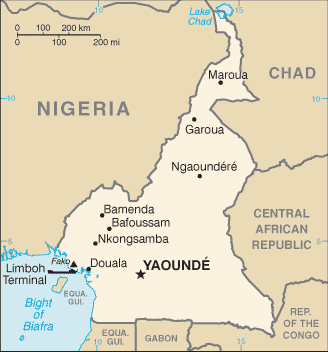
Geography
- Location
- Central Africa, bordering the Bight of Biafra, between Equatorial Guinea and Nigeria
- Area
- 475,440 sq km
- Climate
- varies with terrain, from tropical along coast to semiarid and hot in north
- Terrain
- diverse, with coastal plain in southwest, dissected plateau in center, mountains in west, plains in north
- Natural resources
- petroleum, bauxite, iron ore, timber, hydropower
- Coastline
- 402 km
- Natural hazards
- volcanic activity with periodic releases of poisonous gases from Lake Nyos and Lake Monoun volcanoes volcanism: Mt. Cameroon (4,095 m), which last erupted in 2000, is the most frequently active volcano in West Africa; lakes in the Oku volcanic field sometimes release fatal levels of gas, which killed about 1,700 people in 1986
People & society
- Population
- 31,518,954 (2025 est.)
- Nationality
- Cameroonian(s)
- Ethnic groups
- Bamileke-Bamu 22.2%, Biu-Mandara 16.4%, Arab-Choa/Hausa/Kanuri 13.5%, Beti/Bassa, Mbam 13.1%, Grassfields 9.9%, Adamawa-Ubangi, 9.8%, Cotier/Ngoe/Oroko 4.6%, Southwestern Bantu 4.3%, Kako/Meka 2.3%, foreign/other ethnic group 3.8% (2022 est.)
- Languages
- 24 major African language groups, English (official), French (official)
- Religions
- Roman Catholic 33.1%, Muslim 30.6%, Protestant 27.1% other Christian 6.1%, animist 1.3%, other 0.7%, none 1.2% (2022 est.)
- Median age
- 19.4 years (2025 est.)
- Life expectancy at birth
- 64.2 years (2024 est.)
- Literacy
- 72.6% (2018 est.)
Economy
- Economic overview
- largest CEMAC economy with many natural resources; recent political instability and terrorism reducing economic output; systemic corruption; poor property rights enforcement; increasing poverty in northern regions
- Industries
- petroleum production and refining, aluminum production, food processing, light consumer goods, textiles, lumber, ship repair
- Agricultural products
- cassava, plantains, oil palm fruit, maize, taro, tomatoes, sorghum, sugarcane, bananas, vegetables (2023)
- Exports - partners
- Netherlands 21%, France 14%, UAE 13%, India 9%, China 8% (2023)
- Imports - partners
- China 43%, France 6%, India 6%, Belgium 4%, UAE 4% (2023)
Government
- Government type
- presidential republic
- Capital
- Yaounde
- Independence
- 1 January 1960 (from French-administered UN trusteeship)
- Constitution
- several previous; latest effective 18 January 1996
- Executive branch
- President Paul BIYA (since 6 November 1982)
- Legislative branch
- Parlement - Parliament
Full reference data
Every field, by section, CIA World Factbook. Open a topic to expand it.
Introduction
Travel Facts
Please visit the following links to find further information about your desired destination.
World Health Organization (WHO) - To learn what vaccines and health precautions to take while visiting your destination.
US State Dept Travel Information - Overall information about foreign travel for US citizens.
To obtain an international driving permit (IDP). Only two organizations in the US issue IDPs: American Automobile Association (AAA) and American Automobile Touring Alliance (AATA)
How to get help in an emergency? Contact the nearest US embassy or consulate, or call one of these numbers: from the US or Canada - 1-888-407-4747 or from Overseas - +1 202-501-4444
Page last updated: Wednesday, October 05, 2022