
Country exposure · CV
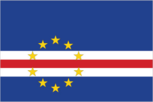
Cabo Verde
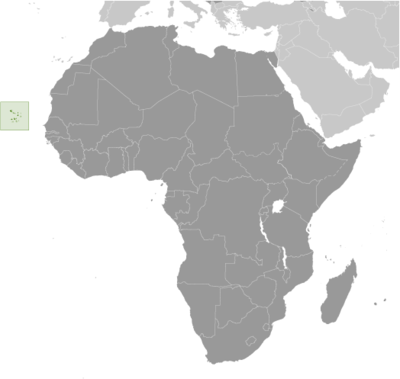
Africa · Praia · parliamentary republic
What Cabo Verde means for your money, the prices you pay, the tariffs in motion, and where U.S. policy could change both.
$6M
U.S. imports, 2025
+47.1%
change in one year
$38M
U.S. exports, 2025
611K
Population
$2.8B
GDP
In your house
What you buy that Cabo Verde makes
America bought $6M in goods from Cabo Verde in 2025, up 47.1% in a single year. Of every $100 of it, here's where the money went.
U.s. goods returned, and reimports
Fish and shellfish
fish, shrimp, shellfish
Alcoholic beverages, excluding wine
spirits and liquor
Bakery products
Apparel, household goods - cotton
cotton clothing and linens
Measuring, testing, control instruments
Household appliances
household appliances
Engines and engine parts
Minimum value shipments
Fruits, frozen juices
fruit and frozen juices
2026 so far (through July): $2M in imports. Source: U.S. Census Bureau, International Trade in Goods (customs basis).
The other direction
What America sells to Cabo Verde
$38M in 2025, a trade rupture cuts both ways, for American producers as well as American prices.
Civilian aircraft, engines, equipment, and parts
$19MMedicinal equipment
$5Mmedical devices and equipment
Corn
$4MMinimum value shipments
$3MFurniture, household goods, etc.
$2Mfurniture, mattresses, lamps
Plastic materials
$1Mplastics for packaging and goods
Other parts and accessories of vehicles
$792Kcar parts and accessories
Passenger cars, new and used
$337Knew and used cars
Miscellaneous domestic exports and special transactions
$307KWhere you stand
U.S. tariff posture toward Cabo Verde
No U.S. tariff action singles this country out. Its goods face the universal 10% temporary import surcharge under Section 122 of the Trade Act (which replaced the IEEPA reciprocal baseline in February 2026) plus the sectoral Section 232 duties — steel and aluminum at 50% — that apply to all countries. The Section 122 surcharge is statutorily temporary — scheduled to lapse on or about July 23, 2026 (a 150-day cap) unless extended or replaced.
Reciprocal tariff (universal baseline)
10%
The universal 10% floor, a Section 122 import surcharge since February 2026, previously the EO 14257 reciprocal baseline, applies to nearly all U.S. imports. This country has no higher assigned rate of its own.
Policy in motion
Tariff status: a moving target
No U.S. tariff action names Cabo Verde. These are the universal measures, applied to every country without a country-specific arrangement, that set its treatment.
2026-04-06
Section 232 metals coverage expanded
In effectThe April 2026 proclamation strengthening Section 232 actions on aluminum, steel, and copper expanded derivative-product coverage for all countries, keeping the general metals rate at 50%.
91 FR 18201 →2026-02-24
IEEPA reciprocal tariffs terminated — replaced by 10% Section 122 surcharge
In effectExecutive Order 14389 (Ending Certain Tariff Actions) terminated the IEEPA tariff duties — including the EO 14257 reciprocal baseline — effective February 24, 2026. A flat 10% Section 122 temporary import surcharge (Proclamation 11012 of February 20, 2026) replaced them, leaving the universal rate unchanged at 10% on a different statutory basis. Section 122 caps such surcharges at 150 days, so this 10% surcharge is scheduled to lapse on or about July 23, 2026 absent further action (the administration has signaled it could raise the rate toward the 15% statutory maximum).
91 FR 9437 →2025-11-13
Agricultural products exempted from reciprocal tariffs
In effectExecutive Order 14360 of November 14, 2025 removed reciprocal duties from certain agricultural products listed in its annexes (coffee, cocoa, bananas, and other goods the U.S. does not produce in sufficient quantity), retroactive to November 13, 2025 — for all countries subject to the reciprocal tariff.
90 FR 54091 →2025-06-04
Section 232 steel and aluminum duties doubled to 50%
In effectThe June 3, 2025 proclamation raised Section 232 duties on steel and aluminum articles and derivatives from 25% to 50% for all countries, effective June 4, 2025.
90 FR 24199 →2025-04-05
Universal 10% reciprocal baseline takes effect
In effectExecutive Order 14257 (signed April 2, 2025) imposed a 10% ad valorem reciprocal duty on imports from all trading partners, effective April 5, 2025. Countries without a higher Annex I rate remain at this baseline.
Federal Register · 2025-06063 →2025-03-12
Section 232 steel and aluminum duties set at 25% for all countries
In effectProclamations of February 10, 2025 terminated all country exemptions and quota arrangements and applied 25% Section 232 duties to steel and aluminum imports from every country, effective March 12, 2025.
90 FR 9817 →
Reference
The country itself
Africa · Geography, people, economy, and government, public-domain data from the CIA World Factbook.
The Portuguese discovered and colonized the uninhabited islands of Cabo Verde in the 15th century; Cabo Verde subsequently became a trading center for African slaves and later an important coaling and resupply stop for whaling and transatlantic shipping. The fusing of European and various African cultural traditions is reflected in Cabo Verde’s Crioulo language, music, and pano textiles. After gaining independence in 1975, a one-party system was established and maintained until multi-party elections were held in 1990. Cabo Verde continues to sustain one of Africa's most stable democratic governments and relatively stable economies, maintaining a currency pegged first to the Portuguese escudo and then to the euro since 1998. Repeated droughts during the second half of the 20th century caused significant hardship and prompted heavy emigration. As a result, Cabo Verde's expatriate population -- concentrated in Boston, Massachusetts and Western Europe -- is greater than its domestic one. Most Cabo Verdeans have both African and Portuguese antecedents. Cabo Verde’s population descends from its first permanent inhabitants in the late 15th-century -- a preponderance of West African slaves, a small share of Portuguese colonists, and even fewer Italians and Spaniards. Among the nine inhabited islands, population distribution is varied. The islands in the east are very dry and are home to the country's growing tourism industry. The more western islands receive more precipitation and support larger populations, but agriculture and livestock grazing have damaged their soil fertility and vegetation. For centuries, the country’s overall population size has fluctuated significantly, as recurring periods of famine and epidemics have caused high death tolls and emigration.
Geography
- Location
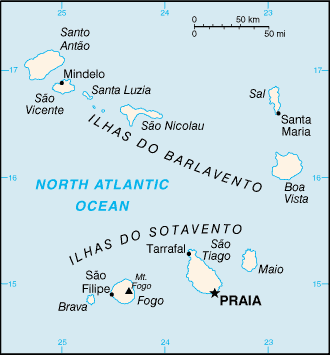
- Western Africa, group of islands in the North Atlantic Ocean, west of Senegal
- Area
- 4,033 sq km
- Climate
- temperate; warm, dry summer; precipitation meager and erratic
- Terrain
- steep, rugged, rocky, volcanic
- Natural resources
- salt, basalt rock, limestone, kaolin, fish, clay, gypsum
- Coastline
- 965 km
- Natural hazards
- prolonged droughts; seasonal harmattan wind produces obscuring dust; volcanically and seismically active volcanism: Fogo (2,829 m), which last erupted in 1995, is Cabo Verde's only active volcano
People & society
- Population
- 611,014 (2024 est.)
- Nationality
- Cabo Verdean(s)
- Ethnic groups
- Creole (Mulatto) 71%, African 28%, European 1%
- Languages
- Portuguese (official), Crioulo (a Portuguese-based creole language with two main dialects)
- Religions
- Roman Catholic 72.5%, Protestant 4% (includes Adventist 1.9%, Nazarene 1.8%, Assembly of God 0.2%, God is Love 0.1%), Christian Rationalism 1.7%, Muslim 1.3%, Jehovah's Witness 1.2%, Church of Jesus Christ 1%, other Christian 1.3%, other 1.2%, none 15.6%, no response 0.4% (2021 est.)
- Median age
- 29.3 years (2025 est.)
- Life expectancy at birth
- 74.3 years (2024 est.)
- Literacy
- 88.5% (2024 est.)
Economy
- Economic overview
- stable, middle-income, developing island economy; strong GDP growth led by tourism sector recovery; sustained poverty reduction through PEDS II development plan; high reliance on foreign remittances and aid to finance external debt
- Industries
- food and beverages, fish processing, shoes and garments, salt mining, ship repair
- Agricultural products
- sugarcane, tomatoes, coconuts, pulses, goat milk, milk, vegetables, bananas, cabbages, onions (2023)
- Exports - partners
- Spain 46%, Portugal 9%, Togo 7%, Italy 7%, India 6% (2023)
- Imports - partners
- Portugal 29%, Saudi Arabia 11%, Netherlands 9%, Spain 8%, China 7% (2023)
Government
- Government type
- parliamentary republic
- Capital
- Praia
- Independence
- 5 July 1975 (from Portugal)
- Constitution
- previous 1981; latest effective 25 September 1992
- Executive branch
- President Jose Maria Pereira NEVES (since 9 November 2021)
- Legislative branch
- National Assembly (Assembleia Nacional)
Full reference data
Every field, by section, CIA World Factbook. Open a topic to expand it.
Introduction
Travel Facts
Please visit the following links to find further information about your desired destination.
World Health Organization (WHO) - To learn what vaccines and health precautions to take while visiting your destination.
US State Dept Travel Information - Overall information about foreign travel for US citizens.
To obtain an international driving permit (IDP). Only two organizations in the US issue IDPs: American Automobile Association (AAA) and American Automobile Touring Alliance (AATA)
How to get help in an emergency? Contact the nearest US embassy or consulate, or call one of these numbers: from the US or Canada - 1-888-407-4747 or from Overseas - +1 202-501-4444
Page last updated: Tuesday, September 20, 2022