
Country exposure · DY
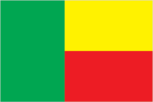
Benin
Africa · Porto-Novo (constitutional capital); Cotonou (seat of government) · presidential republic
What Benin means for your money, the prices you pay, the tariffs in motion, and where U.S. policy could change both.
15M
Population
$21.5B
GDP
U.S. exposure
Minimal direct economic exposure
Benin is not a significant U.S. goods-trade partner and has no tracked tariff actions. Policy changes here are unlikely to reach American prices directly.
Reference
The country itself
Africa · Geography, people, economy, and government, public-domain data from the CIA World Factbook.
Present-day Benin is comprised of about 42 ethnic groups, including the Yoruba in the southeast, who migrated from what is now Nigeria in the 12th century; the Dendi in the north-central area, who came from Mali in the 16th century; the Bariba and the Fula in the northeast; the Ottamari in the Atakora mountains; the Fon in the area around Abomey in the south-central area; and the Mina, Xueda, and Aja, who came from Togo, on the coast. The Kingdom of Dahomey emerged on the Abomey plateau in the 17th century and was a regional power for much of the 18th and 19th centuries. The growth of Dahomey coincided with the growth of the Atlantic slave trade, and it became known as a major source of enslaved people. France began to control the coastal areas of Dahomey in the second half of the 19th century; the entire kingdom was conquered by 1894. French Dahomey achieved independence in 1960, and it changed its name to the Republic of Benin in 1975. A succession of military governments ended in 1972 with the rise to power of Mathieu KEREKOU and a Marxist-Leninist government. A move to representative government began in 1989. Two years later, free elections ushered in former Prime Minister Nicephore SOGLO as president, marking the first successful transfer of power in Africa from a dictatorship to a democracy. KEREKOU returned to power after elections in 1996 and 2001. He stepped down in 2006 and was succeeded by Thomas YAYI Boni, a political outsider and independent, who won a second term in 2011. Patrice TALON, a wealthy businessman, took office in 2016; the space for pluralism, dissent, and free expression has narrowed under his administration. TALON won a second term in 2021.
Geography
- Location
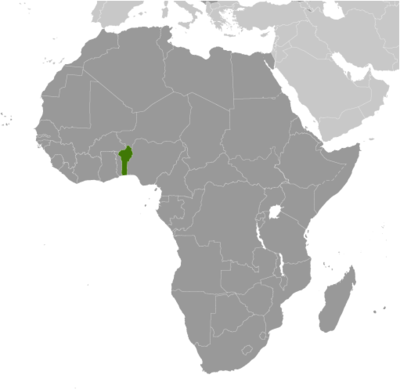
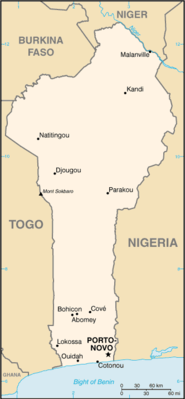
- Western Africa, bordering the Bight of Benin, between Nigeria and Togo
- Area
- 112,622 sq km
- Climate
- tropical; hot, humid in south; semiarid in north
- Terrain
- mostly flat to undulating plain; some hills and low mountains
- Natural resources
- small offshore oil deposits, limestone, marble, timber
- Coastline
- 121 km
- Natural hazards
- hot, dry, dusty harmattan wind may affect north from December to March
People & society
- Population
- 15,186,090 (2025 est.)
- Nationality
- Beninese (singular and plural)
- Ethnic groups
- Fon and related 38.4%, Adja and related 15.1%, Yoruba and related 12%, Bariba and related 9.6%, Fulani and related 8.6%, Ottamari and related 6.1%, Yoa-Lokpa and related 4.3%, Dendi and related 2.9%, other 0.9%, foreigner 1.9% (2013 est.)
- Languages
- 55 languages; French (official); Fon (a Gbe language), Yom (a Gur language) and Yoruba are the most important indigenous languages in the south; half a dozen regionally important languages in the north, including Bariba and Fulfulde
- Religions
- Muslim 27.7%, Roman Catholic 25.5%, Protestant 13.5% (Celestial 6.7%, Methodist 3.4%, other Protestant 3.4%), Vodoun 11.6%, other Christian 9.5%, other traditional religions 2.6%, other 2.6%, none 5.8% (2013 est.)
- Median age
- 17.2 years (2025 est.)
- Life expectancy at birth
- 63 years (2024 est.)
- Literacy
- 51.4% (2022 est.)
Economy
- Economic overview
- robust economic growth; slightly declining but still widespread poverty; strong trade relations with Nigeria; cotton exporter; COVID-19 has led to capital outflows and border closures; WAEMU member with currency pegged to the euro; recent fiscal deficit and debt reductions
- Industries
- textiles, food processing, construction materials, cement
- Agricultural products
- cassava, yams, maize, oil palm fruit, cotton, soybeans, rice, pineapples, tomatoes, chillies/peppers (2023)
- Exports - partners
- UAE 42%, Bangladesh 20%, India 11%, China 5%, Togo 3% (2023)
- Imports - partners
- China 21%, India 15%, USA 6%, France 6%, Nigeria 4% (2023)
Government
- Government type
- presidential republic
- Capital
- Porto-Novo (constitutional capital); Cotonou (seat of government)
- Independence
- 1 August 1960 (from France)
- Constitution
- previous 1946, 1958 (pre-independence); latest adopted by referendum 2 December 1990, promulgated 11 December 1990
- Executive branch
- President Patrice TALON (since 6 April 2016)
- Legislative branch
- National Assembly (Assemblée nationale)
Full reference data
Every field, by section, CIA World Factbook. Open a topic to expand it.
Introduction
Travel Facts
Please visit the following links to find further information about your desired destination.
CDC - To learn what vaccines and health precautions to take while visiting your destination.
US State Dept Travel Information - Overall information about foreign travel for US citizens.
To obtain an international driving permit (IDP). Only two organizations in the US issue IDPs: American Automobile Association (AAA) and American Automobile Touring Alliance (AATA)
How to get help in an emergency? Contact the nearest US embassy or consulate, or call one of these numbers: from the US or Canada - 1-888-407-4747 or from Overseas - +1 202-501-4444
Page last updated: Wednesday, June 19, 2024