
Country exposure · EU
European Union
Europe · Brussels (Belgium), Strasbourg (France), Luxembourg, Frankfurt (Germany) · a hybrid and unique intergovernmental and supranational organization
What European Union means for your money, the prices you pay, the tariffs in motion, and where U.S. policy could change both.
452M
Population
$19.4T
GDP
Where you stand
U.S. tariff posture toward European Union
Since February 24, 2026 most EU goods face the universal 10% Section 122 temporary import surcharge, which replaced the framework's 15% all-inclusive IEEPA structure when EO 14389 terminated the reciprocal tariffs. The framework's Section 232 terms persist: EU autos at 15%, and the April 2026 metals expansion expressly preserved the EU's trade-agreement-partner treatment (steel and aluminum otherwise at 50%).
Reciprocal tariff (assigned, terminated)
20%
The rate this country was assigned under the EO 14257 reciprocal Annex, no longer in force. The Supreme Court struck down the IEEPA tariffs and they were terminated February 24, 2026 (EO 14389), replaced by a universal ~10% Section 122 surcharge. See the timeline below for the current effective rate.
Section 232 sectors
Autos, Wood
Steel, aluminum, autos, and similar national-security tariffs that name this country.
Policy in motion
Tariff status: a moving target
U.S. tariff policy toward European Union has changed 11 times since 2025. This page tracks it.
2026-04-06
EU treatment preserved in expanded metals tariffs
In effectThe April 2026 proclamation expanding Section 232 coverage of aluminum, steel, and copper derivatives expressly does not alter or supersede the prior U.S.–EU agreement implementation, and lists the EU among 'Trade Agreement Partners' eligible for its exclusion process.
91 FR 18201 →2026-02-24
IEEPA reciprocal tariffs terminated — replaced by 10% Section 122
In effectExecutive Order 14389 (Ending Certain Tariff Actions) terminated the IEEPA tariff duties — including those under EO 14257, the basis of the EU's 15% all-inclusive structure — effective February 24, 2026. A flat 10% Section 122 temporary import surcharge (Proclamation 11012 of February 20, 2026) replaced them. The framework's Section 232 terms (the 15% EU autos cap, metals carve-outs) rest on separate authority and were expressly unaffected.
91 FR 9437 →2025-09-25
Framework implemented: preferential treatment for certain EU goods
In effectActing under the September 8, 2025 procedures order, Commerce and USTR modified the HTSUS to implement the framework — preferential (zero) reciprocal treatment for certain EU goods and a reduction of the Section 232 automobile and parts duty to 15% for EU-origin vehicles.
90 FR 46136 →2025-08-21
U.S.–EU Framework Agreement joint statement
AgreementThe United States and the European Union issued the Joint Statement on a Framework on an Agreement on Reciprocal, Fair, and Balanced Trade: the U.S. committed to the 15% all-inclusive ceiling, zero reciprocal duty on certain products, and a cut of the Section 232 automobile duty to 15%; the EU committed to eliminate tariffs on U.S. industrial goods and expand agricultural access, plus $750B in U.S. energy procurement through 2028.
Source ↗2025-08-07
15% all-inclusive structure replaces the 20% rate
In effectThe July 31, 2025 order ('Further Modifying the Reciprocal Tariff Rates') gave the EU a unique structure effective August 7, 2025: for goods with an MFN (Column 1) rate below 15%, the reciprocal duty tops the total up to exactly 15%; goods with an MFN rate of 15% or higher pay no additional reciprocal duty.
Federal Register · 2025-15010 →2025-07-09
Reciprocal-rate pause extended to August 1
In effectThe July 7, 2025 order extended the suspension of country-specific reciprocal rates through August 1, 2025, keeping the EU at the 10% baseline while framework talks continued.
90 FR 30823 →2025-06-04
Section 232 steel and aluminum duties doubled to 50%
In effectThe June 3, 2025 proclamation raised Section 232 duties on steel and aluminum articles and derivatives from 25% to 50% effective June 4, 2025, with no EU carve-out.
90 FR 24199 →2025-04-10
90-day pause suspends the 20% rate back to 10%
In effectThe April 9, 2025 modification order suspended country-specific reciprocal rates for 90 days for all partners except China, returning the EU to the 10% universal baseline effective April 10, 2025 while negotiations proceeded.
90 FR 15625 →2025-04-09
EU country-specific reciprocal rate of 20% takes effect
In effectAnnex I of Executive Order 14257 assigned the European Union a 20% country-specific reciprocal rate, effective April 9, 2025 — the rate still carried for the EU in the HTS Chapter 99 Subchapter III note.
Federal Register · 2025-06063 →2025-04-05
Universal 10% reciprocal baseline takes effect
In effectExecutive Order 14257 (signed April 2, 2025) imposed a 10% ad valorem reciprocal duty on imports from all trading partners, including the EU, effective April 5, 2025. The order singled out the EU's 5% average MFN rate and 10% passenger-vehicle tariff as examples of non-reciprocal treatment.
Federal Register · 2025-06063 →2025-03-12
Section 232 steel and aluminum arrangements terminated — 25% duties on EU metals
In effectProclamations of February 10, 2025 ended the EU's tariff-rate-quota arrangements for steel and aluminum and raised the aluminum duty from 10% to 25%, applying 25% Section 232 duties to EU steel and aluminum effective March 12, 2025.
90 FR 9817 →
Go deeper
The supply chain view
European Union sits upstream of 14 essential American goods through 12 tracked inputs.
manufactured
20%Forged Steel Wheels (Railcar and Locomotive)
manufactured
20%Positive Train Control (PTC) / Signaling Systems
chemical
18%Quaternary Ammonium Compounds (BAC/DDAC)
agricultural
17%Raw Whole Milk (Dairy)
manufactured
15%High-Strength Structural Steel (Q460 / S355)
pharmaceutical
15%Acetaminophen (APAP) API
Reference
The country itself
Europe · Geography, people, economy, and government, public-domain data from the CIA World Factbook.
In the aftermath and devastation of the two World Wars, a number of far-sighted European leaders in the late 1940s sought to respond to the overwhelming desire for peace and reconciliation on the continent. In 1950, French Foreign Minister Robert SCHUMAN proposed pooling the production of coal and steel in Western Europe, which would bring France and West Germany together and be open to other countries as well. The following year, the European Coal and Steel Community (ECSC) was set up when six members -- Belgium, France, West Germany, Italy, Luxembourg, and the Netherlands -- signed the Treaty of Paris. Within a few years, the ECSC was so successful that member states decided to further integrate their economies. In 1957, envisioning an "ever closer union," the Treaties of Rome created the European Economic Community (EEC) and the European Atomic Energy Community (Euratom), which eliminated trade barriers among the six member states to create a common market. In 1967, the institutions of all three communities were formally merged into the European Community (EC), creating a single Commission, a single Council of Ministers, and a legislative body known today as the European Parliament. Members of the European Parliament were initially selected by national parliaments, but direct elections began in 1979 and have been held every five years since. In 1973, the first enlargement of the EC added Denmark, Ireland, and the UK. The 1980s saw further membership expansion, with Greece joining in 1981 and Spain and Portugal in 1986. The 1992 Treaty of Maastricht laid the basis for further cooperation in foreign and defense policy and judicial and internal affairs, as well as the creation of an economic and monetary union -- including a common currency. The Maastricht Treaty created the European Union (EU), at the time standing alongside the EC. In 1995, Austria, Finland, and Sweden joined the EU/EC, raising the total number of member states to 15. On 1 January 1999, the new euro currency was launched in world markets and became the unit of exchange for all EU member states except Denmark, Sweden, and the UK. In 2002, citizens of the 12 participating member states began using euro banknotes and coins. In an effort to ensure that the EU could function efficiently with an expanded membership, the Treaty of Nice in 2000 set forth rules to streamline the size and procedures of the EU's institutions. An effort to establish a "Constitution for Europe," growing out of a Convention held in 2002-2003, foundered when it was rejected in referenda in France and the Netherlands in 2005. A subsequent effort in 2007 incorporated many features of the rejected draft Constitutional Treaty, while also making a number of substantive as well as symbolic changes. The new treaty, referred to as the Treaty of Lisbon, sought to amend existing treaties rather than replace them. The treaty was approved at a conference of member states, and after all member states ratified, the Lisbon Treaty came into force on 1 December 2009, at which point the EU officially replaced and succeeded the EC. Ten new countries joined the EU in 2004 -- Cyprus, the Czech Republic, Estonia, Hungary, Latvia, Lithuania, Malta, Poland, Slovakia, and Slovenia. Bulgaria and Romania joined in 2007 and Croatia in 2013. UK citizens on 23 June 2016 narrowly voted to leave the EU; the formal exit, widely known as "Brexit," took place on 31 January 2020. The EU and the UK negotiated a withdrawal agreement that included a status quo transition period through December 2020, when the follow-on EU-UK Trade and Cooperation Agreement was concluded. Current EU membership stands at 27. Eight of the newer member states -- Croatia, Cyprus, Estonia, Latvia, Lithuania, Malta, Slovakia, and Slovenia -- have now adopted the euro, bringing total euro-zone membership to 20.
Geography
- Location
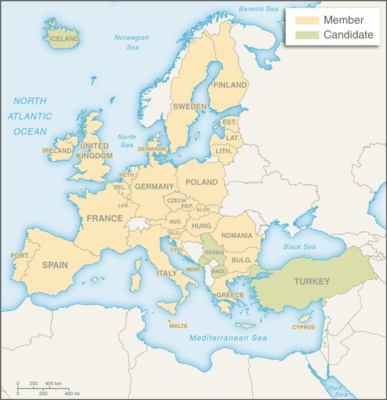
- Europe between the North Atlantic Ocean in the west and Russia, Belarus, and Ukraine to the east
- Area
- 4,236,351 sq km
- Climate
- cold temperate; potentially subarctic in the north to temperate; mild wet winters; hot dry summers in the south
- Terrain
- fairly flat along Baltic and Atlantic coasts; mountainous in the central and southern areas
- Natural resources
- iron ore, natural gas, petroleum, coal, copper, lead, zinc, bauxite, uranium, potash, salt, hydropower, arable land, timber, fish
- Coastline
- 53,563.9 km
- Natural hazards
- flooding along coasts; avalanches in mountainous area; earthquakes in the south; volcanic eruptions in Italy; periodic droughts in Spain; ice floes in the Baltic Sea region
People & society
- Population
- 451,815,312 (2024 est.)
- Languages
- Bulgarian, Croatian, Czech, Danish, Dutch, English, Estonian, Finnish, French, German, Greek, Hungarian, Irish, Italian, Latvian, Lithuanian, Maltese, Polish, Portuguese, Romanian, Slovak, Slovene, Spanish, Swedish
- Religions
- Roman Catholic 41%, Orthodox 10%, Protestant 9%, other Christian 4%, Muslim 2%, other 4% (includes Jewish, Sikh, Buddhist, Hindu), atheist 10%, non-believer/agnostic 17%, unspecified 3% (2019 est.)
- Median age
- 44 years (2020)
- Life expectancy at birth
- 77.63 years (2021)
Economy
- Industries
- among the world's largest and most technologically advanced regions, the EU industrial base includes: ferrous and non-ferrous metal production and processing, metal products, petroleum, coal, cement, chemicals, pharmaceuticals, aerospace, rail transportation equipment, passenger and commercial vehicles, construction equipment, industrial equipment, shipbuilding, electrical power equipment, machine tools and automated manufacturing systems, electronics and telecommunications equipment, fishing, food and beverages, furniture, paper, textiles
- Agricultural products
- milk, wheat, sugar beets, maize, potatoes, barley, grapes, pork, rapeseed, tomatoes (2022)
- Exports - partners
- US 20%, UK 12%, China 10%, Switzerland 7%, Turkey 4% (2023)
- Imports - partners
- China 21%, US 14%, UK 7%, Switzerland 6%, Norway 5% (2023)
Government
- Government type
- a hybrid and unique intergovernmental and supranational organization
- Capital
- Brussels (Belgium), Strasbourg (France), Luxembourg, Frankfurt (Germany)
- Independence
- 7 February 1992 (Maastricht Treaty signed establishing the European Union); 1 November 1993 (Maastricht Treaty entered into force)
- Constitution
- none; the EU legal order relies primarily on the Treaty on European Union (TEU) and the Treaty on the Functioning of the EU (TFEU)
- Executive branch
- three EU institutions have functions that can be regarded as executive in nature: European Council - composed of member-state heads of state or government, along with the president of the European Commission; meets at least four times a year to issue general policy guidance; the president of the European Council is appointed by leaders of the EU member states for a 2 1/2 year term, renewable once president: António Costa (since 1 December 2024) Council of the European Union - consists of member-state officials, ranging from working-level diplomats to cabinet ministers in specific policy fields such as foreign affairs, agriculture, or economy; has policymaking, coordinating, and legislative functions president: the six-month presidency rotates among the member states European Commission - composed of 27 commissioners (one from each member state), including the president; the president assigns each commissioner one or more policy areas, called portfolios; the Commission has the sole right to initiate EU legislation, except for foreign and security/defense policy, and is responsible for monitoring the application of EU law, implementing/executing the EU budget, negotiating in certain policy areas, and ensuring the EU's external representation in some policy areas; the president is nominated for a 5-year term by the European Council and confirmed by the European Parliament; the European Parliament also confirms the entire Commission for a 5-year term president: Ursula von der Leyen (since 1 December 2019)
- Legislative branch
- Council of the European Union (Council) and the European Parliament (EP) (separate legislative bodies; see note 2 )
Full reference data
Every field, by section, CIA World Factbook. Open a topic to expand it.