
Country exposure · GEC-GA
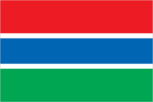
The Gambia
Africa · Banjul · presidential republic
What The Gambia means for your money, the prices you pay, the tariffs in motion, and where U.S. policy could change both.
3M
Population
$2.5B
GDP
U.S. exposure
Minimal direct economic exposure
The Gambia is not a significant U.S. goods-trade partner and has no tracked tariff actions. Policy changes here are unlikely to reach American prices directly.
Reference
The country itself
Africa · Geography, people, economy, and government, public-domain data from the CIA World Factbook.
In the 10th century, Muslim merchants established some of The Gambia’s earliest large settlements as trans-Saharan trade hubs. These settlements eventually grew into major export centers sending slaves, gold, and ivory across the Sahara. Between the 16th and 17th centuries, European colonial powers began establishing trade with The Gambia. In 1664, the United Kingdom established a colony in The Gambia focused on exporting enslaved people across the Atlantic. During the roughly 300 years of the trans-Atlantic slave trade, the UK and other European powers may have exported as many as 3 million people from The Gambia. The Gambia gained its independence from the UK in 1965. Geographically surrounded by Senegal, it formed the short-lived confederation of Senegambia between 1982 and 1989. In 1994, Yahya JAMMEH led a military coup overthrowing the president and banning political activity. He subsequently won every presidential election until 2016, when he lost to Adama BARROW, who headed an opposition coalition during free and fair elections. BARROW won reelection in 2021. The Gambia is the only member of the Economic Community of West African States that does not have presidential term limits. Since the 2016 election, The Gambia and the US have enjoyed improved relations. US assistance to the country has supported democracy-strengthening activities, capacity building, economic development, and security sector education and training programs.
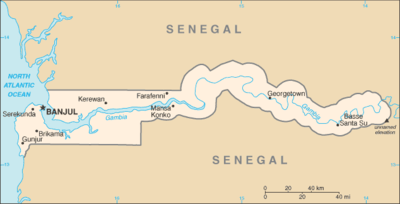
Geography
- Location
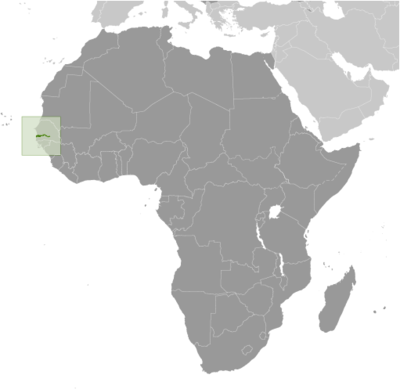
- Western Africa, bordering the North Atlantic Ocean and Senegal
- Area
- 11,300 sq km
- Climate
- tropical; hot, rainy season (June to November); cooler, dry season (November to May)
- Terrain
- flood plain of the Gambia River flanked by some low hills
- Natural resources
- fish, clay, silica sand, titanium (rutile and ilmenite), tin, zircon
- Coastline
- 80 km
- Natural hazards
- droughts
People & society
- Population
- 2,523,327 (2024 est.)
- Nationality
- Gambian(s)
- Ethnic groups
- Mandinka/Jahanka 33.3%, Fulani/Tukulur/Lorobo 18.2%, Wolof 12.9%, Jola/Karoninka 11%, Serahuleh 7.2%, Serer 3.5%, other 4%, non-Gambian 9.9% (2019-20 est.)
- Languages
- English (official), Mandinka, Wolof, Fula, other indigenous vernaculars
- Religions
- Muslim 96.4%, Christian 3.5%, other or none 0.1% (2019-20 est.)
- Median age
- 20.5 years (2025 est.)
- Life expectancy at birth
- 68.4 years (2024 est.)
- Literacy
- 51.6% (2021 est.)
Economy
- Economic overview
- low-income West African economy; agriculture-dominant; high poverty rate; heightened inflation; dependent on foreign assistance and remittances; structural reforms conditioned by IMF Extended Credit Facility program
- Industries
- peanuts, fish, hides, tourism, beverages, agricultural machinery assembly, woodworking, metalworking, clothing
- Agricultural products
- rice, groundnuts, milk, millet, oil palm fruit, maize, vegetables, cassava, fruits, sorghum (2023)
- Exports - partners
- Kazakhstan 92%, Guinea-Bissau 2%, China 1%, India 1%, Greece 1% (2023)
- Imports - partners
- Kazakhstan 26%, China 18%, Senegal 8%, India 7%, Brazil 4% (2023)
Government
- Government type
- presidential republic
- Capital
- Banjul
- Independence
- 18 February 1965 (from the UK)
- Constitution
- previous 1965 (Independence Act), 1970; latest adopted 8 April 1996, approved by referendum 8 August 1996, effective 16 January 1997
- Executive branch
- President Adama BARROW (since 19 January 2022)
- Legislative branch
- National Assembly
Full reference data
Every field, by section, CIA World Factbook. Open a topic to expand it.
Introduction
Travel Facts
Please visit the following links to find further information about your desired destination.
World Health Organization (WHO) - To learn what vaccines and health precautions to take while visiting your destination.
US State Dept Travel Information - Overall information about foreign travel for US citizens.
To obtain an international driving permit (IDP). Only two organizations in the US issue IDPs: American Automobile Association (AAA) and American Automobile Touring Alliance (AATA)
How to get help in an emergency? Contact the nearest US embassy or consulate, or call one of these numbers: from the US or Canada - 1-888-407-4747 or from Overseas - +1 202-501-4444
Page last updated: Wednesday, July 20, 2022