
Country exposure · GW
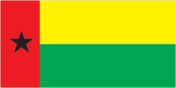
Guinea-Bissau
Africa · Bissau · semi-presidential republic
What Guinea-Bissau means for your money, the prices you pay, the tariffs in motion, and where U.S. policy could change both.
$13K
U.S. imports, 2025
-89%
change in one year
$8M
U.S. exports, 2025
2M
Population
$2.1B
GDP
In your house
What you buy that Guinea-Bissau makes
America bought $13K in goods from Guinea-Bissau in 2025, down 89% in a single year. Of every $100 of it, here's where the money went.
Minimum value shipments
Apparel, household goods - cotton
cotton clothing and linens
Apparel, textiles, nonwool or cotton
synthetic and performance apparel
Camping apparel and gear
camping gear and outdoor apparel
Footwear
shoes and sneakers
2026 so far (through July): $13K in imports. Source: U.S. Census Bureau, International Trade in Goods (customs basis).
The other direction
What America sells to Guinea-Bissau
$8M in 2025, a trade rupture cuts both ways, for American producers as well as American prices.
Industrial machines, other
$3MMeat, poultry, etc.
$1MRice
$1Mcocoa for chocolate
Tobacco, manufactured
$1MVegetables
$458KAgric. industry-unmanufactured
$201KTrucks, buses, and special purpose vehicles
$200Ktrucks, buses, SUVs
Computers
$152Klaptops, desktops, monitors
Minimum value shipments
$138KWhere you stand
U.S. tariff posture toward Guinea-Bissau
No U.S. tariff action singles this country out. Its goods face the universal 10% temporary import surcharge under Section 122 of the Trade Act (which replaced the IEEPA reciprocal baseline in February 2026) plus the sectoral Section 232 duties — steel and aluminum at 50% — that apply to all countries. The Section 122 surcharge is statutorily temporary — scheduled to lapse on or about July 23, 2026 (a 150-day cap) unless extended or replaced.
Reciprocal tariff (universal baseline)
10%
The universal 10% floor, a Section 122 import surcharge since February 2026, previously the EO 14257 reciprocal baseline, applies to nearly all U.S. imports. This country has no higher assigned rate of its own.
Policy in motion
Tariff status: a moving target
No U.S. tariff action names Guinea-Bissau. These are the universal measures, applied to every country without a country-specific arrangement, that set its treatment.
2026-04-06
Section 232 metals coverage expanded
In effectThe April 2026 proclamation strengthening Section 232 actions on aluminum, steel, and copper expanded derivative-product coverage for all countries, keeping the general metals rate at 50%.
91 FR 18201 →2026-02-24
IEEPA reciprocal tariffs terminated — replaced by 10% Section 122 surcharge
In effectExecutive Order 14389 (Ending Certain Tariff Actions) terminated the IEEPA tariff duties — including the EO 14257 reciprocal baseline — effective February 24, 2026. A flat 10% Section 122 temporary import surcharge (Proclamation 11012 of February 20, 2026) replaced them, leaving the universal rate unchanged at 10% on a different statutory basis. Section 122 caps such surcharges at 150 days, so this 10% surcharge is scheduled to lapse on or about July 23, 2026 absent further action (the administration has signaled it could raise the rate toward the 15% statutory maximum).
91 FR 9437 →2025-11-13
Agricultural products exempted from reciprocal tariffs
In effectExecutive Order 14360 of November 14, 2025 removed reciprocal duties from certain agricultural products listed in its annexes (coffee, cocoa, bananas, and other goods the U.S. does not produce in sufficient quantity), retroactive to November 13, 2025 — for all countries subject to the reciprocal tariff.
90 FR 54091 →2025-06-04
Section 232 steel and aluminum duties doubled to 50%
In effectThe June 3, 2025 proclamation raised Section 232 duties on steel and aluminum articles and derivatives from 25% to 50% for all countries, effective June 4, 2025.
90 FR 24199 →2025-04-05
Universal 10% reciprocal baseline takes effect
In effectExecutive Order 14257 (signed April 2, 2025) imposed a 10% ad valorem reciprocal duty on imports from all trading partners, effective April 5, 2025. Countries without a higher Annex I rate remain at this baseline.
Federal Register · 2025-06063 →2025-03-12
Section 232 steel and aluminum duties set at 25% for all countries
In effectProclamations of February 10, 2025 terminated all country exemptions and quota arrangements and applied 25% Section 232 duties to steel and aluminum imports from every country, effective March 12, 2025.
90 FR 9817 →
Reference
The country itself
Africa · Geography, people, economy, and government, public-domain data from the CIA World Factbook.
For much of its history, Guinea-Bissau was under the control of the Mali Empire and the Kaabu Kingdom. In the 16th century, Portugal began establishing trading posts along Guinea-Bissau’s shoreline. Initially, the Portuguese were restricted to the coastline and islands. However, the slave and gold trades were lucrative to local African leaders, and the Portuguese were slowly able to expand their power and influence inland. Starting in the 18th century, the Mali Empire and Kingdom of Kaabu slowly disintegrated into smaller local entities. By the 19th century, Portugal had fully incorporated Guinea-Bissau into its empire. Since gaining independence in 1974, Guinea-Bissau has experienced considerable political and military upheaval. In 1980, a military coup established General Joao Bernardo 'Nino' VIEIRA as president. VIEIRA's regime suppressed political opposition and purged political rivals. Several coup attempts through the 1980s and early 1990s failed to unseat him, but a military mutiny and civil war in 1999 led to VIEIRA's ouster. In 2000, a transitional government turned over power to opposition leader Kumba YALA. In 2003, a bloodless military coup overthrew YALA and installed businessman Henrique ROSA as interim president. In 2005, VIEIRA was reelected, pledging to pursue economic development and national reconciliation; he was assassinated in 2009. Malam Bacai SANHA was then elected president, but he passed away in 2012 from a long-term illness. A military coup blocked the second round of the election to replace him, but after mediation from the Economic Community of Western African States, a civilian transitional government assumed power. In 2014, Jose Mario VAZ was elected president in a free and fair election, and in 2019, he became the first president in Guinea-Bissau’s history to complete a full term. Umaro Sissoco EMBALO was elected president in 2019, but he did not take office until 2020 because of a prolonged challenge to the election results.
Geography
- Location
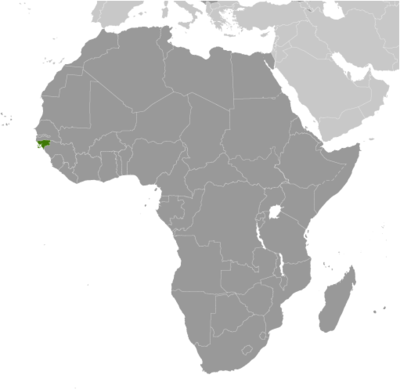
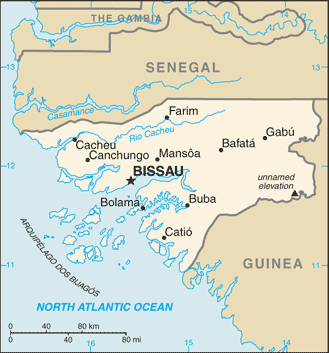
- Western Africa, bordering the North Atlantic Ocean, between Guinea and Senegal
- Area
- 36,125 sq km
- Climate
- tropical; generally hot and humid; monsoonal-type rainy season (June to November) with southwesterly winds; dry season (December to May) with northeasterly harmattan winds
- Terrain
- mostly low-lying coastal plain with a deeply indented estuarine coastline rising to savanna in east; numerous off-shore islands including the Arquipelago Dos Bijagos consisting of 18 main islands and many small islets
- Natural resources
- fish, timber, phosphates, bauxite, clay, granite, limestone, unexploited deposits of petroleum
- Coastline
- 350 km
- Natural hazards
- hot, dry, dusty harmattan haze may reduce visibility during dry season; brush fires
People & society
- Population
- 2,132,325 (2024 est.)
- Nationality
- Bissau-Guinean(s)
- Ethnic groups
- Balanta 30%, Fulani 30%, Manjaco 14%, Mandinga 13%, Papel 7%, unspecified smaller ethnic groups 6% (2015 est.)
- Languages
- Portuguese-based Creole, Portuguese (official; largely used as a second or third language), Pular (a Fula language), Mandingo
- Religions
- Muslim 46.1%, folk religions 30.6%, Christian 18.9%, other or unaffiliated 4.4% (2020 est.)
- Median age
- 18.5 years (2025 est.)
- Life expectancy at birth
- 64.5 years (2024 est.)
- Literacy
- 63.9% (2022 est.)
Economy
- Economic overview
- extremely poor West African economy; ethnically diverse labor force; increasing government expenditures; slight inflation due to food supply disruptions; major cashew exporter; systemic banking instabilities and corruption; vulnerable to oil price shocks
- Industries
- agricultural products processing, beer, soft drinks
- Agricultural products
- rice, groundnuts, cashews, root vegetables, oil palm fruit, plantains, cassava, coconuts, vegetables, sweet potatoes (2023)
- Exports - partners
- India 66%, Chile 9%, Cote d'Ivoire 5%, Ghana 4%, Netherlands 3% (2023)
- Imports - partners
- Senegal 28%, Portugal 24%, China 11%, Gambia, The 10%, Pakistan 4% (2023)
Government
- Government type
- semi-presidential republic
- Capital
- Bissau
- Independence
- 24 September 1973 (declared); 10 September 1974 (from Portugal)
- Constitution
- promulgated 16 May 1984
- Executive branch
- Interim President Gen. Horta Nta Na MAN (since 27 November 2025)
- Legislative branch
- People's National Assembly (Assembleia Nacional Popular)
Full reference data
Every field, by section, CIA World Factbook. Open a topic to expand it.
Introduction
Travel Facts
Please visit the following links to find further information about your desired destination.
World Health Organization (WHO) - To learn what vaccines and health precautions to take while visiting your destination.
US State Dept Travel Information - Overall information about foreign travel for US citizens.
To obtain an international driving permit (IDP). Only two organizations in the US issue IDPs: American Automobile Association (AAA) and American Automobile Touring Alliance (AATA)
How to get help in an emergency? Contact the nearest US embassy or consulate, or call one of these numbers: from the US or Canada - 1-888-407-4747 or from Overseas - +1 202-501-4444
Page last updated: Monday, August 15, 2022