
Country exposure · GZ
Gaza Strip administered by Israel
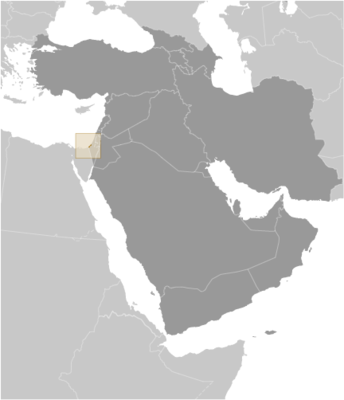
Middle East
What Gaza Strip administered by Israel means for your money, the prices you pay, the tariffs in motion, and where U.S. policy could change both.
$9K
U.S. imports, 2025
-95.8%
change in one year
$3K
U.S. exports, 2025
2M
Population
$13.7B
GDP
In your house
What you buy that Gaza Strip administered by Israel makes
America bought $9K in goods from Gaza Strip administered by Israel in 2025, down 95.8% in a single year. Of every $100 of it, here's where the money went.
Apparel, household goods - cotton
cotton clothing and linens
Minimum value shipments
2026 so far (through July): $4K in imports. Source: U.S. Census Bureau, International Trade in Goods (customs basis).
The other direction
What America sells to Gaza Strip administered by Israel
$3K in 2025, a trade rupture cuts both ways, for American producers as well as American prices.
Chemicals-other
$3KWhere you stand
U.S. tariff posture toward Gaza Strip administered by Israel
No U.S. tariff action singles this country out. Its goods face the universal 10% temporary import surcharge under Section 122 of the Trade Act (which replaced the IEEPA reciprocal baseline in February 2026) plus the sectoral Section 232 duties — steel and aluminum at 50% — that apply to all countries. The Section 122 surcharge is statutorily temporary — scheduled to lapse on or about July 23, 2026 (a 150-day cap) unless extended or replaced.
Reciprocal tariff (universal baseline)
10%
The universal 10% floor, a Section 122 import surcharge since February 2026, previously the EO 14257 reciprocal baseline, applies to nearly all U.S. imports. This country has no higher assigned rate of its own.
Policy in motion
Tariff status: a moving target
No U.S. tariff action names Gaza Strip administered by Israel. These are the universal measures, applied to every country without a country-specific arrangement, that set its treatment.
2026-04-06
Section 232 metals coverage expanded
In effectThe April 2026 proclamation strengthening Section 232 actions on aluminum, steel, and copper expanded derivative-product coverage for all countries, keeping the general metals rate at 50%.
91 FR 18201 →2026-02-24
IEEPA reciprocal tariffs terminated — replaced by 10% Section 122 surcharge
In effectExecutive Order 14389 (Ending Certain Tariff Actions) terminated the IEEPA tariff duties — including the EO 14257 reciprocal baseline — effective February 24, 2026. A flat 10% Section 122 temporary import surcharge (Proclamation 11012 of February 20, 2026) replaced them, leaving the universal rate unchanged at 10% on a different statutory basis. Section 122 caps such surcharges at 150 days, so this 10% surcharge is scheduled to lapse on or about July 23, 2026 absent further action (the administration has signaled it could raise the rate toward the 15% statutory maximum).
91 FR 9437 →2025-11-13
Agricultural products exempted from reciprocal tariffs
In effectExecutive Order 14360 of November 14, 2025 removed reciprocal duties from certain agricultural products listed in its annexes (coffee, cocoa, bananas, and other goods the U.S. does not produce in sufficient quantity), retroactive to November 13, 2025 — for all countries subject to the reciprocal tariff.
90 FR 54091 →2025-06-04
Section 232 steel and aluminum duties doubled to 50%
In effectThe June 3, 2025 proclamation raised Section 232 duties on steel and aluminum articles and derivatives from 25% to 50% for all countries, effective June 4, 2025.
90 FR 24199 →2025-04-05
Universal 10% reciprocal baseline takes effect
In effectExecutive Order 14257 (signed April 2, 2025) imposed a 10% ad valorem reciprocal duty on imports from all trading partners, effective April 5, 2025. Countries without a higher Annex I rate remain at this baseline.
Federal Register · 2025-06063 →2025-03-12
Section 232 steel and aluminum duties set at 25% for all countries
In effectProclamations of February 10, 2025 terminated all country exemptions and quota arrangements and applied 25% Section 232 duties to steel and aluminum imports from every country, effective March 12, 2025.
90 FR 9817 →
Reference
The country itself
Middle East · Geography, people, economy, and government, public-domain data from the CIA World Factbook.
The Gaza Strip has been under the de facto governing authority of the Islamic Resistance Movement (HAMAS) since 2007 and has faced years of conflict, poverty, and humanitarian crises. Inhabited since at least the 15th century B.C., the Gaza Strip area has been dominated by many different peoples and empires throughout its history; it was incorporated into the Ottoman Empire in the early 16th century. The Gaza Strip fell to British forces during World War I, becoming a part of the British Mandate of Palestine. Following the 1948 Arab-Israeli War, Egypt administered the newly formed Gaza Strip; Israel captured it in the Six-Day War in 1967. Under a series of agreements known as the Oslo Accords signed between 1993 and 1999, Israel transferred to the newly-created Palestinian Authority (PA) security and civilian responsibility for many Palestinian-populated areas of the Gaza Strip, as well as the West Bank. In 2000, a violent intifada or uprising began in response to perceived Israeli provocations, and in 2001, negotiations to determine the permanent status of the West Bank, East Jerusalem, and Gaza Strip stalled. Subsequent attempts to re-start negotiations have not resulted in progress toward determining final status and resolving the Israeli-Palestinian conflict. Israel in 2005 unilaterally withdrew all of its settlers and soldiers and dismantled its military facilities in the Gaza Strip, but it continues to control the Gaza Strip’s land borders, maritime territorial waters, cyberspace, telecommunications, and airspace. In 2006, HAMAS won a majority in the Palestinian Legislative Council election. Fatah, the dominant Palestinian political faction in the West Bank, and HAMAS failed to maintain a unity government, leading to violent clashes between their respective supporters and HAMAS's violent seizure of all PA military and governmental institutions in the Gaza Strip in 2007. Since HAMAS's takeover, Israel and Egypt have enforced tight restrictions on movement and access of goods and individuals into and out of the territory. Fatah and HAMAS have since negotiated a series of agreements aimed at restoring political unity between the Gaza Strip and the West Bank but have struggled to enact them. Palestinian militants in the Gaza Strip and the Israel Defense Forces periodically exchange projectiles and air strikes, respectively, threatening broader conflict. In 2021, HAMAS launched rockets into Israel, sparking an 11-day conflict that also involved other Gaza-based militant groups. Egypt, Qatar, and the UN Special Coordinator for the Middle East Peace Process negotiated ceasefires, averting a broader conflict. Since 2018, HAMAS has coordinated demonstrations along the Gaza-Israel security fence. HAMAS has also stood by while other militant groups, such as Palestinian Islamic Jihad, fought brief conflicts with Israel, most recently in August 2022 and May 2023. On 7 October 2023, HAMAS militants inside the Gaza Strip launched a combined unguided rocket and ground attack into Israel. The attack began with a barrage of more than 3,000 rockets fired toward Israel from Gaza, and included thousands of terrorists infiltrating Israel by land, sea, and air via paragliders. Militants attacked military bases, clashed with security forces mostly in southern Israel, and simultaneously infiltrated civilian communities. During the attack, terrorists carried out massacres and murdered civilians, including torture, acts of abuse and rape, a massacre at the Supernova music festival near Kibbutz Re'im, as well as kidnapping approximately 240 civilians, including men, women, children, and soldiers. These attacks were followed soon after by Israeli Defense Forces (IDF) air strikes inside Gaza. The next day, Israeli Prime Minister NETANYAHU formally declared war on Gaza. The IDF on 28 October launched a large-scale ground assault inside Gaza that is ongoing as of April 2024.
Geography
- Location
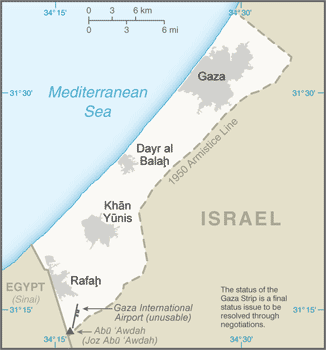
- Middle East, bordering the Mediterranean Sea, between Egypt and Israel
- Area
- 360 sq km
- Climate
- temperate, mild winters, dry and warm to hot summers
- Terrain
- flat to rolling, sand- and dune-covered coastal plain
- Natural resources
- arable land, natural gas
- Coastline
- 40 km
- Natural hazards
- droughts
People & society
- Population
- 2,184,652 (2025 est.)
- Ethnic groups
- Palestinian Arab
- Languages
- Arabic, Hebrew (spoken by many Palestinians), English (widely understood)
- Religions
- Muslim 98.0 - 99.0% (predominantly Sunni), Christian <1.0%, other, unaffiliated, unspecified <1.0% (2012 est.)
- Median age
- 19.9 years (2025 est.)
- Life expectancy at birth
- 75.5 years (2024 est.)
- Literacy
- 98% (2022 est.)
Economy
- Industries
- textiles, food processing, furniture
- Agricultural products
- tomatoes, milk, cucumbers/gherkins, olives, potatoes, sheep milk, eggplants, pumpkins/squash, grapes, goat milk (2023)
- Exports - partners
- Jordan 51%, Turkey 12%, UAE 8%, Saudi Arabia 5%, UK 4% (2023)
- Imports - partners
- Egypt 25%, Jordan 17%, China 8%, Germany 7%, UAE 7% (2023)
Full reference data
Every field, by section, CIA World Factbook. Open a topic to expand it.