Country exposure · HM

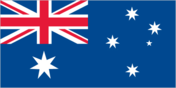
Flag of Heard Island and McDonald Islands

Heard Island and McDonald Islands

Antarctica

What Heard Island and McDonald Islands means for your money — the prices you pay, the tariffs in motion, and where U.S. policy could change both.
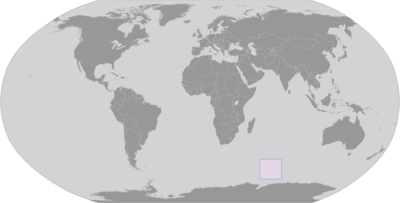
Map showing the location of Heard Island and McDonald Islands

U.S. exposure

Minimal direct economic exposure

Heard Island and McDonald Islands is not a significant U.S. goods-trade partner and has no tracked tariff actions. Policy changes here are unlikely to reach American prices directly.

Reference

The country itself

Antarctica · Geography, people, economy, and government — public-domain data from the CIA World Factbook.

American sailor John HEARD discovered Heard Island in 1853 while fellow American William MCDONALD discovered the McDonald Islands the following year. Starting in 1855, sealers lived on the islands and harvested elephant seal oil; by the time the practice was ended in 1877, most of the islands’ seals were killed. The UK formally claimed the islands in 1910, and Australian explorer Douglas MAWSON visited Heard Island in 1929. In 1947, the UK transferred the islands to Australia for its Antarctica research, but Australia closed the research station on Heard Island in 1954 when it opened a new research station on the Antarctic continent. McDonald Island has been an active volcano since it emerged from dormancy in 1992, and the island doubled in size after an eruption in 1996. In 1997, the islands were named a UNESCO World Heritage site. Populated by a large number of bird species, seals, and penguins, the islands are primarily used for research, with limited fishing permitted in the surrounding waters.
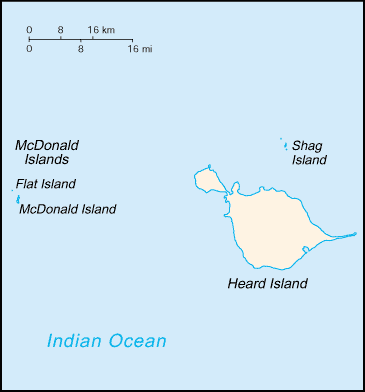
Regional map of Heard Island and McDonald Islands

Geography

Location
islands in the Indian Ocean, about two-thirds of the way from Madagascar to Antarctica
Area
412 sq km
Climate
antarctic
Terrain
Heard Island - 80% ice-covered, bleak and mountainous, dominated by a large massif (Big Ben) and an active volcano (Mawson Peak); McDonald Islands - small and rocky
Natural resources
fish
Coastline
101.9 km
Natural hazards
Mawson Peak, an active volcano, is on Heard Island

People & society

Population
uninhabited

Full reference data

Every field, by section — CIA World Factbook. Open a topic to expand it.

Introduction
Background
American sailor John HEARD discovered Heard Island in 1853 while fellow American William MCDONALD discovered the McDonald Islands the following year. Starting in 1855, sealers lived on the islands and harvested elephant seal oil; by the time the practice was ended in 1877, most of the islands’ seals were killed. The UK formally claimed the islands in 1910, and Australian explorer Douglas MAWSON visited Heard Island in 1929. In 1947, the UK transferred the islands to Australia for its Antarctica research, but Australia closed the research station on Heard Island in 1954 when it opened a new research station on the Antarctic continent. McDonald Island has been an active volcano since it emerged from dormancy in 1992, and the island doubled in size after an eruption in 1996. In 1997, the islands were named a UNESCO World Heritage site. Populated by a large number of bird species, seals, and penguins, the islands are primarily used for research, with limited fishing permitted in the surrounding waters.
Geography
Location
islands in the Indian Ocean, about two-thirds of the way from Madagascar to Antarctica
Geographic coordinates
53 06 S, 72 31 E
Map references
Antarctic Region
Area - total
412 sq km
Area - land
412 sq km
Area - water
0 sq km
Area - comparative
slightly more than two times the size of Washington, D.C.
Land boundaries - total
0 km
Coastline
101.9 km
Maritime claims - territorial sea
12 nm
Maritime claims - exclusive fishing zone
200 nm
Climate
antarctic
Terrain
Heard Island - 80% ice-covered, bleak and mountainous, dominated by a large massif (Big Ben) and an active volcano (Mawson Peak); McDonald Islands - small and rocky
Elevation - highest point
Mawson Peak on Big Ben volcano 2,745 m
Elevation - lowest point
Indian Ocean 0 m
Natural resources
fish
Land use - agricultural land
0% (2011 est.)
Land use - other
100% (2018 est.)
Natural hazards
Mawson Peak, an active volcano, is on Heard Island
Geography - note
Mawson Peak on Heard Island is the highest Australian mountain; at 2,745 m (9,006 ft), Mawson is taller than Mt. Kosciuszko in mainland Australia), and one of only two active volcanoes located in Australian territory; in 1992, McDonald Island, the other active volcano, broke its dormancy and began erupting; it has erupted several times since
People and Society
Population - total
uninhabited
Population - note
note: limited scientific research and expeditions
Government
Country name - conventional long form
Territory of Heard Island and McDonald Islands
Country name - conventional short form
Heard Island and McDonald Islands
Country name - abbreviation
HIMI
Country name - etymology
named after US Captain John HEARD, who sighted the island on 25 November 1853, and US Captain William McDONALD, who discovered the islands on 4 January 1854
Dependency status
territory of Australia; administered from Canberra by the Department of Agriculture, Water, and the Environment (Australian Antarctic Division)
Legal system
the laws of Australia apply
Diplomatic representation in the US
none (territory of Australia)
Diplomatic representation from the US - embassy
none (territory of Australia)
Flag
the flag of Australia is used
National heritage - total World Heritage Sites
1 (natural); note - excerpted from the Australia entry
National heritage - selected World Heritage Site locales
Heard Island and McDonald Islands
Communications
Internet country code
.hm
Transportation
Heliports
2 (2025)
Military and Security
Military - note
defense is the responsibility of Australia
Environment
Climate
antarctic
Land use - agricultural land
0% (2011 est.)
Land use - other
100% (2018 est.)