
Country exposure · KE
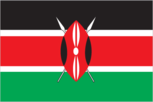
Kenya
Africa · Nairobi · presidential republic
What Kenya means for your money, the prices you pay, the tariffs in motion, and where U.S. policy could change both.
$862M
U.S. imports, 2025
+17%
change in one year
$982M
U.S. exports, 2025
56M
Population
$124.5B
GDP
In your house
What you buy that Kenya makes
America bought $862M in goods from Kenya in 2025, up 17% in a single year. Of every $100 of it, here's where the money went.
Apparel, textiles, nonwool or cotton
synthetic and performance apparel
Apparel, household goods - cotton
cotton clothing and linens
Green coffee
green coffee for roasters
Camping apparel and gear
camping gear and outdoor apparel
Tobacco, waxes, etc.
Nuts
nuts
U.s. goods returned, and reimports
Nursery stock, etc.
Artwork, antiques, stamps, etc.
Tea, spices, etc.
tea and spices
2026 so far (through July): $845M in imports. Source: U.S. Census Bureau, International Trade in Goods (customs basis).
The other direction
What America sells to Kenya
$982M in 2025, a trade rupture cuts both ways, for American producers as well as American prices.
Natural gas liquids
$492MCivilian aircraft, engines, equipment, and parts
$110MMilitary trucks, armored vehicles, etc.
$62MPlastic materials
$34Mplastics for packaging and goods
Coal and fuels, other
$29MPulpwood and woodpulp
$24MTelecommunications equipment
$23Mphones, routers, networking gear
Minimum value shipments
$18MWheat
$14Mgreen coffee for roasters
Where you stand
U.S. tariff posture toward Kenya
No U.S. tariff action singles this country out. Its goods face the universal 10% temporary import surcharge under Section 122 of the Trade Act (which replaced the IEEPA reciprocal baseline in February 2026) plus the sectoral Section 232 duties — steel and aluminum at 50% — that apply to all countries. The Section 122 surcharge is statutorily temporary — scheduled to lapse on or about July 23, 2026 (a 150-day cap) unless extended or replaced.
Reciprocal tariff (universal baseline)
10%
The universal 10% floor, a Section 122 import surcharge since February 2026, previously the EO 14257 reciprocal baseline, applies to nearly all U.S. imports. This country has no higher assigned rate of its own.
Policy in motion
Tariff status: a moving target
No U.S. tariff action names Kenya. These are the universal measures, applied to every country without a country-specific arrangement, that set its treatment.
2026-04-06
Section 232 metals coverage expanded
In effectThe April 2026 proclamation strengthening Section 232 actions on aluminum, steel, and copper expanded derivative-product coverage for all countries, keeping the general metals rate at 50%.
91 FR 18201 →2026-02-24
IEEPA reciprocal tariffs terminated — replaced by 10% Section 122 surcharge
In effectExecutive Order 14389 (Ending Certain Tariff Actions) terminated the IEEPA tariff duties — including the EO 14257 reciprocal baseline — effective February 24, 2026. A flat 10% Section 122 temporary import surcharge (Proclamation 11012 of February 20, 2026) replaced them, leaving the universal rate unchanged at 10% on a different statutory basis. Section 122 caps such surcharges at 150 days, so this 10% surcharge is scheduled to lapse on or about July 23, 2026 absent further action (the administration has signaled it could raise the rate toward the 15% statutory maximum).
91 FR 9437 →2025-11-13
Agricultural products exempted from reciprocal tariffs
In effectExecutive Order 14360 of November 14, 2025 removed reciprocal duties from certain agricultural products listed in its annexes (coffee, cocoa, bananas, and other goods the U.S. does not produce in sufficient quantity), retroactive to November 13, 2025 — for all countries subject to the reciprocal tariff.
90 FR 54091 →2025-06-04
Section 232 steel and aluminum duties doubled to 50%
In effectThe June 3, 2025 proclamation raised Section 232 duties on steel and aluminum articles and derivatives from 25% to 50% for all countries, effective June 4, 2025.
90 FR 24199 →2025-04-05
Universal 10% reciprocal baseline takes effect
In effectExecutive Order 14257 (signed April 2, 2025) imposed a 10% ad valorem reciprocal duty on imports from all trading partners, effective April 5, 2025. Countries without a higher Annex I rate remain at this baseline.
Federal Register · 2025-06063 →2025-03-12
Section 232 steel and aluminum duties set at 25% for all countries
In effectProclamations of February 10, 2025 terminated all country exemptions and quota arrangements and applied 25% Section 232 duties to steel and aluminum imports from every country, effective March 12, 2025.
90 FR 9817 →
Made for America
What Kenya makes for America
Kenya is a direct U.S. source of 5 essential goods Americans rely on, the items themselves, shipped finished off the line.
Go deeper
The supply chain view
Kenya sits upstream of 1 essential American goods through 2 tracked inputs.
manufactured
15%Annatto Extract (Natural Food Color, Orange/Yellow)
agricultural
8%Raw Tea Leaf (Camellia sinensis)
Reference
The country itself
Africa · Geography, people, economy, and government, public-domain data from the CIA World Factbook.
Trade centers such as Mombasa have existed along the Kenyan and Tanzanian coastlines, known as the Land of Zanj, since at least the 2nd century. These centers traded with the outside world, including China, India, Indonesia, the Middle East, North Africa, and Persia. By around the 9th century, the mix of Africans, Arabs, and Persians who lived and traded there became known as Swahili ("people of the coast") with a distinct language (KiSwahili) and culture. The Portuguese arrived in the 1490s and, using Mombasa as a base, sought to monopolize trade in the Indian Ocean. The Portuguese were pushed out in the late 1600s by the combined forces of Oman and Pate, an island off the coast. In 1890, Germany and the UK divided up the region, with the UK taking the north and the Germans the south, including present-day Tanzania, Burundi, and Rwanda. In 1895, the British established the East Africa Protectorate, which in 1920 was converted into a colony, and named Kenya after its highest mountain. Numerous political disputes between the colony and the UK led to the violent Mau Mau Uprising, which began in 1952, and the eventual declaration of independence in 1963. Jomo KENYATTA, the founding president and an icon of the liberation struggle, led Kenya from independence in 1963 until his death in 1978, when Vice President Daniel Arap MOI took power in a constitutional succession. The country was a de facto one-party state from 1969 until 1982, after which time the ruling Kenya African National Union (KANU) changed the constitution to make itself the sole legal political party. MOI gave in to internal and external pressure for political liberalization in 1991, but the ethnically fractured opposition failed to dislodge KANU from power in elections in 1992 and 1997, which were marred by violence and fraud. MOI stepped down in 2002 after fair and peaceful elections. Mwai KIBAKI, running as the candidate of the multiethnic, united opposition group, the National Rainbow Coalition (NARC), defeated KANU candidate Uhuru KENYATTA, the son of the founding president, and assumed the presidency following a campaign centered on an anticorruption platform. Opposition candidate Raila ODINGA challenged KIBAKI's reelection in 2007 on the grounds of widespread vote rigging, leading to two months of ethnic violence that caused more than 1,100 deaths and displaced hundreds of thousands. African Union-sponsored mediation resulted in a power-sharing accord that brought ODINGA into the government as prime minister and outlined a reform agenda. In 2010, Kenyans overwhelmingly voted to adopt a new constitution that eliminated the prime minister, introduced additional checks and balances to executive power, and devolved power and resources to 47 newly created counties. Uhuru KENYATTA won the first presidential election under the new constitution in 2013. He won a second and final term in office in 2017 after a contentious repeat election. In 2022, William RUTO won a close presidential election; he assumed the office the following month after the Kenyan Supreme Court upheld the victory.
Geography
- Location
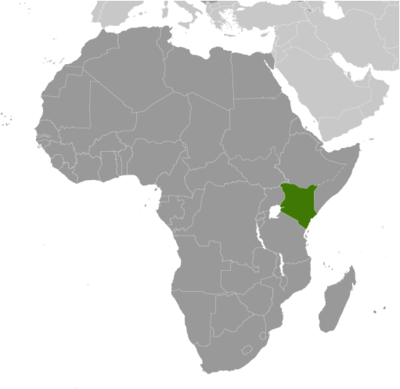
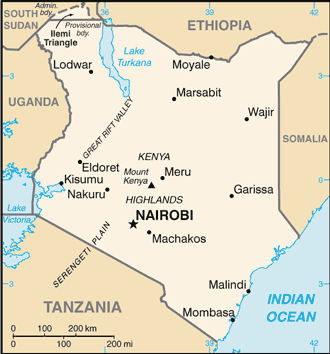
- Eastern Africa, bordering the Indian Ocean, between Somalia and Tanzania
- Area
- 580,367 sq km
- Climate
- varies from tropical along coast to arid in interior
- Terrain
- low plains rise to central highlands bisected by Great Rift Valley; fertile plateau in west
- Natural resources
- limestone, soda ash, salt, gemstones, fluorspar, zinc, diatomite, gypsum, wildlife, hydropower
- Coastline
- 536 km
- Natural hazards
- recurring drought; flooding during rainy seasons volcanism: limited volcanic activity; the Barrier (1,032 m) last erupted in 1921; South Island is the only other historically active volcano
People & society
- Population
- 55,751,717 (2025 est.)
- Nationality
- Kenyan(s)
- Ethnic groups
- Kikuyu 17.1%, Luhya 14.3%, Kalenjin 13.4%, Luo 10.7%, Kamba 9.8%, Somali 5.8%, Kisii 5.7%, Mijikenda 5.2%, Meru 4.2%, Maasai 2.5%, Turkana 2.1%, non-Kenyan 1%, other 8.2% (2019 est.)
- Languages
- English (official), Kiswahili (official), numerous indigenous languages
- Religions
- Christian 85.5% (Protestant 33.4%, Catholic 20.6%, Evangelical 20.4%, African Instituted Churches 7%, other Christian 4.1%), Muslim 10.9%, other 1.8%, none 1.6%, don't know/no answer 0.2% (2019 est.)
- Median age
- 21.5 years (2025 est.)
- Life expectancy at birth
- 70.4 years (2024 est.)
Economy
- Economic overview
- fast growing, third largest Sub-Saharan economy; strong agriculture sector with emerging services and tourism industries; IMF program to address current account and debt service challenges; business-friendly policies foster infrastructure investment, digital innovation and public-private partnerships; vulnerable to climate change-induced droughts
- Industries
- agriculture, transportation, services, manufacturing, construction, telecommunications, tourism, retail
- Agricultural products
- sugarcane, milk, maize, bananas, tea, potatoes, cassava, cabbages, camel milk, mangoes/guavas (2023)
- Exports - partners
- Uganda 10%, USA 10%, UAE 8%, Netherlands 8%, Pakistan 6% (2023)
- Imports - partners
- China 22%, UAE 14%, India 10%, Saudi Arabia 5%, Malaysia 4% (2023)
Government
- Government type
- presidential republic
- Capital
- Nairobi
- Independence
- 12 December 1963 (from the UK)
- Constitution
- current constitution passed by referendum on 4 August 2010
- Executive branch
- President William RUTO (since 13 September 2022)
- Legislative branch
- Parliament of Kenya
Full reference data
Every field, by section, CIA World Factbook. Open a topic to expand it.
Introduction
Travel Facts
Please visit the following links to find further information about your desired destination.
World Health Organization (WHO) - To learn what vaccines and health precautions to take while visiting your destination.
US State Dept Travel Information - Overall information about foreign travel for US citizens.
To obtain an international driving permit (IDP). Only two organizations in the US issue IDPs: American Automobile Association (AAA) and American Automobile Touring Alliance (AATA)
How to get help in an emergency? Contact the nearest US embassy or consulate, or call one of these numbers: from the US or Canada - 1-888-407-4747 or from Overseas - +1 202-501-4444
Page last updated: Monday, July 25, 2022