
Country exposure · KM
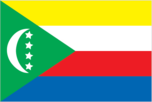
Comoros
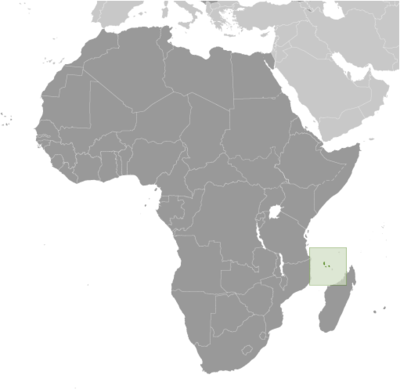
Africa · Moroni · federal presidential republic
What Comoros means for your money, the prices you pay, the tariffs in motion, and where U.S. policy could change both.
$849K
U.S. imports, 2025
-54%
change in one year
$2M
U.S. exports, 2025
912K
Population
$1.5B
GDP
In your house
What you buy that Comoros makes
America bought $849K in goods from Comoros in 2025, down 54% in a single year. Of every $100 of it, here's where the money went.
Tea, spices, etc.
tea and spices
Fish and shellfish
fish, shrimp, shellfish
Furniture, household goods, etc.
furniture, mattresses, lamps
Tobacco, waxes, etc.
Minimum value shipments
Jewelry
jewelry
2026 so far (through July): $522K in imports. Source: U.S. Census Bureau, International Trade in Goods (customs basis).
The other direction
What America sells to Comoros
$2M in 2025, a trade rupture cuts both ways, for American producers as well as American prices.
Meat, poultry, etc.
$1MPassenger cars, new and used
$342Knew and used cars
Computer accessories
$159Kkeyboards, drives, computer parts
Laboratory testing instruments
$71KMiscellaneous domestic exports and special transactions
$59KCell phones and other household goods, n.e.c.
$58Kcell phones and home electronics
Logs and lumber
$55KCivilian aircraft, engines, equipment, and parts
$50KPharmaceutical preparations
$50Kmedicines and pharmacy items
Where you stand
U.S. tariff posture toward Comoros
No U.S. tariff action singles this country out. Its goods face the universal 10% temporary import surcharge under Section 122 of the Trade Act (which replaced the IEEPA reciprocal baseline in February 2026) plus the sectoral Section 232 duties — steel and aluminum at 50% — that apply to all countries. The Section 122 surcharge is statutorily temporary — scheduled to lapse on or about July 23, 2026 (a 150-day cap) unless extended or replaced.
Reciprocal tariff (universal baseline)
10%
The universal 10% floor, a Section 122 import surcharge since February 2026, previously the EO 14257 reciprocal baseline, applies to nearly all U.S. imports. This country has no higher assigned rate of its own.
Policy in motion
Tariff status: a moving target
No U.S. tariff action names Comoros. These are the universal measures, applied to every country without a country-specific arrangement, that set its treatment.
2026-04-06
Section 232 metals coverage expanded
In effectThe April 2026 proclamation strengthening Section 232 actions on aluminum, steel, and copper expanded derivative-product coverage for all countries, keeping the general metals rate at 50%.
91 FR 18201 →2026-02-24
IEEPA reciprocal tariffs terminated — replaced by 10% Section 122 surcharge
In effectExecutive Order 14389 (Ending Certain Tariff Actions) terminated the IEEPA tariff duties — including the EO 14257 reciprocal baseline — effective February 24, 2026. A flat 10% Section 122 temporary import surcharge (Proclamation 11012 of February 20, 2026) replaced them, leaving the universal rate unchanged at 10% on a different statutory basis. Section 122 caps such surcharges at 150 days, so this 10% surcharge is scheduled to lapse on or about July 23, 2026 absent further action (the administration has signaled it could raise the rate toward the 15% statutory maximum).
91 FR 9437 →2025-11-13
Agricultural products exempted from reciprocal tariffs
In effectExecutive Order 14360 of November 14, 2025 removed reciprocal duties from certain agricultural products listed in its annexes (coffee, cocoa, bananas, and other goods the U.S. does not produce in sufficient quantity), retroactive to November 13, 2025 — for all countries subject to the reciprocal tariff.
90 FR 54091 →2025-06-04
Section 232 steel and aluminum duties doubled to 50%
In effectThe June 3, 2025 proclamation raised Section 232 duties on steel and aluminum articles and derivatives from 25% to 50% for all countries, effective June 4, 2025.
90 FR 24199 →2025-04-05
Universal 10% reciprocal baseline takes effect
In effectExecutive Order 14257 (signed April 2, 2025) imposed a 10% ad valorem reciprocal duty on imports from all trading partners, effective April 5, 2025. Countries without a higher Annex I rate remain at this baseline.
Federal Register · 2025-06063 →2025-03-12
Section 232 steel and aluminum duties set at 25% for all countries
In effectProclamations of February 10, 2025 terminated all country exemptions and quota arrangements and applied 25% Section 232 duties to steel and aluminum imports from every country, effective March 12, 2025.
90 FR 9817 →
Reference
The country itself
Africa · Geography, people, economy, and government, public-domain data from the CIA World Factbook.
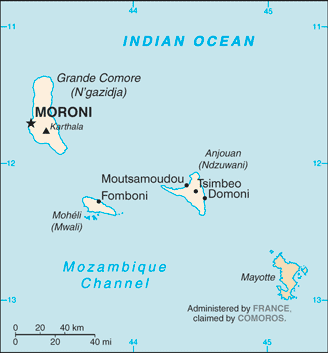
For centuries prior to colonization in the 19th century, the Comoros archipelago in the Indian Ocean served as a key node in maritime trade networks that connected the Middle East, India, and eastern African regions. Composed of the islands of Anjouan, Mayotte, Moheli, and Grande Comore, Comoros spent most of the 20th century as a colonial outpost until it declared independence from France on 6 July 1975. Residents of Mayotte, however, voted to remain in France, and the French Government has since classified it as a French Overseas Department. Since independence, Comoros has weathered approximately 20 successful and attempted coups, mostly between 1975 and 2000, resulting in prolonged political instability and stunted economic development. In 2002, President AZALI Assoumani became the first elected president following the completion of the Fomboni Accords, in which the islands of Grande Comore, Anjouan, and Moheli agreed to rotate the presidency among the islands every five years. This power-sharing agreement also included provisions allowing each island to maintain its local government. In 2007, Mohamed BACAR effected Anjouan's de-facto secession from the Union of the Comoros, refusing to step down when Comoros' other islands held legitimate elections. The African Union (AU) initially attempted to resolve the political crisis with sanctions and a naval blockade of Anjouan, but in 2008, the AU and Comoran soldiers seized the island. The island's inhabitants generally welcomed the move. In 2011, Ikililou DHOININE won the presidency in peaceful elections widely deemed to be free and fair. In closely contested elections in 2016, AZALI won a second term, when the rotating presidency returned to Grande Comore. In 2018, a referendum -- which the opposition parties boycotted -- approved a new constitution that extended presidential term limits and abolished the requirement for the presidency to rotate between the three main islands. AZALI formed a new government later that year, and he subsequently ran and was reelected in 2019. AZALI was reelected again in January 2024 in an election that the opposition disputed but the Supreme Court validated.
Geography
- Location
- Southern Africa, group of islands at the northern mouth of the Mozambique Channel, about two-thirds of the way between northern Madagascar and northern Mozambique
- Area
- 2,235 sq km
- Climate
- tropical marine; rainy season (November to May)
- Terrain
- volcanic islands, interiors vary from steep mountains to low hills
- Natural resources
- fish
- Coastline
- 340 km
- Natural hazards
- cyclones possible during rainy season (December to April); volcanic activity on Grand Comore volcanism: Karthala (2,361 m) on Grand Comore Island last erupted in 2007; a 2005 eruption forced thousands of people to be evacuated and produced a large ash cloud
People & society
- Population
- 911,707 (2025 est.)
- Nationality
- Comoran(s)
- Ethnic groups
- Antalote, Cafre, Makoa, Oimatsaha, Sakalava
- Languages
- Arabic (official), French (official), Shikomoro (official; similar to Swahili), Comorian
- Religions
- Muslim 98.1% (overwhelmingly Sunni Muslim, small Shia Muslim and Ahmadiyya Muslim populations), ethnic religionist 1.1%, Christian 0.6%, other 0.3% (2020 est.)
- Median age
- 23.1 years (2025 est.)
- Life expectancy at birth
- 67.8 years (2024 est.)
- Literacy
- 75.8% (2021 est.)
Economy
- Economic overview
- small trade-based island economy; declining remittances; new structural and fiscal reforms; adverse cyclone and COVID-19 impacts; manageable debts; fragile liquidity environment; large foreign direct investment; state-owned enterprises suffering
- Industries
- fishing, tourism, perfume distillation
- Agricultural products
- bananas, coconuts, cassava, yams, maize, taro, milk, tomatoes, sweet potatoes, pulses (2023)
- Exports - partners
- Indonesia 25%, India 23%, Turkey 16%, UAE 11%, USA 3% (2023)
- Imports - partners
- China 24%, UAE 21%, Tanzania 12%, France 7%, India 6% (2023)
Government
- Government type
- federal presidential republic
- Capital
- Moroni
- Independence
- 6 July 1975 (from France)
- Constitution
- previous 1996, 2001; newest adopted 30 July 2018
- Executive branch
- President AZALI Assoumani (since 26 May 2016)
- Legislative branch
- Assembly of the Union (Assemblée de l'Union)
Full reference data
Every field, by section, CIA World Factbook. Open a topic to expand it.
Introduction
Travel Facts
Please visit the following links to find further information about your desired destination.
World Health Organization (WHO) - To learn what vaccines and health precautions to take while visiting your destination.
US State Dept Travel Information - Overall information about foreign travel for US citizens.
To obtain an international driving permit (IDP). Only two organizations in the US issue IDPs: American Automobile Association (AAA) and American Automobile Touring Alliance (AATA)
How to get help in an emergency? Contact the nearest US embassy or consulate, or call one of these numbers: from the US or Canada - 1-888-407-4747 or from Overseas - +1 202-501-4444
Page last updated: Wednesday, October 05, 2022