
Country exposure · KP
North Korea (Democratic People's Republic of Korea)
East N Southeast Asia · Pyongyang · dictatorship, single-party communist state
What North Korea (Democratic People's Republic of Korea) means for your money, the prices you pay, the tariffs in motion, and where U.S. policy could change both.
$139K
U.S. imports, 2025
+141.7%
change in one year
$543K
U.S. exports, 2025
26M
Population
$16.4B
GDP
In your house
What you buy that North Korea (Democratic People's Republic of Korea) makes
America bought $139K in goods from North Korea (Democratic People's Republic of Korea) in 2025, up 141.7% in a single year. Of every $100 of it, here's where the money went.
Toiletries and cosmetics
toiletries and cosmetics
The other direction
What America sells to North Korea (Democratic People's Republic of Korea)
$543K in 2025, a trade rupture cuts both ways, for American producers as well as American prices.
Chemicals-inorganic
$523KMeasuring, testing, control instruments
$14KChemicals-other
$4KToiletries and cosmetics
$3Ktoiletries and cosmetics
Go deeper
The supply chain view
North Korea (Democratic People's Republic of Korea) sits upstream of 1 essential American goods through 1 tracked inputs.
Full supply-map profile →Reference
The country itself
East N Southeast Asia · Geography, people, economy, and government, public-domain data from the CIA World Factbook.
The first recorded kingdom (Choson) on the Korean Peninsula dates from approximately 2300 B.C. Over the subsequent centuries, three main kingdoms -- Kogoryo, Paekche, and Silla -- were established on the Peninsula. By the 5th century A.D., Kogoryo emerged as the most powerful, with control over much of the Peninsula and part of Manchuria (modern-day northeast China). However, Silla allied with the Chinese to create the first unified Korean state in 688. Following the collapse of Silla in the 9th century, Korea was unified under the Koryo (Goryeo; 918-1392) and the Chosen (Joseon; 1392-1910) dynasties. Korea became the object of intense imperialistic rivalry among the Chinese (its traditional benefactor), Japanese, and Russian empires in the latter half of the 19th and early 20th centuries. After the Sino-Japanese War (1894-95) and the Russo-Japanese War (1904-05), Korea was occupied by Imperial Japan. In 1910, Japan formally annexed the entire peninsula. After World War II, the northern half came under Soviet-sponsored communist control. In 1948, North Korea (formally known as the Democratic People's Republic of Korea or DPRK) was founded under President KIM Il Sung, who consolidated power and cemented autocratic one-party rule under the Korean Worker's Party (KWP). North Korea failed to conquer UN-backed South Korea (formally the Republic of Korea or ROK) during the Korean War (1950-53), after which a demilitarized zone separated the two Koreas. KIM's authoritarian rule included tight control over North Korean citizens and the demonization of the US as the central threat to North Korea's political and social system. In addition, he molded the country's economic, military, and political policies around the core objective of unifying Korea under Pyongyang's control. North Korea also declared a central ideology of juche (" self-reliance") as a check against outside influence, while continuing to rely heavily on China and the Soviet Union for economic support. KIM Il Sung's son, KIM Jong Il, was officially designated as his father's successor in 1980, and he assumed a growing political and managerial role until the elder KIM's death in 1994. Under KIM Jong Il's reign, North Korea continued developing nuclear weapons and ballistic missiles. KIM Jong Un was publicly unveiled as his father's successor in 2010. Following KIM Jong Il's death in 2011, KIM Jong Un quickly assumed power and has since occupied the regime's highest political and military posts. After the end of Soviet aid in 1991, North Korea faced serious economic setbacks that exacerbated decades of economic mismanagement and resource misallocation. Since the mid-1990s, North Korea has faced chronic food shortages and economic stagnation. In recent years, the North's domestic agricultural production has improved but still falls far short of producing sufficient food for its population. Starting in 2002, North Korea began to tolerate semi-private markets but has made few other efforts to meet its goal of improving the overall standard of living. New economic development plans in the 2010s failed to meet government-mandated goals for key industrial sectors, food production, or overall economic performance. At the onset of the COVID-19 pandemic in 2020, North Korea instituted a nationwide lockdown that severely restricted its economy and international engagement. Since then, KIM has repeatedly expressed concerns with the regime's economic failures and food problems, but in 2021, he vowed to continue "self-reliant" policies and has reinvigorated his pursuit of greater regime control of the economy. As of 2024, despite slowly renewing cross-border trade with China, North Korea remained one of the world's most isolated countries and one of Asia's poorest. In 2024, Pyongyang announced it was ending all economic cooperation with South Korea. The move followed earlier proclamations that it was scrapping a 2018 military pact with South Korea to de-escalate tensions along their militarized border, abandoning the country’s decades-long pursuit of peaceful unification with South Korea, and designating the South as North Korea’s “principal enemy.”
Geography
- Location
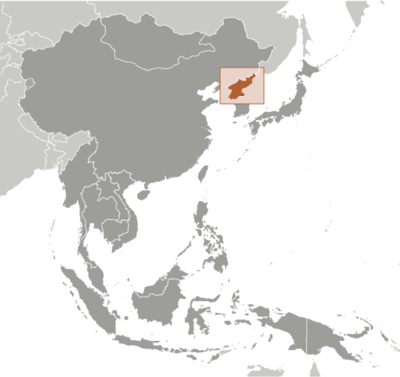
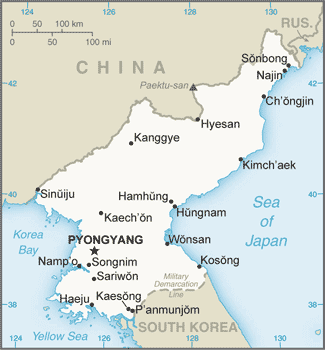
- Eastern Asia, northern half of the Korean Peninsula bordering the Korea Bay and the Sea of Japan, between China and South Korea
- Area
- 120,538 sq km
- Climate
- temperate, with rainfall concentrated in summer; long, bitter winters
- Terrain
- mostly hills and mountains separated by deep, narrow valleys; wide coastal plains in west, discontinuous in east
- Natural resources
- coal, iron ore, limestone, magnesite, graphite, copper, zinc, lead, precious metals, hydropower
- Coastline
- 2,495 km
- Natural hazards
- late spring droughts often followed by severe flooding; occasional typhoons during the early fall volcanism: P'aektu-san (2,744 m) (also known as Baitoushan, Baegdu, or Changbaishan), on the Chinese border, is considered historically active
People & society
- Population
- 26,402,841 (2025 est.)
- Nationality
- Korean(s)
- Ethnic groups
- racially homogeneous; there is a small Chinese community and a few ethnic Japanese
- Languages
- Korean
- Religions
- traditionally Buddhist and Confucian, some Christian and syncretic Chondogyo (Religion of the Heavenly Way)
- Median age
- 36.2 years (2025 est.)
- Life expectancy at birth
- 73.5 years (2024 est.)
Economy
- Economic overview
- one of the last centrally planned economies; hard hit by COVID-19, crop failures, international sanctions, and isolationist policies; declining growth and trade, and heavily reliant on China; poor exchange rate stability; economic data integrity issues
- Industries
- military products; machine building, electric power, chemicals; mining (coal, iron ore, limestone, magnesite, graphite, copper, zinc, lead, and precious metals), metallurgy; textiles, food processing; tourism
- Agricultural products
- maize, vegetables, rice, apples, cabbages, fruits, sweet potatoes, potatoes, beans, soybeans (2023)
- Exports - partners
- China 74%, Poland 3%, Senegal 3%, Angola 3%, Austria 3% (2023)
- Imports - partners
- China 97%, Togo 1%, Peru 1%, Gabon 1%, India 0% (2023)
Government
- Government type
- dictatorship, single-party communist state
- Capital
- Pyongyang
- Independence
- 15 August 1945 (from Japan)
- Constitution
- previous 1948, 1972; latest adopted 1998
- Executive branch
- State Affairs Commission President KIM Jong Un (since 17 December 2011)
- Legislative branch
- Supreme People's Assembly (Choe Go In Min Hoe Ui)
Full reference data
Every field, by section, CIA World Factbook. Open a topic to expand it.
Introduction
Travel Facts
Please visit the following links to find further information about your desired destination.
World Health Organization (WHO) - To learn what vaccines and health precautions to take while visiting your destination.
US State Dept Travel Information - Overall information about foreign travel for US citizens.
To obtain an international driving permit (IDP). Only two organizations in the US issue IDPs: American Automobile Association (AAA) and American Automobile Touring Alliance (AATA)
How to get help in an emergency? Contact the nearest US embassy or consulate, or call one of these numbers: from the US or Canada - 1-888-407-4747 or from Overseas - +1 202-501-4444
Page last updated: Wednesday, October 19, 2022