
Country exposure · KZ
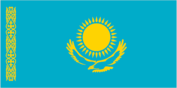
Kazakhstan
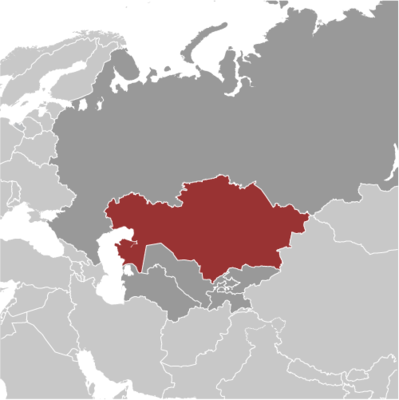
Central Asia · Astana · presidential republic
What Kazakhstan means for your money, the prices you pay, the tariffs in motion, and where U.S. policy could change both.
$4.1B
U.S. imports, 2025
+73.4%
change in one year
$986M
U.S. exports, 2025
20M
Population
$288.4B
GDP
In your house
What you buy that Kazakhstan makes
America bought $4.1B in goods from Kazakhstan in 2025, up 73.4% in a single year. Of every $100 of it, here's where the money went.
Finished metal shapes
Crude oil
Other precious metals
Nuclear fuel materials
Steelmaking materials
Nonferrous metals, other
Copper
copper for wiring
Fuel oil
fuel oil
Chemicals-inorganic
U.s. goods returned, and reimports
2026 so far (through July): $667M in imports. Source: U.S. Census Bureau, International Trade in Goods (customs basis).
The other direction
What America sells to Kazakhstan
$986M in 2025, a trade rupture cuts both ways, for American producers as well as American prices.
Civilian aircraft, engines, equipment, and parts
$230MIndustrial engines
$92MGenerators, accessories
$54MPassenger cars, new and used
$52Mnew and used cars
Chemicals-other
$46MElectric apparatus
$44MIndustrial machines, other
$41MRailway transportation equipment
$41MOther foods
$35MWhere you stand
U.S. tariff posture toward Kazakhstan
Kazakhstan was assigned 27% in April 2025, reduced to 25% in August — the harshest rate in Central Asia on paper — but the impact is minimal: oil, uranium, silver, ferroalloys, tantalum, and titanium are exempt, covering roughly 95% of Kazakh exports to the U.S. (crude oil alone is over half). No formal deal was reached. Executive Order 14389 (Ending Certain Tariff Actions, Feb 20, 2026) terminated the IEEPA reciprocal duties, and Proclamation 11012 replaced it with a 10% Section 122 temporary import surcharge effective February 24, 2026; energy and strategic-mineral imports remain exempt. Kazakhstan has no Section 232 steel/aluminum exposure.
Reciprocal tariff (assigned, terminated)
27%
The rate this country was assigned under the EO 14257 reciprocal Annex, no longer in force. The Supreme Court struck down the IEEPA tariffs and they were terminated February 24, 2026 (EO 14389), replaced by a universal ~10% Section 122 surcharge. See the timeline below for the current effective rate.
Policy in motion
Tariff status: a moving target
U.S. tariff policy toward Kazakhstan has changed 4 times since 2025. This page tracks it.
2026-02-24
IEEPA reciprocal tariffs terminated — replaced by 10% Section 122
In effectExecutive Order 14389 (Ending Certain Tariff Actions) terminated the IEEPA tariff duties effective February 24, 2026, replacing Kazakhstan's 25% reciprocal rate with a 10% Section 122 temporary import surcharge under Proclamation 11012 (capped at 150 days); energy and strategic-mineral imports remain exempt.
91 FR 9437 →2025-08-07
Rate set at 25% — no deal reached
In effectExecutive Order 14326 set the post-pause Annex I reciprocal rates; Kazakhstan's rate was lowered to 25% effective August 7, 2025 with no formal agreement, the oil and strategic-mineral exemptions leaving most exports untouched.
90 FR 37963 →2025-04-10
Elevated reciprocal rates paused to 10% for 90 days
In effectExecutive Order 14266 suspended the higher country-specific reciprocal rates — including Kazakhstan's 27% — back to the 10% baseline for 90 days.
90 FR 15625 →2025-04-05
Reciprocal tariff regime begins — Kazakhstan assigned 27% (oil/minerals exempt)
In effectExecutive Order 14257 imposed a 10% universal reciprocal duty effective April 5 and a 27% country-specific rate for Kazakhstan scheduled to take effect April 9 — but oil, uranium, silver, ferroalloys, tantalum, and titanium, about 95% of Kazakh exports, were carved out.
90 FR 15041 →
Made for America
What Kazakhstan makes for America
Kazakhstan is a direct U.S. source of 2 essential goods Americans rely on, the items themselves, shipped finished off the line.
Go deeper
The supply chain view
Kazakhstan sits upstream of 11 essential American goods through 12 tracked inputs.
mineral
43%Low-Enriched Uranium (LEU) Nuclear Fuel
mineral
22%Low-Enriched Uranium (LEU) Nuclear Fuel
mineral
10%Yellow Phosphorus (P4) — Organophosphate Feedstock
energy
8%Uranium ore & natural concentrates (U3O8)
agricultural
7%Durum Wheat / Semolina
mineral
6%Sterling Silver (Jewelry Grade)
Reference
The country itself
Central Asia · Geography, people, economy, and government, public-domain data from the CIA World Factbook.
Ethnic Kazakhs derive from a mix of Turkic nomadic tribes that migrated to the region in the 15th century. The Russian Empire conquered the Kazakh steppe in the 18th and 19th centuries, and Kazakhstan became a Soviet Republic in 1925. Forced agricultural collectivization led to repression and starvation, resulting in more than a million deaths in the early 1930s. During the 1950s and 1960s, the agricultural "Virgin Lands" program generated an influx of settlers -- mostly ethnic Russians, but also other nationalities -- and by the time of Kazakhstan’s independence in 1991, ethnic Kazakhs were a minority. However, non-Muslim ethnic minorities departed Kazakhstan in large numbers from the mid-1990s through the mid-2000s, and a national program has repatriated about a million ethnic Kazakhs (from Uzbekistan, Tajikistan, Mongolia, and the Xinjiang region of China) to Kazakhstan. As a result of this shift, the ethnic Kazakh share of the population now exceeds two-thirds. Kazakhstan's economy is the largest in Central Asia, mainly due to the country's vast natural resources. Current issues include diversifying the economy, attracting foreign direct investment, enhancing Kazakhstan's economic competitiveness, and strengthening economic relations with neighboring states and foreign powers.
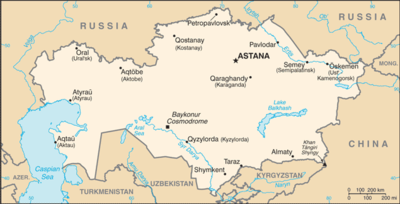
Geography
- Location
- Central Asia, northwest of China; a small portion west of the Ural (Oral) River in easternmost Europe
- Area
- 2,724,900 sq km
- Climate
- continental, cold winters and hot summers, arid and semiarid
- Terrain
- vast flat steppe extending from the Volga in the west to the Altai Mountains in the east and from the plains of western Siberia in the north to oases and deserts of Central Asia in the south
- Natural resources
- major deposits of petroleum, natural gas, coal, iron ore, manganese, chrome ore, nickel, cobalt, copper, molybdenum, lead, zinc, bauxite, gold, uranium
- Coastline
- 0 km (landlocked)
- Natural hazards
- earthquakes in the south; mudslides around Almaty
People & society
- Population
- 20,432,662 (2025 est.)
- Nationality
- Kazakhstani(s)
- Ethnic groups
- Kazakh 71%, Russian 14.9%, Uzbek 3.3%, Ukrainian 1.9%, Uyghurs 1.5%, German 1.1%, Tatar 1.1%, other 4.9%, unspecified 0.3% (2023 est.)
- Languages
- Kazakh (official, Qazaq) 80.1%, Russian 83.7%, English 35.1% (2021 est.)
- Religions
- Muslim 69.3%, Christian 17.2% (Orthodox 17%, other 0.2%), Buddhism 0.1%, other 0.1%, non-believers 2.3%, unspecified 11% (2021 est.)
- Median age
- 32.1 years (2025 est.)
- Life expectancy at birth
- 73.3 years (2024 est.)
Economy
- Economic overview
- upper-middle-income Central Asian economy; robust growth due to rising oil production, expansion in manufacturing and services, rising domestic demand, and infrastructure investments; however, rapid growth contributing to high inflation rate; declining unemployment and poverty rates
- Industries
- oil, coal, iron ore, manganese, chromite, lead, zinc, copper, titanium, bauxite, gold, silver, phosphates, sulfur, uranium, iron and steel; tractors and other agricultural machinery, electric motors, construction materials
- Agricultural products
- wheat, milk, barley, potatoes, watermelons, cantaloupes/melons, sunflower seeds, maize, onions, tomatoes (2023)
- Exports - partners
- China 16%, UK 15%, Russia 10%, Turkey 6%, Italy 5% (2023)
- Imports - partners
- China 28%, Russia 24%, Gambia, The 4%, Turkey 4%, USA 4% (2023)
Government
- Government type
- presidential republic
- Capital
- Astana
- Independence
- 16 December 1991 (from the Soviet Union)
- Constitution
- previous 1937, 1978 (pre-independence), 1993; latest approved by referendum 30 August 1995, effective 5 September 1995
- Executive branch
- President Kasym-Zhomart TOKAYEV (since 20 March 2019)
- Legislative branch
- Parliament (Parlament)
Full reference data
Every field, by section, CIA World Factbook. Open a topic to expand it.
Introduction
Travel Facts
Please visit the following links to find further information about your desired destination.
World Health Organization (WHO) - To learn what vaccines and health precautions to take while visiting your destination.
US State Dept Travel Information - Overall information about foreign travel for US citizens.
To obtain an international driving permit (IDP). Only two organizations in the US issue IDPs: American Automobile Association (AAA) and American Automobile Touring Alliance (AATA)
How to get help in an emergency? Contact the nearest US embassy or consulate, or call one of these numbers: from the US or Canada - 1-888-407-4747 or from Overseas - +1 202-501-4444
Page last updated: Wednesday, October 05, 2022