
Country exposure · MH

Marshall Islands
Australia Oceania · Majuro · mixed presidential-parliamentary system in free association with the US
What Marshall Islands means for your money, the prices you pay, the tariffs in motion, and where U.S. policy could change both.
$17M
U.S. imports, 2025
-15.7%
change in one year
$263M
U.S. exports, 2025
82K
Population
$280M
GDP
In your house
What you buy that Marshall Islands makes
America bought $17M in goods from Marshall Islands in 2025, down 15.7% in a single year. Of every $100 of it, here's where the money went.
Fish and shellfish
fish, shrimp, shellfish
U.s. goods returned, and reimports
Minimum value shipments
Other (movies, miscellaneous imports, and special transactions)
Computers
laptops, desktops, monitors
Furniture, household goods, etc.
furniture, mattresses, lamps
Steelmaking materials
Camping apparel and gear
camping gear and outdoor apparel
Shingles, wallboard
Computer accessories
keyboards, drives, computer parts
2026 so far (through July): $9M in imports. Source: U.S. Census Bureau, International Trade in Goods (customs basis).
The other direction
What America sells to Marshall Islands
$263M in 2025, a trade rupture cuts both ways, for American producers as well as American prices.
Telecommunications equipment
$116Mphones, routers, networking gear
Civilian aircraft, engines, equipment, and parts
$30MMinimum value shipments
$25MFinished metal shapes
$12MDrilling & oilfield equipment
$11MMeat, poultry, etc.
$8MElectric apparatus
$7MOther foods
$6MGenerators, accessories
$6MWhere you stand
U.S. tariff posture toward Marshall Islands
No U.S. tariff action singles this country out. Its goods face the universal 10% temporary import surcharge under Section 122 of the Trade Act (which replaced the IEEPA reciprocal baseline in February 2026) plus the sectoral Section 232 duties — steel and aluminum at 50% — that apply to all countries. The Section 122 surcharge is statutorily temporary — scheduled to lapse on or about July 23, 2026 (a 150-day cap) unless extended or replaced.
Reciprocal tariff (universal baseline)
10%
The universal 10% floor, a Section 122 import surcharge since February 2026, previously the EO 14257 reciprocal baseline, applies to nearly all U.S. imports. This country has no higher assigned rate of its own.
Policy in motion
Tariff status: a moving target
No U.S. tariff action names Marshall Islands. These are the universal measures, applied to every country without a country-specific arrangement, that set its treatment.
2026-04-06
Section 232 metals coverage expanded
In effectThe April 2026 proclamation strengthening Section 232 actions on aluminum, steel, and copper expanded derivative-product coverage for all countries, keeping the general metals rate at 50%.
91 FR 18201 →2026-02-24
IEEPA reciprocal tariffs terminated — replaced by 10% Section 122 surcharge
In effectExecutive Order 14389 (Ending Certain Tariff Actions) terminated the IEEPA tariff duties — including the EO 14257 reciprocal baseline — effective February 24, 2026. A flat 10% Section 122 temporary import surcharge (Proclamation 11012 of February 20, 2026) replaced them, leaving the universal rate unchanged at 10% on a different statutory basis. Section 122 caps such surcharges at 150 days, so this 10% surcharge is scheduled to lapse on or about July 23, 2026 absent further action (the administration has signaled it could raise the rate toward the 15% statutory maximum).
91 FR 9437 →2025-11-13
Agricultural products exempted from reciprocal tariffs
In effectExecutive Order 14360 of November 14, 2025 removed reciprocal duties from certain agricultural products listed in its annexes (coffee, cocoa, bananas, and other goods the U.S. does not produce in sufficient quantity), retroactive to November 13, 2025 — for all countries subject to the reciprocal tariff.
90 FR 54091 →2025-06-04
Section 232 steel and aluminum duties doubled to 50%
In effectThe June 3, 2025 proclamation raised Section 232 duties on steel and aluminum articles and derivatives from 25% to 50% for all countries, effective June 4, 2025.
90 FR 24199 →2025-04-05
Universal 10% reciprocal baseline takes effect
In effectExecutive Order 14257 (signed April 2, 2025) imposed a 10% ad valorem reciprocal duty on imports from all trading partners, effective April 5, 2025. Countries without a higher Annex I rate remain at this baseline.
Federal Register · 2025-06063 →2025-03-12
Section 232 steel and aluminum duties set at 25% for all countries
In effectProclamations of February 10, 2025 terminated all country exemptions and quota arrangements and applied 25% Section 232 duties to steel and aluminum imports from every country, effective March 12, 2025.
90 FR 9817 →
Made for America
What Marshall Islands makes for America
Marshall Islands is a direct U.S. source of 1 essential good Americans rely on, the items themselves, shipped finished off the line.
Reference
The country itself
Australia Oceania · Geography, people, economy, and government, public-domain data from the CIA World Factbook.
Humans arrived in the Marshall Islands in the first millennium B.C. and gradually created permanent settlements on the various atolls. The early inhabitants were skilled navigators who frequently traveled between atolls using stick charts to map the islands. Society became organized under two paramount chiefs, one each for the Ratak (Sunrise) Chain and the Ralik (Sunset) Chain. Spain formally claimed the islands in 1592. Germany established a supply station on Jaluit Atoll and bought the islands from Spain in 1884, although paramount chiefs continued to rule. Japan seized the Marshall Islands in 1914 and was granted a League of Nations Mandate to administer the islands in 1920. The US captured the islands in heavy fighting during World War II, and the islands came under US administration as part of the Trust Territory of the Pacific Islands (TTPI) in 1947. Between 1946 and 1958, the US resettled populations from Bikini and Enewetak Atolls and conducted 67 nuclear tests; people from Ailinginae, Rongelap, and Utrik Atolls were also evacuated because of nuclear fallout, and Bikini and Rongelap remain largely uninhabited. In 1979, the Marshall Islands drafted a constitution separate from the rest of the TTPI and declared independence under President Amata KABUA, a paramount chief. In 2000, Kessai NOTE became the first commoner elected president. In 2016, Hilda HEINE was the first woman elected president.
Geography
- Location
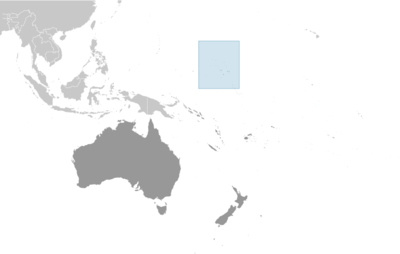
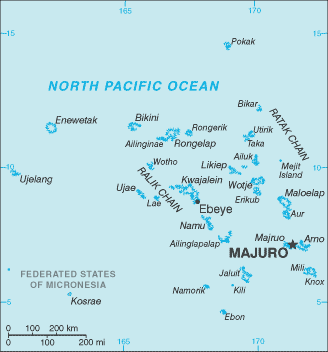
- Oceania, consists of 29 atolls and five isolated islands in the North Pacific Ocean, about halfway between Hawaii and Australia; the atolls and islands are situated in two, almost-parallel island chains - the Ratak (Sunrise) group and the Ralik (Sunset) group; the total number of islands and islets is about 1,225; 22 of the atolls and four of the islands are uninhabited
- Area
- 181 sq km
- Climate
- tropical; hot and humid; wet season May to November; islands border typhoon belt
- Terrain
- low coral limestone and sand islands
- Natural resources
- coconut products, marine products, deep seabed minerals
- Coastline
- 370.4 km
- Natural hazards
- infrequent typhoons
People & society
- Population
- 82,011 (2024 est.)
- Nationality
- Marshallese (singular and plural)
- Ethnic groups
- Marshallese 95.6%, Filipino 1.1%, other 3.3% (2021 est.)
- Languages
- Marshallese (official) 98.2%, other languages 1.8% (1999)
- Religions
- Protestant 79.3% (United Church of Christ 47.9%, Assembly of God 14.1%, Full Gospel 5%, Bukot Nan Jesus 3%, Salvation Army 2.3%, Reformed Congressional Church 2.2%, Seventh Day Adventist 1.7%, New Beginning Church 1.4%, other Protestant 1.6%), Roman Catholic 9.3%, Church of Jesus Christ 5.7%, Jehovah's Witness 1.3%, other 3.3%, none 1.1% (2021 est.)
- Median age
- 25.9 years (2025 est.)
- Life expectancy at birth
- 75.2 years (2024 est.)
- Literacy
- 95.8% (2021 est.)
Economy
- Economic overview
- upper middle-income Pacific island economy; US aid reliance; large public sector; coconut oil production as diesel fuel substitute; growing offshore banking locale; fishing rights seller; import-dependent
- Industries
- copra, tuna processing, tourism, craft items (from seashells, wood, and pearls)
- Agricultural products
- coconuts (2023)
- Exports - partners
- UK 16%, Germany 13%, Denmark 10%, Ghana 9%, Cyprus 9% (2023)
- Imports - partners
- China 47%, Japan 15%, Germany 5%, Brazil 4%, Cyprus 4% (2023)
Government
- Government type
- mixed presidential-parliamentary system in free association with the US
- Capital
- Majuro
- Independence
- 21 October 1986 (from the US-administered UN trusteeship)
- Constitution
- effective 1 May 1979
- Executive branch
- President Hilda C. HEINE (since 3 January 2023)
- Legislative branch
- Parliament (Nitijela)
Full reference data
Every field, by section, CIA World Factbook. Open a topic to expand it.
Introduction
Travel Facts
Please visit the following links to find further information about your desired destination.
World Health Organization (WHO) - To learn what vaccines and health precautions to take while visiting your destination.
US State Dept Travel Information - Overall information about foreign travel for US citizens.
To obtain an international driving permit (IDP). Only two organizations in the US issue IDPs: American Automobile Association (AAA) and American Automobile Touring Alliance (AATA)
How to get help in an emergency? Contact the nearest US embassy or consulate, or call one of these numbers: from the US or Canada - 1-888-407-4747 or from Overseas - +1 202-501-4444
Page last updated: Tuesday, October 18, 2022