
Country exposure · ML
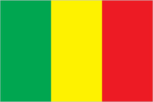
Mali
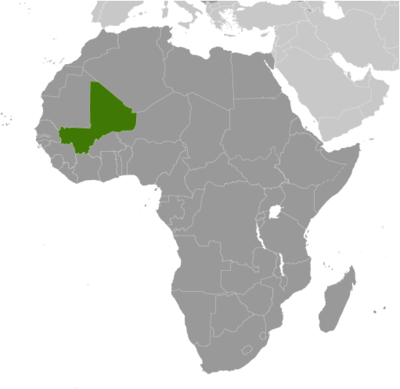
Africa · Bamako · semi-presidential republic
What Mali means for your money, the prices you pay, the tariffs in motion, and where U.S. policy could change both.
$6M
U.S. imports, 2025
+3.1%
change in one year
$34M
U.S. exports, 2025
23M
Population
$26.6B
GDP
In your house
What you buy that Mali makes
America bought $6M in goods from Mali in 2025. Of every $100 of it, here's where the money went.
Synthetic rubber--primary
Other (movies, miscellaneous imports, and special transactions)
Computer accessories
keyboards, drives, computer parts
Semiconductors
semiconductors and chips
U.s. goods returned, and reimports
Artwork, antiques, stamps, etc.
Fruits, frozen juices
fruit and frozen juices
Furniture, household goods, etc.
furniture, mattresses, lamps
Minimum value shipments
Tobacco, waxes, etc.
2026 so far (through July): $2M in imports. Source: U.S. Census Bureau, International Trade in Goods (customs basis).
The other direction
What America sells to Mali
$34M in 2025, a trade rupture cuts both ways, for American producers as well as American prices.
Excavating machinery
$8MPassenger cars, new and used
$4Mnew and used cars
Finished metal shapes
$2MIndustrial engines
$2MTextile, sewing machines
$2MPlastic materials
$2Mplastics for packaging and goods
Telecommunications equipment
$1Mphones, routers, networking gear
Semiconductors
$1Msemiconductors and chips
Industrial machines, other
$1MWhere you stand
U.S. tariff posture toward Mali
No U.S. tariff action singles this country out. Its goods face the universal 10% temporary import surcharge under Section 122 of the Trade Act (which replaced the IEEPA reciprocal baseline in February 2026) plus the sectoral Section 232 duties — steel and aluminum at 50% — that apply to all countries. The Section 122 surcharge is statutorily temporary — scheduled to lapse on or about July 23, 2026 (a 150-day cap) unless extended or replaced.
Reciprocal tariff (universal baseline)
10%
The universal 10% floor, a Section 122 import surcharge since February 2026, previously the EO 14257 reciprocal baseline, applies to nearly all U.S. imports. This country has no higher assigned rate of its own.
Policy in motion
Tariff status: a moving target
No U.S. tariff action names Mali. These are the universal measures, applied to every country without a country-specific arrangement, that set its treatment.
2026-04-06
Section 232 metals coverage expanded
In effectThe April 2026 proclamation strengthening Section 232 actions on aluminum, steel, and copper expanded derivative-product coverage for all countries, keeping the general metals rate at 50%.
91 FR 18201 →2026-02-24
IEEPA reciprocal tariffs terminated — replaced by 10% Section 122 surcharge
In effectExecutive Order 14389 (Ending Certain Tariff Actions) terminated the IEEPA tariff duties — including the EO 14257 reciprocal baseline — effective February 24, 2026. A flat 10% Section 122 temporary import surcharge (Proclamation 11012 of February 20, 2026) replaced them, leaving the universal rate unchanged at 10% on a different statutory basis. Section 122 caps such surcharges at 150 days, so this 10% surcharge is scheduled to lapse on or about July 23, 2026 absent further action (the administration has signaled it could raise the rate toward the 15% statutory maximum).
91 FR 9437 →2025-11-13
Agricultural products exempted from reciprocal tariffs
In effectExecutive Order 14360 of November 14, 2025 removed reciprocal duties from certain agricultural products listed in its annexes (coffee, cocoa, bananas, and other goods the U.S. does not produce in sufficient quantity), retroactive to November 13, 2025 — for all countries subject to the reciprocal tariff.
90 FR 54091 →2025-06-04
Section 232 steel and aluminum duties doubled to 50%
In effectThe June 3, 2025 proclamation raised Section 232 duties on steel and aluminum articles and derivatives from 25% to 50% for all countries, effective June 4, 2025.
90 FR 24199 →2025-04-05
Universal 10% reciprocal baseline takes effect
In effectExecutive Order 14257 (signed April 2, 2025) imposed a 10% ad valorem reciprocal duty on imports from all trading partners, effective April 5, 2025. Countries without a higher Annex I rate remain at this baseline.
Federal Register · 2025-06063 →2025-03-12
Section 232 steel and aluminum duties set at 25% for all countries
In effectProclamations of February 10, 2025 terminated all country exemptions and quota arrangements and applied 25% Section 232 duties to steel and aluminum imports from every country, effective March 12, 2025.
90 FR 9817 →
Reference
The country itself
Africa · Geography, people, economy, and government, public-domain data from the CIA World Factbook.
Present-day Mali is named after the Mali Empire that ruled the region between the 13th and 16th centuries. At its peak in the 14th century, it was the largest and wealthiest empire in West Africa and controlled an area about twice the size of modern-day France. Primarily a trading empire, Mali derived its wealth from gold and maintained several goldfields and trade routes in the Sahel. The empire also influenced West African culture through the spread of its language, laws, and customs, but by the 16th century, it had fragmented into mostly small chiefdoms. The Songhai Empire, previously a Mali dependency centered in Timbuktu, gained prominence in the 15th and 16th centuries. Under Songhai rule, Timbuktu became a large commercial center, well-known for its scholarship and religious teaching. Timbuktu remains a center of culture in West Africa today. In the late 16th century, the Songhai Empire fell to Moroccan invaders and disintegrated into independent sultanates and kingdoms. France, expanding from Senegal, seized control of the area in the 1890s and incorporated it into French West Africa as French Sudan. In 1960, French Sudan gained independence from France and became the Mali Federation. When Senegal withdrew after only a few months, the remaining area was renamed the Republic of Mali. Mali saw 31 years of dictatorship until 1991, when a military coup led by Amadou Toumani TOURE ousted the government, established a new constitution, and instituted a multi-party democracy. Alpha Oumar KONARE won Mali's first two democratic presidential elections in 1992 and 1997. In keeping with Mali's two-term constitutional limit, he stepped down in 2002 and was succeeded by Amadou Toumani TOURE, who won a second term in 2007. In 2012, rising ethnic tensions and an influx of fighters -- some linked to Al-Qa’ida -- from Libya led to a rebellion and military coup. Following the coup, rebels expelled the military from the country’s three northern regions, allowing terrorist organizations to develop strongholds in the area. With a 2013 French-led military intervention, the Malian government managed to retake most of the north. However, the government’s grasp in the region remains weak with local militias, terrorists, and insurgent groups competing for control. In 2015, the Malian Government and northern rebels signed an internationally mediated peace accord. Despite a 2017 target for implementation of the agreement, the signatories have made little progress. Terrorist groups were left out of the peace process, and terrorist attacks remain common. Ibrahim Boubacar KEITA won the Malian presidential elections in 2013 and 2018. Aside from security and logistic shortfalls, international observers deemed these elections credible. Terrorism, banditry, ethnic-based violence, and extra-judicial military killings plagued the country during KEITA’s second term. In 2020, the military arrested KEITA, his prime minister, and other senior members of the government and established a military junta called the National Committee for the Salvation of the People (CNSP). The junta then established a transition government and appointed Bah N’DAW, a retired army officer and former defense minister, as interim president and Colonel Assimi GOITA, the coup leader and chairman of the CNSP, as interim vice president. The transition government’s charter allowed it to rule for up to 18 months before calling a general election. In 2021, GOITA led a military takeover, arresting the interim president after a Cabinet shake-up removed GOITA’s key allies. GOITA was sworn in as transition president, and Choguel Kokalla MAIGA was sworn in as prime minister. In 2022, the Economic Community of West African States (ECOWAS) imposed sanctions on the transition government, and member states closed their borders with Mali after the transition government presented a five-year extension to the electoral calendar. The transition government and ECOWAS agreed to a new two-year timeline, which would have included presidential elections in February 2024, but the transition government postponed the elections indefinitely in September 2023 and withdrew from ECOWAS in January 2024.
Geography
- Location
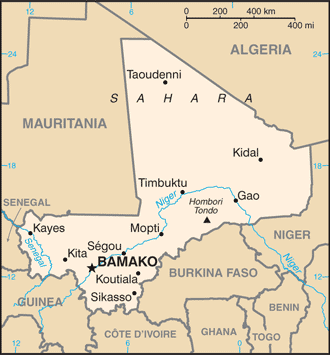
- interior Western Africa, southwest of Algeria, north of Guinea, Cote d'Ivoire, and Burkina Faso, west of Niger
- Area
- 1,240,192 sq km
- Climate
- subtropical to arid; hot and dry (February to June); rainy, humid, and mild (June to November); cool and dry (November to February)
- Terrain
- mostly flat to rolling northern plains covered by sand; savanna in south, rugged hills in northeast
- Natural resources
- gold, phosphates, kaolin, salt, limestone, uranium, gypsum, granite, hydropower
- Coastline
- 0 km (landlocked)
- Natural hazards
- hot, dust-laden harmattan haze common during dry seasons; recurring droughts; occasional Niger River flooding
People & society
- Population
- 22,634,423 (2025 est.)
- Nationality
- Malian(s)
- Ethnic groups
- Bambara 33.3%, Fulani (Peuhl) 13.3%, Sarakole/Soninke/Marka 9.8%, Senufo/Manianka 9.6%, Malinke 8.8%, Dogon 8.7%, Sonrai 5.9%, Bobo 2.1%, Tuareg/Bella 1.7%, other Malian 6%, from members of Economic Community of West Africa 0.4%, other 0.3% (2018 est.)
- Languages
- Bambara (official), French 17.2%, Peuhl/Foulfoulbe/Fulani 9.4%, Dogon 7.2%, Maraka/Soninke 6.4%, Malinke 5.6%, Sonrhai/Djerma 5.6%, Minianka 4.3%, Tamacheq 3.5%, Senoufo 2.6%, Bobo 2.1%, other 6.3%, unspecified 0.7% (2009 est.)
- Religions
- Muslim 93.9%, Christian 2.8%, animist 0.7%, none 2.5% (2018 est.)
- Median age
- 16.5 years (2025 est.)
- Life expectancy at birth
- 63.2 years (2024 est.)
- Literacy
- 35.5% (2018 est.)
Economy
- Economic overview
- low-income Saharan economy; recession due to COVID-19 and political instability; extreme poverty; environmentally fragile; high public debt; agricultural and gold exporter; terrorism and warfare are common
- Industries
- food processing; construction; phosphate and gold mining
- Agricultural products
- maize, rice, millet, sorghum, onions, okra, sugarcane, cotton, mangoes/guavas, sweet potatoes (2023)
- Exports - partners
- UAE 73%, Switzerland 15%, Australia 5%, China 1%, Uganda 1% (2023)
- Imports - partners
- Cote d'Ivoire 25%, Senegal 19%, China 12%, France 5%, Burkina Faso 4% (2023)
Government
- Government type
- semi-presidential republic
- Capital
- Bamako
- Independence
- 22 September 1960 (from France)
- Constitution
- several previous; latest drafted 13 October 2022 and submitted to Transition President Assimi GOITA; final draft completed 1 March 2023; approved by referendum 18 June 2023; validated by Constitutional Court 22 July 2023
- Executive branch
- Transition President Assimi GOITA (since 7 June 2021)
- Legislative branch
- Transitional National Council (Conseil national de transition)
Full reference data
Every field, by section, CIA World Factbook. Open a topic to expand it.
Introduction
Travel Facts
Please visit the following links to find further information about your desired destination.
CDC - To learn what vaccines and health precautions to take while visiting your destination.
US State Dept Travel Information - Overall information about foreign travel for US citizens.
To obtain an international driving permit (IDP). Only two organizations in the US issue IDPs: American Automobile Association (AAA) and American Automobile Touring Alliance (AATA)
How to get help in an emergency? Contact the nearest US embassy or consulate, or call one of these numbers: from the US or Canada - 1-888-407-4747 or from Overseas - +1 202-501-4444
Page last updated: Tuesday, June 18, 2024