
Country exposure · MW
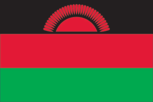
Malawi
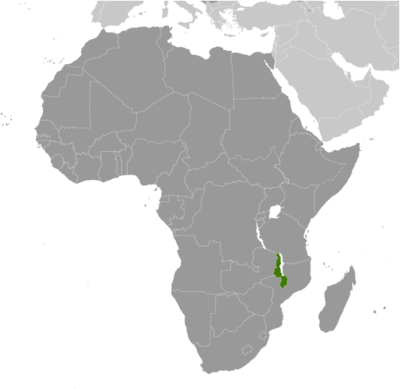
Africa · Lilongwe · presidential republic
What Malawi means for your money, the prices you pay, the tariffs in motion, and where U.S. policy could change both.
$49M
U.S. imports, 2025
+22.4%
change in one year
$24M
U.S. exports, 2025
22M
Population
$11.0B
GDP
In your house
What you buy that Malawi makes
America bought $49M in goods from Malawi in 2025, up 22.4% in a single year. Of every $100 of it, here's where the money went.
Tobacco, waxes, etc.
Nuts
nuts
Tea, spices, etc.
tea and spices
Cane and beet sugar
cane and beet sugar
Footwear
shoes and sneakers
Green coffee
green coffee for roasters
Furniture, household goods, etc.
furniture, mattresses, lamps
Other parts and accessories of vehicles
car parts and accessories
Camping apparel and gear
camping gear and outdoor apparel
Nickel
2026 so far (through July): $35M in imports. Source: U.S. Census Bureau, International Trade in Goods (customs basis).
The other direction
What America sells to Malawi
$24M in 2025, a trade rupture cuts both ways, for American producers as well as American prices.
Minimum value shipments
$4MMiscellaneous domestic exports and special transactions
$3MMedicinal equipment
$2Mmedical devices and equipment
Pharmaceutical preparations
$2Mmedicines and pharmacy items
Telecommunications equipment
$2Mphones, routers, networking gear
Industrial machines, other
$2MChemicals-other
$1MVegetables
$1MFood, tobacco machinery
$904KWhere you stand
U.S. tariff posture toward Malawi
Malawi — one of the world's least-developed economies — was assigned 17% in April 2025, reduced to 15% in August, hitting its tobacco exports (its dominant U.S. export, most of which had entered duty-free under AGOA) hard; tobacco shipments fell sharply. AGOA lapsed in 2025 and was extended short-term on February 3, 2026 through year-end. Executive Order 14389 (Ending Certain Tariff Actions, Feb 20, 2026) terminated the IEEPA reciprocal duties, and Proclamation 11012 replaced it with a 10% Section 122 temporary import surcharge effective February 24, 2026. Malawi has no Section 232 steel/aluminum exposure.
Reciprocal tariff (assigned, terminated)
17%
The rate this country was assigned under the EO 14257 reciprocal Annex, no longer in force. The Supreme Court struck down the IEEPA tariffs and they were terminated February 24, 2026 (EO 14389), replaced by a universal ~10% Section 122 surcharge. See the timeline below for the current effective rate.
Policy in motion
Tariff status: a moving target
U.S. tariff policy toward Malawi has changed 4 times since 2025. This page tracks it.
2026-02-24
IEEPA reciprocal tariffs terminated — replaced by 10% Section 122
In effectExecutive Order 14389 (Ending Certain Tariff Actions) terminated the IEEPA tariff duties effective February 24, 2026, replacing Malawi's 15% reciprocal rate with a 10% Section 122 temporary import surcharge under Proclamation 11012 (capped at 150 days).
91 FR 9437 →2025-08-07
Rate reduced to 15%
In effectExecutive Order 14326 set the post-pause Annex I reciprocal rates; Malawi's rate was lowered from 17% to 15% effective August 7, 2025, weighing on its tobacco exporters as AGOA preferences lapsed.
90 FR 37963 →2025-04-10
Elevated reciprocal rates paused to 10% for 90 days
In effectExecutive Order 14266 suspended the higher country-specific reciprocal rates — including Malawi's 17% — back to the 10% baseline for 90 days.
90 FR 15625 →2025-04-05
Reciprocal tariff regime begins — Malawi assigned 17%
In effectExecutive Order 14257 imposed a 10% universal reciprocal duty effective April 5 and a 17% country-specific rate for Malawi scheduled to take effect April 9, ending duty-free access for tobacco and other goods previously covered by AGOA.
90 FR 15041 →
Made for America
What Malawi makes for America
Malawi is a direct U.S. source of 2 essential goods Americans rely on, the items themselves, shipped finished off the line.
Reference
The country itself
Africa · Geography, people, economy, and government, public-domain data from the CIA World Factbook.
Malawi shares its name with the Chewa word for flames and is linked to the Maravi people from whom the Chewa language originated. The Maravi settled in what is now Malawi around 1400, during one of the later waves of Bantu migration across central and southern Africa. A powerful Maravi kingdom established around 1500 reached its zenith around 1700, when it controlled what is now southern and central Malawi and portions of neighboring Mozambique and Zambia. The kingdom eventually declined because of destabilization from the escalating global trade in enslaved people. In the early 1800s, widespread conflict in southern Africa displaced various ethnic Ngoni groups, some of which moved into Malawi and further undermined the Maravi. Members of the Yao ethnic group -- which had long traded with Malawi from Mozambique -- introduced Islam and began to settle in Malawi in significant numbers in the mid-1800s, followed by members of the Lomwe ethnic group. British missionary and trading activity increased in the area around Lake Nyasa in the mid-1800s, and in 1891, Britain declared a protectorate called British Central Africa over what is now Malawi. The British renamed the territory Nyasaland in 1907, and it was part of the colonial Federation of Rhodesia and Nyasaland -- including present-day Zambia and Zimbabwe -- from 1953 to 1963 before gaining independence as Malawi in 1964. Hastings Kamuzu BANDA served as prime minister at independence and then as president when the country became a republic in 1966. He later instituted one-party rule under his Malawi Congress Party (MCP) and was declared president for life. After three decades of one-party rule, the country held multiparty presidential and parliamentary elections in 1994 under a provisional constitution that came into full effect the following year. Bakili MULUZI of the United Democratic Front party became the first freely elected president of Malawi when he defeated BANDA at the polls in 1994; he won reelection in 1999. President Bingu wa MUTHARIKA was elected in 2004 and reelected to a second term in 2009. He died abruptly in 2012 and was succeeded by Vice President Joyce BANDA. MUTHARIKA's brother, Peter MUTHARIKA, defeated BANDA in the election in 2014. Peter MUTHARIKA was reelected in a disputed election in 2019 that resulted in countrywide protests. The courts ordered a new election, and in 2020, Lazarus CHAKWERA of the MCP was elected president. Population growth, increasing pressure on agricultural lands, corruption, and HIV/AIDS pose major problems for Malawi.
Geography
- Location
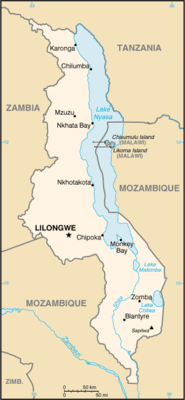
- Southern Africa, east of Zambia, west and north of Mozambique
- Area
- 118,484 sq km
- Climate
- sub-tropical; rainy season (November to May); dry season (May to November)
- Terrain
- narrow elongated plateau with rolling plains, rounded hills, some mountains
- Natural resources
- limestone, arable land, hydropower, unexploited deposits of uranium, coal, and bauxite
- Coastline
- 0 km (landlocked)
- Natural hazards
- flooding; droughts; earthquakes
People & society
- Population
- 21,763,309 (2024 est.)
- Nationality
- Malawian(s)
- Ethnic groups
- Chewa 34.3%, Lomwe 18.8%, Yao 13.2%, Ngoni 10.4%, Tumbuka 9.2%, Sena 3.8%, Mang'anja 3.2%, Tonga 1.8%, Nyanja 1.8%, Nkhonde 1%, other 2.2%, foreign 0.3% (2018 est.)
- Languages
- English (official), Chewa (dominant), Lambya, Lomwe, Ngoni, Nkhonde, Nyakyusa, Nyanja, Sena, Tonga, Tumbuka, Yao
- Religions
- Protestant 33.5% (includes Church of Central Africa Presbyterian 14.2%, Seventh Day Adventist/Baptist 9.4%, Pentecostal 7.6%, Anglican 2.3%), Roman Catholic 17.2%, other Christian 26.6%, Muslim 13.8%, traditionalist 1.1%, other 5.6%, none 2.1% (2018 est.)
- Median age
- 19.4 years (2025 est.)
- Life expectancy at birth
- 73 years (2024 est.)
- Literacy
- 70.2% (2020 est.)
Economy
- Economic overview
- low-income East African economy; primarily agrarian; investing in human capital; urban poverty increasing due to COVID-19; high public debt; endemic corruption and poor property rights; poor hydroelectric grid; localized pharmaceutical industry
- Industries
- tobacco, tea, sugar, sawmill products, cement, consumer goods
- Agricultural products
- sweet potatoes, cassava, maize, sugarcane, mangoes/guavas, potatoes, tomatoes, pigeon peas, pumpkins/squash, plantains (2023)
- Exports - partners
- Germany 11%, India 7%, Zimbabwe 6%, South Africa 5%, USA 5% (2023)
- Imports - partners
- China 17%, South Africa 16%, UAE 12%, India 7%, Tanzania 7% (2023)
Government
- Government type
- presidential republic
- Capital
- Lilongwe
- Independence
- 6 July 1964 (from the UK)
- Constitution
- previous 1953 (pre-independence), 1964, 1966; latest drafted January to May 1994, approved 16 May 1994, entered into force 18 May 1995
- Executive branch
- President Peter MUTHARIKA (since 4 October 2025)
- Legislative branch
- National Assembly
Full reference data
Every field, by section, CIA World Factbook. Open a topic to expand it.
Introduction
Travel Facts
Please visit the following links to find further information about your desired destination.
World Health Organization (WHO) - To learn what vaccines and health precautions to take while visiting your destination.
US State Dept Travel Information - Overall information about foreign travel for US citizens.
To obtain an international driving permit (IDP). Only two organizations in the US issue IDPs: American Automobile Association (AAA) and American Automobile Touring Alliance (AATA)
How to get help in an emergency? Contact the nearest US embassy or consulate, or call one of these numbers: from the US or Canada - 1-888-407-4747 or from Overseas - +1 202-501-4444
Page last updated: Monday, August 08, 2022