
Country exposure · NA
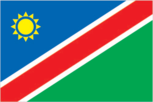
Namibia
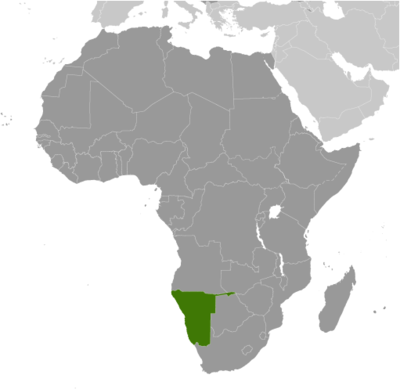
Africa · Windhoek · presidential republic
What Namibia means for your money, the prices you pay, the tariffs in motion, and where U.S. policy could change both.
$271M
U.S. imports, 2025
-1.1%
change in one year
$117M
U.S. exports, 2025
3M
Population
$13.4B
GDP
In your house
What you buy that Namibia makes
America bought $271M in goods from Namibia in 2025. Of every $100 of it, here's where the money went.
Nuclear fuel materials
Gem diamonds
Stone, sand, cement, etc.
cement, stone, sand
U.s. goods returned, and reimports
Fish and shellfish
fish, shrimp, shellfish
Nonagricultural foods, etc.
Minimum value shipments
Gem stones, other
Coal and related fuels
Nontextile floor tiles
2026 so far (through July): $41M in imports. Source: U.S. Census Bureau, International Trade in Goods (customs basis).
The other direction
What America sells to Namibia
$117M in 2025, a trade rupture cuts both ways, for American producers as well as American prices.
Minimum value shipments
$21MChemicals-other
$19MElectric apparatus
$8MIndustrial machines, other
$8MCivilian aircraft, engines, equipment, and parts
$7MPetroleum products, other
$6MFinished metal shapes
$5MExcavating machinery
$5MTelecommunications equipment
$3Mphones, routers, networking gear
Where you stand
U.S. tariff posture toward Namibia
Namibia was assigned 21% in April 2025, reduced to 15% in August without a formal deal. Uranium — its top export (about 29% of the total) — is exempt as a strategic commodity, but diamonds (roughly a fifth of export revenue), beef, and fish were exposed, raising recession concerns. Executive Order 14389 (Ending Certain Tariff Actions, Feb 20, 2026) terminated the IEEPA reciprocal duties, and Proclamation 11012 replaced it with a 10% Section 122 temporary import surcharge effective February 24, 2026; strategic-mineral imports remain exempt. Namibia has no Section 232 steel/aluminum exposure.
Reciprocal tariff (assigned, terminated)
21%
The rate this country was assigned under the EO 14257 reciprocal Annex, no longer in force. The Supreme Court struck down the IEEPA tariffs and they were terminated February 24, 2026 (EO 14389), replaced by a universal ~10% Section 122 surcharge. See the timeline below for the current effective rate.
Policy in motion
Tariff status: a moving target
U.S. tariff policy toward Namibia has changed 4 times since 2025. This page tracks it.
2026-02-24
IEEPA reciprocal tariffs terminated — replaced by 10% Section 122
In effectExecutive Order 14389 (Ending Certain Tariff Actions) terminated the IEEPA tariff duties effective February 24, 2026, replacing Namibia's 15% reciprocal rate with a 10% Section 122 temporary import surcharge under Proclamation 11012 (capped at 150 days); strategic-mineral imports remain exempt.
91 FR 9437 →2025-08-07
Rate reduced to 15%
In effectExecutive Order 14326 set the post-pause Annex I reciprocal rates; Namibia's rate was lowered from 21% to 15% effective August 7, 2025 without a formal deal, with uranium exempt but diamonds, beef, and fish exposed.
90 FR 37963 →2025-04-10
Elevated reciprocal rates paused to 10% for 90 days
In effectExecutive Order 14266 suspended the higher country-specific reciprocal rates — including Namibia's 21% — back to the 10% baseline for 90 days.
90 FR 15625 →2025-04-05
Reciprocal tariff regime begins — Namibia assigned 21%
In effectExecutive Order 14257 imposed a 10% universal reciprocal duty effective April 5 and a 21% country-specific rate for Namibia scheduled to take effect April 9 — with uranium, its leading export, exempt as a strategic commodity.
90 FR 15041 →
Made for America
What Namibia makes for America
Namibia is a direct U.S. source of 2 essential goods Americans rely on, the items themselves, shipped finished off the line.
Go deeper
The supply chain view
Namibia sits upstream of 2 essential American goods through 2 tracked inputs.
Full supply-map profile →Reference
The country itself
Africa · Geography, people, economy, and government, public-domain data from the CIA World Factbook.
Various ethnic groups occupied southwestern Africa prior to Germany establishing a colony over most of the territory in 1884. South Africa occupied the colony, then known as German South West Africa, in 1915 during World War I and administered it as a mandate until after World War II, when it annexed the territory. In 1966, the Marxist South-West Africa People's Organization (SWAPO) guerrilla group launched a war of independence for the area that became Namibia, but it was not until 1988 that South Africa agreed to end its administration in accordance with a UN peace plan for the entire region. Namibia gained independence in 1990, and SWAPO has governed it since, although the party has dropped much of its Marxist ideology. President Hage GEINGOB was elected in 2014 in a landslide victory, replacing Hifikepunye POHAMBA, who stepped down after serving two terms. SWAPO retained its parliamentary super majority in the 2014 elections. In 2019 elections, GEINGOB was reelected but by a substantially reduced majority, and SWAPO narrowly lost its super majority in parliament.
Geography
- Location
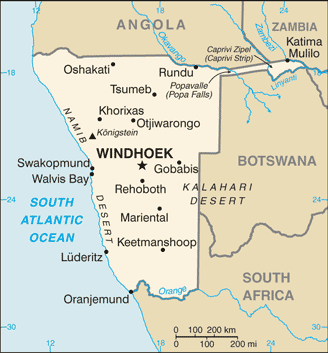
- Southern Africa, bordering the South Atlantic Ocean, between Angola and South Africa
- Area
- 824,292 sq km
- Climate
- desert; hot, dry; rainfall sparse and erratic
- Terrain
- mostly high plateau; Namib Desert along coast; Kalahari Desert in east
- Natural resources
- diamonds, copper, uranium, gold, silver, lead, tin, lithium, cadmium, tungsten, zinc, salt, hydropower, fish
- Coastline
- 1,572 km
- Natural hazards
- prolonged periods of drought
People & society
- Population
- 2,852,777 (2025 est.)
- Nationality
- Namibian(s)
- Ethnic groups
- Ovambo 50%, Kavangos 9%, Herero 7%, Damara 7%, mixed European and African ancestry 6.5%, European 6%, Nama 5%, Caprivian 4%, San 3%, Baster 2%, Tswana 0.5%
- Languages
- Oshiwambo languages 49.7%, Nama/Damara 11%, Kavango languages 10.4%, Afrikaans 9.4%, Herero languages 9.2%, Zambezi languages 4.9%, English (official) 2.3%, other African languages 1.5%, other European languages 0.7%, other 1% (2016 est.)
- Religions
- Christian 97.5%, other 0.6% (includes Muslim, Baha'i, Jewish, Buddhist), unaffiliated 1.9% (2020 est.)
- Median age
- 23.1 years (2025 est.)
- Life expectancy at birth
- 65.9 years (2024 est.)
- Literacy
- 87.6% (2023 est.)
Economy
- Economic overview
- upper middle-income, export-driven Sub-Saharan economy; natural resource rich; Walvis Bay port expansion for trade; high potential for renewable power generation and energy independence; major nature-based tourist locale; natural resource rich; shortage of skilled labor
- Industries
- mining, tourism, fishing, agriculture
- Agricultural products
- root vegetables, milk, maize, beef, grapes, onions, wheat, fruits, pulses, vegetables (2023)
- Exports - partners
- South Africa 27%, China 12%, Botswana 8%, Belgium 7%, France 5% (2023)
- Imports - partners
- South Africa 36%, China 9%, India 7%, UAE 4%, USA 3% (2023)
Government
- Government type
- presidential republic
- Capital
- Windhoek
- Independence
- 21 March 1990 (from South African mandate)
- Constitution
- adopted 9 February 1990, entered into force 21 March 1990
- Executive branch
- President Netumbo NANDI-NDAITWAH (since 21 March 2025)
- Legislative branch
- Parliament
Full reference data
Every field, by section, CIA World Factbook. Open a topic to expand it.
Introduction
Travel Facts
Please visit the following links to find further information about your desired destination.
World Health Organization (WHO) - To learn what vaccines and health precautions to take while visiting your destination.
US State Dept Travel Information - Overall information about foreign travel for US citizens.
To obtain an international driving permit (IDP). Only two organizations in the US issue IDPs: American Automobile Association (AAA) and American Automobile Touring Alliance (AATA)
How to get help in an emergency? Contact the nearest US embassy or consulate, or call one of these numbers: from the US or Canada - 1-888-407-4747 or from Overseas - +1 202-501-4444
Page last updated: Tuesday, August 23, 2022