
Country exposure · NC
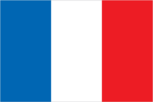
New Caledonia
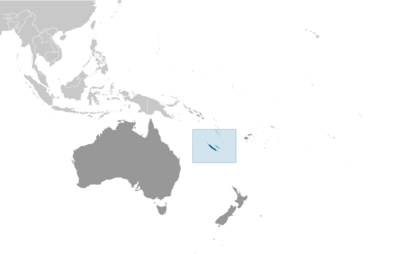
Australia Oceania · Noumea · parliamentary democracy (Territorial Congress); an overseas collectivity of France
What New Caledonia means for your money, the prices you pay, the tariffs in motion, and where U.S. policy could change both.
$31M
U.S. imports, 2025
-8.3%
change in one year
$118M
U.S. exports, 2025
308K
Population
$10.1B
GDP
In your house
What you buy that New Caledonia makes
America bought $31M in goods from New Caledonia in 2025. Of every $100 of it, here's where the money went.
Steelmaking materials
Fish and shellfish
fish, shrimp, shellfish
Synthetic rubber--primary
U.s. goods returned, and reimports
Other parts and accessories of vehicles
car parts and accessories
Other (movies, miscellaneous imports, and special transactions)
Minimum value shipments
Tobacco, waxes, etc.
Other consumer nondurables
Computers
laptops, desktops, monitors
2026 so far (through July): $25M in imports. Source: U.S. Census Bureau, International Trade in Goods (customs basis).
The other direction
What America sells to New Caledonia
$118M in 2025, a trade rupture cuts both ways, for American producers as well as American prices.
Nonmetallic minerals
$77MMinimum value shipments
$22MMeat, poultry, etc.
$3MTelecommunications equipment
$3Mphones, routers, networking gear
Chemicals-other
$2MCivilian aircraft, engines, equipment, and parts
$2MIndustrial machines, other
$893KOther foods
$727KOther industrial supplies
$674KWhere you stand
U.S. tariff posture toward New Caledonia
No U.S. tariff action singles this country out. Its goods face the universal 10% temporary import surcharge under Section 122 of the Trade Act (which replaced the IEEPA reciprocal baseline in February 2026) plus the sectoral Section 232 duties — steel and aluminum at 50% — that apply to all countries. The Section 122 surcharge is statutorily temporary — scheduled to lapse on or about July 23, 2026 (a 150-day cap) unless extended or replaced.
Reciprocal tariff (universal baseline)
10%
The universal 10% floor, a Section 122 import surcharge since February 2026, previously the EO 14257 reciprocal baseline, applies to nearly all U.S. imports. This country has no higher assigned rate of its own.
Policy in motion
Tariff status: a moving target
No U.S. tariff action names New Caledonia. These are the universal measures, applied to every country without a country-specific arrangement, that set its treatment.
2026-04-06
Section 232 metals coverage expanded
In effectThe April 2026 proclamation strengthening Section 232 actions on aluminum, steel, and copper expanded derivative-product coverage for all countries, keeping the general metals rate at 50%.
91 FR 18201 →2026-02-24
IEEPA reciprocal tariffs terminated — replaced by 10% Section 122 surcharge
In effectExecutive Order 14389 (Ending Certain Tariff Actions) terminated the IEEPA tariff duties — including the EO 14257 reciprocal baseline — effective February 24, 2026. A flat 10% Section 122 temporary import surcharge (Proclamation 11012 of February 20, 2026) replaced them, leaving the universal rate unchanged at 10% on a different statutory basis. Section 122 caps such surcharges at 150 days, so this 10% surcharge is scheduled to lapse on or about July 23, 2026 absent further action (the administration has signaled it could raise the rate toward the 15% statutory maximum).
91 FR 9437 →2025-11-13
Agricultural products exempted from reciprocal tariffs
In effectExecutive Order 14360 of November 14, 2025 removed reciprocal duties from certain agricultural products listed in its annexes (coffee, cocoa, bananas, and other goods the U.S. does not produce in sufficient quantity), retroactive to November 13, 2025 — for all countries subject to the reciprocal tariff.
90 FR 54091 →2025-06-04
Section 232 steel and aluminum duties doubled to 50%
In effectThe June 3, 2025 proclamation raised Section 232 duties on steel and aluminum articles and derivatives from 25% to 50% for all countries, effective June 4, 2025.
90 FR 24199 →2025-04-05
Universal 10% reciprocal baseline takes effect
In effectExecutive Order 14257 (signed April 2, 2025) imposed a 10% ad valorem reciprocal duty on imports from all trading partners, effective April 5, 2025. Countries without a higher Annex I rate remain at this baseline.
Federal Register · 2025-06063 →2025-03-12
Section 232 steel and aluminum duties set at 25% for all countries
In effectProclamations of February 10, 2025 terminated all country exemptions and quota arrangements and applied 25% Section 232 duties to steel and aluminum imports from every country, effective March 12, 2025.
90 FR 9817 →
Reference
The country itself
Australia Oceania · Geography, people, economy, and government, public-domain data from the CIA World Factbook.
The first humans settled in New Caledonia around 1600 B.C. The Lapita were skilled navigators, and evidence of their pottery around the Pacific has served as a guide for understanding human expansion in the region. Successive waves of migrants from other islands in Melanesia intermarried with the Lapita, giving rise to the Kanak ethnic group considered indigenous to New Caledonia. British explorer James COOK was the first European to visit New Caledonia in 1774, giving it the Latin name for Scotland. Missionaries first landed in New Caledonia in 1840. In 1853, France annexed New Caledonia to preclude any British attempt to claim the island. France declared it a penal colony in 1864 and sent more than 20,000 prisoners to New Caledonia in the ensuing three decades. Nickel was discovered in 1864, and French prisoners were directed to mine it. France brought in indentured servants and enslaved labor from elsewhere in Southeast Asia to work the mines, blocking Kanaks from accessing the most profitable part of the local economy. In 1878, High Chief ATAI led a rebellion against French rule. The Kanaks were relegated to reservations, leading to periodic smaller uprisings and culminating in a large revolt in 1917 that colonial authorities brutally suppressed. During World War II, New Caledonia became an important base for Allied troops, and the US moved its South Pacific headquarters to the island in 1942. Following the war, France made New Caledonia an overseas territory and granted French citizenship to all inhabitants in 1953, thereby permitting the Kanaks to move off the reservations. The Kanak nationalist movement began in the 1950s, but most voters chose to remain a territory in an independence referendum in 1958. The European population of New Caledonia boomed in the 1970s with a renewed focus on nickel mining, reigniting Kanak nationalism. Key Kanak leaders were assassinated in the early 1980s, leading to escalating violence and dozens of fatalities. The Matignon Accords of 1988 provided for a 10-year transition period. The Noumea Accord of 1998 transferred increasing governing responsibility from France to New Caledonia over a 20-year period and provided for three independence referenda. In the first held in 2018, voters rejected independence by 57% to 43%; in the second held in 2020, voters rejected independence 53% to 47%. In the third referendum held in 2021, voters rejected independence 96% to 4%; however, a boycott by key Kanak groups spurred challenges about the legitimacy of the vote. Pro-independence parties subsequently won a majority in the New Caledonian Government for the first time. France and New Caledonia officials remain in talks about the status of the territory.
Geography
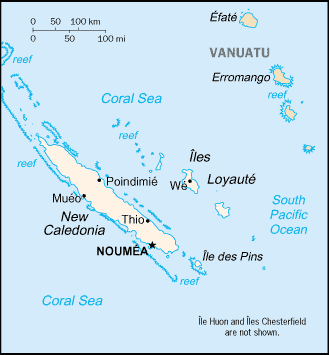
- Location
- Oceania, islands in the South Pacific Ocean, east of Australia
- Area
- 18,575 sq km
- Climate
- tropical; modified by southeast trade winds; hot, humid
- Terrain
- coastal plains with interior mountains
- Natural resources
- nickel, chrome, iron, cobalt, manganese, silver, gold, lead, copper
- Coastline
- 2,254 km
- Natural hazards
- cyclones, most frequent from November to March volcanism: Matthew and Hunter Islands are historically active
People & society
- Population
- 307,612 (2025 est.)
- Nationality
- New Caledonian(s)
- Ethnic groups
- Kanak 39.1%, European 27.1%, Wallisian, Futunian 8.2%, Tahitian 2.1%, Indonesian 1.4%, Ni-Vanuatu 1%, Vietnamese 0.9%, other 17.7%, unspecified 2.5% (2014 est.)
- Languages
- French (official), 33 Melanesian-Polynesian dialects
- Religions
- Christian 85.2%, Muslim 2.8%, other 1.6%, unaffiliated 10.4% (2020 est.)
- Median age
- 34.6 years (2025 est.)
- Life expectancy at birth
- 79.3 years (2024 est.)
Economy
- Economic overview
- upper-middle-income French Pacific territorial economy; enormous nickel reserves; ongoing French independence negotiations; large Chinese nickel exporter; luxury eco-tourism destination; large French aid recipient; high cost-of-living; lingering wealth disparities
- Industries
- nickel mining and smelting
- Agricultural products
- coconuts, vegetables, fruits, pork, beef, maize, eggs, bananas, yams, oranges (2023)
- Exports - partners
- China 75%, Japan 9%, Taiwan 3%, India 3%, France 2% (2023)
- Imports - partners
- France 36%, Singapore 16%, Australia 15%, China 6%, NZ 3% (2023)
Government
- Government type
- parliamentary democracy (Territorial Congress); an overseas collectivity of France
- Capital
- Noumea
- Independence
- none (overseas collectivity of France)
- Constitution
- 4 October 1958 (French Constitution with changes as reflected in the Noumea Accord of 5 May 1998)
- Executive branch
- President Emmanuel MACRON (since 14 May 2017); represented by High Commissioner Jacques BILLANT (since 3 May 2025)
- Legislative branch
- Territorial Congress (Congrès du Territoire)
Full reference data
Every field, by section, CIA World Factbook. Open a topic to expand it.
Introduction
Travel Facts
Please visit the following links to find further information about your desired destination.
World Health Organization (WHO) - To learn what vaccines and health precautions to take while visiting your destination.
US State Dept Travel Information - Overall information about foreign travel for US citizens.
To obtain an international driving permit (IDP). Only two organizations in the US issue IDPs: American Automobile Association (AAA) and American Automobile Touring Alliance (AATA)
How to get help in an emergency? Contact the nearest US embassy or consulate, or call one of these numbers: from the US or Canada - 1-888-407-4747 or from Overseas - +1 202-501-4444
Page last updated: Wednesday, July 20, 2022