
Country exposure · NF

Norfolk Island
Australia Oceania · Kingston · administered as an overseas territory of Australia
What Norfolk Island means for your money, the prices you pay, the tariffs in motion, and where U.S. policy could change both.
$3K
U.S. imports, 2024
-35.1%
change in one year
$0K
U.S. exports, 2024
2K
Population
In your house
What you buy that Norfolk Island makes
America bought $3K in goods from Norfolk Island in 2024, down 35.1% in a single year. Of every $100 of it, here's where the money went.
Minimum value shipments
Where you stand
U.S. tariff posture toward Norfolk Island
No U.S. tariff action singles this country out. Its goods face the universal 10% temporary import surcharge under Section 122 of the Trade Act (which replaced the IEEPA reciprocal baseline in February 2026) plus the sectoral Section 232 duties — steel and aluminum at 50% — that apply to all countries. The Section 122 surcharge is statutorily temporary — scheduled to lapse on or about July 23, 2026 (a 150-day cap) unless extended or replaced.
Reciprocal tariff (universal baseline)
10%
The universal 10% floor, a Section 122 import surcharge since February 2026, previously the EO 14257 reciprocal baseline, applies to nearly all U.S. imports. This country has no higher assigned rate of its own.
Policy in motion
Tariff status: a moving target
No U.S. tariff action names Norfolk Island. These are the universal measures, applied to every country without a country-specific arrangement, that set its treatment.
2026-04-06
Section 232 metals coverage expanded
In effectThe April 2026 proclamation strengthening Section 232 actions on aluminum, steel, and copper expanded derivative-product coverage for all countries, keeping the general metals rate at 50%.
91 FR 18201 →2026-02-24
IEEPA reciprocal tariffs terminated — replaced by 10% Section 122 surcharge
In effectExecutive Order 14389 (Ending Certain Tariff Actions) terminated the IEEPA tariff duties — including the EO 14257 reciprocal baseline — effective February 24, 2026. A flat 10% Section 122 temporary import surcharge (Proclamation 11012 of February 20, 2026) replaced them, leaving the universal rate unchanged at 10% on a different statutory basis. Section 122 caps such surcharges at 150 days, so this 10% surcharge is scheduled to lapse on or about July 23, 2026 absent further action (the administration has signaled it could raise the rate toward the 15% statutory maximum).
91 FR 9437 →2025-11-13
Agricultural products exempted from reciprocal tariffs
In effectExecutive Order 14360 of November 14, 2025 removed reciprocal duties from certain agricultural products listed in its annexes (coffee, cocoa, bananas, and other goods the U.S. does not produce in sufficient quantity), retroactive to November 13, 2025 — for all countries subject to the reciprocal tariff.
90 FR 54091 →2025-06-04
Section 232 steel and aluminum duties doubled to 50%
In effectThe June 3, 2025 proclamation raised Section 232 duties on steel and aluminum articles and derivatives from 25% to 50% for all countries, effective June 4, 2025.
90 FR 24199 →2025-04-05
Universal 10% reciprocal baseline takes effect
In effectExecutive Order 14257 (signed April 2, 2025) imposed a 10% ad valorem reciprocal duty on imports from all trading partners, effective April 5, 2025. Countries without a higher Annex I rate remain at this baseline.
Federal Register · 2025-06063 →2025-03-12
Section 232 steel and aluminum duties set at 25% for all countries
In effectProclamations of February 10, 2025 terminated all country exemptions and quota arrangements and applied 25% Section 232 duties to steel and aluminum imports from every country, effective March 12, 2025.
90 FR 9817 →
Reference
The country itself
Australia Oceania · Geography, people, economy, and government, public-domain data from the CIA World Factbook.
Polynesians lived on Norfolk Island between 1200 and 1500, but the remote island was uninhabited by the time British explorer James COOK landed on the island in 1774. Two British attempts at establishing the island as a penal colony (1788-1814 and 1825-55) were ultimately abandoned. In 1856, almost 200 Pitcairn Islanders -- descendants of the Bounty mutineers and their Tahitian companions -- were relocated to Norfolk Island because of overcrowding on the Pitcairn Islands. Some returned to the Pitcairn Islands over the next few years, but most settled permanently on Norfolk Island and recreated their previous land tenure and governance structures. Norfolk Island retained a great degree of local control until 1897, when it became a dependency of New South Wales. During World War II, Norfolk Island was an airbase and an important refueling stop in the South Pacific. In 1976, an Australian judge recommended Norfolk Island be incorporated fully into Australia, which Norfolk Islanders rejected. After an appeal to the UN, Australia granted limited self-government to Norfolk Island in 1979. With growing financial troubles during the 2000s, Australia abolished the Norfolk Island Legislative Assembly in 2015, reduced Norfolk Island’s autonomy in 2016, and suspended the local council in 2020. Most services are provided by a mix of the Australian Capital Territory and the states of New South Wales and Queensland. These moves were unpopular on Norfolk Island, which has sought to have its self-government restored and as of 2024, the Australian Government was working with Norfolk Island to establish a new local governing body.
Geography
- Location
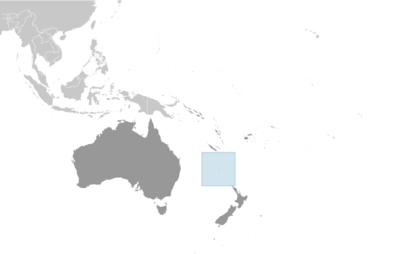
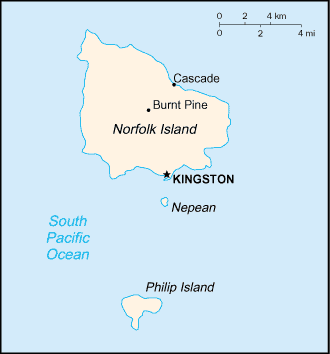
- Oceania, island in the South Pacific Ocean, east of Australia
- Area
- 36 sq km
- Climate
- subtropical; mild, little seasonal temperature variation
- Terrain
- volcanic island with mostly rolling plains
- Natural resources
- fish
- Coastline
- 32 km
- Natural hazards
- tropical cyclones (especially May to July)
People & society
- Population
- 1,739 (2021)
- Nationality
- Norfolk Islander(s)
- Ethnic groups
- Australian 22.8%, English 22.4%, Pitcairn Islander 20%, Scottish 6%, Irish 5.2% (2011 est.)
- Languages
- English (official) 44.9%, Norfolk (official, a mixture of 18th century English and ancient Tahitian) 40.3%, Fijian 1.8%, other 6.8%, unspecified 6.2% (2016 est.)
- Religions
- Protestant 46.8% (Anglican 29.2%, Uniting Church in Australia 9.8%, Presbyterian 2.9%, Seventh Day Adventist 2.7%, other 2.2%), Roman Catholic 12.6%, other Christian 2.9%, other 1.4%, none 26.7%, unspecified 9.5% (2016 est.)
Economy
- Economic overview
- high-income Australian territorial economy; key tourism and re-exportation industries; small labor force and declining participation creating more part-time jobs; former tax haven; increasing medical cannabis exporter; little transportation infrastructure
- Industries
- tourism, light industry, ready mixed concrete
- Agricultural products
- Norfolk Island pine seed, Kentia palm seed, cereals, vegetables, fruit; cattle, poultry
- Exports - partners
- USA 31%, Belgium 9%, Philippines 7%, Israel 6%, Singapore 6% (2023)
- Imports - partners
- Australia 52%, Fiji 13%, NZ 12%, Saudi Arabia 12%, Malaysia 5% (2023)
Government
- Government type
- administered as an overseas territory of Australia
- Capital
- Kingston
- Independence
- none (territory of Australia)
- Constitution
- previous 1913, 1957; latest effective 7 August 1979
- Executive branch
- King CHARLES III (since 8 September 2022); represented by Governor General of the Commonwealth of Australia General Sam MOSTYN (since 1 July 2024)
- Legislative branch
- Norfolk Island Regional Council
Full reference data
Every field, by section, CIA World Factbook. Open a topic to expand it.
Introduction
Travel Facts
Please visit the following links to find further information about your desired destination.
World Health Organization (WHO) - To learn what vaccines and health precautions to take while visiting your destination.
US State Dept Travel Information - Overall information about foreign travel for US citizens.
To obtain an international driving permit (IDP). Only two organizations in the US issue IDPs: American Automobile Association (AAA) and American Automobile Touring Alliance (AATA)
How to get help in an emergency? Contact the nearest US embassy or consulate, or call one of these numbers: from the US or Canada - 1-888-407-4747 or from Overseas - +1 202-501-4444
Page last updated: Wednesday, July 20, 2022