Country exposure · NR

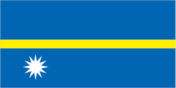
Flag of Nauru

Nauru

Australia Oceania · no official capital; government offices in the Yaren District · parliamentary republic

What Nauru means for your money — the prices you pay, the tariffs in motion, and where U.S. policy could change both.
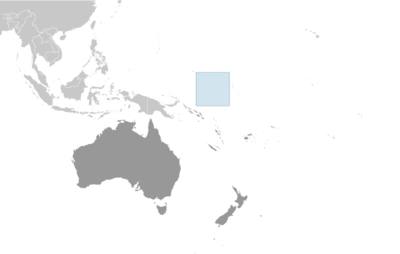
Map showing the location of Nauru

$166K

U.S. imports, 2025

-92.6%

change in one year

$1M

U.S. exports, 2025

10K

Population

$160M

GDP

In your house

What you buy that Nauru makes

America bought $166K in goods from Nauru in 2025 — down 92.6% in a single year. Of every $100 of it, here's where the money went.

Industrial machines, other

$41K24.9%

Pulp and paper machinery

$31K18.4%

Minimum value shipments

$28K16.7%

Agricultural machinery, equipment

$12K7.3%

Toys, games, and sporting goods

toys, games, sporting goods

$12K7%

Apparel, household goods - wool

wool sweaters and coats

$10K6%

U.s. goods returned, and reimports

$9K5.3%

Measuring, testing, control instruments

$6K3.9%

Shingles, wallboard

$5K3%

Motorcycles and parts

motorcycles and parts

$5K2.7%

2026 so far (through April): $11K in imports. Source: U.S. Census Bureau, International Trade in Goods (customs basis).

The other direction

What America sells to Nauru

$1M in 2025 — a trade rupture cuts both ways, for American producers as well as American prices.

Meat, poultry, etc.

$720K

Telecommunications equipment

$341K

phones, routers, networking gear

Minimum value shipments

$65K

Other foods

$40K

Fish and shellfish

$34K

fish, shrimp, shellfish

Civilian aircraft, engines, equipment, and parts

$20K

Toys, games, and sporting goods

$15K

toys, games, sporting goods

Computers

$7K

laptops, desktops, monitors

Other industrial supplies

$5K

Where you stand

U.S. tariff posture toward Nauru

Nauru — one of the world's smallest economies, with minimal trade with the U.S. — was assigned 30% in April 2025 and retained that rate through August with no bilateral deal. Executive Order 14389 (Ending Certain Tariff Actions, Feb 20, 2026) terminated the IEEPA reciprocal duties, and Proclamation 11012 replaced it with a 10% Section 122 temporary import surcharge effective February 24, 2026. Nauru has no Section 232 steel/aluminum exposure.

Reciprocal tariff (assigned — terminated)

30%

The rate this country was assigned under the EO 14257 reciprocal Annex — no longer in force. The Supreme Court struck down the IEEPA tariffs and they were terminated February 24, 2026 (EO 14389), replaced by a universal ~10% Section 122 surcharge. See the timeline below for the current effective rate.

Policy in motion

Tariff status: a moving target

U.S. tariff policy toward Nauru has changed 4 times since 2025. This page tracks it.

  1. 2026-02-24

    IEEPA reciprocal tariffs terminated — replaced by 10% Section 122

    In effect

    Executive Order 14389 (Ending Certain Tariff Actions) terminated the IEEPA tariff duties effective February 24, 2026, replacing Nauru's 30% reciprocal rate with a 10% Section 122 temporary import surcharge under Proclamation 11012 (capped at 150 days).

    91 FR 9437
  2. 2025-08-07

    30% rate takes effect — no deal reached

    In effect

    Executive Order 14326 set the post-pause Annex I reciprocal rates; with no bilateral agreement, Nauru's 30% reciprocal rate took effect August 7, 2025.

    90 FR 37963
  3. 2025-04-10

    Elevated reciprocal rates paused to 10% for 90 days

    In effect

    Executive Order 14266 suspended the higher country-specific reciprocal rates — including Nauru's 30% — back to the 10% baseline for 90 days.

    90 FR 15625
  4. 2025-04-05

    Reciprocal tariff regime begins — Nauru assigned 30%

    In effect

    Executive Order 14257 imposed a 10% universal reciprocal duty effective April 5 and a 30% country-specific rate for Nauru scheduled to take effect April 9 under Annex I.

    90 FR 15041

Reference

The country itself

Australia Oceania · Geography, people, economy, and government — public-domain data from the CIA World Factbook.

By 1000 B.C., Micronesian and Polynesian settlers inhabited Nauru, and the island was divided among 12 clans. Nauru developed in relative isolation because ocean currents made landfall on the island difficult. As a result, the Nauruan language does not clearly resemble any other in the Pacific region. In 1798, a British mariner was the first European to spot the island and by 1830, European whalers used Nauru as a supply stop, trading firearms for food. A civil war in 1878 reduced the population by more than a third. Germany forcibly annexed Nauru in 1888 by holding the 12 chiefs under house arrest until they consented to the annexation. Phosphate was discovered in 1900 and was heavily mined, although Nauru and Nauruans earned about one tenth of one percent of the profits from the phosphate deposits. Australian forces captured Nauru from Germany during World War I, and in 1919, it was placed under a joint Australian-British-New Zealand mandate with Australian administration. Japan occupied Nauru during World War II and used its residents as forced labor elsewhere in the Pacific while destroying much of the infrastructure on the island. After the war, Nauru became a UN trust territory under Australian administration. In 1962, recognizing the phosphate stocks would eventually be depleted, Australian Prime Minister Robert MENZIES offered to resettle all Nauruans on Curtis Island in Queensland, but Nauruans rejected that plan and opted for independence, which was achieved in 1968. In 1970, Nauru purchased the phosphate mining assets, and income from the mines made Nauruans among the richest people in the world. However, a series of unwise investments led to near bankruptcy by 2000. Widespread phosphate mining officially ceased in 2006. As its economy faltered, Nauru briefly tried to rebrand itself as an offshore banking haven, an initiative that ended in 2005, and the country made a successful bid for Russian humanitarian aid in 2008. In 2001, Australia set up the Nauru Regional Processing Center (NRPC), an offshore refugee detention facility, paying Nauru per person at the center. The NRPC closed in 2008 but reopened in 2012. The number of refugees steadily declined after 2014, and in 2020, the remaining people were moved to Brisbane, Australia, effectively shuttering the NRPC. However, in 2023, Australia agreed to continue funding NRPC for two years and restarted settling asylees in the center in mid-2023. The center remains the Government of Nauru’s largest source of income.
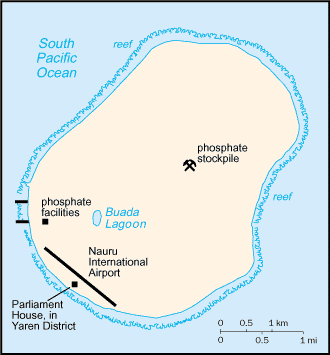
Regional map of Nauru

Geography

Location
Oceania, island in the South Pacific Ocean, south of the Marshall Islands
Area
21 sq km
Climate
tropical with a monsoonal pattern; rainy season (November to February)
Terrain
sandy beach rises to fertile ring around raised coral reefs with phosphate plateau in center
Natural resources
phosphates, fish
Coastline
30 km
Natural hazards
periodic droughts

People & society

Population
9,930 (2025 est.)
Nationality
Nauruan(s)
Ethnic groups
Nauruan 94.6%, I-Kiribati 2.2%, Fijian 1.3%, other 1.9% (2021 est.)
Languages
Nauruan 93% (official, a distinct Pacific Island language), English 2% (widely understood, spoken, and used for most government and commercial purposes), other 5% (includes Gilbertese 2% and Chinese 2%) (2011 est.)
Religions
Protestant 60.4% (Nauruan Congregational 34.7%, Assemblies of God 11.6%, Pacific Light House 6.3%, Nauru Independent 3.6%, Baptist 1.5, Seventh Day Adventist 1.3%, other Protestant 1.4%), Roman Catholic 33.9%, other 4.2%, none 1.3%, no answer 0.3% (2021 est.)
Median age
28.2 years (2025 est.)
Life expectancy at birth
68.6 years (2024 est.)
Literacy
96.6% (2023 est.)

Economy

Economic overview
upper-middle-income Pacific island country; phosphate resource exhaustion made island interior uninhabitable; licenses fishing rights; houses Australia’s Regional Processing Centre; former tax haven; largely dependent on foreign subsidies
Industries
phosphate mining, offshore banking, coconut products
Agricultural products
coconuts, tropical fruits, pork, eggs, pork offal, pork fat, chicken, papayas, vegetables, cabbages (2023)
Exports - partners
Thailand 78%, Philippines 11%, NZ 5%, Japan 1%, Canada 1% (2023)
Imports - partners
Australia 50%, Japan 11%, Fiji 9%, Senegal 9%, China 9% (2023)

Government

Government type
parliamentary republic
Capital
no official capital; government offices in the Yaren District
Independence
31 January 1968 (from the Australia-, NZ-, and UK-administered UN trusteeship)
Constitution
effective 29 January 1968
Executive branch
President David ADEANG (since 30 October 2023)
Legislative branch
Parliament

Full reference data

Every field, by section — CIA World Factbook. Open a topic to expand it.

Introduction
Background
By 1000 B.C., Micronesian and Polynesian settlers inhabited Nauru, and the island was divided among 12 clans. Nauru developed in relative isolation because ocean currents made landfall on the island difficult. As a result, the Nauruan language does not clearly resemble any other in the Pacific region. In 1798, a British mariner was the first European to spot the island and by 1830, European whalers used Nauru as a supply stop, trading firearms for food. A civil war in 1878 reduced the population by more than a third. Germany forcibly annexed Nauru in 1888 by holding the 12 chiefs under house arrest until they consented to the annexation. Phosphate was discovered in 1900 and was heavily mined, although Nauru and Nauruans earned about one tenth of one percent of the profits from the phosphate deposits. Australian forces captured Nauru from Germany during World War I, and in 1919, it was placed under a joint Australian-British-New Zealand mandate with Australian administration. Japan occupied Nauru during World War II and used its residents as forced labor elsewhere in the Pacific while destroying much of the infrastructure on the island. After the war, Nauru became a UN trust territory under Australian administration. In 1962, recognizing the phosphate stocks would eventually be depleted, Australian Prime Minister Robert MENZIES offered to resettle all Nauruans on Curtis Island in Queensland, but Nauruans rejected that plan and opted for independence, which was achieved in 1968. In 1970, Nauru purchased the phosphate mining assets, and income from the mines made Nauruans among the richest people in the world. However, a series of unwise investments led to near bankruptcy by 2000. Widespread phosphate mining officially ceased in 2006. As its economy faltered, Nauru briefly tried to rebrand itself as an offshore banking haven, an initiative that ended in 2005, and the country made a successful bid for Russian humanitarian aid in 2008. In 2001, Australia set up the Nauru Regional Processing Center (NRPC), an offshore refugee detention facility, paying Nauru per person at the center. The NRPC closed in 2008 but reopened in 2012. The number of refugees steadily declined after 2014, and in 2020, the remaining people were moved to Brisbane, Australia, effectively shuttering the NRPC. However, in 2023, Australia agreed to continue funding NRPC for two years and restarted settling asylees in the center in mid-2023. The center remains the Government of Nauru’s largest source of income.
Geography
Location
Oceania, island in the South Pacific Ocean, south of the Marshall Islands
Geographic coordinates
0 32 S, 166 55 E
Map references
Oceania
Area - total
21 sq km
Area - land
21 sq km
Area - water
0 sq km
Area - comparative
about 0.1 times the size of Washington, D.C.
Land boundaries - total
0 km
Coastline
30 km
Maritime claims - territorial sea
12 nm
Maritime claims - contiguous zone
24 nm
Maritime claims - exclusive economic zone
200 nm
Climate
tropical with a monsoonal pattern; rainy season (November to February)
Terrain
sandy beach rises to fertile ring around raised coral reefs with phosphate plateau in center
Elevation - highest point
Command Ridge 70 m
Elevation - lowest point
Pacific Ocean 0 m
Natural resources
phosphates, fish
Land use - agricultural land
20% (2023 est.)
Land use - agricultural land: arable land
arable land: 0% (2022 est.)
Land use - agricultural land: permanent crops
permanent crops: 20% (2023 est.)
Land use - agricultural land: permanent pasture
permanent pasture: 0% (2022 est.)
Land use - forest
0% (2022 est.)
Land use - other
80% (2023 est.)
Irrigated land
0 sq km (2022)
Population distribution
most people live in the fertile coastal areas, especially along the southwest coast
Natural hazards
periodic droughts
Geography - note
Nauru is the third-smallest country in the world behind the Holy See (Vatican City) and Monaco; it is the smallest country in the Pacific Ocean, the smallest country outside Europe, the world's smallest island country, and the world's smallest independent republic; situated just 53 km south of the equator, Nauru is one of the three great phosphate rock islands in the Pacific Ocean -- the others are Banaba (Ocean Island) in Kiribati and Makatea in French Polynesia
People and Society
Population - total
9,930 (2025 est.)
Population - male
4,874
Population - female
5,056
Nationality - noun
Nauruan(s)
Nationality - adjective
Nauruan
Ethnic groups
Nauruan 94.6%, I-Kiribati 2.2%, Fijian 1.3%, other 1.9% (2021 est.)
Languages
Nauruan 93% (official, a distinct Pacific Island language), English 2% (widely understood, spoken, and used for most government and commercial purposes), other 5% (includes Gilbertese 2% and Chinese 2%) (2011 est.)
Languages - note
note: data represent main language spoken at home; Nauruan is spoken by 95% of the population, English by 66%, and other languages by 12%
Religions
Protestant 60.4% (Nauruan Congregational 34.7%, Assemblies of God 11.6%, Pacific Light House 6.3%, Nauru Independent 3.6%, Baptist 1.5, Seventh Day Adventist 1.3%, other Protestant 1.4%), Roman Catholic 33.9%, other 4.2%, none 1.3%, no answer 0.3% (2021 est.)
Age structure - 0-14 years
29.6% (male 1,493/female 1,433)
Age structure - 15-64 years
66% (male 3,220/female 3,309)
Age structure - 65 years and over
4.4% (2024 est.) (male 143/female 294)
Dependency ratios - total dependency ratio
50.7 (2025 est.)
Dependency ratios - youth dependency ratio
43.7 (2025 est.)
Dependency ratios - elderly dependency ratio
7 (2025 est.)
Dependency ratios - potential support ratio
14.4 (2025 est.)
Median age - total
28.2 years (2025 est.)
Median age - male
27.3 years
Median age - female
28.4 years
Population growth rate
0.37% (2025 est.)
Birth rate
19.64 births/1,000 population (2025 est.)
Death rate
6.55 deaths/1,000 population (2025 est.)
Net migration rate
-9.37 migrant(s)/1,000 population (2025 est.)
Population distribution
most people live in the fertile coastal areas, especially along the southwest coast
Urbanization - urban population
100% of total population (2023)
Urbanization - rate of urbanization
0.18% annual rate of change (2020-25 est.)
Sex ratio - at birth
1.04 male(s)/female
Sex ratio - 0-14 years
1.04 male(s)/female
Sex ratio - 15-64 years
0.97 male(s)/female
Sex ratio - 65 years and over
0.49 male(s)/female
Sex ratio - total population
0.96 male(s)/female (2024 est.)
Maternal mortality ratio
273 deaths/100,000 live births (2023 est.)
Infant mortality rate - total
7.5 deaths/1,000 live births (2025 est.)
Infant mortality rate - male
9.8 deaths/1,000 live births
Infant mortality rate - female
5.3 deaths/1,000 live births
Life expectancy at birth - total population
68.6 years (2024 est.)
Life expectancy at birth - male
65 years
Life expectancy at birth - female
72.3 years
Total fertility rate
2.52 children born/woman (2025 est.)
Gross reproduction rate
1.24 (2025 est.)
Drinking water source - improved: total
total: 100% of population
Drinking water source - unimproved: urban
urban: 0% of population
Drinking water source - unimproved: total
total: 0% of population (2020 est.)
Health expenditure - Health expenditure (as % of GDP)
13.1% of GDP (2021)
Health expenditure - Health expenditure (as % of national budget)
11.8% of national budget (2022 est.)
Physician density
1.27 physicians/1,000 population (2015)
Obesity - adult prevalence rate
61% (2016)
Alcohol consumption per capita - total
2.44 liters of pure alcohol (2019 est.)
Alcohol consumption per capita - beer
0.54 liters of pure alcohol (2019 est.)
Alcohol consumption per capita - wine
0.09 liters of pure alcohol (2019 est.)
Alcohol consumption per capita - spirits
1.81 liters of pure alcohol (2019 est.)
Alcohol consumption per capita - other alcohols
0 liters of pure alcohol (2019 est.)
Tobacco use - total
47.7% (2025 est.)
Tobacco use - male
49.3% (2025 est.)
Tobacco use - female
46.1% (2025 est.)
Children under the age of 5 years underweight
3.8% (2023 est.)
Currently married women (ages 15-49)
57.7% (2021 est.)
Education expenditure - Education expenditure (% GDP)
5.7% of GDP (2023 est.) NA
Education expenditure - Education expenditure (% national budget)
6.6% national budget (2025 est.)
Literacy - total population
96.6% (2023 est.)
Literacy - male
93.4% (2023 est.)
Literacy - female
99.7% (2023 est.)
Government
Country name - conventional long form
Republic of Nauru
Country name - conventional short form
Nauru
Country name - local long form
Republic of Nauru
Country name - local short form
Nauru
Country name - former
Pleasant Island
Country name - etymology
the island name may derive from the Nauruan word "anaoero" meaning "I go to the beach"; the former name, Pleasant Island, came from British navigator John Frean, who visited in 1798
Government type
parliamentary republic
Capital - name
no official capital; government offices in the Yaren District
Capital - time difference
UTC+12 (17 hours ahead of Washington, DC, during Standard Time)
Administrative divisions
14 districts; Aiwo, Anabar, Anetan, Anibare, Baitsi, Boe, Buada, Denigomodu, Ewa, Ijuw, Meneng, Nibok, Uaboe, Yaren
Legal system
mixed system of common law based on the English model and customary law
Constitution - history
effective 29 January 1968
Constitution - amendment process
proposed by Parliament; passage requires two-thirds majority vote of Parliament; amendments to constitutional articles, such as the republican form of government, protection of fundamental rights and freedoms, the structure and authorities of the executive and legislative branches, also require two-thirds majority of votes in a referendum
International law organization participation
has not submitted an ICJ jurisdiction declaration; accepts ICCt jurisdiction
Suffrage
20 years of age; universal and compulsory
Executive branch - chief of state
President David ADEANG (since 30 October 2023)
Executive branch - head of government
President David ADEANG (since 30 October 2023)
Executive branch - cabinet
Cabinet appointed by the president from among members of Parliament
Executive branch - election/appointment process
president indirectly elected by Parliament for 3-year term (eligible for a second term)
Executive branch - most recent election date
14 October 2025
Executive branch - election results
2025: David ADEAGN elected president (unopposed) 2023: David ADEAGN elected president over Delvin THOMA, 10-8
Executive branch - expected date of next election
2028
Executive branch - note
note: the president is both chief of state and head of government
Legislative branch - legislature name
Parliament
Legislative branch - legislative structure
unicameral
Legislative branch - number of seats
19 (all directly elected)
Legislative branch - electoral system
plurality/majority
Legislative branch - scope of elections
Full renewal
Legislative branch - term in office
3 years
Legislative branch - most recent election date
10/11/2025
Legislative branch - percentage of women in chamber
10.5%
Legislative branch - expected date of next election
October 2028
Judicial branch - highest court(s)
Supreme Court (consists of the chief justice and several justices)
Judicial branch - judge selection and term of office
judges appointed by the president to serve until age 65
Judicial branch - subordinate courts
District Court, Family Court
Judicial branch - note
note: in 2017, the Nauruan Government revoked the 1976 High Court Appeals Act, which had allowed appeals beyond the Nauruan Supreme Court, and in 2018, the government formed its own appeals court
Political parties
Nauru does not have formal political parties; alliances within the government are often formed based on extended family ties
Diplomatic representation in the US - chief of mission
Ambassador Lara Erab DANIEL (since 13 January 2025); note - also Permanent Representative to the UN
Diplomatic representation in the US - chancery
801 2nd Avenue, Third Floor, New York, NY 10017
Diplomatic representation in the US - telephone
[1] (212) 937-0074
Diplomatic representation in the US - FAX
[1] (212) 937-0079
Diplomatic representation in the US - email address and website
Diplomatic representation from the US - embassy
the US does not have an embassy in Nauru; the US Ambassador to Fiji is accredited to Nauru
International organization participation
ACP, ADB, AOSIS, C, FAO, G-77, ICAO, ICCt, IFAD, Interpol, IOC, IOM, ITU, OPCW, PIF, Sparteca, SPC, UN, UNCTAD, UNESCO, UPU, WHO, WMO
Independence
31 January 1968 (from the Australia-, NZ-, and UK-administered UN trusteeship)
National holiday
Independence Day, 31 January (1968)
Flag
description: blue with a narrow horizontal gold stripe across the center and a large white 12-pointed star below the stripe on the left side meaning: blue stands for the Pacific Ocean; the star indicates the country's location in relation to the equator (the gold stripe), and the 12 points stand for the original tribes of Nauru; the star's white color represents phosphate, the basis of the island's wealth
National symbol(s)
frigatebird, calophyllum flower
National color(s)
blue, yellow, white
National anthem(s) - title
"Nauru Bwiema" (Nauru, Our Homeland)
National anthem(s) - lyrics/music
Margaret HENDRIE/Laurence Henry HICKS
National anthem(s) - history
adopted 1968
Economy
Economic overview
upper-middle-income Pacific island country; phosphate resource exhaustion made island interior uninhabitable; licenses fishing rights; houses Australia’s Regional Processing Centre; former tax haven; largely dependent on foreign subsidies
Real GDP (purchasing power parity) - Real GDP (purchasing power parity) 2024
$150.581 million (2024 est.)
Real GDP (purchasing power parity) - Real GDP (purchasing power parity) 2023
$147.976 million (2023 est.)
Real GDP (purchasing power parity) - Real GDP (purchasing power parity) 2022
$147.026 million (2022 est.)
Real GDP (purchasing power parity) - note
note: data in 2021 dollars
Real GDP growth rate - Real GDP growth rate 2024
1.8% (2024 est.)
Real GDP growth rate - Real GDP growth rate 2023
0.6% (2023 est.)
Real GDP growth rate - Real GDP growth rate 2022
3% (2022 est.)
Real GDP growth rate - note
note: annual GDP % growth based on constant local currency
Real GDP per capita - Real GDP per capita 2024
$12,600 (2024 est.)
Real GDP per capita - Real GDP per capita 2023
$12,500 (2023 est.)
Real GDP per capita - Real GDP per capita 2022
$12,500 (2022 est.)
Real GDP per capita - note
note: data in 2021 dollars
GDP (official exchange rate)
$160.351 million (2024 est.)
GDP (official exchange rate) - note
note: data in current dollars at official exchange rate
Inflation rate (consumer prices) - Inflation rate (consumer prices) 2022
2.6% (2022 est.)
Inflation rate (consumer prices) - Inflation rate (consumer prices) 2021
2.4% (2021 est.)
Inflation rate (consumer prices) - Inflation rate (consumer prices) 2020
1.8% (2020 est.)
Inflation rate (consumer prices) - note
note: annual % change based on consumer prices
Agricultural products
coconuts, tropical fruits, pork, eggs, pork offal, pork fat, chicken, papayas, vegetables, cabbages (2023)
Agricultural products - note
note: top ten agricultural products based on tonnage
Industries
phosphate mining, offshore banking, coconut products
Remittances - Remittances 2023
0.6% of GDP (2023 est.)
Remittances - Remittances 2022
0.6% of GDP (2022 est.)
Remittances - Remittances 2021
0.7% of GDP (2021 est.)
Remittances - note
note: personal transfers and compensation between resident and non-resident individuals/households/entities
Budget - revenues
$199.74 million (2020 est.)
Budget - expenditures
$157.86 million (2020 est.)
Budget - note
note: central government revenues (excluding grants) and expenditures converted to US dollars at average official exchange rate for year indicated
Public debt - Public debt 2016
65% of GDP (2016 est.)
Taxes and other revenues
44.4% (of GDP) (2020 est.)
Taxes and other revenues - note
note: central government tax revenue as a % of GDP
Current account balance - Current account balance 2023
$1.923 million (2023 est.)
Current account balance - Current account balance 2022
$2.966 million (2022 est.)
Current account balance - Current account balance 2021
$6.597 million (2021 est.)
Current account balance - note
note: balance of payments - net trade and primary/secondary income in current dollars
Exports - Exports 2023
$64.931 million (2023 est.)
Exports - Exports 2022
$78.383 million (2022 est.)
Exports - Exports 2021
$54.403 million (2021 est.)
Exports - note
note: balance of payments - exports of goods and services in current dollars
Exports - partners
Thailand 78%, Philippines 11%, NZ 5%, Japan 1%, Canada 1% (2023)
Exports - partners - note
note: top five export partners based on percentage share of exports
Exports - commodities
fish, phosphates (2023)
Exports - commodities - note
note: top export commodities based on value in dollars over $500,000
Imports - Imports 2023
$150.193 million (2023 est.)
Imports - Imports 2022
$165.371 million (2022 est.)
Imports - Imports 2021
$141.185 million (2021 est.)
Imports - note
note: balance of payments - imports of goods and services in current dollars
Imports - partners
Australia 50%, Japan 11%, Fiji 9%, Senegal 9%, China 9% (2023)
Imports - partners - note
note: top five import partners based on percentage share of imports
Imports - commodities
ships, titanium ore, refined petroleum, plastic products, other foods (2023)
Imports - commodities - note
note: top five import commodities based on value in dollars
Exchange rates - Currency
Australian dollars (AUD) per US dollar -
Exchange rates - Exchange rates 2024
1.515 (2024 est.)
Exchange rates - Exchange rates 2023
1.505 (2023 est.)
Exchange rates - Exchange rates 2022
1.442 (2022 est.)
Exchange rates - Exchange rates 2021
1.331 (2021 est.)
Exchange rates - Exchange rates 2020
1.453 (2020 est.)
Energy
Electricity access - electrification - total population
100% (2022 est.)
Electricity - installed generating capacity
19,000 kW (2023 est.)
Electricity - consumption
37.893 million kWh (2023 est.)
Electricity - transmission/distribution losses
3.922 million kWh (2023 est.)
Electricity generation sources - fossil fuels
88% of total installed capacity (2023 est.)
Electricity generation sources - solar
12% of total installed capacity (2023 est.)
Petroleum - refined petroleum consumption
500 bbl/day (2023 est.)
Communications
Telephones - fixed lines - total subscriptions
0 (2019 est.) 0
Telephones - fixed lines - subscriptions per 100 inhabitants
(2022 est.) less than 1
Telephones - mobile cellular - total subscriptions
10,300 (2022 est.)
Telephones - mobile cellular - subscriptions per 100 inhabitants
87 (2022 est.)
Broadcast media
1 state-owned TV station broadcasting programs from New Zealand; 1 state-owned radio station, broadcasting on AM and FM, uses Australian and British programs (2019)
Internet country code
.nr
Internet users - percent of population
82% (2020 est.)
Broadband - fixed subscriptions - total
1,000 (2022 est.)
Broadband - fixed subscriptions - subscriptions per 100 inhabitants
10 (2022 est.)
Transportation
Civil aircraft registration country code prefix
C2
Airports
1 (2025)
Merchant marine - total
6 (2023)
Merchant marine - by type
other 6
Ports - total ports
1 (2024)
Ports - large
0
Ports - medium
0
Ports - small
0
Ports - very small
1
Ports - ports with oil terminals
1
Ports - key ports
Nauru
Military and Security
Military and security forces
no regular military forces; Nauru Police Force
Military - note
under the terms of a security deal signed in December 2024, Australia and Nauru agreed to “deepen and expand security cooperation” and “consult and consider” in the event of threats; Nauru pledged to seek Australia’s agreement before it signed any bilateral accords on maritime security, defense, and policing, and would receive Australian financial assistance in support of Nauru's police and security needs Nauru has a "shiprider" agreement with the US, which allows local maritime law enforcement officers to embark on US Coast Guard (USCG) and US Navy (USN) vessels, including to board and search vessels suspected of violating laws or regulations within Nauru's designated exclusive economic zone (EEZ) or on the high seas; "shiprider" agreements also enable USCG personnel and USN vessels with embarked USCG law enforcement personnel to work with host nations to protect critical regional resources (2025)
Transnational Issues
Refugees and internally displaced persons - refugees
95 (2024 est.)
Environment
Environmental issues
limited natural freshwater resources; effects of intensive phosphate mining that left the central 90% of Nauru a wasteland; air and water pollution from cadmium residue, phosphate dust, and other contaminants; rising sea levels
International environmental agreements - party to
Biodiversity, Climate Change, Climate Change-Kyoto Protocol, Climate Change-Paris Agreement, Comprehensive Nuclear Test Ban, Desertification, Hazardous Wastes, Law of the Sea, Marine Dumping-London Convention, Ozone Layer Protection, Whaling
International environmental agreements - signed, but not ratified
none of the selected agreements
Climate
tropical with a monsoonal pattern; rainy season (November to February)
Land use - agricultural land
20% (2023 est.)
Land use - agricultural land: arable land
arable land: 0% (2022 est.)
Land use - agricultural land: permanent crops
permanent crops: 20% (2023 est.)
Land use - agricultural land: permanent pasture
permanent pasture: 0% (2022 est.)
Land use - forest
0% (2022 est.)
Land use - other
80% (2023 est.)
Urbanization - urban population
100% of total population (2023)
Urbanization - rate of urbanization
0.18% annual rate of change (2020-25 est.)
Carbon dioxide emissions - total emissions
86,000 metric tonnes of CO2 (2023 est.)
Carbon dioxide emissions - from petroleum and other liquids
86,000 metric tonnes of CO2 (2023 est.)
Particulate matter emissions
7.4 micrograms per cubic meter (2019 est.)
Waste and recycling - municipal solid waste generated annually
6,200 tons (2024 est.)
Total renewable water resources
10 million cubic meters (2022 est.)