
Country exposure · PF
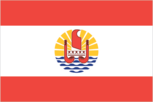
French Polynesia
Australia Oceania · Papeete (located on Tahiti) · parliamentary democracy (Assembly of French Polynesia); an overseas collectivity of France
What French Polynesia means for your money, the prices you pay, the tariffs in motion, and where U.S. policy could change both.
$45M
U.S. imports, 2025
+10.6%
change in one year
$161M
U.S. exports, 2025
306K
Population
$6.6B
GDP
In your house
What you buy that French Polynesia makes
America bought $45M in goods from French Polynesia in 2025. Of every $100 of it, here's where the money went.
Artwork, antiques, stamps, etc.
Fish and shellfish
fish, shrimp, shellfish
U.s. goods returned, and reimports
Jewelry
jewelry
Minimum value shipments
Fruits, frozen juices
fruit and frozen juices
Nonmonetary gold
Chemicals-organic
Other (movies, miscellaneous imports, and special transactions)
Tea, spices, etc.
tea and spices
2026 so far (through July): $14M in imports. Source: U.S. Census Bureau, International Trade in Goods (customs basis).
The other direction
What America sells to French Polynesia
$161M in 2025, a trade rupture cuts both ways, for American producers as well as American prices.
Meat, poultry, etc.
$35MTelecommunications equipment
$34Mphones, routers, networking gear
Minimum value shipments
$11MOther foods
$9MCivilian aircraft, engines, equipment, and parts
$9MVegetables
$8MPleasure boats and motors
$6MBakery products
$3MArtwork, antiques, stamps, etc.
$3MWhere you stand
U.S. tariff posture toward French Polynesia
No U.S. tariff action singles this country out. Its goods face the universal 10% temporary import surcharge under Section 122 of the Trade Act (which replaced the IEEPA reciprocal baseline in February 2026) plus the sectoral Section 232 duties — steel and aluminum at 50% — that apply to all countries. The Section 122 surcharge is statutorily temporary — scheduled to lapse on or about July 23, 2026 (a 150-day cap) unless extended or replaced.
Reciprocal tariff (universal baseline)
10%
The universal 10% floor, a Section 122 import surcharge since February 2026, previously the EO 14257 reciprocal baseline, applies to nearly all U.S. imports. This country has no higher assigned rate of its own.
Policy in motion
Tariff status: a moving target
No U.S. tariff action names French Polynesia. These are the universal measures, applied to every country without a country-specific arrangement, that set its treatment.
2026-04-06
Section 232 metals coverage expanded
In effectThe April 2026 proclamation strengthening Section 232 actions on aluminum, steel, and copper expanded derivative-product coverage for all countries, keeping the general metals rate at 50%.
91 FR 18201 →2026-02-24
IEEPA reciprocal tariffs terminated — replaced by 10% Section 122 surcharge
In effectExecutive Order 14389 (Ending Certain Tariff Actions) terminated the IEEPA tariff duties — including the EO 14257 reciprocal baseline — effective February 24, 2026. A flat 10% Section 122 temporary import surcharge (Proclamation 11012 of February 20, 2026) replaced them, leaving the universal rate unchanged at 10% on a different statutory basis. Section 122 caps such surcharges at 150 days, so this 10% surcharge is scheduled to lapse on or about July 23, 2026 absent further action (the administration has signaled it could raise the rate toward the 15% statutory maximum).
91 FR 9437 →2025-11-13
Agricultural products exempted from reciprocal tariffs
In effectExecutive Order 14360 of November 14, 2025 removed reciprocal duties from certain agricultural products listed in its annexes (coffee, cocoa, bananas, and other goods the U.S. does not produce in sufficient quantity), retroactive to November 13, 2025 — for all countries subject to the reciprocal tariff.
90 FR 54091 →2025-06-04
Section 232 steel and aluminum duties doubled to 50%
In effectThe June 3, 2025 proclamation raised Section 232 duties on steel and aluminum articles and derivatives from 25% to 50% for all countries, effective June 4, 2025.
90 FR 24199 →2025-04-05
Universal 10% reciprocal baseline takes effect
In effectExecutive Order 14257 (signed April 2, 2025) imposed a 10% ad valorem reciprocal duty on imports from all trading partners, effective April 5, 2025. Countries without a higher Annex I rate remain at this baseline.
Federal Register · 2025-06063 →2025-03-12
Section 232 steel and aluminum duties set at 25% for all countries
In effectProclamations of February 10, 2025 terminated all country exemptions and quota arrangements and applied 25% Section 232 duties to steel and aluminum imports from every country, effective March 12, 2025.
90 FR 9817 →
Made for America
What French Polynesia makes for America
French Polynesia is a direct U.S. source of 1 essential good Americans rely on, the items themselves, shipped finished off the line.
Reference
The country itself
Australia Oceania · Geography, people, economy, and government, public-domain data from the CIA World Factbook.
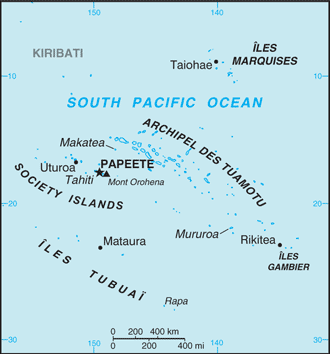
French Polynesia consists of five archipelagos -- the Austral Islands, the Gambier Islands, the Marquesas Islands, the Society Islands, and the Tuamotu Archipelago. The Marquesas were first settled around 200 B.C. and the Society Islands around A.D. 300. Raiatea in the Society Islands became a center for religion and culture. Exploration of the other islands emanated from Raiatea, and by 1000, there were small permanent settlements in all the island groups. Ferdinand MAGELLAN was the first European to see the islands of French Polynesia in 1520. In 1767, British explorer Samuel WALLIS was the first European to visit Tahiti, followed by French navigator Louis Antoine de BOUGAINVILLE in 1768 and British explorer James COOK in 1769. King POMARE I united Tahiti and surrounding islands into the Kingdom of Tahiti in 1788. Protestant missionaries arrived in 1797, and POMARE I’s successor converted in the 1810s, along with most Tahitians. In the 1830s, Queen POMARE IV refused to allow French Catholic missionaries to operate, leading France to declare a protectorate over Tahiti and fight the French-Tahitian War of the 1840s in an attempt to annex the islands. In 1880, King POMARE V ceded Tahiti and its possessions to France, changing its status into a colony. France then claimed the Gambier Islands and Tuamotu Archipelago and by 1901 had incorporated all five island groups into its establishments in Oceania. A Tahitian nationalist movement formed in 1940, leading France to grant French citizenship to the islanders in 1946 and change it to an overseas territory. In 1957, the islands’ name was changed to French Polynesia, and the following year, 64% of voters chose to stay part of France when they approved a new constitution. Uninhabited Mururoa Atoll was established as a French nuclear test site in 1962, and tests were conducted between 1966 and 1992 (underground beginning in 1975). France also conducted tests at Fangataufa Atoll, including its last nuclear test in 1996. France granted French Polynesia partial internal autonomy in 1977 and expanded autonomy in 1984. French Polynesia was converted into an overseas collectivity in 2003 and renamed an overseas territory in 2004. Pro-independence politicians won a surprise majority in local elections that same year, but in subsequent elections, they have been relegated to a vocal minority. In 2013, French Polynesia was relisted on the UN List of Non-Self-Governing Territories.
Geography
- Location
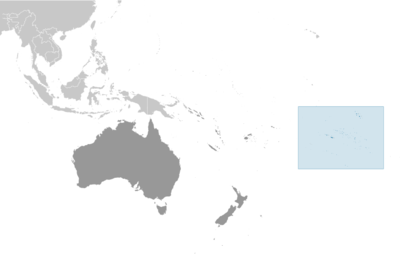
- Oceania, five archipelagoes (Archipel des Tuamotu, Iles Gambier, Iles Marquises, Iles Tubuai, Society Islands) in the South Pacific Ocean about halfway between South America and Australia
- Area
- 4,167 sq km (118 islands and atolls; 67 are inhabited)
- Climate
- tropical, but moderate
- Terrain
- mixture of rugged high islands and low islands with reefs
- Natural resources
- timber, fish, cobalt, hydropower
- Coastline
- 2,525 km
- Natural hazards
- occasional cyclonic storms in January
People & society
- Population
- 305,507 (2025 est.)
- Nationality
- French Polynesian(s)
- Ethnic groups
- Polynesian 78%, Chinese 12%, local French 6%, metropolitan French 4%
- Languages
- French (official) 73.5%, Tahitian 20.1%, Marquesan 2.6%, Austral languages 1.2%, Paumotu 1%, other 1.6% (2017 est.)
- Religions
- Protestant 54%, Roman Catholic 30%, other 10%, no religion 6%
- Median age
- 35.8 years (2025 est.)
- Life expectancy at birth
- 78.9 years (2024 est.)
Economy
- Economic overview
- small, territorial-island tourism-based economy; large French financing; lower EU import duties; Pacific Islands Forum member; fairly resilient from COVID-19; oil-dependent infrastructure
- Industries
- tourism, pearls, agricultural processing, handicrafts, phosphates
- Agricultural products
- coconuts, fruits, cassava, sugarcane, pineapples, eggs, tropical fruits, watermelons, tomatoes, pork (2023)
- Exports - partners
- Japan 44%, USA 15%, France 12%, Netherlands 9%, China 5% (2023)
- Imports - partners
- France 26%, China 11%, USA 10%, NZ 7%, Malaysia 4% (2023)
Government
- Government type
- parliamentary democracy (Assembly of French Polynesia); an overseas collectivity of France
- Capital
- Papeete (located on Tahiti)
- Independence
- none (overseas land of France)
- Constitution
- 4 October 1958 (French Constitution)
- Executive branch
- President Emmanuel MACRON (since 14 May 2017), represented by High Commissioner of the Republic Alexander ROCHATTE (since 1 September 2025)
- Legislative branch
- Assembly of French Polynesia (Assemblée de la Polynésie française)
Full reference data
Every field, by section, CIA World Factbook. Open a topic to expand it.
Introduction
Travel Facts
Please visit the following links to find further information about your desired destination.
World Health Organization (WHO) - To learn what vaccines and health precautions to take while visiting your destination.
US State Dept Travel Information - Overall information about foreign travel for US citizens.
To obtain an international driving permit (IDP). Only two organizations in the US issue IDPs: American Automobile Association (AAA) and American Automobile Touring Alliance (AATA)
How to get help in an emergency? Contact the nearest US embassy or consulate, or call one of these numbers: from the US or Canada - 1-888-407-4747 or from Overseas - +1 202-501-4444
Page last updated: Tuesday, June 04, 2024