
Country exposure · PW

Palau
Australia Oceania · Ngerulmud · presidential republic in free association with the US
What Palau means for your money, the prices you pay, the tariffs in motion, and where U.S. policy could change both.
$414K
U.S. imports, 2025
-81.5%
change in one year
$24M
U.S. exports, 2025
22K
Population
$282M
GDP
In your house
What you buy that Palau makes
America bought $414K in goods from Palau in 2025, down 81.5% in a single year. Of every $100 of it, here's where the money went.
Other (movies, miscellaneous imports, and special transactions)
Materials, excluding chemicals
U.s. goods returned, and reimports
Minimum value shipments
Numismatic coins
2026 so far (through July): $305K in imports. Source: U.S. Census Bureau, International Trade in Goods (customs basis).
The other direction
What America sells to Palau
$24M in 2025, a trade rupture cuts both ways, for American producers as well as American prices.
Meat, poultry, etc.
$5MMinimum value shipments
$3MOther foods
$2MAnimal feeds, n.e.c.
$1MVegetables
$1MTrucks, buses, and special purpose vehicles
$1Mtrucks, buses, SUVs
Telecommunications equipment
$914Kphones, routers, networking gear
Laboratory testing instruments
$655KLogs and lumber
$637KWhere you stand
U.S. tariff posture toward Palau
No U.S. tariff action singles this country out. Its goods face the universal 10% temporary import surcharge under Section 122 of the Trade Act (which replaced the IEEPA reciprocal baseline in February 2026) plus the sectoral Section 232 duties — steel and aluminum at 50% — that apply to all countries. The Section 122 surcharge is statutorily temporary — scheduled to lapse on or about July 23, 2026 (a 150-day cap) unless extended or replaced.
Reciprocal tariff (universal baseline)
10%
The universal 10% floor, a Section 122 import surcharge since February 2026, previously the EO 14257 reciprocal baseline, applies to nearly all U.S. imports. This country has no higher assigned rate of its own.
Policy in motion
Tariff status: a moving target
No U.S. tariff action names Palau. These are the universal measures, applied to every country without a country-specific arrangement, that set its treatment.
2026-04-06
Section 232 metals coverage expanded
In effectThe April 2026 proclamation strengthening Section 232 actions on aluminum, steel, and copper expanded derivative-product coverage for all countries, keeping the general metals rate at 50%.
91 FR 18201 →2026-02-24
IEEPA reciprocal tariffs terminated — replaced by 10% Section 122 surcharge
In effectExecutive Order 14389 (Ending Certain Tariff Actions) terminated the IEEPA tariff duties — including the EO 14257 reciprocal baseline — effective February 24, 2026. A flat 10% Section 122 temporary import surcharge (Proclamation 11012 of February 20, 2026) replaced them, leaving the universal rate unchanged at 10% on a different statutory basis. Section 122 caps such surcharges at 150 days, so this 10% surcharge is scheduled to lapse on or about July 23, 2026 absent further action (the administration has signaled it could raise the rate toward the 15% statutory maximum).
91 FR 9437 →2025-11-13
Agricultural products exempted from reciprocal tariffs
In effectExecutive Order 14360 of November 14, 2025 removed reciprocal duties from certain agricultural products listed in its annexes (coffee, cocoa, bananas, and other goods the U.S. does not produce in sufficient quantity), retroactive to November 13, 2025 — for all countries subject to the reciprocal tariff.
90 FR 54091 →2025-06-04
Section 232 steel and aluminum duties doubled to 50%
In effectThe June 3, 2025 proclamation raised Section 232 duties on steel and aluminum articles and derivatives from 25% to 50% for all countries, effective June 4, 2025.
90 FR 24199 →2025-04-05
Universal 10% reciprocal baseline takes effect
In effectExecutive Order 14257 (signed April 2, 2025) imposed a 10% ad valorem reciprocal duty on imports from all trading partners, effective April 5, 2025. Countries without a higher Annex I rate remain at this baseline.
Federal Register · 2025-06063 →2025-03-12
Section 232 steel and aluminum duties set at 25% for all countries
In effectProclamations of February 10, 2025 terminated all country exemptions and quota arrangements and applied 25% Section 232 duties to steel and aluminum imports from every country, effective March 12, 2025.
90 FR 9817 →
Reference
The country itself
Australia Oceania · Geography, people, economy, and government, public-domain data from the CIA World Factbook.
Humans arrived in the Palauan archipelago from Southeast Asia around 1000 B.C. and developed a complex, highly organized matrilineal society where high-ranking women picked the chiefs. The islands were the westernmost part of the widely scattered Pacific islands north of New Guinea that Spanish explorers named the Caroline Islands in the 17th century. The 18th and 19th centuries saw occasional visits of whalers and traders as Spain gained some influence in the islands and administered it from the Philippines. Spain sold Palau to Germany in 1899 after losing the Philippines in the Spanish-American War. Japan seized Palau in 1914, was granted a League of Nations mandate to administer the islands in 1920, and made Koror the capital of its South Seas Mandate in 1922. By the outbreak of World War II, there were four times as many Japanese living in Koror as Palauans. In 1944, the US invasion of the island of Peleliu was one of the bloodiest island fights of the Pacific War. After the war, Palau became part of the US-administered Trust Territory of the Pacific Islands. Palau voted against joining the Federated States of Micronesia in 1978 and adopted its own constitution in 1981, which stated that Palau was a nuclear-free country. In 1982, Palau signed a Compact of Free Association (COFA) with the US, which granted Palau financial assistance and access to many US domestic programs in exchange for exclusive US military access and defense responsibilities. However, many Palauans saw the COFA as incompatible with the Palauan Constitution because of the US military’s nuclear arsenal, and seven referenda failed to achieve ratification. Following a constitutional amendment and eighth referendum in 1993, the COFA was ratified and entered into force in 1994 when the islands gained their independence. Its funding was renewed in 2010. Palau has been on the frontlines of combatting climate change and protecting marine resources. In 2011, Palau banned commercial shark fishing and created the world’s first shark sanctuary. In 2017, Palau began stamping the Palau Pledge into passports, reminding visitors to act in ecologically and culturally responsible ways. In 2020, Palau banned coral reef-toxic sunscreens and expanded its fishing prohibition to include 80% of its exclusive economic zone.
Geography
- Location
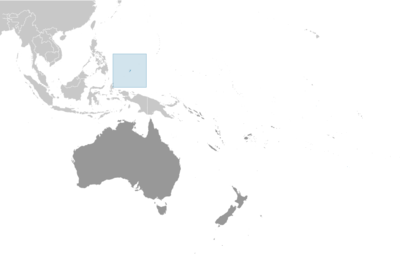
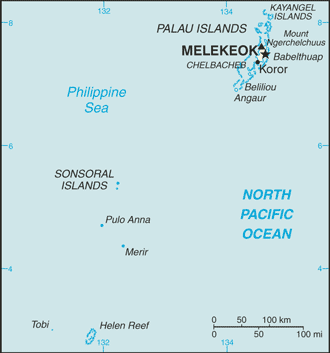
- Oceania, group of islands in the North Pacific Ocean, southeast of the Philippines
- Area
- 459 sq km
- Climate
- tropical; hot and humid; wet season May to November
- Terrain
- varying topography from the high, mountainous main island of Babelthuap to low, coral islands usually fringed by large barrier reefs
- Natural resources
- forests, minerals (especially gold), marine products, deep-seabed minerals
- Coastline
- 1,519 km
- Natural hazards
- typhoons (June to December)
People & society
- Population
- 21,947 (2025 est.)
- Nationality
- Palauan(s)
- Ethnic groups
- Palauan (Micronesian with Malayan and Melanesian admixtures) 70.6%, Carolinian 1.2%, Asian 26.5%, other 1.7% (2020 est.)
- Languages
- Palauan (official on most islands) 65.2%, other Micronesian 1.9%, English (official) 19.1%, Filipino 9.9%, Chinese 1.2%, other 2.8% (2015 est.)
- Religions
- Roman Catholic 46.9%, Protestant 30.9% (Evangelical 24.6%, Seventh Day Adventist 5%, other Protestant 1.4%), Modekngei 5.1% (indigenous to Palau), Muslim 4.9%, other 12.3% (2020 est.)
- Median age
- 35.5 years (2025 est.)
- Life expectancy at birth
- 75.2 years (2024 est.)
- Literacy
- 100% (2020 est.)
Economy
- Economic overview
- high-income Pacific island economy; environmentally fragile; subsistence agriculture and fishing industries; US aid reliance; rebounding post-pandemic tourism industry and services sector; very high living standard and low unemployment
- Industries
- tourism, fishing, subsistence agriculture
- Agricultural products
- coconuts, cassava (manioc, tapioca), sweet potatoes; fish, pigs, chickens, eggs, bananas, papaya, breadfruit, calamansi, soursop, Polynesian chestnuts, Polynesian almonds, mangoes, taro, guava, beans, cucumbers, squash/pumpkins (various), eggplant, green onions, kangkong (watercress), cabbages (various), radishes, betel nuts, melons, peppers, noni, okra
- Exports - partners
- India 41%, Turkey 26%, Taiwan 10%, USA 9%, Japan 5% (2023)
- Imports - partners
- Italy 32%, China 25%, USA 11%, Turkey 10%, Japan 6% (2023)
Government
- Government type
- presidential republic in free association with the US
- Capital
- Ngerulmud
- Independence
- 1 October 1994 (from the US-administered UN trusteeship)
- Constitution
- ratified 9 July 1980, effective 1 January 1981
- Executive branch
- President Surangel WHIPPS, Jr. (since 21 January 2021)
- Legislative branch
- National Congress (Olbiil Era Kelulau)
Full reference data
Every field, by section, CIA World Factbook. Open a topic to expand it.
Introduction
Travel Facts
Please visit the following links to find further information about your desired destination.
World Health Organization (WHO) - To learn what vaccines and health precautions to take while visiting your destination.
US State Dept Travel Information - Overall information about foreign travel for US citizens.
To obtain an international driving permit (IDP). Only two organizations in the US issue IDPs: American Automobile Association (AAA) and American Automobile Touring Alliance (AATA)
How to get help in an emergency? Contact the nearest US embassy or consulate, or call one of these numbers: from the US or Canada - 1-888-407-4747 or from Overseas - +1 202-501-4444
Page last updated: Tuesday, January 24, 2023