
Country exposure · SB
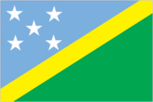
Solomon Islands
Australia Oceania · Honiara · parliamentary democracy under a constitutional monarchy; a Commonwealth realm
What Solomon Islands means for your money, the prices you pay, the tariffs in motion, and where U.S. policy could change both.
$2M
U.S. imports, 2025
+19%
change in one year
$21M
U.S. exports, 2025
739K
Population
$1.8B
GDP
In your house
What you buy that Solomon Islands makes
America bought $2M in goods from Solomon Islands in 2025, up 19% in a single year. Of every $100 of it, here's where the money went.
Tobacco, waxes, etc.
Tea, spices, etc.
tea and spices
U.s. goods returned, and reimports
Minimum value shipments
Numismatic coins
Materials, excluding chemicals
Artwork, antiques, stamps, etc.
Industrial supplies, other
Jewelry
jewelry
Engines and engine parts
2026 so far (through July): $291K in imports. Source: U.S. Census Bureau, International Trade in Goods (customs basis).
The other direction
What America sells to Solomon Islands
$21M in 2025, a trade rupture cuts both ways, for American producers as well as American prices.
Minimum value shipments
$8MCivilian aircraft, engines, equipment, and parts
$6MMeat, poultry, etc.
$4MComputers
$512Klaptops, desktops, monitors
Cell phones and other household goods, n.e.c.
$458Kcell phones and home electronics
Iron and steel products, other
$373KFinished metal shapes
$257KMilitary trucks, armored vehicles, etc.
$192KIndustrial machines, other
$177KWhere you stand
U.S. tariff posture toward Solomon Islands
No U.S. tariff action singles this country out. Its goods face the universal 10% temporary import surcharge under Section 122 of the Trade Act (which replaced the IEEPA reciprocal baseline in February 2026) plus the sectoral Section 232 duties — steel and aluminum at 50% — that apply to all countries. The Section 122 surcharge is statutorily temporary — scheduled to lapse on or about July 23, 2026 (a 150-day cap) unless extended or replaced.
Reciprocal tariff (universal baseline)
10%
The universal 10% floor, a Section 122 import surcharge since February 2026, previously the EO 14257 reciprocal baseline, applies to nearly all U.S. imports. This country has no higher assigned rate of its own.
Policy in motion
Tariff status: a moving target
No U.S. tariff action names Solomon Islands. These are the universal measures, applied to every country without a country-specific arrangement, that set its treatment.
2026-04-06
Section 232 metals coverage expanded
In effectThe April 2026 proclamation strengthening Section 232 actions on aluminum, steel, and copper expanded derivative-product coverage for all countries, keeping the general metals rate at 50%.
91 FR 18201 →2026-02-24
IEEPA reciprocal tariffs terminated — replaced by 10% Section 122 surcharge
In effectExecutive Order 14389 (Ending Certain Tariff Actions) terminated the IEEPA tariff duties — including the EO 14257 reciprocal baseline — effective February 24, 2026. A flat 10% Section 122 temporary import surcharge (Proclamation 11012 of February 20, 2026) replaced them, leaving the universal rate unchanged at 10% on a different statutory basis. Section 122 caps such surcharges at 150 days, so this 10% surcharge is scheduled to lapse on or about July 23, 2026 absent further action (the administration has signaled it could raise the rate toward the 15% statutory maximum).
91 FR 9437 →2025-11-13
Agricultural products exempted from reciprocal tariffs
In effectExecutive Order 14360 of November 14, 2025 removed reciprocal duties from certain agricultural products listed in its annexes (coffee, cocoa, bananas, and other goods the U.S. does not produce in sufficient quantity), retroactive to November 13, 2025 — for all countries subject to the reciprocal tariff.
90 FR 54091 →2025-06-04
Section 232 steel and aluminum duties doubled to 50%
In effectThe June 3, 2025 proclamation raised Section 232 duties on steel and aluminum articles and derivatives from 25% to 50% for all countries, effective June 4, 2025.
90 FR 24199 →2025-04-05
Universal 10% reciprocal baseline takes effect
In effectExecutive Order 14257 (signed April 2, 2025) imposed a 10% ad valorem reciprocal duty on imports from all trading partners, effective April 5, 2025. Countries without a higher Annex I rate remain at this baseline.
Federal Register · 2025-06063 →2025-03-12
Section 232 steel and aluminum duties set at 25% for all countries
In effectProclamations of February 10, 2025 terminated all country exemptions and quota arrangements and applied 25% Section 232 duties to steel and aluminum imports from every country, effective March 12, 2025.
90 FR 9817 →
Reference
The country itself
Australia Oceania · Geography, people, economy, and government, public-domain data from the CIA World Factbook.
Settlers from Papua arrived on the Solomon Islands around 30,000 years ago. About 6,000 years ago, Austronesian settlers came to the islands, and the two groups mixed extensively. Despite significant inter-island trade, no attempts were made to unite the islands into a single political entity. In 1568, a Spanish explorer became the first European to spot the islands. After a failed Spanish attempt at creating a permanent European settlement in the late 1500s, the Solomon Islands remained free of European contact until a British explorer arrived in 1767. European explorers and US and British whaling ships regularly visited the islands into the 1800s. Germany declared a protectorate over the northern Solomon Islands in 1885, and the UK established a protectorate over the southern islands in 1893. In 1899, Germany transferred its islands to the UK in exchange for the UK relinquishing all claims in Samoa. In 1942, Japan invaded the islands, and the Guadalcanal Campaign (August 1942-February 1943) proved a turning point in the Pacific theater of WWII. The fighting destroyed large parts of the Solomon Islands, and a nationalist movement emerged near the end of the war. By 1960, the British allowed some local autonomy. The islands were granted self-government in 1976 and independence two years later under Prime Minister Sir Peter KENILOREA. In 1999, longstanding tensions between ethnic Guale in Honiara and ethnic Malaitans in Honiara’s suburbs erupted in civil war, leading thousands of Malaitans to take refuge in Honiara and prompting Guale to flee the city. In 2000, newly elected Prime Minister Manasseh SOGAVARE focused on peace agreements and distributing resources equally among groups, but his actions bankrupted the government in 2001 and led to his ouster. In 2003, the Solomon Islands requested international assistance to reestablish law and order; the Australian-led Regional Assistance Mission to the Solomon Islands, which ended in 2017, improved the security situation. In 2006, however, riots broke out in Honiara, and the city’s Chinatown was burned amid allegations that the prime minister took money from China. SOGAVARE was reelected prime minister for a fourth time in 2019. When a small group of protestors, mostly from the island of Malaita, approached parliament to lodge a petition calling for SOGAVARE’s removal and more development in Malaita in 2021, police fired tear gas into the crowd which sparked rioting and looting in Honiara.
Geography
- Location
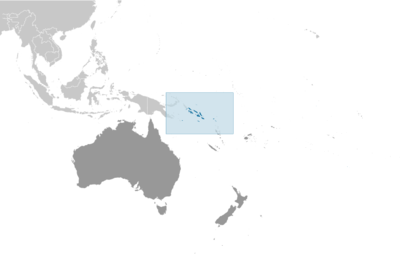
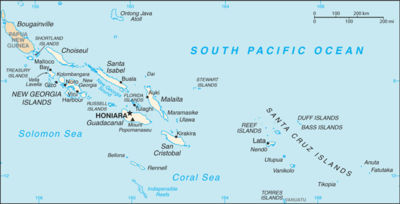
- Oceania, group of islands in the South Pacific Ocean, east of Papua New Guinea
- Area
- 28,896 sq km
- Climate
- tropical monsoon; few temperature and weather extremes
- Terrain
- mostly rugged mountains with some low coral atolls
- Natural resources
- fish, forests, gold, bauxite, phosphates, lead, zinc, nickel
- Coastline
- 5,313 km
- Natural hazards
- tropical cyclones, but rarely destructive; geologically active region with frequent earthquakes, tremors, and volcanic activity; tsunamis volcanism: Tinakula (851 m) has frequent eruption activity, and an eruption of Savo (485 m) could affect the capital Honiara on nearby Guadalcanal
People & society
- Population
- 738,774 (2025 est.)
- Nationality
- Solomon Islander(s)
- Ethnic groups
- Melanesian 95.3%, Polynesian 3.1%, Micronesian 1.2%, other 0.3% (2009 est.)
- Languages
- Melanesian pidgin (lingua franca in much of the country), English (official but spoken by only 1%-2% of the population), 120 indigenous languages
- Religions
- Protestant 73.4% (Church of Melanesia 31.9%, South Sea Evangelical 17.1%, Seventh Day Adventist 11.7%, United Church 10.1%, Christian Fellowship Church 2.5%), Roman Catholic 19.6%, other Christian 2.9%, other 4%, unspecified 0.1% (2009 est.)
- Median age
- 25.5 years (2025 est.)
- Life expectancy at birth
- 77.2 years (2024 est.)
Economy
- Economic overview
- lower middle-income Pacific island economy; natural resource rich but environmentally fragile; key agrarian sector; growing Chinese economic relationship; infrastructure damage due to social unrest; metal mining operations
- Industries
- fish (tuna), mining, timber
- Agricultural products
- oil palm fruit, coconuts, sweet potatoes, yams, taro, fruits, pulses, vegetables, cocoa beans, cassava (2023)
- Exports - partners
- China 56%, Australia 11%, Italy 10%, Spain 5%, Netherlands 4% (2023)
- Imports - partners
- China 42%, Singapore 13%, Australia 13%, Taiwan 5%, Malaysia 5% (2023)
Government
- Government type
- parliamentary democracy under a constitutional monarchy; a Commonwealth realm
- Capital
- Honiara
- Independence
- 7 July 1978 (from the UK)
- Constitution
- adopted 31 May 1978, effective 7 July 1978
- Executive branch
- King CHARLES III (since 8 September 2022); represented by Governor General David Tiva KAPU (since 7 July 2024)
- Legislative branch
- National Parliament
Full reference data
Every field, by section, CIA World Factbook. Open a topic to expand it.
Introduction
Travel Facts
Please visit the following links to find further information about your desired destination.
World Health Organization (WHO) - To learn what vaccines and health precautions to take while visiting your destination.
US State Dept Travel Information - Overall information about foreign travel for US citizens.
To obtain an international driving permit (IDP). Only two organizations in the US issue IDPs: American Automobile Association (AAA) and American Automobile Touring Alliance (AATA)
How to get help in an emergency? Contact the nearest US embassy or consulate, or call one of these numbers: from the US or Canada - 1-888-407-4747 or from Overseas - +1 202-501-4444
Page last updated: Wednesday, May 03, 2023