
Country exposure · SD

Sudan
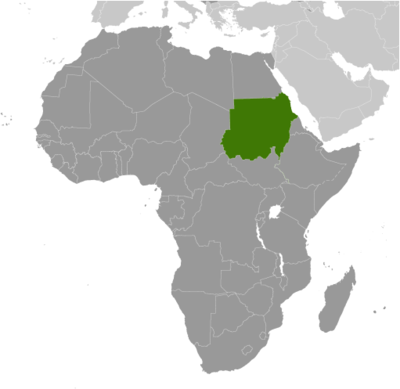
Africa · Khartoum · presidential republic
What Sudan means for your money, the prices you pay, the tariffs in motion, and where U.S. policy could change both.
$11M
U.S. imports, 2025
-12.5%
change in one year
$38M
U.S. exports, 2025
50M
Population
$49.9B
GDP
In your house
What you buy that Sudan makes
America bought $11M in goods from Sudan in 2025. Of every $100 of it, here's where the money went.
Synthetic rubber--primary
Artwork, antiques, stamps, etc.
Minimum value shipments
Tobacco, waxes, etc.
2026 so far (through July): $6M in imports. Source: U.S. Census Bureau, International Trade in Goods (customs basis).
The other direction
What America sells to Sudan
$38M in 2025, a trade rupture cuts both ways, for American producers as well as American prices.
Sorghum, barley, oats
$14MAgric. industry-unmanufactured
$10MVegetables
$7MChemicals-fertilizers
$2MMiscellaneous domestic exports and special transactions
$2MPharmaceutical preparations
$1Mmedicines and pharmacy items
Medicinal equipment
$874Kmedical devices and equipment
Rice
$854Kcocoa for chocolate
Laboratory testing instruments
$276KWhere you stand
U.S. tariff posture toward Sudan
No U.S. tariff action singles this country out. Its goods face the universal 10% temporary import surcharge under Section 122 of the Trade Act (which replaced the IEEPA reciprocal baseline in February 2026) plus the sectoral Section 232 duties — steel and aluminum at 50% — that apply to all countries. The Section 122 surcharge is statutorily temporary — scheduled to lapse on or about July 23, 2026 (a 150-day cap) unless extended or replaced.
Reciprocal tariff (universal baseline)
10%
The universal 10% floor, a Section 122 import surcharge since February 2026, previously the EO 14257 reciprocal baseline, applies to nearly all U.S. imports. This country has no higher assigned rate of its own.
Policy in motion
Tariff status: a moving target
No U.S. tariff action names Sudan. These are the universal measures, applied to every country without a country-specific arrangement, that set its treatment.
2026-04-06
Section 232 metals coverage expanded
In effectThe April 2026 proclamation strengthening Section 232 actions on aluminum, steel, and copper expanded derivative-product coverage for all countries, keeping the general metals rate at 50%.
91 FR 18201 →2026-02-24
IEEPA reciprocal tariffs terminated — replaced by 10% Section 122 surcharge
In effectExecutive Order 14389 (Ending Certain Tariff Actions) terminated the IEEPA tariff duties — including the EO 14257 reciprocal baseline — effective February 24, 2026. A flat 10% Section 122 temporary import surcharge (Proclamation 11012 of February 20, 2026) replaced them, leaving the universal rate unchanged at 10% on a different statutory basis. Section 122 caps such surcharges at 150 days, so this 10% surcharge is scheduled to lapse on or about July 23, 2026 absent further action (the administration has signaled it could raise the rate toward the 15% statutory maximum).
91 FR 9437 →2025-11-13
Agricultural products exempted from reciprocal tariffs
In effectExecutive Order 14360 of November 14, 2025 removed reciprocal duties from certain agricultural products listed in its annexes (coffee, cocoa, bananas, and other goods the U.S. does not produce in sufficient quantity), retroactive to November 13, 2025 — for all countries subject to the reciprocal tariff.
90 FR 54091 →2025-06-04
Section 232 steel and aluminum duties doubled to 50%
In effectThe June 3, 2025 proclamation raised Section 232 duties on steel and aluminum articles and derivatives from 25% to 50% for all countries, effective June 4, 2025.
90 FR 24199 →2025-04-05
Universal 10% reciprocal baseline takes effect
In effectExecutive Order 14257 (signed April 2, 2025) imposed a 10% ad valorem reciprocal duty on imports from all trading partners, effective April 5, 2025. Countries without a higher Annex I rate remain at this baseline.
Federal Register · 2025-06063 →2025-03-12
Section 232 steel and aluminum duties set at 25% for all countries
In effectProclamations of February 10, 2025 terminated all country exemptions and quota arrangements and applied 25% Section 232 duties to steel and aluminum imports from every country, effective March 12, 2025.
90 FR 9817 →
Reference
The country itself
Africa · Geography, people, economy, and government, public-domain data from the CIA World Factbook.
Long referred to as Nubia, modern-day Sudan was the site of the Kingdom of Kerma (ca. 2500-1500 B.C.) until it was absorbed into the New Kingdom of Egypt. By the 11th century B.C., the Kingdom of Kush gained independence from Egypt; it lasted in various forms until the middle of the 4th century A.D. After the fall of Kush, the Nubians formed three Christian kingdoms of Nobatia, Makuria, and Alodia, with the latter two enduring until around 1500. Between the 14th and 15th centuries, Arab nomads settled much of Sudan, leading to extensive Islamization between the 16th and 19th centuries. Following Egyptian occupation early in the 19th century, an agreement in 1899 set up a joint British-Egyptian government in Sudan, but it was effectively a British colony. Military regimes favoring Islamic-oriented governments have dominated national politics since Sudan gained independence from Anglo-Egyptian co-rule in 1956. During most of the second half of the 20th century, Sudan was embroiled in two prolonged civil wars rooted in northern domination of the largely non-Muslim, non-Arab southern portion of the country. The first civil war ended in 1972, but another broke out in 1983. Peace talks gained momentum in 2002-04, and the final North/South Comprehensive Peace Agreement in 2005 granted the southern rebels autonomy for six years, followed by a referendum on independence for Southern Sudan. South Sudan became independent in 2011, but Sudan and South Sudan have yet to fully implement security and economic agreements to normalize relations between the two countries. Sudan has also faced conflict in Darfur, Southern Kordofan, and Blue Nile starting in 2003. In 2019, after months of nationwide protests, the 30-year reign of President Omar Hassan Ahmad al-BASHIR ended when the military forced him out. Economist and former international civil servant Abdalla HAMDOUK al-Kinani was selected to serve as the prime minister of a transitional government as the country prepared for elections in 2022. In late 2021, however, the Sudanese military ousted HAMDOUK and his government and replaced civilian members of the Sovereign Council (Sudan’s collective Head of State) with individuals selected by the military. HAMDOUK was briefly reinstated but resigned in January 2022. General Abd-al-Fatah al-BURHAN Abd-al-Rahman, the Chair of Sudan’s Sovereign Council and Commander-in-Chief of the Sudanese Armed Forces, currently serves as de facto head of state and government. He presides over a Sovereign Council consisting of military leaders, former armed opposition group representatives, and military-appointed civilians. A cabinet of acting ministers handles day-to-day administration.
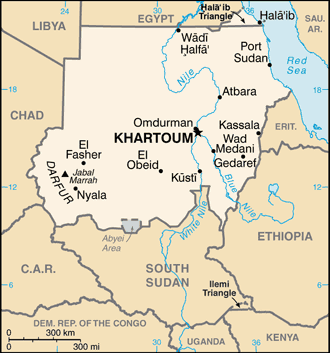
Geography
- Location
- north-eastern Africa, bordering the Red Sea, between Egypt and Eritrea
- Area
- 1,861,484 sq km
- Climate
- hot and dry; arid desert; rainy season varies by region (April to November)
- Terrain
- generally flat, featureless plain; desert dominates the north
- Natural resources
- petroleum; small reserves of iron ore, copper, chromium ore, zinc, tungsten, mica, silver, gold; hydropower
- Coastline
- 853 km
- Natural hazards
- dust storms and periodic persistent droughts
People & society
- Population
- 50,467,278 (2024 est.)
- Nationality
- Sudanese (singular and plural)
- Ethnic groups
- Sudanese Arab (approximately 70%), Fur, Beja, Nuba, Ingessana, Uduk, Fallata, Masalit, Dajo, Gimir, Tunjur, Berti; there are over 500 ethnic groups
- Languages
- Arabic (official), English (official), Nubian, Ta Bedawie, Fur
- Religions
- Sunni Muslim, small Christian minority
- Median age
- 19.5 years (2025 est.)
- Life expectancy at birth
- 67.8 years (2024 est.)
Economy
- Economic overview
- low-income Sahel economy devastated by ongoing civil war; major impacts on rural income, basic commodity prices, industrial production, agricultural supply chain, communications and commerce; hyperinflation and currency depreciation worsening food access and humanitarian conditions
- Industries
- oil, cotton ginning, textiles, cement, edible oils, sugar, soap distilling, shoes, petroleum refining, pharmaceuticals, armaments, automobile/light truck assembly, milling
- Agricultural products
- sugarcane, sorghum, milk, onions, groundnuts, sesame seeds, goat milk, bananas, mangoes/guavas, millet (2023)
- Exports - partners
- UAE 21%, China 17%, Saudi Arabia 16%, Malaysia 9%, Egypt 8% (2023)
- Imports - partners
- China 21%, India 19%, Egypt 16%, UAE 14%, Saudi Arabia 7% (2023)
Government
- Government type
- presidential republic
- Capital
- Khartoum
- Independence
- 1 January 1956 (from Egypt and the UK)
- Constitution
- previous 1973, 1998, 2005 (interim constitution, which was suspended in April 2019); latest initial draft completed by Transitional Military Council in May 2019; revised draft known as the "Draft Constitutional Charter for the 2019 Transitional Period," or “2019 Constitutional Declaration” was signed by the Council and opposition coalition on 4 August 2019
- Executive branch
- Sovereign Council Chair and Commander-in-Chief of the Sudanese Armed Forces General Abd-al-Fattah al-BURHAN Abd-al-Rahman (since 11 November 2021)
- Legislative branch
- note: the Parliament of Sudan was dissolved after a coup in April 2019; the August 2019 Constitutional Declaration established Sudan's transitional government; a Transitional Legislative Council (TLC) was to have served as the national legislature during the transitional period until elections could be held, but the TLC has not been created
Full reference data
Every field, by section, CIA World Factbook. Open a topic to expand it.
Introduction
Travel Facts
Please visit the following links to find further information about your desired destination.
World Health Organization (WHO) - To learn what vaccines and health precautions to take while visiting your destination.
US State Dept Travel Information - Overall information about foreign travel for US citizens.
To obtain an international driving permit (IDP). Only two organizations in the US issue IDPs: American Automobile Association (AAA) and American Automobile Touring Alliance (AATA)
How to get help in an emergency? Contact the nearest US embassy or consulate, or call one of these numbers: from the US or Canada - 1-888-407-4747 or from Overseas - +1 202-501-4444
Page last updated: Wednesday, July 20, 2022