Country exposure · SH

Flag of Saint Helena

Saint Helena

Africa · Jamestown · parliamentary democracy

What Saint Helena means for your money — the prices you pay, the tariffs in motion, and where U.S. policy could change both.
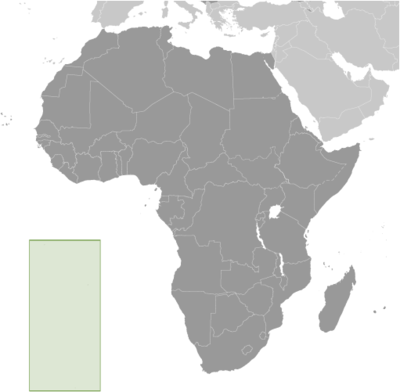
Map showing the location of Saint Helena

$6M

U.S. imports, 2025

-43.5%

change in one year

$1M

U.S. exports, 2025

8K

Population

In your house

What you buy that Saint Helena makes

America bought $6M in goods from Saint Helena in 2025 — down 43.5% in a single year. Of every $100 of it, here's where the money went.

Fish and shellfish

fish, shrimp, shellfish

$6M98.3%

Household appliances

household appliances

$27K0.4%

Laboratory testing instruments

$24K0.4%

U.s. goods returned, and reimports

$22K0.4%

Semiconductors

semiconductors and chips

$14K0.2%

Minimum value shipments

$12K0.2%

Numismatic coins

$5K0.1%

2026 so far (through April): $7M in imports. Source: U.S. Census Bureau, International Trade in Goods (customs basis).

The other direction

What America sells to Saint Helena

$1M in 2025 — a trade rupture cuts both ways, for American producers as well as American prices.

Telecommunications equipment

$664K

phones, routers, networking gear

Industrial engines

$519K

Glassware, chinaware

$47K

glassware and china

Shingles, molding, wallboard

$31K

Minimum value shipments

$31K

Chemicals-other

$25K

Civilian aircraft, engines, equipment, and parts

$9K

Copper

$6K

Electric apparatus

$6K

Where you stand

U.S. tariff posture toward Saint Helena

No U.S. tariff action singles this country out. Its goods face the universal 10% temporary import surcharge under Section 122 of the Trade Act (which replaced the IEEPA reciprocal baseline in February 2026) plus the sectoral Section 232 duties — steel and aluminum at 50% — that apply to all countries. The Section 122 surcharge is statutorily temporary — scheduled to lapse on or about July 23, 2026 (a 150-day cap) unless extended or replaced.

Reciprocal tariff (universal baseline)

10%

The universal 10% floor — a Section 122 import surcharge since February 2026, previously the EO 14257 reciprocal baseline — applies to nearly all U.S. imports. This country has no higher assigned rate of its own.

Policy in motion

Tariff status: a moving target

No U.S. tariff action names Saint Helena. These are the universal measures — applied to every country without a country-specific arrangement — that set its treatment.

  1. 2026-04-06

    Section 232 metals coverage expanded

    In effect

    The April 2026 proclamation strengthening Section 232 actions on aluminum, steel, and copper expanded derivative-product coverage for all countries, keeping the general metals rate at 50%.

    91 FR 18201
  2. 2026-02-24

    IEEPA reciprocal tariffs terminated — replaced by 10% Section 122 surcharge

    In effect

    Executive Order 14389 (Ending Certain Tariff Actions) terminated the IEEPA tariff duties — including the EO 14257 reciprocal baseline — effective February 24, 2026. A flat 10% Section 122 temporary import surcharge (Proclamation 11012 of February 20, 2026) replaced them, leaving the universal rate unchanged at 10% on a different statutory basis. Section 122 caps such surcharges at 150 days, so this 10% surcharge is scheduled to lapse on or about July 23, 2026 absent further action (the administration has signaled it could raise the rate toward the 15% statutory maximum).

    91 FR 9437
  3. 2025-11-13

    Agricultural products exempted from reciprocal tariffs

    In effect

    Executive Order 14360 of November 14, 2025 removed reciprocal duties from certain agricultural products listed in its annexes (coffee, cocoa, bananas, and other goods the U.S. does not produce in sufficient quantity), retroactive to November 13, 2025 — for all countries subject to the reciprocal tariff.

    90 FR 54091
  4. 2025-06-04

    Section 232 steel and aluminum duties doubled to 50%

    In effect

    The June 3, 2025 proclamation raised Section 232 duties on steel and aluminum articles and derivatives from 25% to 50% for all countries, effective June 4, 2025.

    90 FR 24199
  5. 2025-04-05

    Universal 10% reciprocal baseline takes effect

    In effect

    Executive Order 14257 (signed April 2, 2025) imposed a 10% ad valorem reciprocal duty on imports from all trading partners, effective April 5, 2025. Countries without a higher Annex I rate remain at this baseline.

    Federal Register · 2025-06063
  6. 2025-03-12

    Section 232 steel and aluminum duties set at 25% for all countries

    In effect

    Proclamations of February 10, 2025 terminated all country exemptions and quota arrangements and applied 25% Section 232 duties to steel and aluminum imports from every country, effective March 12, 2025.

    90 FR 9817

Made for America

What Saint Helena makes for America

Saint Helena is a direct U.S. source of 1 essential good Americans rely on — the items themselves, shipped finished off the line.

Reference

The country itself

Africa · Geography, people, economy, and government — public-domain data from the CIA World Factbook.

Saint Helena is a British Overseas Territory off the coast of Africa in the South Atlantic Ocean, and it consists of Saint Helena, Ascension Island, and the island group of Tristan da Cunha. Saint Helena: The island was uninhabited when the Portuguese first discovered it in 1502, and the British garrisoned troops on Saint Helena during the 17th century. It acquired fame as the place of Napoleon BONAPARTE's exile from 1815 until his death in 1821, but its importance as a port of call declined after the opening of the Suez Canal in 1869. During the Anglo-Boer War in South Africa, several thousand Boer prisoners were confined on the island between 1900 and 1903. Saint Helena is one of the most remote populated places in the world. The British Government committed to building an airport on Saint Helena in 2005. After more than a decade of delays and construction, a commercial air service to South Africa via Namibia was inaugurated in 2017. The weekly service to Saint Helena from Johannesburg via Windhoek in Namibia takes just over six hours (including the refueling stop in Windhoek) and replaces the mail ship that had made a five-day journey to the island every three weeks. Ascension Island: This barren and uninhabited island was discovered and named by the Portuguese in 1503. The British garrisoned the island in 1815 to prevent a rescue of NAPOLEON from Saint Helena. It served as a provisioning station for the Royal Navy's West Africa Squadron on anti-slavery patrol. The island remained under Admiralty control until 1922, when it became a dependency of Saint Helena. During World War II, the UK permitted the US to construct an airfield on Ascension in support of transatlantic flights to Africa and anti-submarine operations in the South Atlantic. In the 1960s, the island became an important space tracking station for the US. In 1982, Ascension was an essential staging area for British forces during the Falklands War. It remains a critical refueling point in the air-bridge from the UK to the South Atlantic. The island hosts one of four dedicated ground antennas that assist in the operation of the Global Positioning System (GPS) navigation system -- the others are on Diego Garcia (British Indian Ocean Territory), Kwajalein (Marshall Islands), and at Cape Canaveral, Florida (US). NASA and the US Air Force also operate a Meter-Class Autonomous Telescope (MCAT) on Ascension as part of the deep space surveillance system for tracking orbital debris, which can be a hazard to spacecraft and astronauts. Tristan da Cunha: The island group consists of Tristan da Cunha, Nightingale, Inaccessible, and Gough Islands. Tristan da Cunha, named after its Portuguese discoverer (1506), was garrisoned by the British in 1816 to prevent any attempt to rescue NAPOLEON from Saint Helena. Gough and Inaccessible Islands have been designated World Heritage Sites. South Africa leases a site for a meteorological station on Gough Island.
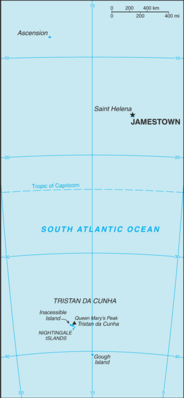
Regional map of Saint Helena

Geography

Location
islands in the South Atlantic Ocean, about midway between South America and Africa; Ascension Island lies 1,300 km (800 mi) northwest of Saint Helena; Tristan da Cunha lies 4,300 km (2,700 mi) southwest of Saint Helena
Area
394 sq km
Climate
Saint Helena: tropical marine; mild, tempered by trade winds Ascension Island: tropical marine; mild, semi-arid Tristan da Cunha: temperate marine; mild, tempered by trade winds (tends to be cooler than Saint Helena)
Terrain
the islands of this group are of volcanic origin associated with the Atlantic Mid-Ocean Ridge Saint Helena: rugged, volcanic; small scattered plateaus and plains Ascension: surface covered by lava flows and cinder cones of 44 dormant volcanoes; terrain rises to the east Tristan da Cunha: sheer cliffs line the coastline of the nearly circular island; the flanks of the central volcanic peak are deeply dissected; narrow coastal plain lies between The Peak and the coastal cliffs
Natural resources
fish, lobster
Coastline
Saint Helena: 60 km Ascension Island: NA Tristan da Cunha (island only): 34 km
Natural hazards
active volcanism volcanism: the volcanoes of Tristan da Cunha (2,060 m) and Nightingale Island (365 m) are active

People & society

Population
7,943 (2024 est.)
Nationality
Saint Helenian(s)
Ethnic groups
St. Helena 82.1%, UK 7.6%, South Africa 3.6%, Ascension 2.8%, other 3.9% (2021 est.)
Languages
English
Religions
Anglican 63.2%, unspecified 11.4%, no religion 9%, Jehovah's Witness 3.8%, Baptist 2.3%, Salvation Army 2%, Roman Catholic 2.2%, Seventh Day Adventist 1.9%, New Apostolic 1.6%, other Christian 1.4%, other 1.1% (2021 est.)
Median age
45.5 years (2025 est.)
Life expectancy at birth
80.9 years (2024 est.)

Economy

Economic overview
upper middle-income, British Atlantic Ocean territorial economy; native (but pegged to British pound) currency user on 2 of 3 islands; significant UK financial support; unique land/farming commune structure; military-related economic activity; sport fishing locale
Industries
construction, crafts (furniture, lacework, fancy woodwork), fishing, collectible postage stamps
Agricultural products
coffee, corn, potatoes, vegetables; fish, lobster; livestock; timber
Exports - partners
Singapore 33%, USA 16%, Japan 10%, Turkey 10%, Senegal 8% (2023)
Imports - partners
UK 34%, Greece 26%, Spain 16%, South Africa 15%, Namibia 2% (2023)

Government

Government type
parliamentary democracy
Capital
Jamestown
Independence
none (overseas territory of the UK)
Constitution
several previous; latest effective 1 September 2009 (St. Helena, Ascension and Tristan da Cunha Constitution Order 2009)
Executive branch
King CHARLES III (since 8 September 2022)
Legislative branch
note: the Constitution Order provides for separate Island Councils for both Ascension and Tristan da Cunha

Full reference data

Every field, by section — CIA World Factbook. Open a topic to expand it.

Introduction
Background
Saint Helena is a British Overseas Territory off the coast of Africa in the South Atlantic Ocean, and it consists of Saint Helena, Ascension Island, and the island group of Tristan da Cunha. Saint Helena: The island was uninhabited when the Portuguese first discovered it in 1502, and the British garrisoned troops on Saint Helena during the 17th century. It acquired fame as the place of Napoleon BONAPARTE's exile from 1815 until his death in 1821, but its importance as a port of call declined after the opening of the Suez Canal in 1869. During the Anglo-Boer War in South Africa, several thousand Boer prisoners were confined on the island between 1900 and 1903. Saint Helena is one of the most remote populated places in the world. The British Government committed to building an airport on Saint Helena in 2005. After more than a decade of delays and construction, a commercial air service to South Africa via Namibia was inaugurated in 2017. The weekly service to Saint Helena from Johannesburg via Windhoek in Namibia takes just over six hours (including the refueling stop in Windhoek) and replaces the mail ship that had made a five-day journey to the island every three weeks. Ascension Island: This barren and uninhabited island was discovered and named by the Portuguese in 1503. The British garrisoned the island in 1815 to prevent a rescue of NAPOLEON from Saint Helena. It served as a provisioning station for the Royal Navy's West Africa Squadron on anti-slavery patrol. The island remained under Admiralty control until 1922, when it became a dependency of Saint Helena. During World War II, the UK permitted the US to construct an airfield on Ascension in support of transatlantic flights to Africa and anti-submarine operations in the South Atlantic. In the 1960s, the island became an important space tracking station for the US. In 1982, Ascension was an essential staging area for British forces during the Falklands War. It remains a critical refueling point in the air-bridge from the UK to the South Atlantic. The island hosts one of four dedicated ground antennas that assist in the operation of the Global Positioning System (GPS) navigation system -- the others are on Diego Garcia (British Indian Ocean Territory), Kwajalein (Marshall Islands), and at Cape Canaveral, Florida (US). NASA and the US Air Force also operate a Meter-Class Autonomous Telescope (MCAT) on Ascension as part of the deep space surveillance system for tracking orbital debris, which can be a hazard to spacecraft and astronauts. Tristan da Cunha: The island group consists of Tristan da Cunha, Nightingale, Inaccessible, and Gough Islands. Tristan da Cunha, named after its Portuguese discoverer (1506), was garrisoned by the British in 1816 to prevent any attempt to rescue NAPOLEON from Saint Helena. Gough and Inaccessible Islands have been designated World Heritage Sites. South Africa leases a site for a meteorological station on Gough Island.
Geography
Location
islands in the South Atlantic Ocean, about midway between South America and Africa; Ascension Island lies 1,300 km (800 mi) northwest of Saint Helena; Tristan da Cunha lies 4,300 km (2,700 mi) southwest of Saint Helena
Geographic coordinates
Saint Helena: 15 57 S, 5 42 W Ascension Island: 7 57 S, 14 22 W Tristan da Cunha island group: 37 15 S, 12 30 W
Map references
Africa
Area - total
394 sq km
Area - land
122 sq km Saint Helena Island
Area - water
0 sq km
Area - note
88 sq km Ascension Island, 184 sq km Tristan da Cunha island group (includes Tristan (98 sq km), Inaccessible, Nightingale, and Gough islands)
Area - comparative
slightly more than twice the size of Washington, D.C.
Land boundaries - total
0 km
Coastline
Saint Helena: 60 km Ascension Island: NA Tristan da Cunha (island only): 34 km
Maritime claims - territorial sea
12 nm
Maritime claims - exclusive fishing zone
200 nm
Climate
Saint Helena: tropical marine; mild, tempered by trade winds Ascension Island: tropical marine; mild, semi-arid Tristan da Cunha: temperate marine; mild, tempered by trade winds (tends to be cooler than Saint Helena)
Terrain
the islands of this group are of volcanic origin associated with the Atlantic Mid-Ocean Ridge Saint Helena: rugged, volcanic; small scattered plateaus and plains Ascension: surface covered by lava flows and cinder cones of 44 dormant volcanoes; terrain rises to the east Tristan da Cunha: sheer cliffs line the coastline of the nearly circular island; the flanks of the central volcanic peak are deeply dissected; narrow coastal plain lies between The Peak and the coastal cliffs
Elevation - highest point
Queen Mary's Peak on Tristan da Cunha 2,060 m; Green Mountain on Ascension Island 859 m; Diana's Peak on Saint Helena Island 818 m
Elevation - lowest point
Atlantic Ocean 0 m
Natural resources
fish, lobster
Land use - agricultural land
30.8% (2022 est.)
Land use - agricultural land: arable land
arable land: 10.3% (2022 est.)
Land use - agricultural land: permanent crops
permanent crops: 0% (2022 est.)
Land use - agricultural land: permanent pasture
permanent pasture: 20.5% (2022 est.)
Land use - forest
5.1% (2022 est.)
Land use - other
64.1% (2022 est.)
Irrigated land
0 sq km (2022)
Population distribution
Saint Helena: population is concentrated in and around the capital of Jamestown in the northwest, with another significant cluster in the interior Longwood area Ascension: most of the population lives in and around Georgetown Tristan da Cunha: most of the nearly 300 inhabitants live in the northern coastal town of Edinburgh of the Seven Seas
Natural hazards
active volcanism volcanism: the volcanoes of Tristan da Cunha (2,060 m) and Nightingale Island (365 m) are active
Geography - note
Saint Helena harbors at least 40 species of plants unknown elsewhere in the world; Ascension is a breeding ground for sea turtles and sooty terns; Queen Mary's Peak on Tristan da Cunha is the highest island mountain in the South Atlantic and a prominent landmark on the sea lanes around southern Africa
People and Society
Population - total
7,943 (2024 est.)
Population - male
3,978
Population - female
3,965
Nationality - noun
Saint Helenian(s)
Nationality - adjective
Saint Helenian
Nationality - note
note: referred to locally as "Saints"
Ethnic groups
St. Helena 82.1%, UK 7.6%, South Africa 3.6%, Ascension 2.8%, other 3.9% (2021 est.)
Ethnic groups - note
note: data represent population of Saint Helena by country of birth
Languages
English
Religions
Anglican 63.2%, unspecified 11.4%, no religion 9%, Jehovah's Witness 3.8%, Baptist 2.3%, Salvation Army 2%, Roman Catholic 2.2%, Seventh Day Adventist 1.9%, New Apostolic 1.6%, other Christian 1.4%, other 1.1% (2021 est.)
Religions - note
note: data represent Saint Helena only
Age structure - 0-14 years
14.3% (male 579/female 556)
Age structure - 15-64 years
66.5% (male 2,626/female 2,655)
Age structure - 65 years and over
19.2% (2024 est.) (male 773/female 754)
Dependency ratios - total dependency ratio
50.4 (2024 est.)
Dependency ratios - youth dependency ratio
21.5 (2024 est.)
Dependency ratios - elderly dependency ratio
28.9 (2024 est.)
Dependency ratios - potential support ratio
3.5 (2024 est.)
Median age - total
45.5 years (2025 est.)
Median age - male
44.8 years
Median age - female
45.4 years
Population growth rate
0.08% (2025 est.)
Birth rate
9.31 births/1,000 population (2025 est.)
Death rate
8.55 deaths/1,000 population (2025 est.)
Net migration rate
0 migrant(s)/1,000 population (2025 est.)
Population distribution
Saint Helena: population is concentrated in and around the capital of Jamestown in the northwest, with another significant cluster in the interior Longwood area Ascension: most of the population lives in and around Georgetown Tristan da Cunha: most of the nearly 300 inhabitants live in the northern coastal town of Edinburgh of the Seven Seas
Urbanization - urban population
40.7% of total population (2023)
Urbanization - rate of urbanization
0.98% annual rate of change (2020-25 est.)
Major urban areas - population
1,000 JAMESTOWN (capital) (2018)
Sex ratio - at birth
1.06 male(s)/female
Sex ratio - 0-14 years
1.04 male(s)/female
Sex ratio - 15-64 years
0.99 male(s)/female
Sex ratio - 65 years and over
1.03 male(s)/female
Sex ratio - total population
1 male(s)/female (2024 est.)
Infant mortality rate - total
17.5 deaths/1,000 live births (2025 est.)
Infant mortality rate - male
21.7 deaths/1,000 live births
Infant mortality rate - female
14.2 deaths/1,000 live births
Life expectancy at birth - total population
80.9 years (2024 est.)
Life expectancy at birth - male
78.1 years
Life expectancy at birth - female
83.9 years
Total fertility rate
1.61 children born/woman (2025 est.)
Gross reproduction rate
0.79 (2025 est.)
Drinking water source - improved: total
total: 99.1% of population (2022 est.)
Drinking water source - unimproved: total
total: 0.9% of population (2022 est.)
Sanitation facility access - improved: total
total: 100% of population (2022 est.)
Sanitation facility access - unimproved: total
total: 0% of population (2022 est.)
Government
Country name - conventional long form
Saint Helena, Ascension, and Tristan da Cunha
Country name - conventional short form
none
Country name - etymology
on the feast day of Saint Helena in 1502, Spanish navigator Joao da NOVA (sailing for Portugal) sighted and named the island that now bears the saint's name; da NOVA originally named Ascension "Conception Island" in honor of the Virgin Mary, but Portuguese navigator Afonso de ALBUQUERQUE later found the island on the feast day of the Ascension in 1508 and renamed it; Portuguese explorer Tristao da CUNHA sighted the third island in 1506 and named it after himself (the name was later anglicized)
Government type
parliamentary democracy
Dependency status
overseas territory of the UK
Capital - name
Jamestown
Capital - geographic coordinates
15 56 S, 5 43 W
Capital - time difference
UTC 0 (5 hours ahead of Washington, DC, during Standard Time)
Capital - etymology
founded in 1659 and named after James, Duke of York, who would become King JAMES II of England
Administrative divisions
3 administrative areas; Ascension, Saint Helena, Tristan da Cunha
Legal system
English common law and local statutes
Constitution - history
several previous; latest effective 1 September 2009 (St. Helena, Ascension and Tristan da Cunha Constitution Order 2009)
Citizenship
see United Kingdom
Suffrage
18 years of age
Executive branch - chief of state
King CHARLES III (since 8 September 2022)
Executive branch - head of government
Governor Nigel PHILLIPS (since 13 August 2022)
Executive branch - cabinet
Executive Council consists of the governor, 3 ex-officio officers, and 5 elected members of the Legislative Council
Executive branch - election/appointment process
none; the monarchy is hereditary; governor appointed by the monarch
Executive branch - note
note: the constitution order provides for an administrator for Ascension and Tristan da Cunha, appointed by the governor
Legislative branch - note
note: the Constitution Order provides for separate Island Councils for both Ascension and Tristan da Cunha
Judicial branch - highest court(s)
Court of Appeal (consists of the court president and 2 justices); Supreme Court (consists of the chief justice and judges)
Judicial branch - judge selection and term of office
Court of Appeal and Supreme Court justices appointed by the governor acting upon the instructions from a secretary of state acting on behalf of the British monarch; justices of both courts serve until retirement at age 70, but terms can be extended
Judicial branch - subordinate courts
Magistrates' Court; Small Claims Court; Juvenile Court
Judicial branch - note
note: appeals beyond the Court of Appeal are heard by the Judicial Committee of the Privy Council (in London)
Political parties
none
Diplomatic representation in the US
none (overseas territory of the UK)
Diplomatic representation from the US - embassy
none (overseas territory of the UK)
International organization participation
UPU
Independence
none (overseas territory of the UK)
National holiday
Official birthday of King Charles III, celebrated in April or June as designated by the governor (1948)
Flag
description: blue with the UK flag in the upper-left quadrant and the Saint Helenian shield centered on the right half of the flag; the upper third of the shield depicts a white plover on a yellow field; under the bird is a rocky coastline and a three-masted sailing ship with sails furled and flying an English flag history: the flag has been in use since 1984, when it was commissioned to mark the 150th anniversary of Saint Helena becoming a Crown Colony
Flag - note
note: the French flag flies at Longwood House (Napoleon's former residence) and Napoleon's (now-empty) tomb on the island, because the French Government has owned the properties since 1858
National symbol(s)
Saint Helena plover (wire bird)
National coat of arms
the coat of arms of Saint Helena was officially granted on January 30, 1984; the national bird, the Saint Helena plover ( Charadrius sanctaehelenae ), is at the top of the shield; the lower part of the shield shows a three-masted sailing ship with the mountainous island to the left; below the shield is a scroll with the motto “Loyal and unshakable;” the crest shows an image of Saint Helena, holding a cross and a flower
National anthem(s) - title
"God Save the King"
National anthem(s) - lyrics/music
unknown
National anthem(s) - history
official anthem, as a UK overseas territory
Economy
Economic overview
upper middle-income, British Atlantic Ocean territorial economy; native (but pegged to British pound) currency user on 2 of 3 islands; significant UK financial support; unique land/farming commune structure; military-related economic activity; sport fishing locale
Agricultural products
coffee, corn, potatoes, vegetables; fish, lobster; livestock; timber
Industries
construction, crafts (furniture, lacework, fancy woodwork), fishing, collectible postage stamps
Exports - partners
Singapore 33%, USA 16%, Japan 10%, Turkey 10%, Senegal 8% (2023)
Exports - partners - note
note: top five export partners based on percentage share of exports
Exports - commodities
fish, shellfish, natural gas, trucks, construction vehicles (2023)
Exports - commodities - note
note: top five export commodities based on value in dollars
Imports - partners
UK 34%, Greece 26%, Spain 16%, South Africa 15%, Namibia 2% (2023)
Imports - partners - note
note: top five import partners based on percentage share of imports
Imports - commodities
refined petroleum, baked goods, plastic products, vehicle parts/accessories, air pumps (2023)
Imports - commodities - note
note: top five import commodities based on value in dollars
Exchange rates - Currency
Saint Helena pounds (SHP) per US dollar -
Exchange rates - Exchange rates 2023
0.805 (2023 est.)
Exchange rates - Exchange rates 2022
0.811 (2022 est.)
Exchange rates - Exchange rates 2021
0.727 (2021 est.)
Exchange rates - Exchange rates 2020
0.78 (2020 est.)
Exchange rates - Exchange rates 2019
0.783 (2019 est.)
Energy
Electricity access - electrification - total population
100% (2021)
Electricity - installed generating capacity
5,000 kW (2023 est.)
Electricity - consumption
6.962 million kWh (2023 est.)
Electricity - transmission/distribution losses
1.5 million kWh (2023 est.)
Electricity generation sources - fossil fuels
100% of total installed capacity (2023 est.)
Coal - imports
70 metric tons (2022 est.)
Petroleum - refined petroleum consumption
85 bbl/day (2023 est.)
Communications
Telephones - fixed lines - total subscriptions
4,000 (2021 est.)
Telephones - fixed lines - subscriptions per 100 inhabitants
74 (2021 est.)
Telephones - mobile cellular - total subscriptions
4,000 (2021 est.)
Telephones - mobile cellular - subscriptions per 100 inhabitants
74 (2021 est.)
Broadcast media
Saint Helena : no local TV station; 2 local radio stations, one of which is relayed to Ascension Island; satellite TV stations rebroadcast terrestrially Ascension Island : no local TV station; 1 local radio station and receives relays of broadcasts from radio station on Saint Helena; broadcasts from the British Forces Broadcasting Service (BFBS) available, as well as US military TV Tristan da Cunha : 1 local radio station and receives BFBS TV and radio broadcasts
Internet country code
.sh
Internet country code - note
note: Ascension Island assigned .ac
Internet users - percent of population
37.6% (2021 est.)
Broadband - fixed subscriptions - total
1,000 (2018 est.)
Broadband - fixed subscriptions - subscriptions per 100 inhabitants
17 (2020 est.)
Transportation
Civil aircraft registration country code prefix
VQ-H
Airports
2 (2025)
Heliports
2 (2025)
Ports - total ports
4 (2024)
Ports - large
1
Ports - medium
1
Ports - small
1
Ports - very small
1
Ports - ports with oil terminals
2
Ports - key ports
Edinburgh of the Seven Seas, Georgetown, Jamestown, North Point
Transportation - note
the new airport on Saint Helena opened for limited operations in 2016, and the first commercial flight took place in 2017; the military airport on Ascension Island is closed to civilian traffic; there is no air connection to Tristan da Cunha and very limited sea connections
Military and Security
Military - note
defense is the responsibility of the UK
Environment
Environmental issues
development threatens wildlife on Saint Helena
Climate
Saint Helena: tropical marine; mild, tempered by trade winds Ascension Island: tropical marine; mild, semi-arid Tristan da Cunha: temperate marine; mild, tempered by trade winds (tends to be cooler than Saint Helena)
Land use - agricultural land
30.8% (2022 est.)
Land use - agricultural land: arable land
arable land: 10.3% (2022 est.)
Land use - agricultural land: permanent crops
permanent crops: 0% (2022 est.)
Land use - agricultural land: permanent pasture
permanent pasture: 20.5% (2022 est.)
Land use - forest
5.1% (2022 est.)
Land use - other
64.1% (2022 est.)
Urbanization - urban population
40.7% of total population (2023)
Urbanization - rate of urbanization
0.98% annual rate of change (2020-25 est.)
Carbon dioxide emissions - total emissions
12,000 metric tonnes of CO2 (2023 est.)
Carbon dioxide emissions - from petroleum and other liquids
12,000 metric tonnes of CO2 (2023 est.)