
Country exposure · SR
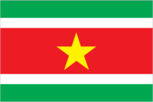
Suriname
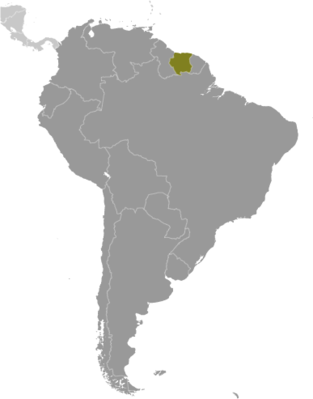
South America · Paramaribo · presidential republic
What Suriname means for your money, the prices you pay, the tariffs in motion, and where U.S. policy could change both.
$75M
U.S. imports, 2025
-17.6%
change in one year
$486M
U.S. exports, 2025
654K
Population
$4.7B
GDP
In your house
What you buy that Suriname makes
America bought $75M in goods from Suriname in 2025, down 17.6% in a single year. Of every $100 of it, here's where the money went.
Fish and shellfish
fish, shrimp, shellfish
Nonferrous metals, other
U.s. goods returned, and reimports
Lumber
lumber for homebuilding
Copper
copper for wiring
Shingles, wallboard
Other parts and accessories of vehicles
car parts and accessories
Fuel oil
fuel oil
Minimum value shipments
Engines and engine parts
2026 so far (through July): $52M in imports. Source: U.S. Census Bureau, International Trade in Goods (customs basis).
The other direction
What America sells to Suriname
$486M in 2025, a trade rupture cuts both ways, for American producers as well as American prices.
Petroleum products, other
$46MMeat, poultry, etc.
$30MMinimum value shipments
$29MIndustrial machines, other
$28MIndustrial engines
$26MDrilling & oilfield equipment
$22MExcavating machinery
$20MMeasuring, testing, control instruments
$19MFuel oil
$17MWhere you stand
U.S. tariff posture toward Suriname
No U.S. tariff action singles this country out. Its goods face the universal 10% temporary import surcharge under Section 122 of the Trade Act (which replaced the IEEPA reciprocal baseline in February 2026) plus the sectoral Section 232 duties — steel and aluminum at 50% — that apply to all countries. The Section 122 surcharge is statutorily temporary — scheduled to lapse on or about July 23, 2026 (a 150-day cap) unless extended or replaced.
Reciprocal tariff (universal baseline)
10%
The universal 10% floor, a Section 122 import surcharge since February 2026, previously the EO 14257 reciprocal baseline, applies to nearly all U.S. imports. This country has no higher assigned rate of its own.
Policy in motion
Tariff status: a moving target
No U.S. tariff action names Suriname. These are the universal measures, applied to every country without a country-specific arrangement, that set its treatment.
2026-04-06
Section 232 metals coverage expanded
In effectThe April 2026 proclamation strengthening Section 232 actions on aluminum, steel, and copper expanded derivative-product coverage for all countries, keeping the general metals rate at 50%.
91 FR 18201 →2026-02-24
IEEPA reciprocal tariffs terminated — replaced by 10% Section 122 surcharge
In effectExecutive Order 14389 (Ending Certain Tariff Actions) terminated the IEEPA tariff duties — including the EO 14257 reciprocal baseline — effective February 24, 2026. A flat 10% Section 122 temporary import surcharge (Proclamation 11012 of February 20, 2026) replaced them, leaving the universal rate unchanged at 10% on a different statutory basis. Section 122 caps such surcharges at 150 days, so this 10% surcharge is scheduled to lapse on or about July 23, 2026 absent further action (the administration has signaled it could raise the rate toward the 15% statutory maximum).
91 FR 9437 →2025-11-13
Agricultural products exempted from reciprocal tariffs
In effectExecutive Order 14360 of November 14, 2025 removed reciprocal duties from certain agricultural products listed in its annexes (coffee, cocoa, bananas, and other goods the U.S. does not produce in sufficient quantity), retroactive to November 13, 2025 — for all countries subject to the reciprocal tariff.
90 FR 54091 →2025-06-04
Section 232 steel and aluminum duties doubled to 50%
In effectThe June 3, 2025 proclamation raised Section 232 duties on steel and aluminum articles and derivatives from 25% to 50% for all countries, effective June 4, 2025.
90 FR 24199 →2025-04-05
Universal 10% reciprocal baseline takes effect
In effectExecutive Order 14257 (signed April 2, 2025) imposed a 10% ad valorem reciprocal duty on imports from all trading partners, effective April 5, 2025. Countries without a higher Annex I rate remain at this baseline.
Federal Register · 2025-06063 →2025-03-12
Section 232 steel and aluminum duties set at 25% for all countries
In effectProclamations of February 10, 2025 terminated all country exemptions and quota arrangements and applied 25% Section 232 duties to steel and aluminum imports from every country, effective March 12, 2025.
90 FR 9817 →
Made for America
What Suriname makes for America
Suriname is a direct U.S. source of 2 essential goods Americans rely on, the items themselves, shipped finished off the line.
Reference
The country itself
South America · Geography, people, economy, and government, public-domain data from the CIA World Factbook.
The Spaniards first explored Suriname in the 16th century, and the English then settled it in the mid-17th century. Suriname became a Dutch colony in 1667. With the abolition of African slavery in 1863, workers were brought in from India and Java. The Netherlands granted the colony independence in 1975. Five years later, the civilian government was replaced by a military regime that soon declared Suriname a socialist republic. It continued to exert control through a succession of nominally civilian administrations until 1987, when international pressure finally forced a democratic election. In 1990, the military overthrew the civilian leadership, but a democratically elected government -- a four-party coalition -- returned to power in 1991. The coalition expanded to eight parties in 2005 and ruled until 2010, when voters returned former military leader Desire BOUTERSE and his opposition coalition to power. President BOUTERSE ran unopposed in 2015 and was reelected. Opposition parties campaigned hard against BOUTERSE in the run-up to the 2020 elections, and a multi-party coalition led by Chandrikapersad SANTOKHI’s VHP and Ronnie Brunswijk’s ABOP was installed.
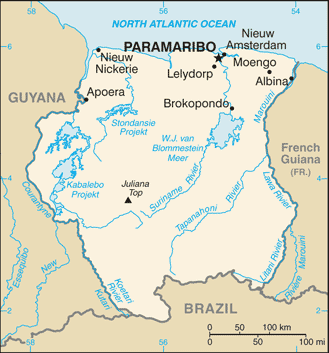
Geography
- Location
- Northern South America, bordering the North Atlantic Ocean, between French Guiana and Guyana
- Area
- 163,820 sq km
- Climate
- tropical; moderated by trade winds
- Terrain
- mostly rolling hills; narrow coastal plain with swamps
- Natural resources
- timber, hydropower, fish, kaolin, shrimp, bauxite, gold, and small amounts of nickel, copper, platinum, iron ore
- Coastline
- 386 km
- Natural hazards
- flooding
People & society
- Population
- 653,605 (2025 est.)
- Nationality
- Surinamer(s)
- Ethnic groups
- Hindustani (also known locally as "East Indians"; their ancestors emigrated from northern India in the latter part of the 19th century) 27.4%, Maroon (their African ancestors were brought to the country in the 17th and 18th centuries as slaves and escaped to the interior) 21.7%, Creole (mixed White and Black) 15.7%, Javanese 13.7%, mixed 13.4%, other 7.6%, unspecified 0.6% (2012 est.)
- Languages
- Dutch (official), English (widely spoken), Sranang Tongo (Surinamese, sometimes called Taki-Taki, is the native language of Creoles and much of the younger population), Caribbean Hindustani (a dialect of Hindi), Javanese
- Religions
- Protestant 23.6% (includes Evangelical 11.2%, Moravian 11.2%, Reformed 0.7%, Lutheran 0.5%), Hindu 22.3%, Roman Catholic 21.6%, Muslim 13.8%, other Christian 3.2%, Winti 1.8%, Jehovah's Witness 1.2%, other 1.7%, none 7.5%, unspecified 3.2% (2012 est.)
- Median age
- 32.3 years (2025 est.)
- Life expectancy at birth
- 72.7 years (2024 est.)
Economy
- Economic overview
- upper middle-income South American economy; new floating currency regime; key aluminum goods, gold, and hydrocarbon exporter; new IMF plan for economic recovery and fiscal sustainability; controversial hardwood industry
- Industries
- gold mining, oil, lumber, food processing, fishing
- Agricultural products
- rice, sugarcane, oranges, vegetables, chicken, cassava, plantains, pineapples, eggs, citrus fruits (2023)
- Exports - partners
- Switzerland 49%, UAE 28%, Guyana 5%, USA 4%, France 3% (2023)
- Imports - partners
- USA 22%, China 12%, Netherlands 11%, Trinidad & Tobago 9%, Guyana 8% (2023)
Government
- Government type
- presidential republic
- Capital
- Paramaribo
- Independence
- 25 November 1975 (from the Netherlands)
- Constitution
- previous 1975; latest ratified 30 September 1987, effective 30 October 1987
- Executive branch
- President Jennifer GEERLINGS-SIMONS (since 16 July 2025)
- Legislative branch
- National Assembly (Nationale Assemblee)
Full reference data
Every field, by section, CIA World Factbook. Open a topic to expand it.
Introduction
Travel Facts
Please visit the following links to find further information about your desired destination.
World Health Organization (WHO) - To learn what vaccines and health precautions to take while visiting your destination.
US State Dept Travel Information - Overall information about foreign travel for US citizens.
To obtain an international driving permit (IDP). Only two organizations in the US issue IDPs: American Automobile Association (AAA) and American Automobile Touring Alliance (AATA)
How to get help in an emergency? Contact the nearest US embassy or consulate, or call one of these numbers: from the US or Canada - 1-888-407-4747 or from Overseas - +1 202-501-4444
Page last updated: Wednesday, July 20, 2022