
Country exposure · TG
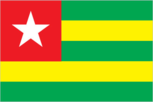
Togo
Africa · Lome · presidential republic
What Togo means for your money, the prices you pay, the tariffs in motion, and where U.S. policy could change both.
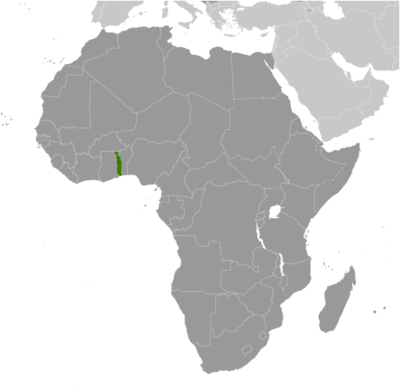
$81M
U.S. imports, 2025
-10.3%
change in one year
$241M
U.S. exports, 2025
9M
Population
$9.9B
GDP
In your house
What you buy that Togo makes
America bought $81M in goods from Togo in 2025. Of every $100 of it, here's where the money went.
Feedstuff and foodgrains
Tobacco, waxes, etc.
Cocoa beans
cocoa for chocolate
Apparel,household goods-nontextile
leather goods and accessories
Fruits, frozen juices
fruit and frozen juices
Toiletries and cosmetics
toiletries and cosmetics
Other (movies, miscellaneous imports, and special transactions)
Food oils, oilseeds
U.s. goods returned, and reimports
Minimum value shipments
2026 so far (through July): $54M in imports. Source: U.S. Census Bureau, International Trade in Goods (customs basis).
The other direction
What America sells to Togo
$241M in 2025, a trade rupture cuts both ways, for American producers as well as American prices.
Natural gas liquids
$60MPetroleum products, other
$52MPassenger cars, new and used
$48Mnew and used cars
Plastic materials
$20Mplastics for packaging and goods
Other parts and accessories of vehicles
$16Mcar parts and accessories
Wheat
$8Mgreen coffee for roasters
Coal and fuels, other
$7MRice
$6Mcocoa for chocolate
Cell phones and other household goods, n.e.c.
$4Mcell phones and home electronics
Where you stand
U.S. tariff posture toward Togo
No U.S. tariff action singles this country out. Its goods face the universal 10% temporary import surcharge under Section 122 of the Trade Act (which replaced the IEEPA reciprocal baseline in February 2026) plus the sectoral Section 232 duties — steel and aluminum at 50% — that apply to all countries. The Section 122 surcharge is statutorily temporary — scheduled to lapse on or about July 23, 2026 (a 150-day cap) unless extended or replaced.
Reciprocal tariff (universal baseline)
10%
The universal 10% floor, a Section 122 import surcharge since February 2026, previously the EO 14257 reciprocal baseline, applies to nearly all U.S. imports. This country has no higher assigned rate of its own.
Policy in motion
Tariff status: a moving target
No U.S. tariff action names Togo. These are the universal measures, applied to every country without a country-specific arrangement, that set its treatment.
2026-04-06
Section 232 metals coverage expanded
In effectThe April 2026 proclamation strengthening Section 232 actions on aluminum, steel, and copper expanded derivative-product coverage for all countries, keeping the general metals rate at 50%.
91 FR 18201 →2026-02-24
IEEPA reciprocal tariffs terminated — replaced by 10% Section 122 surcharge
In effectExecutive Order 14389 (Ending Certain Tariff Actions) terminated the IEEPA tariff duties — including the EO 14257 reciprocal baseline — effective February 24, 2026. A flat 10% Section 122 temporary import surcharge (Proclamation 11012 of February 20, 2026) replaced them, leaving the universal rate unchanged at 10% on a different statutory basis. Section 122 caps such surcharges at 150 days, so this 10% surcharge is scheduled to lapse on or about July 23, 2026 absent further action (the administration has signaled it could raise the rate toward the 15% statutory maximum).
91 FR 9437 →2025-11-13
Agricultural products exempted from reciprocal tariffs
In effectExecutive Order 14360 of November 14, 2025 removed reciprocal duties from certain agricultural products listed in its annexes (coffee, cocoa, bananas, and other goods the U.S. does not produce in sufficient quantity), retroactive to November 13, 2025 — for all countries subject to the reciprocal tariff.
90 FR 54091 →2025-06-04
Section 232 steel and aluminum duties doubled to 50%
In effectThe June 3, 2025 proclamation raised Section 232 duties on steel and aluminum articles and derivatives from 25% to 50% for all countries, effective June 4, 2025.
90 FR 24199 →2025-04-05
Universal 10% reciprocal baseline takes effect
In effectExecutive Order 14257 (signed April 2, 2025) imposed a 10% ad valorem reciprocal duty on imports from all trading partners, effective April 5, 2025. Countries without a higher Annex I rate remain at this baseline.
Federal Register · 2025-06063 →2025-03-12
Section 232 steel and aluminum duties set at 25% for all countries
In effectProclamations of February 10, 2025 terminated all country exemptions and quota arrangements and applied 25% Section 232 duties to steel and aluminum imports from every country, effective March 12, 2025.
90 FR 9817 →
Made for America
What Togo makes for America
Togo is a direct U.S. source of 1 essential good Americans rely on, the items themselves, shipped finished off the line.
Reference
The country itself
Africa · Geography, people, economy, and government, public-domain data from the CIA World Factbook.
From the 11th to the 16th centuries, various ethnic groups settled the Togo region. From the 16th to the 18th centuries, the coastal region became a major trading center for enslaved people, and the surrounding region took on the name of "The Slave Coast." In 1884, Germany declared the area a protectorate called Togoland, which included present-day Togo. After World War I, colonial rule over Togo was transferred to France. French Togoland became Togo upon independence in 1960. Gen. Gnassingbe EYADEMA, installed as military ruler in 1967, ruled Togo with a heavy hand for almost four decades. Despite the facade of multi-party elections instituted in the early 1990s, EYADEMA largely dominated the government. His Rally of the Togolese People (RPT) party has been in power almost continually since 1967, with its successor, the Union for the Republic, maintaining a majority of seats in today's legislature. Upon EYADEMA's death in 2005, the military installed his son, Faure GNASSINGBE, as president and then engineered his formal election two months later. Togo held its first relatively free and fair legislative elections in 2007. Since then, GNASSINGBE has started the country along a gradual path to democratic reform. Togo has held multiple presidential and legislative elections, and in 2019, the country held its first local elections in 32 years. Despite those positive moves, political reconciliation has moved slowly, and the country experiences periodic outbursts of protests from frustrated citizens, leading to violence between security forces and protesters. Constitutional changes in 2019 to institute a runoff system in presidential elections and to establish term limits have done little to reduce the resentment many Togolese feel after more than 50 years of one-family rule. GNASSINGBE became eligible for his current fourth term and one additional fifth term under the new rules. The next presidential election is set for 2025.
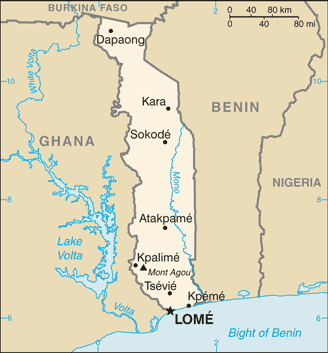
Geography
- Location
- Western Africa, bordering the Bight of Benin, between Benin and Ghana
- Area
- 56,785 sq km
- Climate
- tropical; hot, humid in south; semiarid in north
- Terrain
- gently rolling savanna in north; central hills; southern plateau; low coastal plain with extensive lagoons and marshes
- Natural resources
- phosphates, limestone, marble, arable land
- Coastline
- 56 km
- Natural hazards
- hot, dry harmattan wind can reduce visibility in north during winter; periodic droughts
People & society
- Population
- 9,143,439 (2025 est.)
- Nationality
- Togolese (singular and plural)
- Ethnic groups
- Adja-Ewe/Mina 42.4%, Kabye/Tem 25.9%, Para-Gourma/Akan 17.1%, Akposso/Akebu 4.1%, Ana-Ife 3.2%, other Togolese 1.7%, foreigners 5.2%, no response 0.4% (2013-14 est.)
- Languages
- French (official, language of commerce), Ewe and Mina (in the south), Kabye (sometimes spelled Kabiye) and Dagomba (in the north)
- Religions
- Christian 42.3%, folk religion 36.9%, Muslim 14%, Hindu <1%, Buddhist <1%, Jewish <1%, other <1%, none 6.2% (2020 est.)
- Median age
- 20.9 years (2025 est.)
- Life expectancy at birth
- 72.1 years (2024 est.)
- Literacy
- 72.6% (2022 est.)
Economy
- Economic overview
- low-income West African economy; primarily agrarian economy; has a deep-water port; growing international shipping locale; improving privatization and public budgeting transparency; key phosphate mining industry; extremely high rural poverty
- Industries
- phosphate mining, agricultural processing, cement, handicrafts, textiles, beverages
- Agricultural products
- cassava, maize, yams, sorghum, soybeans, beans, rice, vegetables, oil palm fruit, cotton (2023)
- Exports - partners
- UAE 40%, India 13%, Angola 13%, Burkina Faso 4%, Cote d'Ivoire 3% (2023)
- Imports - partners
- China 26%, India 26%, Belgium 6%, Netherlands 6%, USA 3% (2023)
Government
- Government type
- presidential republic
- Capital
- Lome
- Independence
- 27 April 1960 (from French-administered UN trusteeship)
- Constitution
- several previous; latest adopted 27 September 1992, effective 14 October 1992; revised 6 May 2024
- Executive branch
- President Jean-Lucien Kwassi Savi de TOVE (since 3 May 2025)
- Legislative branch
- Parliament
Full reference data
Every field, by section, CIA World Factbook. Open a topic to expand it.
Introduction
Travel Facts
Please visit the following links to find further information about your desired destination.
World Health Organization (WHO) - To learn what vaccines and health precautions to take while visiting your destination.
US State Dept Travel Information - Overall information about foreign travel for US citizens.
To obtain an international driving permit (IDP). Only two organizations in the US issue IDPs: American Automobile Association (AAA) and American Automobile Touring Alliance (AATA)
How to get help in an emergency? Contact the nearest US embassy or consulate, or call one of these numbers: from the US or Canada - 1-888-407-4747 or from Overseas - +1 202-501-4444
Page last updated: Thursday, May 09, 2024