Country exposure · TJ

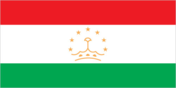
Flag of Tajikistan

Tajikistan

Central Asia · Dushanbe · presidential republic

What Tajikistan means for your money — the prices you pay, the tariffs in motion, and where U.S. policy could change both.
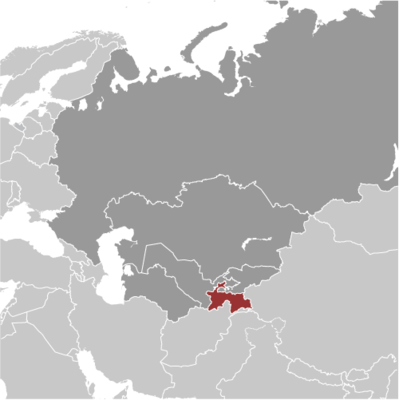
Map showing the location of Tajikistan

$571K

U.S. imports, 2025

-87.5%

change in one year

$37M

U.S. exports, 2025

11M

Population

$14.2B

GDP

In your house

What you buy that Tajikistan makes

America bought $571K in goods from Tajikistan in 2025 — down 87.5% in a single year. Of every $100 of it, here's where the money went.

U.s. goods returned, and reimports

$279K49%

Fruits, frozen juices

fruit and frozen juices

$136K23.9%

Other foods

$42K7.4%

Minimum value shipments

$36K6.3%

Gem stones, other

$36K6.3%

Artwork, antiques, stamps, etc.

$19K3.4%

Food oils, oilseeds

$10K1.8%

Other parts and accessories of vehicles

car parts and accessories

$6K1.1%

Feedstuff and foodgrains

$5K0.9%

Apparel, household goods - cotton

cotton clothing and linens

$0K0.1%

2026 so far (through April): $3M in imports. Source: U.S. Census Bureau, International Trade in Goods (customs basis).

The other direction

What America sells to Tajikistan

$37M in 2025 — a trade rupture cuts both ways, for American producers as well as American prices.

Other foods

$7M

Civilian aircraft, engines, equipment, and parts

$6M

Pulpwood and woodpulp

$5M

Telecommunications equipment

$4M

phones, routers, networking gear

Civilian aircraft

$2M

Tanks, artillery, missiles, rockets, guns and ammunition

$2M

Medicinal equipment

$2M

medical devices and equipment

Passenger cars, new and used

$2M

new and used cars

Measuring, testing, control instruments

$1M

Where you stand

U.S. tariff posture toward Tajikistan

No U.S. tariff action singles this country out. Its goods face the universal 10% temporary import surcharge under Section 122 of the Trade Act (which replaced the IEEPA reciprocal baseline in February 2026) plus the sectoral Section 232 duties — steel and aluminum at 50% — that apply to all countries. The Section 122 surcharge is statutorily temporary — scheduled to lapse on or about July 23, 2026 (a 150-day cap) unless extended or replaced.

Reciprocal tariff (universal baseline)

10%

The universal 10% floor — a Section 122 import surcharge since February 2026, previously the EO 14257 reciprocal baseline — applies to nearly all U.S. imports. This country has no higher assigned rate of its own.

Policy in motion

Tariff status: a moving target

No U.S. tariff action names Tajikistan. These are the universal measures — applied to every country without a country-specific arrangement — that set its treatment.

  1. 2026-04-06

    Section 232 metals coverage expanded

    In effect

    The April 2026 proclamation strengthening Section 232 actions on aluminum, steel, and copper expanded derivative-product coverage for all countries, keeping the general metals rate at 50%.

    91 FR 18201
  2. 2026-02-24

    IEEPA reciprocal tariffs terminated — replaced by 10% Section 122 surcharge

    In effect

    Executive Order 14389 (Ending Certain Tariff Actions) terminated the IEEPA tariff duties — including the EO 14257 reciprocal baseline — effective February 24, 2026. A flat 10% Section 122 temporary import surcharge (Proclamation 11012 of February 20, 2026) replaced them, leaving the universal rate unchanged at 10% on a different statutory basis. Section 122 caps such surcharges at 150 days, so this 10% surcharge is scheduled to lapse on or about July 23, 2026 absent further action (the administration has signaled it could raise the rate toward the 15% statutory maximum).

    91 FR 9437
  3. 2025-11-13

    Agricultural products exempted from reciprocal tariffs

    In effect

    Executive Order 14360 of November 14, 2025 removed reciprocal duties from certain agricultural products listed in its annexes (coffee, cocoa, bananas, and other goods the U.S. does not produce in sufficient quantity), retroactive to November 13, 2025 — for all countries subject to the reciprocal tariff.

    90 FR 54091
  4. 2025-06-04

    Section 232 steel and aluminum duties doubled to 50%

    In effect

    The June 3, 2025 proclamation raised Section 232 duties on steel and aluminum articles and derivatives from 25% to 50% for all countries, effective June 4, 2025.

    90 FR 24199
  5. 2025-04-05

    Universal 10% reciprocal baseline takes effect

    In effect

    Executive Order 14257 (signed April 2, 2025) imposed a 10% ad valorem reciprocal duty on imports from all trading partners, effective April 5, 2025. Countries without a higher Annex I rate remain at this baseline.

    Federal Register · 2025-06063
  6. 2025-03-12

    Section 232 steel and aluminum duties set at 25% for all countries

    In effect

    Proclamations of February 10, 2025 terminated all country exemptions and quota arrangements and applied 25% Section 232 duties to steel and aluminum imports from every country, effective March 12, 2025.

    90 FR 9817

Go deeper

The supply chain view

Tajikistan sits upstream of 1 essential American goods through 1 tracked inputs.

Full supply-map profile →

Reference

The country itself

Central Asia · Geography, people, economy, and government — public-domain data from the CIA World Factbook.

The Tajik people came under Russian imperial rule in the 1860s and 1870s, but Russia's hold on Central Asia weakened following the Revolution of 1917. At that time, bands of indigenous guerrillas (known as "basmachi") fiercely contested Bolshevik control of the area, which was not fully reestablished until 1925. Tajikistan was first established as an autonomous Soviet Socialist Republic within the Uzbek Soviet Socialist Republic in 1924, but in 1929 the Soviet Union made Tajikistan as a separate republic and transferred to it much of present-day Sughd Province. Ethnic Uzbeks form a substantial minority in Tajikistan, and ethnic Tajiks an even larger minority in Uzbekistan. Tajikistan became independent in 1991 after the breakup of the Soviet Union, and the country experienced a civil war among political, regional, and religious factions from 1992 to 1997. Despite Tajikistan's general elections for both the presidency (once every seven years) and legislature (once every five years), observers note an electoral system rife with irregularities and abuse, and results that are neither free nor fair. President Emomali RAHMON, who came to power in 1992 during the civil war and was first elected president in 1994, used an attack planned by a disaffected deputy defense minister in 2015 to ban the last major opposition party in Tajikistan. RAHMON further strengthened his position by having himself declared "Founder of Peace and National Unity, Leader of the Nation," with limitless terms and lifelong immunity through constitutional amendments ratified in a referendum. The referendum also lowered the minimum age required to run for president from 35 to 30, which made RAHMON's first-born son Rustam EMOMALI, the mayor of the capital city of Dushanbe, eligible to run for president in 2020. RAHMON orchestrated EMOMALI's selection in 2020 as chairman of the Majlisi Milli (the upper chamber of Tajikistan's parliament), positioning EMOMALI as next in line of succession for the presidency. RAHMON opted to run in the presidential election later that year and received 91% of the vote. The country remains the poorest of the former Soviet republics. Tajikistan became a member of the WTO in 2013, but its economy continues to face major challenges, including dependence on remittances from Tajikistani migrant laborers in Russia and Kazakhstan, pervasive corruption, the opiate trade, and destabilizing violence emanating from neighboring Afghanistan. Tajikistan has endured several domestic security incidents since 2010, including armed conflict between government forces and local strongmen in the Rasht Valley and between government forces and informal leaders in Gorno-Badakhshan Autonomous Oblast. Tajikistan suffered its first ISIS-claimed attack in 2018, when assailants attacked a group of Western bicyclists, killing four. Friction between forces on the border between Tajikistan and the Kyrgyz Republic flared up in 2021, culminating in fatal clashes between border forces in 2021 and 2022.
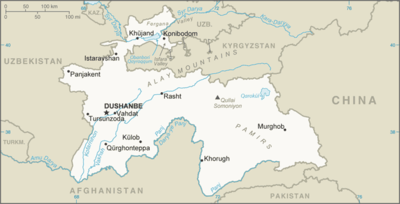
Regional map of Tajikistan

Geography

Location
Central Asia, west of China, south of Kyrgyzstan
Area
144,100 sq km
Climate
mid-latitude continental, hot summers, mild winters; semiarid to polar in Pamir Mountains
Terrain
mountainous region dominated by the Alay Mountains in the north and the Pamirs in the southeast; western Fergana Valley in north, Kofirnihon and Vakhsh Valleys in southwest
Natural resources
hydropower, some petroleum, uranium, mercury, brown coal, lead, zinc, antimony, tungsten, silver, gold
Coastline
0 km (landlocked)
Natural hazards
earthquakes; floods

People & society

Population
10,593,876 (2025 est.)
Nationality
Tajikistani(s)
Ethnic groups
Tajik 84.3% (includes Pamiri and Yagnobi), Uzbek 13.8%, other 2% (includes Kyrgyz, Russian, Turkmen, Tatar, Arab) (2014 est.)
Languages
Tajik (official) 84.4%, Uzbek 11.9%, Kyrgyz 0.8%, Russian 0.5%, other 2.4% (2010 est.)
Religions
Muslim 98% (Sunni 95%, Shia 3%) other 2% (2014 est.)
Median age
22.8 years (2025 est.)
Life expectancy at birth
71.9 years (2024 est.)
Literacy
94.6% (2017 est.)

Economy

Economic overview
lower-middle-income Central Asian economy; large infrastructure projects, including Rogun Dam, and a push towards green development and digitalization driving growth; strong metal mining, electricity, and manufacturing industries; challenges include land scarcity, climate vulnerability, and complex bureaucratic processes for investors
Industries
aluminum, cement, coal, gold, silver, antimony, textile, vegetable oil
Agricultural products
potatoes, milk, wheat, watermelons, onions, tomatoes, carrots/turnips, cotton, vegetables, grapes (2023)
Exports - partners
Switzerland 31%, Kazakhstan 18%, China 17%, Uzbekistan 10%, Turkey 8% (2023)
Imports - partners
China 57%, Kazakhstan 13%, Uzbekistan 8%, Turkey 6%, UAE 4% (2023)

Government

Government type
presidential republic
Capital
Dushanbe
Independence
9 September 1991 (from the Soviet Union)
Constitution
several previous; latest adopted 6 November 1994
Executive branch
President Emomali RAHMON (since 16 November 1994; head of state and Supreme Assembly Chairman since 20 November 1992)
Legislative branch
Supreme Council (Majlisi Oli)

Full reference data

Every field, by section — CIA World Factbook. Open a topic to expand it.

Introduction
Background
The Tajik people came under Russian imperial rule in the 1860s and 1870s, but Russia's hold on Central Asia weakened following the Revolution of 1917. At that time, bands of indigenous guerrillas (known as "basmachi") fiercely contested Bolshevik control of the area, which was not fully reestablished until 1925. Tajikistan was first established as an autonomous Soviet Socialist Republic within the Uzbek Soviet Socialist Republic in 1924, but in 1929 the Soviet Union made Tajikistan as a separate republic and transferred to it much of present-day Sughd Province. Ethnic Uzbeks form a substantial minority in Tajikistan, and ethnic Tajiks an even larger minority in Uzbekistan. Tajikistan became independent in 1991 after the breakup of the Soviet Union, and the country experienced a civil war among political, regional, and religious factions from 1992 to 1997. Despite Tajikistan's general elections for both the presidency (once every seven years) and legislature (once every five years), observers note an electoral system rife with irregularities and abuse, and results that are neither free nor fair. President Emomali RAHMON, who came to power in 1992 during the civil war and was first elected president in 1994, used an attack planned by a disaffected deputy defense minister in 2015 to ban the last major opposition party in Tajikistan. RAHMON further strengthened his position by having himself declared "Founder of Peace and National Unity, Leader of the Nation," with limitless terms and lifelong immunity through constitutional amendments ratified in a referendum. The referendum also lowered the minimum age required to run for president from 35 to 30, which made RAHMON's first-born son Rustam EMOMALI, the mayor of the capital city of Dushanbe, eligible to run for president in 2020. RAHMON orchestrated EMOMALI's selection in 2020 as chairman of the Majlisi Milli (the upper chamber of Tajikistan's parliament), positioning EMOMALI as next in line of succession for the presidency. RAHMON opted to run in the presidential election later that year and received 91% of the vote. The country remains the poorest of the former Soviet republics. Tajikistan became a member of the WTO in 2013, but its economy continues to face major challenges, including dependence on remittances from Tajikistani migrant laborers in Russia and Kazakhstan, pervasive corruption, the opiate trade, and destabilizing violence emanating from neighboring Afghanistan. Tajikistan has endured several domestic security incidents since 2010, including armed conflict between government forces and local strongmen in the Rasht Valley and between government forces and informal leaders in Gorno-Badakhshan Autonomous Oblast. Tajikistan suffered its first ISIS-claimed attack in 2018, when assailants attacked a group of Western bicyclists, killing four. Friction between forces on the border between Tajikistan and the Kyrgyz Republic flared up in 2021, culminating in fatal clashes between border forces in 2021 and 2022.
Travel Facts
US State Dept Travel Advisory
The US Department of State currently recommends US citizens exercise increased caution in Tajikistan due to terrorism. Consult its website via the link below for updates to travel advisories and statements on safety, security, local laws, and special circumstances in this country. https://travel.state.gov/content/travel/en/traveladvisories/traveladvisories.html
Passport/Visa Requirements
US citizens should make sure their passport will not expire for at least 6 months after they enter the country even if they do not intend to stay that long. They should also make sure they have at least 1 blank page in their passport for each entry stamp/visa that will be required. A visa is required. US citizens will need to get in touch with the country’s embassy or nearest consulate to obtain a visa prior to visiting the country. If travel originates from a country without an Embassy of Tajikistan, it is possible for a traveler to purchase a visa upon arrival at the airport; however, the traveler will need to first apply for a visa online with the Tajikistani Ministry of Foreign Affairs (MFA), receive a pre-approval confirmation, and a Letter of Invitation from the US Embassy Dushanbe prior to arrival.
US Embassy/Consulate
992-37-229-2000, 992-37-229-2300, (consular direct line); EMER: 992-98-580-1032; US Embassy Dushanbe, 109A, Ismoili Somoni Avenue, Dushanbe, Tajikistan 734019; DushanbeConsular@state.gov; https://tj.usembassy.gov/
Telephone Code
992
Local Emergency Phone
3
Vaccinations
See WHO recommendations. On 21 March 2022, the US Centers for Disease Control and Prevention (CDC) issued a Travel Alert for polio in Asia; Tajikistan is currently considered a high risk to travelers for polio; the CDC recommends that before any international travel, anyone unvaccinated, incompletely vaccinated, or with an unknown polio vaccination status should complete the routine polio vaccine series; before travel to any high-risk destination, CDC recommends that adults who previously completed the full, routine polio vaccine series receive a single, lifetime booster dose of polio vaccine. http://www.who.int/
Climate
Mid-latitude continental, hot summers, mild winters; semiarid to polar in Pamir Mountains
Currency (Code)
Tajikistani somoni (TJS)
Electricity/Voltage/Plug Type(s)
220 V / 50 Hz / plug types(s): C, F
Major Languages
Tajik, Uzbek, Kyrgyz, Russian
Major Religions
Muslim 98% (Sunni 95%, Shia 3%), other 2%
Time Difference
UTC+5 (10 hours ahead of Washington, DC, during Standard Time)
Potable Water
Opt for bottled water
International Driving Permit
Suggested
Road Driving Side
Right
Tourist Destinations
Dushanbe; Pamir Highway; Jisev Valley Hiking; Iskanderkul Lake; Murghab; Bulunkul & Yashilkul Lakes Trekking
Major Sports
Baseball, soccer, basketball, golf, softball
Cultural Practices
Best not to use your left hand for exchanges of money, gifts, shaking hands, or passing food. The use of ones left hand is considered unclean.
Tipping Guidelines
It is standard to tip a bellhop $1 (USD) per bag; although not expected, tipping the hotel cleaning staff is appropriate. Taxi drivers do not expect tips.
Souvenirs
Arabic words worked into jewelry, musical instruments, utensils, and small sculptures; carved furniture; hand-woven carpets; brocade fabric items; gold-embroidered rumol belts, toki kallapush scullcaps, and other items; dried apricots; Soviet-era memorabilia
Traditional Cuisine
Qurutob — dried balls of cheese are soaked in water and the resulting salty liquid is used as the base of the dish; strips of flatbread are placed on top and the mixture is usually topped with a variety of vegetables, meat, or garnished with chili peppers
CIA source last updated
Wednesday, July 20, 2022
Travel resources

Please visit the following links to find further information about your desired destination.

World Health Organization (WHO) - To learn what vaccines and health precautions to take while visiting your destination.

US State Dept Travel Information - Overall information about foreign travel for US citizens.

To obtain an international driving permit (IDP). Only two organizations in the US issue IDPs: American Automobile Association (AAA) and American Automobile Touring Alliance (AATA)

How to get help in an emergency? Contact the nearest US embassy or consulate, or call one of these numbers: from the US or Canada - 1-888-407-4747 or from Overseas - +1 202-501-4444

Page last updated: Wednesday, July 20, 2022

Geography
Location
Central Asia, west of China, south of Kyrgyzstan
Geographic coordinates
39 00 N, 71 00 E
Map references
Asia
Area - total
144,100 sq km
Area - land
141,510 sq km
Area - water
2,590 sq km
Area - comparative
slightly smaller than Wisconsin
Land boundaries - total
4,130 km
Land boundaries - border countries
Afghanistan 1,357 km; China 477 km; Kyrgyzstan 984 km; Uzbekistan 1,312 km
Coastline
0 km (landlocked)
Maritime claims
none (landlocked)
Climate
mid-latitude continental, hot summers, mild winters; semiarid to polar in Pamir Mountains
Terrain
mountainous region dominated by the Alay Mountains in the north and the Pamirs in the southeast; western Fergana Valley in north, Kofirnihon and Vakhsh Valleys in southwest
Elevation - highest point
Qullai Somoniyon 7,495 m
Elevation - lowest point
Syr Darya (Sirdaryo) 300 m
Elevation - mean elevation
3,186 m
Natural resources
hydropower, some petroleum, uranium, mercury, brown coal, lead, zinc, antimony, tungsten, silver, gold
Land use - agricultural land
27.9% (2023 est.)
Land use - agricultural land: arable land
arable land: 6.1% (2023 est.)
Land use - agricultural land: permanent crops
permanent crops: 1.5% (2023 est.)
Land use - agricultural land: permanent pasture
permanent pasture: 20.4% (2023 est.)
Land use - forest
3.1% (2023 est.)
Land use - other
69% (2023 est.)
Irrigated land
5,681 sq km (2022)
Major rivers (by length in km)
Syr Darya (shared with Kyrgyzstan [s], Uzbekistan, and Kazakhstan [m]) - 3,078 km; Amu Darya river source (shared with Turkmenistan, Afghanistan, and Uzbekistan [m]) - 2,620 km note: [s] after country name indicates river source; [m] after country name indicates river mouth
Major watersheds (area sq km) - Internal (endorheic basin) drainage
Tarim Basin (1,152,448 sq km), (Aral Sea Basin) Amu Darya (534,739 sq km), Syr Darya (782,617 sq km)
Population distribution
the population is concentrated at lower elevations, with perhaps as many as 90% living in valleys; overall density increases from east to west
Natural hazards
earthquakes; floods
Geography - note
landlocked; highest point, Qullai Ismoili Somoni (formerly Communism Peak), was the tallest mountain in the former USSR
People and Society
Population - total
10,593,876 (2025 est.)
Population - male
5,322,920
Population - female
5,270,956
Nationality - noun
Tajikistani(s)
Nationality - adjective
Tajikistani
Ethnic groups
Tajik 84.3% (includes Pamiri and Yagnobi), Uzbek 13.8%, other 2% (includes Kyrgyz, Russian, Turkmen, Tatar, Arab) (2014 est.)
Languages - Languages
Tajik (official) 84.4%, Uzbek 11.9%, Kyrgyz 0.8%, Russian 0.5%, other 2.4% (2010 est.)
Languages - major-language sample(s)
Китоби Фактҳои Ҷаҳонӣ, манбаи бебадали маълумоти асосӣ (Tajik) The World Factbook, the indispensable source for basic information.
Languages - note
note: Russian widely used in government and business
Religions
Muslim 98% (Sunni 95%, Shia 3%) other 2% (2014 est.)
Age structure - 0-14 years
36.9% (male 1,953,472/female 1,877,192)
Age structure - 15-64 years
59.3% (male 3,086,964/female 3,071,642)
Age structure - 65 years and over
3.9% (2024 est.) (male 181,382/female 223,411)
Dependency ratios - total dependency ratio
68.5 (2025 est.)
Dependency ratios - youth dependency ratio
61.5 (2025 est.)
Dependency ratios - elderly dependency ratio
6.9 (2025 est.)
Dependency ratios - potential support ratio
14.5 (2025 est.)
Median age - total
22.8 years (2025 est.)
Median age - male
22.3 years
Median age - female
23.2 years
Population growth rate
1.89% (2025 est.)
Birth rate
25.31 births/1,000 population (2025 est.)
Death rate
4.45 deaths/1,000 population (2025 est.)
Net migration rate
-1.94 migrant(s)/1,000 population (2025 est.)
Population distribution
the population is concentrated at lower elevations, with perhaps as many as 90% living in valleys; overall density increases from east to west
Urbanization - urban population
28.2% of total population (2023)
Urbanization - rate of urbanization
2.73% annual rate of change (2020-25 est.)
Major urban areas - population
987,000 DUSHANBE (capital) (2023)
Sex ratio - at birth
1.05 male(s)/female
Sex ratio - 0-14 years
1.04 male(s)/female
Sex ratio - 15-64 years
1 male(s)/female
Sex ratio - 65 years and over
0.81 male(s)/female
Sex ratio - total population
1.01 male(s)/female (2024 est.)
Mother's mean age at first birth
23.2 years (2017 est.)
Maternal mortality ratio
14 deaths/100,000 live births (2023 est.)
Infant mortality rate - total
20.3 deaths/1,000 live births (2025 est.)
Infant mortality rate - male
24.3 deaths/1,000 live births
Infant mortality rate - female
18.9 deaths/1,000 live births
Life expectancy at birth - total population
71.9 years (2024 est.)
Life expectancy at birth - male
70.1 years
Life expectancy at birth - female
73.8 years
Total fertility rate
3.52 children born/woman (2025 est.)
Gross reproduction rate
1.71 (2025 est.)
Drinking water source - improved: urban
urban: 95.6% of population (2022 est.)
Drinking water source - improved: rural
rural: 76.6% of population (2022 est.)
Drinking water source - improved: total
total: 81.9% of population (2022 est.)
Drinking water source - unimproved: urban
urban: 4.4% of population (2022 est.)
Drinking water source - unimproved: rural
rural: 23.4% of population (2022 est.)
Drinking water source - unimproved: total
total: 18.1% of population (2022 est.)
Health expenditure - Health expenditure (as % of GDP)
8% of GDP (2021)
Health expenditure - Health expenditure (as % of national budget)
6.4% of national budget (2022 est.)
Physician density
1.87 physicians/1,000 population (2023)
Hospital bed density
4.3 beds/1,000 population (2021 est.)
Sanitation facility access - improved: urban
urban: 98.9% of population (2022 est.)
Sanitation facility access - improved: rural
rural: 99.6% of population (2022 est.)
Sanitation facility access - improved: total
total: 99.4% of population (2022 est.)
Sanitation facility access - unimproved: urban
urban: 1.1% of population (2022 est.)
Sanitation facility access - unimproved: rural
rural: 0.4% of population (2022 est.)
Sanitation facility access - unimproved: total
total: 0.6% of population (2022 est.)
Obesity - adult prevalence rate
14.2% (2016)
Alcohol consumption per capita - total
0.85 liters of pure alcohol (2019 est.)
Alcohol consumption per capita - beer
0.38 liters of pure alcohol (2019 est.)
Alcohol consumption per capita - wine
0.01 liters of pure alcohol (2019 est.)
Alcohol consumption per capita - spirits
0.45 liters of pure alcohol (2019 est.)
Alcohol consumption per capita - other alcohols
0 liters of pure alcohol (2019 est.)
Children under the age of 5 years underweight
5.2% (2023 est.)
Currently married women (ages 15-49)
68% (2020 est.)
Child marriage - women married by age 15
0.1% (2017)
Child marriage - women married by age 18
8.7% (2017)
Education expenditure - Education expenditure (% GDP)
5.4% of GDP (2023 est.)
Education expenditure - Education expenditure (% national budget)
19.3% national budget (2024 est.)
Literacy - female
94.6% (2017 est.)
School life expectancy (primary to tertiary education) - total
12 years (2024 est.)
School life expectancy (primary to tertiary education) - male
12 years (2024 est.)
School life expectancy (primary to tertiary education) - female
11 years (2024 est.)
Government
Country name - conventional long form
Republic of Tajikistan
Country name - conventional short form
Tajikistan
Country name - local long form
Jumhurii Tojikiston
Country name - local short form
Tojikiston
Country name - former
Tajik Soviet Socialist Republic
Country name - etymology
the Persian suffix - ostan means "land," so the country name means "Land of the Tajik [people];" the name Tajik comes from the Sanskrit tajika , a name originally used to distinguish Arabs from Turks and derived from the Tay, an Arab people
Government type
presidential republic
Capital - name
Dushanbe
Capital - geographic coordinates
38 33 N, 68 46 E
Capital - time difference
UTC+5 (10 hours ahead of Washington, DC, during Standard Time)
Capital - etymology
the name means Monday in Persian; today's city was originally at the crossroads where a large bazaar was held on Mondays, or the second day ( du ) after Saturday ( shambe )
Administrative divisions
2 provinces ( viloyatho , singular - viloyat ), 1 autonomous province* ( viloyati mukhtor ), 1 capital region** ( viloyati poytakht ), and 1 area referred to as Districts Under Republic Administration***; Dushanbe**, Khatlon (Bokhtar), Kuhistoni Badakhshon [Gorno-Badakhshan]* (Khorugh), Nohiyahoi Tobei Jumhuri***, Sughd (Khujand)
Administrative divisions - note
note: the administrative center name follows in parentheses
Legal system
civil law system
Constitution - history
several previous; latest adopted 6 November 1994
Constitution - amendment process
proposed by the president of the republic or by at least one third of the total membership of both houses of the Supreme Assembly; adoption of any amendment requires a referendum, which includes approval of the president or approval by at least two-thirds majority of the Assembly of Representatives; passage in a referendum requires participation of an absolute majority of eligible voters and an absolute majority of votes; constitutional articles, including Tajikistan’s form of government, its territory, and its democratic nature, cannot be amended
International law organization participation
has not submitted an ICJ jurisdiction declaration; accepts ICCt jurisdiction
Citizenship - citizenship by birth
no
Citizenship - citizenship by descent only
at least one parent must be a citizen of Tajikistan
Citizenship - dual citizenship recognized
no
Citizenship - residency requirement for naturalization
5 years or 3 years of continuous residence prior to application
Suffrage
18 years of age; universal
Executive branch - chief of state
President Emomali RAHMON (since 16 November 1994; head of state and Supreme Assembly Chairman since 20 November 1992)
Executive branch - head of government
Prime Minister Qohir RASULZODA (since 23 November 2013)
Executive branch - cabinet
Council of Ministers appointed by the president, approved by the Supreme Assembly
Executive branch - election/appointment process
president directly elected by simple-majority popular vote for a 7-year term (two-term limit), but as the "Leader of the Nation," president has no term limit; prime minister appointed by the president
Executive branch - most recent election date
11 October 2020
Executive branch - election results
2020 : Emomali RAHMON reelected president; percent of vote - Emomali RAHMON (PDPT) 92.1%, Rustam LATIFZODA (APT) 3.1%, other 4.8% 2013: Emomali RAHMON reelected president; percent of vote - Emomali RAHMON (PDPT) 84%, Ismoil TALBAKOV CPT) 5%, other 11%
Executive branch - expected date of next election
2027
Legislative branch - legislature name
Supreme Council (Majlisi Oli)
Legislative branch - legislative structure
bicameral
Legislative branch - lower chamber - chamber name
House of Representatives (Majlisi namoyandogon)
Legislative branch - lower chamber - number of seats
63 (all directly elected)
Legislative branch - lower chamber - electoral system
mixed system
Legislative branch - lower chamber - scope of elections
full renewal
Legislative branch - lower chamber - term in office
5 years
Legislative branch - lower chamber - most recent election date
3/2/2025
Legislative branch - lower chamber - parties elected and seats per party
People's Democratic Party of Tajikistan (PDPT) (49); Agrarian Party of Tajikistan (APT) (7); Party of Economic Reforms of Tajikistan (PERT) (5); Other (2)
Legislative branch - lower chamber - percentage of women in chamber
28.6%
Legislative branch - lower chamber - expected date of next election
March 2030
Legislative branch - upper chamber - chamber name
National Assembly (Majlisi milli)
Legislative branch - upper chamber - number of seats
33 (25 indirectly elected; 8 appointed)
Legislative branch - upper chamber - scope of elections
full renewal
Legislative branch - upper chamber - term in office
5 years
Legislative branch - upper chamber - most recent election date
3/28/2025
Legislative branch - upper chamber - percentage of women in chamber
30.3%
Legislative branch - upper chamber - expected date of next election
March 2030
Judicial branch - highest court(s)
Supreme Court (consists of the chairman, deputy chairmen, and 34 judges organized into civil, family, criminal, administrative offense, and military chambers); Constitutional Court (consists of the court chairman, deputy chairman, and 5 judges); High Economic Court (consists of 16 judicial positions)
Judicial branch - judge selection and term of office
Supreme Court, Constitutional Court, and High Economic Court judges nominated by the president and approved by the National Assembly; judges of all 3 courts appointed for 10-year renewable terms with no term limits, but the last appointment must occur before the age of 65
Judicial branch - subordinate courts
regional and district courts; Dushanbe City Court; viloyat (province-level) courts; Court of Gorno-Badakhshan Autonomous Region
Political parties
Agrarian Party of Tajikistan or APT Democratic Party or DPT Party of Economic Reforms or PERT People's Democratic Party of Tajikistan or PDPT Socialist Party of Tajikistan or SPT
Diplomatic representation in the US - chief of mission
Ambassador-designate Zavqi ZAVQIZODA (since 14 November 2025)
Diplomatic representation in the US - chancery
1005 New Hampshire Avenue NW, Washington, DC 20037
Diplomatic representation in the US - telephone
[1] (202) 223-6090
Diplomatic representation in the US - FAX
[1] (202) 223-6091
Diplomatic representation in the US - email address and website
Diplomatic representation from the US - chief of mission
Ambassador Manuel P. MICALLER Jr. (since 9 March 2023)
Diplomatic representation from the US - embassy
109-A Ismoili Somoni Avenue (Zarafshon district), Dushanbe 734019
Diplomatic representation from the US - mailing address
7090 Dushanbe Place, Washington DC 20521-7090
Diplomatic representation from the US - telephone
[992] (37) 229-20-00
Diplomatic representation from the US - FAX
[992] (37) 229-20-50
Diplomatic representation from the US - email address and website
International organization participation
ADB, CICA, CIS, CSTO, EAEC, EAPC, EBRD, ECO, EITI (candidate country), FAO, G-77, GCTU, IAEA, IBRD, ICAO, ICC (NGOs), ICCt, ICRM, IDA, IDB, IFAD, IFC, IFRCS, ILO, IMF, Interpol, IOC, IOM, IPU, ISO (correspondent), ITSO, ITU, MIGA, NAM (observer), OIC, OPCW, OSCE, PFP, SCO, UN, UNCTAD, UNESCO, UNIDO, UNISFA, UNWTO, UPU, WCO, WFTU (NGOs), WHO, WIPO, WMO, WTO
Independence
9 September 1991 (from the Soviet Union)
National holiday
Independence Day (or National Day), 9 September (1991)
Flag
description: three horizontal stripes of red (top), a wider stripe of white, and green; a gold crown under seven five-pointed gold stars is in the center of the white stripe meaning: red stands for the sun, victory, and the unity of the nation; white for purity, cotton, and mountain snows; green for Islam and nature's bounty; the crown symbolizes the Tajik people; the stars represent the number seven, which is considered a symbol of perfection and the embodiment of happiness
National symbol(s)
arc of seven five-pointed stars over a crown, Marco Polo sheep
National color(s)
red, white, green
National anthem(s) - title
"Surudi milli" (National Anthem)
National anthem(s) - lyrics/music
Gulnazar KELDI/Sulaimon YUDAKOV
National anthem(s) - history
adopted 1994; after the fall of the Soviet Union, Tajikistan kept the music of its Soviet-era anthem, but adopted new lyrics
National heritage - total World Heritage Sites
5 (3 cultural, 2 natural)
National heritage - selected World Heritage Site locales
Proto-urban Site of Sarazm (c); Tajik National Park (Mountains of the Pamirs) (n); Silk Roads: Zarafshan-Karakum Corridor (c); Tugay forests of the Tigrovaya Balka Nature Reserve (n); Cultural Heritage Sites of Ancient Khuttal (c)
Economy
Economic overview
lower-middle-income Central Asian economy; large infrastructure projects, including Rogun Dam, and a push towards green development and digitalization driving growth; strong metal mining, electricity, and manufacturing industries; challenges include land scarcity, climate vulnerability, and complex bureaucratic processes for investors
Real GDP (purchasing power parity) - Real GDP (purchasing power parity) 2024
$50.37 billion (2024 est.)
Real GDP (purchasing power parity) - Real GDP (purchasing power parity) 2023
$46.467 billion (2023 est.)
Real GDP (purchasing power parity) - Real GDP (purchasing power parity) 2022
$42.905 billion (2022 est.)
Real GDP (purchasing power parity) - note
note: data in 2021 dollars
Real GDP growth rate - Real GDP growth rate 2024
8.4% (2024 est.)
Real GDP growth rate - Real GDP growth rate 2023
8.3% (2023 est.)
Real GDP growth rate - Real GDP growth rate 2022
8% (2022 est.)
Real GDP growth rate - note
note: annual GDP % growth based on constant local currency
Real GDP per capita - Real GDP per capita 2024
$4,800 (2024 est.)
Real GDP per capita - Real GDP per capita 2023
$4,500 (2023 est.)
Real GDP per capita - Real GDP per capita 2022
$4,200 (2022 est.)
Real GDP per capita - note
note: data in 2021 dollars
GDP (official exchange rate)
$14.205 billion (2024 est.)
GDP (official exchange rate) - note
note: data in current dollars at official exchange rate
Inflation rate (consumer prices) - Inflation rate (consumer prices) 2019
7.7% (2019 est.)
Inflation rate (consumer prices) - Inflation rate (consumer prices) 2018
3.9% (2018 est.)
Inflation rate (consumer prices) - Inflation rate (consumer prices) 2017
7.3% (2017 est.)
Inflation rate (consumer prices) - note
note: annual % change based on consumer prices
GDP - composition, by sector of origin - agriculture
22.9% (2023 est.)
GDP - composition, by sector of origin - industry
33.6% (2023 est.)
GDP - composition, by sector of origin - services
34.7% (2023 est.)
GDP - composition, by sector of origin - note
note: figures may not total 100% due to non-allocated consumption not captured in sector-reported data
GDP - composition, by end use - household consumption
89.6% (2023 est.)
GDP - composition, by end use - government consumption
10.7% (2023 est.)
GDP - composition, by end use - investment in fixed capital
28.3% (2023 est.)
GDP - composition, by end use - investment in inventories
3.4% (2023 est.)
GDP - composition, by end use - exports of goods and services
17.2% (2023 est.)
GDP - composition, by end use - imports of goods and services
-48.4% (2023 est.)
GDP - composition, by end use - note
note: figures may not total 100% due to rounding or gaps in data collection
Agricultural products
potatoes, milk, wheat, watermelons, onions, tomatoes, carrots/turnips, cotton, vegetables, grapes (2023)
Agricultural products - note
note: top ten agricultural products based on tonnage
Industries
aluminum, cement, coal, gold, silver, antimony, textile, vegetable oil
Industrial production growth rate
9.9% (2023 est.)
Industrial production growth rate - note
note: annual % change in industrial value added based on constant local currency
Labor force
2.78 million (2024 est.)
Labor force - note
note: number of people ages 15 or older who are employed or seeking work
Unemployment rate - Unemployment rate 2024
11.7% (2024 est.)
Unemployment rate - Unemployment rate 2023
11.6% (2023 est.)
Unemployment rate - Unemployment rate 2022
11.7% (2022 est.)
Unemployment rate - note
note: % of labor force seeking employment
Youth unemployment rate (ages 15-24) - total
27.1% (2024 est.)
Youth unemployment rate (ages 15-24) - male
30% (2024 est.)
Youth unemployment rate (ages 15-24) - female
23.3% (2024 est.)
Youth unemployment rate (ages 15-24) - note
note: % of labor force ages 15-24 seeking employment
Population below poverty line
20.4% (2023 est.)
Population below poverty line - note
note: % of population with income below national poverty line
Gini Index coefficient - distribution of family income - Gini Index coefficient - distribution of family income 2015
34 (2015 est.)
Gini Index coefficient - distribution of family income - note
note: index (0-100) of income distribution; higher values represent greater inequality
Household income or consumption by percentage share - lowest 10%
3% (2015 est.)
Household income or consumption by percentage share - highest 10%
26.4% (2015 est.)
Household income or consumption by percentage share - note
note: % share of income accruing to lowest and highest 10% of population
Remittances - Remittances 2024
47.9% of GDP (2024 est.)
Remittances - Remittances 2023
37.8% of GDP (2023 est.)
Remittances - Remittances 2022
49.9% of GDP (2022 est.)
Remittances - note
note: personal transfers and compensation between resident and non-resident individuals/households/entities
Budget - revenues
$2.911 billion (2023 est.)
Budget - expenditures
$3.036 billion (2023 est.)
Budget - note
note: central government revenues (excluding grants) and expenditures converted to US dollars at average official exchange rate for year indicated
Public debt - Public debt 2016
42% of GDP (2016 est.)
Taxes and other revenues
10.8% (of GDP) (2023 est.)
Taxes and other revenues - note
note: central government tax revenue as a % of GDP
Current account balance - Current account balance 2024
$887.016 million (2024 est.)
Current account balance - Current account balance 2023
$584.022 million (2023 est.)
Current account balance - Current account balance 2022
$1.635 billion (2022 est.)
Current account balance - note
note: balance of payments - net trade and primary/secondary income in current dollars
Exports - Exports 2024
$1.618 billion (2024 est.)
Exports - Exports 2023
$2.105 billion (2023 est.)
Exports - Exports 2022
$1.753 billion (2022 est.)
Exports - note
note: balance of payments - exports of goods and services in current dollars
Exports - partners
Switzerland 31%, Kazakhstan 18%, China 17%, Uzbekistan 10%, Turkey 8% (2023)
Exports - partners - note
note: top five export partners based on percentage share of exports
Exports - commodities
gold, precious metal ore, aluminum, lead ore, antimony (2023)
Exports - commodities - note
note: top five export commodities based on value in dollars
Imports - Imports 2024
$6.907 billion (2024 est.)
Imports - Imports 2023
$5.931 billion (2023 est.)
Imports - Imports 2022
$5.261 billion (2022 est.)
Imports - note
note: balance of payments - imports of goods and services in current dollars
Imports - partners
China 57%, Kazakhstan 13%, Uzbekistan 8%, Turkey 6%, UAE 4% (2023)
Imports - partners - note
note: top five import partners based on percentage share of imports
Imports - commodities
garments, footwear, cars, wheat, vehicle parts/accessories (2023)
Imports - commodities - note
note: top five import commodities based on value in dollars
Reserves of foreign exchange and gold - Reserves of foreign exchange and gold 2023
$3.304 billion (2023 est.)
Reserves of foreign exchange and gold - Reserves of foreign exchange and gold 2022
$3.847 billion (2022 est.)
Reserves of foreign exchange and gold - Reserves of foreign exchange and gold 2021
$2.499 billion (2021 est.)
Reserves of foreign exchange and gold - note
note: holdings of gold (year-end prices)/foreign exchange/special drawing rights in current dollars
Debt - external - Debt - external 2023
$3.024 billion (2023 est.)
Debt - external - note
note: present value of external debt in current US dollars
Exchange rates - Currency
Tajikistani somoni (TJS) per US dollar -
Exchange rates - Exchange rates 2024
10.799 (2024 est.)
Exchange rates - Exchange rates 2023
10.845 (2023 est.)
Exchange rates - Exchange rates 2022
11.031 (2022 est.)
Exchange rates - Exchange rates 2021
11.309 (2021 est.)
Exchange rates - Exchange rates 2020
10.322 (2020 est.)
Energy
Electricity access - electrification - total population
100% (2022 est.)
Electricity access - electrification - urban areas
99%
Electricity access - electrification - rural areas
100%
Electricity - installed generating capacity
6.481 million kW (2023 est.)
Electricity - consumption
15.275 billion kWh (2023 est.)
Electricity - exports
3.101 billion kWh (2023 est.)
Electricity - imports
714.025 million kWh (2023 est.)
Electricity - transmission/distribution losses
3.94 billion kWh (2023 est.)
Electricity generation sources - fossil fuels
7.4% of total installed capacity (2023 est.)
Electricity generation sources - hydroelectricity
92.6% of total installed capacity (2023 est.)
Coal - production
2.394 million metric tons (2023 est.)
Coal - consumption
2.297 million metric tons (2023 est.)
Coal - exports
475,000 metric tons (2023 est.)
Coal - imports
147,000 metric tons (2023 est.)
Coal - proven reserves
4.075 billion metric tons (2023 est.)
Petroleum - total petroleum production
300 bbl/day (2023 est.)
Petroleum - refined petroleum consumption
31,000 bbl/day (2023 est.)
Petroleum - crude oil estimated reserves
12 million barrels (2021 est.)
Natural gas - production
18.476 million cubic meters (2023 est.)
Natural gas - consumption
43.767 million cubic meters (2023 est.)
Natural gas - imports
24.196 million cubic meters (2023 est.)
Natural gas - proven reserves
5.663 billion cubic meters (2021 est.)
Energy consumption per capita - Total energy consumption per capita 2023
16.192 million Btu/person (2023 est.)
Communications
Telephones - fixed lines - total subscriptions
502,000 (2021 est.)
Telephones - fixed lines - subscriptions per 100 inhabitants
5 (2022 est.)
Telephones - mobile cellular - total subscriptions
7.92 million (2023 est.)
Telephones - mobile cellular - subscriptions per 100 inhabitants
119 (2023 est.)
Broadcast media
state-run broadcaster has 9 national TV and 10 radio stations, and 4 regional stations; 31 independent TV and 20 independent radio stations broadcast locally and regionally; Russian and other foreign stations available via cable and satellite (2016)
Internet country code
.tj
Internet users - percent of population
57% (2023 est.)
Broadband - fixed subscriptions - total
6,000 (2022 est.)
Broadband - fixed subscriptions - subscriptions per 100 inhabitants
(2022 est.) less than 1
Transportation
Civil aircraft registration country code prefix
EY
Airports
19 (2025)
Heliports
1 (2025)
Railways - total
680 km (2014)
Railways - broad gauge
680 km (2014) 1.520-m gauge
Military and Security
Military and security forces
Armed Forces of the Republic of Tajikistan: Ground Forces, Mobile Forces, Air and Air Defense Forces Tajik National Guard (TNG); Ministry of Internal Affairs: Internal Troops of Tajikistan; State Committee on National Security: Border Troops (aka Tajik Border Service) (2025)
Military and security forces - note
note 1: the Mobile Forces are the airborne, air assault, mountain, and rapid reaction troops of the Armed Forces note 2: the Tajik National Guard, formerly the Presidential Guard, is a paramilitary force under direct authority of the President; it is tasked with ensuring public safety and security, similar to the tasks of the Internal Troops; it also has ceremonial duties
Military expenditures - Military Expenditures 2024
1.8% of GDP (2024 est.)
Military expenditures - Military Expenditures 2023
2% of GDP (2023 est.)
Military expenditures - Military Expenditures 2022
1.9% of GDP (2022 est.)
Military expenditures - Military Expenditures 2021
1.2% of GDP (2021 est.)
Military expenditures - Military Expenditures 2020
1.1% of GDP (2020 est.)
Military and security service personnel strengths
estimated 10,000 active Armed Forces; estimated 5-10,000 active paramilitary National Guard, Border Service, and Internal Troops personnel (2025)
Military equipment inventories and acquisitions
the military is equipped with mostly older Russian and Soviet-era armaments; it also has smaller amounts of items from suppliers such as China, Türkiye, and the US (2025)
Military service age and obligation
18-27 years of age for compulsory (men only) or voluntary (men and women) military service; up to a 24-month service obligation for conscripts based on education level (2025)
Military service age and obligation - note
note 1: in addition to the Armed Forces, conscripts are assigned to Tajikistan's other security agencies note 2: those called up to perform military service can participate in just one month of military training instead of fulfilling the full service obligation for a fee of about the equivalent of $2,200 USD
Military - note
the military's primary concerns are terrorism, border security, territorial defense, and regional security, particularly in neighboring Afghanistan; Russia is traditionally Tajikistan’s most important security partner and thousands of Russian troops are stationed in the country, primarily at the 201st military base, which Moscow has leased until at least 2042; Russia and Tajikistan have a joint air defense system, and they conduct periodic joint exercises; Tajikistan has been a member of the Russian-led Collective Security Treaty Organization (CSTO) since 1994 and contributes troops to CSTO's rapid reaction force; Tajikistan also cooperates on security matters with China, including joint military training Tajikistan is the only former Soviet republic that did not form its armed forces from old Soviet Army units following the collapse of the USSR in 1991; rather, Russia retained command of the Soviet units there while the Tajik government raised a military from scratch; the first ground forces were officially created in 1993 from groups that fought for the government during the Tajik Civil War (2025)
Terrorism
Terrorist group(s)
Islamic State of Iraq and ash-Sham (ISIS)
Terrorist group(s) - note
note 1: US-designated foreign terrorist groups such as the Islamic Jihad Union, the Islamic Movement of Uzbekistan, and the Islamic State of Iraq and ash-Sham-Khorasan Province have operated in the area where the Uzbek, Kyrgyz, and Tajik borders converge and ill-defined and porous borders allow for the relatively free movement of people and illicit goods note 2: details about the history, aims, leadership, organization, areas of operation, tactics, targets, weapons, size, and sources of support of the group(s) appear(s) in the Terrorism reference guide
Transnational Issues
Refugees and internally displaced persons - refugees
15,191 (2024 est.)
Refugees and internally displaced persons - IDPs
238 (2024 est.)
Refugees and internally displaced persons - stateless persons
4,466 (2024 est.)
Environment
Environmental issues
air pollution from motor vehicles and industry; water pollution from agricultural runoff and untreated industrial waste and sewage; poor management of water resources; soil erosion; increasing levels of soil salinity
International environmental agreements - party to
Biodiversity, Climate Change, Climate Change-Kyoto Protocol, Climate Change-Paris Agreement, Comprehensive Nuclear Test Ban, Desertification, Endangered Species, Environmental Modification, Hazardous Wastes, Ozone Layer Protection, Ship Pollution, Wetlands
International environmental agreements - signed, but not ratified
none of the selected agreements
Climate
mid-latitude continental, hot summers, mild winters; semiarid to polar in Pamir Mountains
Land use - agricultural land
27.9% (2023 est.)
Land use - agricultural land: arable land
arable land: 6.1% (2023 est.)
Land use - agricultural land: permanent crops
permanent crops: 1.5% (2023 est.)
Land use - agricultural land: permanent pasture
permanent pasture: 20.4% (2023 est.)
Land use - forest
3.1% (2023 est.)
Land use - other
69% (2023 est.)
Urbanization - urban population
28.2% of total population (2023)
Urbanization - rate of urbanization
2.73% annual rate of change (2020-25 est.)
Carbon dioxide emissions - total emissions
8.616 million metric tonnes of CO2 (2023 est.)
Carbon dioxide emissions - from coal and metallurgical coke
4.676 million metric tonnes of CO2 (2023 est.)
Carbon dioxide emissions - from petroleum and other liquids
3.855 million metric tonnes of CO2 (2023 est.)
Carbon dioxide emissions - from consumed natural gas
86,000 metric tonnes of CO2 (2023 est.)
Particulate matter emissions
53.8 micrograms per cubic meter (2019 est.)
Waste and recycling - municipal solid waste generated annually
1.787 million tons (2024 est.)
Waste and recycling - percent of municipal solid waste recycled
13.9% (2022 est.)
Total water withdrawal - municipal
912 million cubic meters (2022 est.)
Total water withdrawal - industrial
1.61 billion cubic meters (2022 est.)
Total water withdrawal - agricultural
7.378 billion cubic meters (2022 est.)
Total renewable water resources
21.91 billion cubic meters (2022 est.)