
Country exposure · TO

Tonga
Australia Oceania · Nuku'alofa · constitutional monarchy
What Tonga means for your money, the prices you pay, the tariffs in motion, and where U.S. policy could change both.
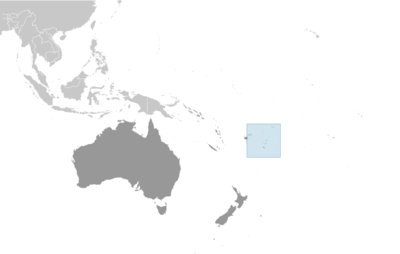
$3M
U.S. imports, 2025
+14.2%
change in one year
$15M
U.S. exports, 2025
105K
Population
$509M
GDP
In your house
What you buy that Tonga makes
America bought $3M in goods from Tonga in 2025. Of every $100 of it, here's where the money went.
Medicinal equipment
medical devices and equipment
Engines-civilian aircraft
Minimum value shipments
Nonagricultural foods, etc.
Fish and shellfish
fish, shrimp, shellfish
Materials, excluding chemicals
Plastic materials
plastics for packaging and goods
Tobacco, waxes, etc.
Vegetables
vegetables
Industrial supplies, other
2026 so far (through July): $1M in imports. Source: U.S. Census Bureau, International Trade in Goods (customs basis).
The other direction
What America sells to Tonga
$15M in 2025, a trade rupture cuts both ways, for American producers as well as American prices.
Meat, poultry, etc.
$6MMinimum value shipments
$3MTelecommunications equipment
$1Mphones, routers, networking gear
Other foods
$1MCell phones and other household goods, n.e.c.
$531Kcell phones and home electronics
Glassware, chinaware
$505Kglassware and china
Electric apparatus
$336KFinished metal shapes
$250KShingles, molding, wallboard
$232KWhere you stand
U.S. tariff posture toward Tonga
No U.S. tariff action singles this country out. Its goods face the universal 10% temporary import surcharge under Section 122 of the Trade Act (which replaced the IEEPA reciprocal baseline in February 2026) plus the sectoral Section 232 duties — steel and aluminum at 50% — that apply to all countries. The Section 122 surcharge is statutorily temporary — scheduled to lapse on or about July 23, 2026 (a 150-day cap) unless extended or replaced.
Reciprocal tariff (universal baseline)
10%
The universal 10% floor, a Section 122 import surcharge since February 2026, previously the EO 14257 reciprocal baseline, applies to nearly all U.S. imports. This country has no higher assigned rate of its own.
Policy in motion
Tariff status: a moving target
No U.S. tariff action names Tonga. These are the universal measures, applied to every country without a country-specific arrangement, that set its treatment.
2026-04-06
Section 232 metals coverage expanded
In effectThe April 2026 proclamation strengthening Section 232 actions on aluminum, steel, and copper expanded derivative-product coverage for all countries, keeping the general metals rate at 50%.
91 FR 18201 →2026-02-24
IEEPA reciprocal tariffs terminated — replaced by 10% Section 122 surcharge
In effectExecutive Order 14389 (Ending Certain Tariff Actions) terminated the IEEPA tariff duties — including the EO 14257 reciprocal baseline — effective February 24, 2026. A flat 10% Section 122 temporary import surcharge (Proclamation 11012 of February 20, 2026) replaced them, leaving the universal rate unchanged at 10% on a different statutory basis. Section 122 caps such surcharges at 150 days, so this 10% surcharge is scheduled to lapse on or about July 23, 2026 absent further action (the administration has signaled it could raise the rate toward the 15% statutory maximum).
91 FR 9437 →2025-11-13
Agricultural products exempted from reciprocal tariffs
In effectExecutive Order 14360 of November 14, 2025 removed reciprocal duties from certain agricultural products listed in its annexes (coffee, cocoa, bananas, and other goods the U.S. does not produce in sufficient quantity), retroactive to November 13, 2025 — for all countries subject to the reciprocal tariff.
90 FR 54091 →2025-06-04
Section 232 steel and aluminum duties doubled to 50%
In effectThe June 3, 2025 proclamation raised Section 232 duties on steel and aluminum articles and derivatives from 25% to 50% for all countries, effective June 4, 2025.
90 FR 24199 →2025-04-05
Universal 10% reciprocal baseline takes effect
In effectExecutive Order 14257 (signed April 2, 2025) imposed a 10% ad valorem reciprocal duty on imports from all trading partners, effective April 5, 2025. Countries without a higher Annex I rate remain at this baseline.
Federal Register · 2025-06063 →2025-03-12
Section 232 steel and aluminum duties set at 25% for all countries
In effectProclamations of February 10, 2025 terminated all country exemptions and quota arrangements and applied 25% Section 232 duties to steel and aluminum imports from every country, effective March 12, 2025.
90 FR 9817 →
Reference
The country itself
Australia Oceania · Geography, people, economy, and government, public-domain data from the CIA World Factbook.
The first humans arrived in Tonga around 1000 B.C. The islands’ politics were highly centralized under the Tu’i Tonga, or Tongan king, by A.D. 950, and by 1200, the Tu’i Tonga had expanded his influence throughout Polynesia and into Melanesia and Micronesia. The Tongan Empire began to decline in the 1300s, with civil wars, a military defeat to Samoa, and internal political strife. By the mid-1500s, some Tu’i Tongans were ethnic Samoan, and day-to-day administration of Tonga was transferred to a new position occupied by ethnic Tongans. Dutch navigators explored the islands in the 1600s, followed by the British in the 1770s, who named them the Friendly Islands. Between 1799 and 1852 Tonga went through a period of war and disorder. In the 1830s, a low-ranking chief from Ha’apai began to consolidate control over the islands and was crowned King George TUPOU I in 1845, establishing the only still-extant Polynesian monarchy. During TUPOU's reign (1845–93), Tonga became a unified and independent country with a modern constitution (1875), legal code, and administrative structure. In separate treaties, Germany (1876), Great Britain (1879), and the US (1888) recognized Tonga’s independence. His son and successor, King George TUPOU II, agreed to enter a protectorate agreement with the UK in 1900 after rival Tongan chiefs tried to overthrow him. As a protectorate, Tonga never completely lost its indigenous governance, but it did become more isolated and the social hierarchy became more stratified between a group of nobles and a large class of commoners. Today, about one third of parliamentary seats are reserved for nobles. Tonga regained full control of domestic and foreign affairs and became a fully independent nation within the Commonwealth in 1970. A pro-democracy movement gained steam in the early 2000s, led by ‘Akilisi POHIVA, and in 2006, riots broke out in Nuku’alofa to protest the lack of progress on reform. To appease the activists, in 2008, King George TUPOU V announced he was relinquishing most of his powers leading up to parliamentary elections in 2010 and henceforth most of the monarch’s governmental decisions, except those relating to the judiciary, were to be made in consultation with the prime minister. The 2010 Legislative Assembly was called Tonga’s first democratically elected Parliament. King George TUPOU V died in 2012 and was succeeded by his brother Crown Prince Tupouto‘a Lavaka who ruled as George TUPOU VI. In 2015, ‘Akalisi POHIVA became Tonga’s first non-noble prime minister.
Geography
- Location
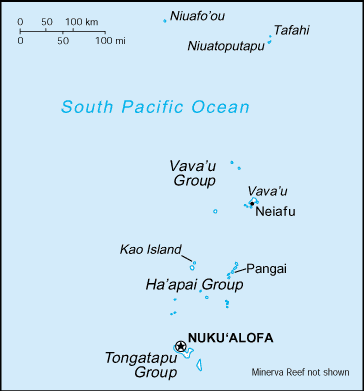
- Oceania, archipelago in the South Pacific Ocean, about two-thirds of the way from Hawaii to New Zealand
- Area
- 747 sq km
- Climate
- tropical; modified by trade winds; warm season (December to May), cool season (May to December)
- Terrain
- mostly flat islands with limestone bedrock formed from uplifted coral formation; others have limestone overlying volcanic rock
- Natural resources
- arable land, fish
- Coastline
- 419 km
- Natural hazards
- cyclones (October to April); earthquakes and volcanic activity on Fonuafo'ou volcanism: moderate volcanic activity; Fonualei (180 m) has had frequent activity in recent years, and Niuafo'ou (260 m) has forced evacuations; other historically active volcanoes include Late and Tofua
People & society
- Population
- 104,519 (2025 est.)
- Nationality
- Tongan(s)
- Ethnic groups
- Tongan 96.5%, other (European, Fijian, Samoan, Indian, Chinese, other Pacific Islander, other Asian, other) 3.5% (2021 est.)
- Languages
- Tongan only 85%, Tongan and other language 13.9%, Tongan not used at home 1.1% (2021 est.)
- Religions
- Protestant 63.9% (Free Wesleyan Church 34.2%, Free Church of Tonga 11.3%, Church of Tonga 6.8%, Seventh Day Adventist 2.5%, Assembly of God 2.5%, Tokaikolo/Maamafo'ou 1.5%, Constitutional Church of Tonga 1.2%, other Protestant 4%), Church of Jesus Christ 19.7%, Roman Catholic 13.7%, other 2.1%, none 0.6%, no answer 0.1% (2021 est.)
- Median age
- 26.4 years (2025 est.)
- Life expectancy at birth
- 78 years (2024 est.)
- Literacy
- 91.1% (2019 est.)
Economy
- Economic overview
- upper middle-income Pacific island economy; enormous diaspora and remittance reliance; key tourism and agricultural sectors; major fish exporter; rapidly growing Chinese infrastructure investments; rising methamphetamine hub
- Industries
- tourism, construction, fishing
- Agricultural products
- coconuts, pumpkins/squash, cassava, sweet potatoes, vegetables, yams, taro, root vegetables, plantains, lemons/limes (2023)
- Exports - partners
- Guyana 17%, USA 17%, NZ 15%, Australia 15%, UAE 12% (2023)
- Imports - partners
- Fiji 27%, NZ 24%, China 21%, Australia 8%, USA 5% (2023)
Government
- Government type
- constitutional monarchy
- Capital
- Nuku'alofa
- Independence
- 4 June 1970 (from UK protectorate status)
- Constitution
- adopted 4 November 1875, revised 1988, 2016
- Executive branch
- King TUPOU VI (since 18 March 2012)
- Legislative branch
- Legislative Assembly (Fale Alea)
Full reference data
Every field, by section, CIA World Factbook. Open a topic to expand it.
Introduction
Travel Facts
Please visit the following links to find further information about your desired destination.
World Health Organization (WHO) - To learn what vaccines and health precautions to take while visiting your destination.
US State Dept Travel Information - Overall information about foreign travel for US citizens.
To obtain an international driving permit (IDP). Only two organizations in the US issue IDPs: American Automobile Association (AAA) and American Automobile Touring Alliance (AATA)
How to get help in an emergency? Contact the nearest US embassy or consulate, or call one of these numbers: from the US or Canada - 1-888-407-4747 or from Overseas - +1 202-501-4444
Page last updated: Wednesday, November 09, 2022