
Country exposure · TP
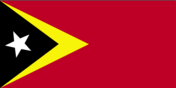
Timor-Leste
East N Southeast Asia · Dili · semi-presidential republic
What Timor-Leste means for your money, the prices you pay, the tariffs in motion, and where U.S. policy could change both.
1M
Population
$1.9B
GDP
U.S. exposure
Minimal direct economic exposure
Timor-Leste is not a significant U.S. goods-trade partner and has no tracked tariff actions. Policy changes here are unlikely to reach American prices directly.
Reference
The country itself
East N Southeast Asia · Geography, people, economy, and government, public-domain data from the CIA World Factbook.
The island of Timor was actively involved in Southeast Asian trading networks for centuries, and by the 14th century, it exported sandalwood, slaves, honey, and wax. The sandalwood trade attracted the Portuguese, who arrived in the early 16th century; by mid-century, they had colonized the island, which was previously ruled by local chieftains. In 1859, Portugal ceded the western portion of the island to the Dutch. Imperial Japan occupied Portuguese Timor from 1942 to 1945, but Portugal resumed colonial authority after the Japanese defeat in World War II. The eastern part of Timor declared itself independent from Portugal on 28 November 1975, but Indonesian forces invaded and occupied the area nine days later. It was incorporated into Indonesia in 1976 as the province of Timor Timur (East Timor or Timor Leste). Indonesia conducted an unsuccessful pacification campaign in the province over the next two decades, during which as many as 250,000 people died. In a UN-supervised referendum in 1999, an overwhelming majority of the people of Timor-Leste voted for independence from Indonesia. However, anti-independence Timorese militias -- organized and supported by the Indonesian military -- began a large-scale, scorched-earth campaign of retribution, killing approximately 1,400 Timorese and displacing nearly 500,000. Most of the country's infrastructure was destroyed, including homes, irrigation systems, water supply systems, schools, and most of the electrical grid. Australian-led peacekeeping troops eventually deployed to the country and ended the violence. In 2002, Timor-Leste was internationally recognized as an independent state. In 2006, Australia and the UN had to step in again to stabilize the country, which allowed presidential and parliamentary elections to be conducted in 2007 in a largely peaceful atmosphere. In 2008, rebels staged an unsuccessful attack against the president and prime minister. Since that attack, Timor-Leste has made considerable progress in building stability and democratic institutions, holding a series of successful parliamentary and presidential elections since 2012. Nonetheless, weak and unstable political coalitions have led to periodic episodes of stalemate and crisis. The UN continues to provide assistance on economic development and strengthening governing institutions. Currently, Timor-Leste is one of the world's poorest nations, with an economy that relies heavily on energy resources in the Timor Sea.
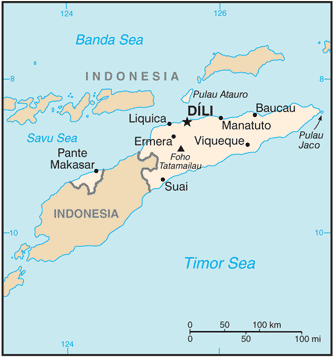
Geography
- Location
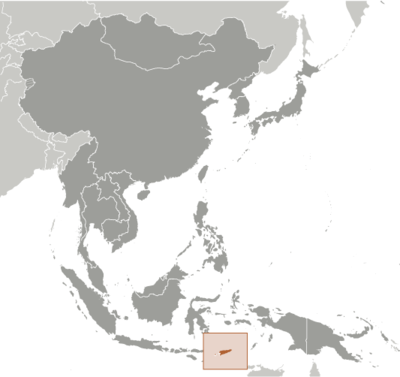
- Southeastern Asia, northwest of Australia in the Lesser Sunda Islands at the eastern end of the Indonesian archipelago; note - Timor-Leste includes the eastern half of the island of Timor, the Oecussi (Ambeno) region on the northwest portion of the island of Timor, and the islands of Pulau Atauro and Pulau Jaco
- Area
- 14,874 sq km
- Climate
- tropical; hot, humid; distinct rainy and dry seasons
- Terrain
- mountainous
- Natural resources
- gold, petroleum, natural gas, manganese, marble
- Coastline
- 706 km
- Natural hazards
- floods and landslides are common; earthquakes; tsunamis; tropical cyclones
People & society
- Population
- 1,404,785 (2025 est.)
- Nationality
- Timorese
- Ethnic groups
- Austronesian (Malayo-Polynesian) (includes Tetun, Mambai, Tokodede, Galoli, Kemak, Baikeno), Melanesian-Papuan (includes Bunak, Fataluku, Bakasai), small Chinese minority
- Languages
- Tetun Prasa 30.6%, Mambai 16.6%, Makasai 10.5%, Tetun Terik 6.1%, Baikenu 5.9%, Kemak 5.8%, Bunak 5.5%, Tokodede 4%, Fataluku 3.5%, Waima'a 1.8%, Galoli 1.4%, Naueti 1.4%, Idate 1.2%, Midiki 1.2%, other 4.5% (2015 est.)
- Religions
- Catholic 90.7%, other 7.1%, Protestant Evangelical 1.9%; less than 1%: Islam, Buddhist, Hindu (2022 est.)
- Median age
- 23 years (2025 est.)
- Life expectancy at birth
- 70.5 years (2024 est.)
- Literacy
- 72.5% (2022 est.)
Economy
- Economic overview
- lower middle-income Southeast Asian economy; government expenditures funded via oil fund drawdowns; endemic corruption undermines growth; foreign aid-dependent; wide-scale poverty, unemployment, and illiteracy
- Industries
- printing, soap manufacturing, handicrafts, woven cloth
- Agricultural products
- maize, rice, coconuts, root vegetables, vegetables, cassava, other meats, pork, beans, coffee (2023)
- Exports - partners
- China 46%, Singapore 25%, Japan 15%, Indonesia 5%, USA 3% (2023)
- Imports - partners
- Indonesia 34%, China 26%, Singapore 9%, Taiwan 5%, India 4% (2023)
Government
- Government type
- semi-presidential republic
- Capital
- Dili
- Independence
- 28 November 1975 (from Portugal); 20 May 2002 (from Indonesia)
- Constitution
- drafted 2001, approved 22 March 2002, entered into force 20 May 2002
- Executive branch
- President José RAMOS-HORTA (since 20 May 2022)
- Legislative branch
- National Parliament
Full reference data
Every field, by section, CIA World Factbook. Open a topic to expand it.
Introduction
Travel Facts
Please visit the following links to find further information about your desired destination.
World Health Organization (WHO) - To learn what vaccines and health precautions to take while visiting your destination.
US State Dept Travel Information - Overall information about foreign travel for US citizens.
To obtain an international driving permit (IDP). Only two organizations in the US issue IDPs: American Automobile Association (AAA) and American Automobile Touring Alliance (AATA)
How to get help in an emergency? Contact the nearest US embassy or consulate, or call one of these numbers: from the US or Canada - 1-888-407-4747 or from Overseas - +1 202-501-4444
Page last updated: Wednesday, October 05, 2022