Country exposure · TV

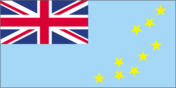
Flag of Tuvalu

Tuvalu

Australia Oceania · Funafuti · parliamentary democracy under a constitutional monarchy; a Commonwealth realm

What Tuvalu means for your money — the prices you pay, the tariffs in motion, and where U.S. policy could change both.
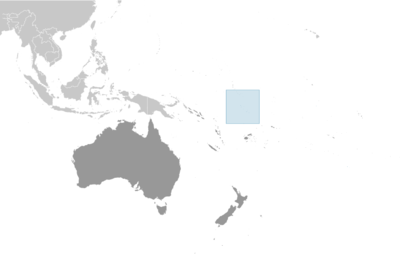
Map showing the location of Tuvalu

$17K

U.S. imports, 2025

-92.5%

change in one year

$2M

U.S. exports, 2025

12K

Population

$62M

GDP

In your house

What you buy that Tuvalu makes

America bought $17K in goods from Tuvalu in 2025 — down 92.5% in a single year. Of every $100 of it, here's where the money went.

Numismatic coins

$15K87%

Minimum value shipments

$2K13%

2026 so far (through April): $3K in imports. Source: U.S. Census Bureau, International Trade in Goods (customs basis).

The other direction

What America sells to Tuvalu

$2M in 2025 — a trade rupture cuts both ways, for American producers as well as American prices.

Telecommunications equipment

$1M

phones, routers, networking gear

Meat, poultry, etc.

$499K

Electric apparatus

$235K

Minimum value shipments

$116K

Apparel, household goods - textile

$96K

cotton clothing and linens

Chemicals-fertilizers

$28K

Chemicals-organic

$19K

Medicinal equipment

$18K

medical devices and equipment

Fish and shellfish

$8K

fish, shrimp, shellfish

Where you stand

U.S. tariff posture toward Tuvalu

No U.S. tariff action singles this country out. Its goods face the universal 10% temporary import surcharge under Section 122 of the Trade Act (which replaced the IEEPA reciprocal baseline in February 2026) plus the sectoral Section 232 duties — steel and aluminum at 50% — that apply to all countries. The Section 122 surcharge is statutorily temporary — scheduled to lapse on or about July 23, 2026 (a 150-day cap) unless extended or replaced.

Reciprocal tariff (universal baseline)

10%

The universal 10% floor — a Section 122 import surcharge since February 2026, previously the EO 14257 reciprocal baseline — applies to nearly all U.S. imports. This country has no higher assigned rate of its own.

Policy in motion

Tariff status: a moving target

No U.S. tariff action names Tuvalu. These are the universal measures — applied to every country without a country-specific arrangement — that set its treatment.

  1. 2026-04-06

    Section 232 metals coverage expanded

    In effect

    The April 2026 proclamation strengthening Section 232 actions on aluminum, steel, and copper expanded derivative-product coverage for all countries, keeping the general metals rate at 50%.

    91 FR 18201
  2. 2026-02-24

    IEEPA reciprocal tariffs terminated — replaced by 10% Section 122 surcharge

    In effect

    Executive Order 14389 (Ending Certain Tariff Actions) terminated the IEEPA tariff duties — including the EO 14257 reciprocal baseline — effective February 24, 2026. A flat 10% Section 122 temporary import surcharge (Proclamation 11012 of February 20, 2026) replaced them, leaving the universal rate unchanged at 10% on a different statutory basis. Section 122 caps such surcharges at 150 days, so this 10% surcharge is scheduled to lapse on or about July 23, 2026 absent further action (the administration has signaled it could raise the rate toward the 15% statutory maximum).

    91 FR 9437
  3. 2025-11-13

    Agricultural products exempted from reciprocal tariffs

    In effect

    Executive Order 14360 of November 14, 2025 removed reciprocal duties from certain agricultural products listed in its annexes (coffee, cocoa, bananas, and other goods the U.S. does not produce in sufficient quantity), retroactive to November 13, 2025 — for all countries subject to the reciprocal tariff.

    90 FR 54091
  4. 2025-06-04

    Section 232 steel and aluminum duties doubled to 50%

    In effect

    The June 3, 2025 proclamation raised Section 232 duties on steel and aluminum articles and derivatives from 25% to 50% for all countries, effective June 4, 2025.

    90 FR 24199
  5. 2025-04-05

    Universal 10% reciprocal baseline takes effect

    In effect

    Executive Order 14257 (signed April 2, 2025) imposed a 10% ad valorem reciprocal duty on imports from all trading partners, effective April 5, 2025. Countries without a higher Annex I rate remain at this baseline.

    Federal Register · 2025-06063
  6. 2025-03-12

    Section 232 steel and aluminum duties set at 25% for all countries

    In effect

    Proclamations of February 10, 2025 terminated all country exemptions and quota arrangements and applied 25% Section 232 duties to steel and aluminum imports from every country, effective March 12, 2025.

    90 FR 9817

Reference

The country itself

Australia Oceania · Geography, people, economy, and government — public-domain data from the CIA World Factbook.

Voyagers from either Samoa or Tonga first populated Tuvalu in the first millennium A.D., and the islands provided a stepping-stone for various Polynesian communities that subsequently settled in Melanesia and Micronesia. Tuvalu eventually came under Samoan and Tongan spheres of influence, although proximity to Micronesia allowed some Micronesian communities to flourish in Tuvalu, in particular on Nui Atoll. In the late 1700s and early 1800s, a series of American, British, Dutch, and Russian ships visited the islands, which were named the Ellice Islands in 1819. The UK declared a protectorate over islands in 1892 and merged them with the Micronesian Gilbert Islands. The Gilbert and Ellice Islands Protectorate became a colony in 1916. During World War II, the US set up military bases on a few islands, and in 1943, after Japan captured many of the northern Gilbert Islands, the UK transferred administration of the colony southward to Funafuti. After the war, Tarawa in the Gilbert Islands was once again made the colony’s capital, and the center of power was firmly in the Gilbert Islands, including the colony’s only secondary school. Amid growing tensions with the Gilbertese, Tuvaluans voted to secede from the colony in 1974, were granted self-rule in 1975, and gained independence in 1978 as Tuvalu. In 1979, the US relinquished its claims to the Tuvaluan islands in a treaty of friendship.
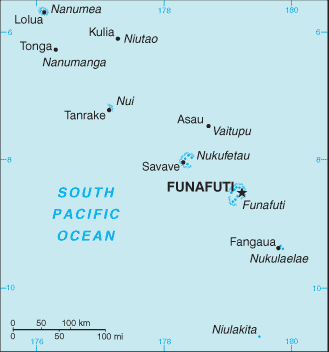
Regional map of Tuvalu

Geography

Location
Oceania, island group consisting of nine coral atolls in the South Pacific Ocean, about half way from Hawaii to Australia
Area
26 sq km
Climate
tropical; moderated by easterly trade winds (March to November); westerly gales and heavy rain (November to March)
Terrain
low-lying and narrow coral atolls
Natural resources
fish, coconut (copra)
Coastline
24 km
Natural hazards
severe tropical storms are usually rare, but in 1997 there were three cyclones; low levels of islands make them sensitive to changes in sea level

People & society

Population
11,824 (2025 est.)
Nationality
Tuvaluan(s)
Ethnic groups
Tuvaluan 97%, Tuvaluan/I-Kiribati 1.6%, Tuvaluan/other 0.8%, other 0.6% (2017 est.)
Languages
Tuvaluan (official), English (official), Samoan, Kiribati (on the island of Nui)
Religions
Protestant 92.7% (Congregational Christian Church of Tuvalu 85.9%, Brethren 2.8%, Seventh Day Adventist 2.5%, Assemblies of God 1.5%), Baha'i 1.5%, Jehovah's Witness 1.5%, other 3.9%, none or refused 0.4% (2017 est.)
Median age
28.1 years (2025 est.)
Life expectancy at birth
69 years (2024 est.)
Literacy
100% (2022 est.)

Economy

Economic overview
upper middle-income Pacific island economy; extremely environmentally fragile; currency pegged to Australian dollar; large international aid recipient; subsistence agrarian sector; Te Kakeega sustainable development; domain name licensing incomes
Industries
fishing
Agricultural products
coconuts, vegetables, tropical fruits, bananas, root vegetables, pork, chicken, eggs, pork fat, pork offal (2023)
Exports - partners
Thailand 88%, Japan 6%, Philippines 3%, Ireland 1%, USA 1% (2023)
Imports - partners
China 42%, Fiji 24%, Japan 11%, Australia 11%, NZ 4% (2023)

Government

Government type
parliamentary democracy under a constitutional monarchy; a Commonwealth realm
Capital
Funafuti
Independence
1 October 1978 (from the UK)
Constitution
previous 1978 (at independence); latest effective 1 October 1986
Executive branch
King CHARLES III (since 8 September 2022); represented by Governor General Tofiga Vaevalu FALANI (since 29 August 2021)
Legislative branch
Parliament (Palamene)

Full reference data

Every field, by section — CIA World Factbook. Open a topic to expand it.

Introduction
Background
Voyagers from either Samoa or Tonga first populated Tuvalu in the first millennium A.D., and the islands provided a stepping-stone for various Polynesian communities that subsequently settled in Melanesia and Micronesia. Tuvalu eventually came under Samoan and Tongan spheres of influence, although proximity to Micronesia allowed some Micronesian communities to flourish in Tuvalu, in particular on Nui Atoll. In the late 1700s and early 1800s, a series of American, British, Dutch, and Russian ships visited the islands, which were named the Ellice Islands in 1819. The UK declared a protectorate over islands in 1892 and merged them with the Micronesian Gilbert Islands. The Gilbert and Ellice Islands Protectorate became a colony in 1916. During World War II, the US set up military bases on a few islands, and in 1943, after Japan captured many of the northern Gilbert Islands, the UK transferred administration of the colony southward to Funafuti. After the war, Tarawa in the Gilbert Islands was once again made the colony’s capital, and the center of power was firmly in the Gilbert Islands, including the colony’s only secondary school. Amid growing tensions with the Gilbertese, Tuvaluans voted to secede from the colony in 1974, were granted self-rule in 1975, and gained independence in 1978 as Tuvalu. In 1979, the US relinquished its claims to the Tuvaluan islands in a treaty of friendship.
Travel Facts
US State Dept Travel Advisory
The US Department of State currently recommends US citizens Reconsider Travel to Tuvalu due to COVID-19-related restrictions. Consult its website via the link below for updates to travel advisories and statements on safety, security, local laws, and special circumstances in this country. https://travel.state.gov/content/travel/en/traveladvisories/traveladvisories.html
Passport/Visa Requirements
US citizens should make sure their passport will not expire for at least 6 months after they enter the country even if they do not intend to stay that long. They should also make sure they have at least 1 blank page in their passport for any entry stamp. A visa is required, but US citizen travelers may obtain the visa upon entering the country.
US Embassy/Consulate
US does not have an embassy in Tuvalu; the US Ambassador to Fiji is accredited to Tuvalu; +(679) 331-4466; EMER: +(679) 772-8049; US Embassy Suva, 158 Princes Rd, Tamavua, Suva, Fiji Islands
Telephone Code
688
Local Emergency Phone
911
Vaccinations
See WHO recommendations http://www.who.int/
Climate
Tropical; moderated by easterly trade winds (March to November); westerly gales and heavy rain (November to March)
Currency (Code)
Tuvaluan dollars or Australian dollars (AUD)
Electricity/Voltage/Plug Type(s)
230 V / 50 Hz / plug types(s): I
Major Languages
Tuvaluan, English, Samoan, Kiribati (on the island of Nui)
Major Religions
Protestant 92.4%, Baha'i 2%, Jehovah's Witness 1.3%, Mormon 1%
Time Difference
UTC+12 (17 hours ahead of Washington, DC, during Standard Time)
Potable Water
Opt for bottled water
International Driving Permit
Suggested
Road Driving Side
Left
Tourist Destinations
Funafuti Marine Conservation Area; Tuvalu Woman's Handicraft Center
Major Sports
Kilikiti (similar to cricket), ano (variant of volleyball), soccer, volleyball
Cultural Practices
Traditionally, Sundays are a day of rest and church attendance, and visitors are asked to be discreet in their choice of activities. Female visitors are also asked to dress modestly in towns and villages.
Tipping Guidelines
Tipping is not common nor expected.
Souvenirs
Carved tuluma wooden tackle boxes, woven cloth, shell jewelry, stamps
Traditional Cuisine
Pulaka (similar to taro); often combined with coconut cream and served with fish
CIA source last updated
Wednesday, October 19, 2022
Travel resources

Please visit the following links to find further information about your desired destination.

World Health Organization (WHO) - To learn what vaccines and health precautions to take while visiting your destination.

US State Dept Travel Information - Overall information about foreign travel for US citizens.

To obtain an international driving permit (IDP). Only two organizations in the US issue IDPs: American Automobile Association (AAA) and American Automobile Touring Alliance (AATA)

How to get help in an emergency? Contact the nearest US embassy or consulate, or call one of these numbers: from the US or Canada - 1-888-407-4747 or from Overseas - +1 202-501-4444

Page last updated: Wednesday, October 19, 2022

Geography
Location
Oceania, island group consisting of nine coral atolls in the South Pacific Ocean, about half way from Hawaii to Australia
Geographic coordinates
8 00 S, 178 00 E
Map references
Oceania
Area - total
26 sq km
Area - land
26 sq km
Area - water
0 sq km
Area - comparative
about the size of Washington, D.C.
Land boundaries - total
0 km
Coastline
24 km
Maritime claims - territorial sea
12 nm
Maritime claims - contiguous zone
24 nm
Maritime claims - exclusive economic zone
200 nm
Climate
tropical; moderated by easterly trade winds (March to November); westerly gales and heavy rain (November to March)
Terrain
low-lying and narrow coral atolls
Elevation - highest point
unnamed location 5 m
Elevation - lowest point
Pacific Ocean 0 m
Elevation - mean elevation
2 m
Natural resources
fish, coconut (copra)
Land use - agricultural land
60% (2023 est.)
Land use - agricultural land: arable land
arable land: 0% (2022 est.)
Land use - agricultural land: permanent crops
permanent crops: 60% (2023 est.)
Land use - agricultural land: permanent pasture
permanent pasture: 0% (2022 est.)
Land use - forest
34.3% (2023 est.)
Land use - other
5.7% (2023 est.)
Irrigated land
0 sq km (2022)
Population distribution
over half of the population resides on the atoll of Funafuti
Natural hazards
severe tropical storms are usually rare, but in 1997 there were three cyclones; low levels of islands make them sensitive to changes in sea level
Geography - note
one of the smallest and most remote countries on earth; six of the nine coral atolls -- Nanumea, Nui, Vaitupu, Nukufetau, Funafuti, and Nukulaelae -- have lagoons open to the ocean; Nanumaya and Niutao have landlocked lagoons; Niulakita does not have a lagoon
People and Society
Population - total
11,824 (2025 est.)
Population - male
5,865
Population - female
5,959
Nationality - noun
Tuvaluan(s)
Nationality - adjective
Tuvaluan
Ethnic groups
Tuvaluan 97%, Tuvaluan/I-Kiribati 1.6%, Tuvaluan/other 0.8%, other 0.6% (2017 est.)
Languages
Tuvaluan (official), English (official), Samoan, Kiribati (on the island of Nui)
Religions
Protestant 92.7% (Congregational Christian Church of Tuvalu 85.9%, Brethren 2.8%, Seventh Day Adventist 2.5%, Assemblies of God 1.5%), Baha'i 1.5%, Jehovah's Witness 1.5%, other 3.9%, none or refused 0.4% (2017 est.)
Age structure - 0-14 years
29.2% (male 1,754/female 1,672)
Age structure - 15-64 years
63.2% (male 3,736/female 3,675)
Age structure - 65 years and over
7.6% (2024 est.) (male 326/female 570)
Dependency ratios - total dependency ratio
59 (2025 est.)
Dependency ratios - youth dependency ratio
46.4 (2025 est.)
Dependency ratios - elderly dependency ratio
12.6 (2025 est.)
Dependency ratios - potential support ratio
7.9 (2025 est.)
Median age - total
28.1 years (2025 est.)
Median age - male
26.8 years
Median age - female
28.8 years
Population growth rate
0.75% (2025 est.)
Birth rate
21.57 births/1,000 population (2025 est.)
Death rate
7.78 deaths/1,000 population (2025 est.)
Net migration rate
-6.26 migrant(s)/1,000 population (2025 est.)
Population distribution
over half of the population resides on the atoll of Funafuti
Urbanization - urban population
66.2% of total population (2023)
Urbanization - rate of urbanization
2.08% annual rate of change (2020-25 est.)
Major urban areas - population
7,000 FUNAFUTI (capital) (2018)
Sex ratio - at birth
1.05 male(s)/female
Sex ratio - 0-14 years
1.05 male(s)/female
Sex ratio - 15-64 years
1.02 male(s)/female
Sex ratio - 65 years and over
0.57 male(s)/female
Sex ratio - total population
0.98 male(s)/female (2024 est.)
Maternal mortality ratio
170 deaths/100,000 live births (2023 est.)
Infant mortality rate - total
27.2 deaths/1,000 live births (2025 est.)
Infant mortality rate - male
31.3 deaths/1,000 live births
Infant mortality rate - female
24 deaths/1,000 live births
Life expectancy at birth - total population
69 years (2024 est.)
Life expectancy at birth - male
66.5 years
Life expectancy at birth - female
71.6 years
Total fertility rate
2.76 children born/woman (2025 est.)
Gross reproduction rate
1.34 (2025 est.)
Drinking water source - improved: urban
urban: 99% of population (2022 est.)
Drinking water source - improved: rural
rural: 99.7% of population (2022 est.)
Drinking water source - improved: total
total: 99.3% of population (2022 est.)
Drinking water source - unimproved: urban
urban: 1% of population (2022 est.)
Drinking water source - unimproved: rural
rural: 0.3% of population (2022 est.)
Drinking water source - unimproved: total
total: 0.7% of population (2022 est.)
Health expenditure - Health expenditure (as % of GDP)
20% of GDP (2021)
Health expenditure - Health expenditure (as % of national budget)
11.2% of national budget (2022 est.)
Physician density
1.35 physicians/1,000 population (2020)
Sanitation facility access - improved: urban
urban: 96.7% of population (2022 est.)
Sanitation facility access - improved: rural
rural: 93.9% of population (2022 est.)
Sanitation facility access - improved: total
total: 95.8% of population (2022 est.)
Sanitation facility access - unimproved: urban
urban: 3.3% of population (2022 est.)
Sanitation facility access - unimproved: rural
rural: 6.1% of population (2022 est.)
Sanitation facility access - unimproved: total
total: 4.2% of population (2022 est.)
Obesity - adult prevalence rate
51.6% (2016)
Alcohol consumption per capita - total
0.93 liters of pure alcohol (2019 est.)
Alcohol consumption per capita - beer
0.01 liters of pure alcohol (2019 est.)
Alcohol consumption per capita - wine
0.69 liters of pure alcohol (2019 est.)
Alcohol consumption per capita - spirits
0.22 liters of pure alcohol (2019 est.)
Alcohol consumption per capita - other alcohols
0 liters of pure alcohol (2019 est.)
Tobacco use - total
32.4% (2025 est.)
Tobacco use - male
46.2% (2025 est.)
Tobacco use - female
18.1% (2025 est.)
Children under the age of 5 years underweight
2.9% (2019 est.)
Currently married women (ages 15-49)
64.2% (2020 est.)
Child marriage - women married by age 15
0% (2020)
Child marriage - women married by age 18
1.8% (2020)
Child marriage - men married by age 18
1.7% (2020)
Education expenditure - Education expenditure (% GDP)
12.8% of GDP (2023 est.)
Education expenditure - Education expenditure (% national budget)
16.8% national budget (2025 est.)
Literacy - total population
100% (2022 est.)
Literacy - male
100% (2022 est.)
Literacy - female
100% (2022 est.)
Government
Country name - conventional long form
none
Country name - conventional short form
Tuvalu
Country name - local long form
none
Country name - local short form
Tuvalu
Country name - former
Ellice Islands
Country name - etymology
the name in the local language means "group of eight" or "eight standing together," referring to eight of the country's nine islands; the remaining island, Nui, was left out of the original grouping because its inhabitants spoke a different language; the former name was given in honor of Canadian shipping company owner Alexander Ellice, who owned a ship that visited the islands in 1819
Government type
parliamentary democracy under a constitutional monarchy; a Commonwealth realm
Capital - name
Funafuti
Capital - geographic coordinates
8 31 S, 179 13 E
Capital - time difference
UTC+12 (17 hours ahead of Washington, DC, during Standard Time)
Capital - etymology
the town has the same name as the island it is located on; the name may either come from the Polynesian word futi (banana) or the name Futi, one of the wives of a local ruler, with the word funa added as a feminine prefix
Capital - note
note: the capital is an atoll of 29 islets; administrative offices are in Vaiaku Village on Fongafale Islet
Administrative divisions
7 island councils and 1 town council*; Funafuti*, Nanumaga, Nanumea, Niutao, Nui, Nukufetau, Nukulaelae, Vaitupu
Legal system
mixed system of English common law and local customary law
Constitution - history
previous 1978 (at independence); latest effective 1 October 1986
Constitution - amendment process
proposed by the House of Assembly; passage requires at least two-thirds majority vote by the Assembly membership in the final reading
International law organization participation
has not submitted an ICJ jurisdiction declaration; non-party state to the ICCt
Citizenship - citizenship by birth
yes
Citizenship - citizenship by descent only
yes; for a child born abroad, at least one parent must be a citizen of Tuvalu
Citizenship - dual citizenship recognized
yes
Citizenship - residency requirement for naturalization
na
Suffrage
18 years of age; universal
Executive branch - chief of state
King CHARLES III (since 8 September 2022); represented by Governor General Tofiga Vaevalu FALANI (since 29 August 2021)
Executive branch - head of government
Prime Minister Feleti Penitala TEO (since 27 February 2024)
Executive branch - cabinet
Cabinet members selected by the prime minister
Executive branch - election/appointment process
the monarchy is hereditary; governor general appointed by the monarch on recommendation of the prime minister and the parliament; prime minister and deputy prime minister elected by and from members of House of Assembly following parliamentary elections
Executive branch - election results
2024: TEO was the only candidate nominated by the House of Assembly 2019: Kausea NATANO elected prime minister by House of Assembly; House of Assembly vote - 10 to 6
Legislative branch - legislature name
Parliament (Palamene)
Legislative branch - legislative structure
unicameral
Legislative branch - chamber name
Parliament of Tuvalu (Palamene o Tuvalu)
Legislative branch - number of seats
16 (all directly elected)
Legislative branch - electoral system
plurality/majority
Legislative branch - scope of elections
full renewal
Legislative branch - term in office
4 years
Legislative branch - most recent election date
1/26/2024
Legislative branch - percentage of women in chamber
0%
Legislative branch - expected date of next election
January 2028
Judicial branch - highest court(s)
Court of Appeal (consists of the chief justice and not less than 3 appeals judges); High Court (consists of the chief justice); appeals beyond the Court of Appeal are heard by the Judicial Committee of the Privy Council (in London)
Judicial branch - judge selection and term of office
Court of Appeal judges appointed by the governor general on the advice of the Cabinet; judge tenure based on terms of appointment; High Court chief justice appointed by the governor general on the advice of the Cabinet; chief justice serves for life; other judges appointed by the governor general on the advice of the Cabinet after consultation with chief justice; judge tenure set by terms of appointment
Judicial branch - subordinate courts
magistrates' courts; island courts; land courts
Political parties
note: no political parties, but members of parliament usually align in informal groupings
Diplomatic representation in the US - chief of mission
Ambassador Tapugao FALEFOU (since 19 April 2023); note - also Permanent Representative to UN
Diplomatic representation in the US - chancery
685 Third Avenue, Suite 1104, New York, NY 10017
Diplomatic representation in the US - telephone
[1] (212) 490-0534
Diplomatic representation in the US - FAX
[1] (212) 808-4975
Diplomatic representation in the US - email address and website
Diplomatic representation in the US - note
note: the Tuvalu Permanent Mission to the UN serves as the Embassy
Diplomatic representation from the US - embassy
the US does not have an embassy in Tuvalu; the US Ambassador to Fiji is accredited to Tuvalu
International organization participation
ACP, ADB, AOSIS, C, FAO, IBRD, IDA, IFAD, IFRCS (observer), ILO, IMF, IMO, IOC, ITU, OPCW, PIF, Sparteca, SPC, UN, UNCTAD, UNESCO, UNIDO, UPU, WHO, WIPO, WMO
Independence
1 October 1978 (from the UK)
National holiday
Independence Day, 1 October (1978)
Flag
description: light blue with the UK flag in the upper-left quadrant; the right half of the flag has nine five-pointed yellow stars meaning: the stars represent a map of the country, with each symbolizing an atoll in the ocean
National symbol(s)
maneapa (native meeting house)
National color(s)
light blue, yellow
National anthem(s) - title
"God Save the King"
National anthem(s) - lyrics/music
unknown
National anthem(s) - history
used since 1745
Economy
Economic overview
upper middle-income Pacific island economy; extremely environmentally fragile; currency pegged to Australian dollar; large international aid recipient; subsistence agrarian sector; Te Kakeega sustainable development; domain name licensing incomes
Real GDP (purchasing power parity) - Real GDP (purchasing power parity) 2023
$57.055 million (2023 est.)
Real GDP (purchasing power parity) - Real GDP (purchasing power parity) 2022
$54.938 million (2022 est.)
Real GDP (purchasing power parity) - Real GDP (purchasing power parity) 2021
$54.568 million (2021 est.)
Real GDP (purchasing power parity) - note
note: data in 2021 dollars
Real GDP growth rate - Real GDP growth rate 2023
3.9% (2023 est.)
Real GDP growth rate - Real GDP growth rate 2022
0.7% (2022 est.)
Real GDP growth rate - Real GDP growth rate 2021
1.8% (2021 est.)
Real GDP growth rate - note
note: annual GDP % growth based on constant local currency
Real GDP per capita - Real GDP per capita 2023
$5,800 (2023 est.)
Real GDP per capita - Real GDP per capita 2022
$5,500 (2022 est.)
Real GDP per capita - Real GDP per capita 2021
$5,400 (2021 est.)
Real GDP per capita - note
note: data in 2021 dollars
GDP (official exchange rate)
$62.28 million (2023 est.)
GDP (official exchange rate) - note
note: data in current dollars at official exchange rate
Inflation rate (consumer prices) - Inflation rate (consumer prices) 2022
11.5% (2022 est.)
Inflation rate (consumer prices) - Inflation rate (consumer prices) 2021
6.2% (2021 est.)
Inflation rate (consumer prices) - Inflation rate (consumer prices) 2020
1.9% (2020 est.)
Inflation rate (consumer prices) - note
note: annual % change based on consumer prices
GDP - composition, by sector of origin - agriculture
15.9% (2015 est.)
GDP - composition, by sector of origin - industry
7% (2015 est.)
GDP - composition, by sector of origin - services
70% (2012 est.)
GDP - composition, by sector of origin - note
note: figures may not total 100% due to non-allocated consumption not captured in sector-reported data
Agricultural products
coconuts, vegetables, tropical fruits, bananas, root vegetables, pork, chicken, eggs, pork fat, pork offal (2023)
Agricultural products - note
note: top ten agricultural products based on tonnage
Industries
fishing
Remittances - Remittances 2023
4.2% of GDP (2023 est.)
Remittances - Remittances 2022
4.2% of GDP (2022 est.)
Remittances - Remittances 2021
4.9% of GDP (2021 est.)
Remittances - note
note: personal transfers and compensation between resident and non-resident individuals/households/entities
Budget - revenues
$87 million (2019 est.)
Budget - expenditures
$88 million (2019 est.)
Budget - note
note: revenue data include Official Development Assistance from Australia
Public debt - Public debt 2016
47.2% of GDP (2016 est.)
Current account balance - Current account balance 2022
$2.713 million (2022 est.)
Current account balance - Current account balance 2021
$14.533 million (2021 est.)
Current account balance - Current account balance 2020
$8.46 million (2020 est.)
Current account balance - note
note: balance of payments - net trade and primary/secondary income in current dollars
Exports - Exports 2022
$2.232 million (2022 est.)
Exports - Exports 2021
$2.745 million (2021 est.)
Exports - Exports 2020
$3.089 million (2020 est.)
Exports - note
note: balance of payments - exports of goods and services in current dollars
Exports - partners
Thailand 88%, Japan 6%, Philippines 3%, Ireland 1%, USA 1% (2023)
Exports - partners - note
note: top five export partners based on percentage share of exports
Exports - commodities
fish (2023)
Exports - commodities - note
note: top export commodities based on value in dollars over $500,000
Imports - Imports 2022
$57.388 million (2022 est.)
Imports - Imports 2021
$63.962 million (2021 est.)
Imports - Imports 2020
$56.947 million (2020 est.)
Imports - note
note: balance of payments - imports of goods and services in current dollars
Imports - partners
China 42%, Fiji 24%, Japan 11%, Australia 11%, NZ 4% (2023)
Imports - partners - note
note: top five import partners based on percentage share of imports
Imports - commodities
ships, refined petroleum, iron structures, fish, hand tools (2023)
Imports - commodities - note
note: top five import commodities based on value in dollars
Exchange rates - Currency
Tuvaluan dollars or Australian dollars (AUD) per US dollar -
Exchange rates - Exchange rates 2024
1.515 (2024 est.)
Exchange rates - Exchange rates 2023
1.505 (2023 est.)
Exchange rates - Exchange rates 2022
1.442 (2022 est.)
Exchange rates - Exchange rates 2021
1.331 (2021 est.)
Exchange rates - Exchange rates 2020
1.453 (2020 est.)
Energy
Electricity access - electrification - total population
100% (2022 est.)
Electricity access - electrification - urban areas
100%
Electricity access - electrification - rural areas
99.1%
Communications
Telephones - fixed lines - total subscriptions
2,000 (2021 est.)
Telephones - fixed lines - subscriptions per 100 inhabitants
21 (2022 est.)
Telephones - mobile cellular - total subscriptions
9,880 (2022 est.)
Telephones - mobile cellular - subscriptions per 100 inhabitants
99 (2022 est.)
Broadcast media
no TV stations; many households use satellite dishes to watch foreign TV; 1 state-owned radio station, Radio Tuvalu, includes relays from international broadcasters (2019)
Internet country code
.tv
Internet users - percent of population
74% (2023 est.)
Broadband - fixed subscriptions - total
0 (2022 est.)
Broadband - fixed subscriptions - subscriptions per 100 inhabitants
5 (2022 est.)
Transportation
Civil aircraft registration country code prefix
T2
Airports
1 (2025)
Merchant marine - total
270 (2023)
Merchant marine - by type
bulk carrier 21, container ship 3, general cargo 29, oil tanker 19, other 198
Ports - total ports
1 (2024)
Ports - large
0
Ports - medium
0
Ports - small
0
Ports - very small
1
Ports - ports with oil terminals
1
Ports - key ports
Funafuti Atoll
Military and Security
Military and security forces
no regular military forces; Tuvalu Police Force
Military - note
as part of the Falepili Union treaty between Australia and Tuvalu, which entered into force in August 2024, Australia committed to assist Tuvalu in response to a major natural disaster, health pandemic, or military aggression; Tuvalu pledged to mutually agree with Australia any partnership, arrangement, or engagement with any other State or entity on security and defense-related matters in Tuvalu Tuvalu has a "shiprider" agreement with the US, which allows local maritime law enforcement officers to embark on US Coast Guard (USCG) and US Navy (USN) vessels, including to board and search vessels suspected of violating laws or regulations within Tuvalu's designated exclusive economic zone (EEZ) or on the high seas; "shiprider" agreements also enable USCG personnel and USN vessels with embarked USCG law enforcement personnel to work with host nations to protect critical regional resources (2025)
Environment
Environmental issues
limited freshwater resources; beach erosion; deforestation; damage to coral reefs; rising sea levels
International environmental agreements - party to
Biodiversity, Climate Change, Climate Change-Kyoto Protocol, Climate Change-Paris Agreement, Desertification, Hazardous Wastes, Law of the Sea, Ozone Layer Protection, Ship Pollution, Whaling
International environmental agreements - signed, but not ratified
Comprehensive Nuclear Test Ban
Climate
tropical; moderated by easterly trade winds (March to November); westerly gales and heavy rain (November to March)
Land use - agricultural land
60% (2023 est.)
Land use - agricultural land: arable land
arable land: 0% (2022 est.)
Land use - agricultural land: permanent crops
permanent crops: 60% (2023 est.)
Land use - agricultural land: permanent pasture
permanent pasture: 0% (2022 est.)
Land use - forest
34.3% (2023 est.)
Land use - other
5.7% (2023 est.)
Urbanization - urban population
66.2% of total population (2023)
Urbanization - rate of urbanization
2.08% annual rate of change (2020-25 est.)
Particulate matter emissions
6.8 micrograms per cubic meter (2019 est.)
Waste and recycling - municipal solid waste generated annually
4,000 tons (2024 est.)