
Country exposure · UG
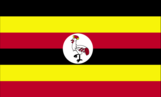
Uganda
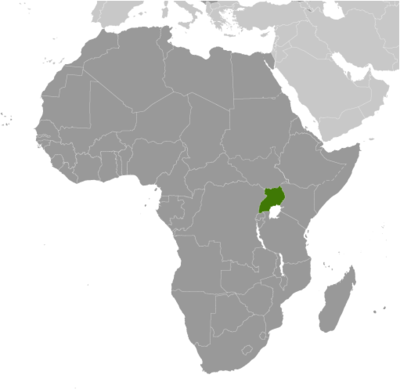
Africa · Kampala · presidential republic
What Uganda means for your money, the prices you pay, the tariffs in motion, and where U.S. policy could change both.
$199M
U.S. imports, 2025
+50.3%
change in one year
$119M
U.S. exports, 2025
51M
Population
$53.7B
GDP
In your house
What you buy that Uganda makes
America bought $199M in goods from Uganda in 2025, up 50.3% in a single year. Of every $100 of it, here's where the money went.
Green coffee
green coffee for roasters
Cocoa beans
cocoa for chocolate
Tea, spices, etc.
tea and spices
U.s. goods returned, and reimports
Fruits, frozen juices
fruit and frozen juices
Tobacco, waxes, etc.
Sulfur, nonmetallic minerals
Nursery stock, etc.
Fish and shellfish
fish, shrimp, shellfish
Vegetables
vegetables
2026 so far (through July): $137M in imports. Source: U.S. Census Bureau, International Trade in Goods (customs basis).
The other direction
What America sells to Uganda
$119M in 2025, a trade rupture cuts both ways, for American producers as well as American prices.
Civilian aircraft, engines, equipment, and parts
$27MPlastic materials
$12Mplastics for packaging and goods
Wheat
$10Mgreen coffee for roasters
Rice
$8Mcocoa for chocolate
Other foods
$8MTelecommunications equipment
$5Mphones, routers, networking gear
Pharmaceutical preparations
$5Mmedicines and pharmacy items
Pulpwood and woodpulp
$4MElectric apparatus
$3MWhere you stand
U.S. tariff posture toward Uganda
No U.S. tariff action singles this country out. Its goods face the universal 10% temporary import surcharge under Section 122 of the Trade Act (which replaced the IEEPA reciprocal baseline in February 2026) plus the sectoral Section 232 duties — steel and aluminum at 50% — that apply to all countries. The Section 122 surcharge is statutorily temporary — scheduled to lapse on or about July 23, 2026 (a 150-day cap) unless extended or replaced.
Reciprocal tariff (universal baseline)
10%
The universal 10% floor, a Section 122 import surcharge since February 2026, previously the EO 14257 reciprocal baseline, applies to nearly all U.S. imports. This country has no higher assigned rate of its own.
Policy in motion
Tariff status: a moving target
No U.S. tariff action names Uganda. These are the universal measures, applied to every country without a country-specific arrangement, that set its treatment.
2026-04-06
Section 232 metals coverage expanded
In effectThe April 2026 proclamation strengthening Section 232 actions on aluminum, steel, and copper expanded derivative-product coverage for all countries, keeping the general metals rate at 50%.
91 FR 18201 →2026-02-24
IEEPA reciprocal tariffs terminated — replaced by 10% Section 122 surcharge
In effectExecutive Order 14389 (Ending Certain Tariff Actions) terminated the IEEPA tariff duties — including the EO 14257 reciprocal baseline — effective February 24, 2026. A flat 10% Section 122 temporary import surcharge (Proclamation 11012 of February 20, 2026) replaced them, leaving the universal rate unchanged at 10% on a different statutory basis. Section 122 caps such surcharges at 150 days, so this 10% surcharge is scheduled to lapse on or about July 23, 2026 absent further action (the administration has signaled it could raise the rate toward the 15% statutory maximum).
91 FR 9437 →2025-11-13
Agricultural products exempted from reciprocal tariffs
In effectExecutive Order 14360 of November 14, 2025 removed reciprocal duties from certain agricultural products listed in its annexes (coffee, cocoa, bananas, and other goods the U.S. does not produce in sufficient quantity), retroactive to November 13, 2025 — for all countries subject to the reciprocal tariff.
90 FR 54091 →2025-06-04
Section 232 steel and aluminum duties doubled to 50%
In effectThe June 3, 2025 proclamation raised Section 232 duties on steel and aluminum articles and derivatives from 25% to 50% for all countries, effective June 4, 2025.
90 FR 24199 →2025-04-05
Universal 10% reciprocal baseline takes effect
In effectExecutive Order 14257 (signed April 2, 2025) imposed a 10% ad valorem reciprocal duty on imports from all trading partners, effective April 5, 2025. Countries without a higher Annex I rate remain at this baseline.
Federal Register · 2025-06063 →2025-03-12
Section 232 steel and aluminum duties set at 25% for all countries
In effectProclamations of February 10, 2025 terminated all country exemptions and quota arrangements and applied 25% Section 232 duties to steel and aluminum imports from every country, effective March 12, 2025.
90 FR 9817 →
Made for America
What Uganda makes for America
Uganda is a direct U.S. source of 2 essential goods Americans rely on, the items themselves, shipped finished off the line.
Go deeper
The supply chain view
Uganda sits upstream of 3 essential American goods through 3 tracked inputs.
agricultural
6%Green Coffee Beans — Robusta
agricultural
4%Vanilla Beans
agricultural
1%Cocoa Beans (Theobroma cacao)
Reference
The country itself
Africa · Geography, people, economy, and government, public-domain data from the CIA World Factbook.
An ancient crossroads for various migrations, Uganda has as many as 65 ethnic groups that speak languages from three of Africa’s four major linguistic families. As early as 1200, fertile soils and regular rainfall in the south fostered the formation of several large, centralized kingdoms, including Buganda, from which the country derives its name. Muslim traders from Egypt reached northern Uganda in the 1820s, and Swahili merchants from the Indian Ocean coast arrived in the south by the 1840s. The area attracted the attention of British explorers seeking the source of the Nile River in the 1860s, and this influence expanded in subsequent decades with the arrival of Christian missionaries and trade agreements; Uganda was declared a British protectorate in 1894. Buganda and other southern kingdoms negotiated agreements with Britain to secure privileges and a level of autonomy that were rare during the colonial period in Africa. Uganda's colonial boundaries grouped together a wide range of ethnic groups with different political systems and cultures, and the disparities between how Britain governed southern and northern areas compounded these differences, complicating efforts to establish a cohesive independent country. Uganda gained independence in 1962 with one of the more developed economies and one of the strongest education systems in Sub-Saharan Africa, but it descended within a few years into political turmoil and internal conflict that lasted more than two decades. In 1966, Prime Minister Milton OBOTE suspended the constitution and violently deposed President Edward MUTESA, who was also the king of Buganda. Idi AMIN seized power in 1971 through a military coup and led the country into economic ruin and rampant mass atrocities that killed as many as 500,000 civilians. AMIN’s annexation of Tanzanian territory in 1979 provoked Tanzania to invade Uganda, depose AMIN, and install a coalition government. In the aftermath, Uganda continued to experience atrocities, looting, and political instability and had four different heads of state between 1979 and 1980. OBOTE regained the presidency in 1980 through a controversial election that sparked renewed guerrilla warfare, killing as an estimated 300,000 civilians. Gen. Tito OKELLO seized power in a coup in 1985, but his rule was short-lived, with Yoweri MUSEVENI becoming president in 1986 after his insurgency captured the capital. MUSEVENI is widely credited with restoring relative stability and economic growth to Uganda but has resisted calls to leave office. In 2017, parliament removed presidential age limits, making it possible for MUSEVENI to remain in office for life.
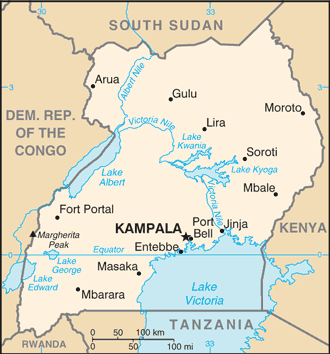
Geography
- Location
- East-Central Africa, west of Kenya, east of the Democratic Republic of the Congo
- Area
- 241,038 sq km
- Climate
- tropical; generally rainy with two dry seasons (December to February, June to August); semiarid in northeast
- Terrain
- mostly plateau with rim of mountains
- Natural resources
- copper, cobalt, hydropower, limestone, salt, arable land, gold
- Coastline
- 0 km (landlocked)
- Natural hazards
- droughts; floods; earthquakes; landslides; hailstorms
People & society
- Population
- 50,863,850 (2025 est.)
- Nationality
- Ugandan(s)
- Ethnic groups
- Baganda 16.5%, Banyankole 9.6%, Basoga 8.8%, Bakiga 7.1%, Iteso 7%, Langi 6.3%, Bagisu 4.9%, Acholi 4.4%, Lugbara 3.3%, other 32.1% (2014 est.)
- Languages
- English (official), Ganda or Luganda (most widely used of the Niger-Congo languages and the language used most often in the capital), other Niger-Congo languages, Nilo-Saharan languages, Swahili (official), Arabic
- Religions
- Protestant 45.1% (Anglican 32.0%, Pentecostal/Born Again/Evangelical 11.1%, Seventh Day Adventist 1.7%, Baptist .3%), Roman Catholic 39.3%, Muslim 13.7%, other 1.6%, none 0.2% (2014 est.)
- Median age
- 16.4 years (2025 est.)
- Life expectancy at birth
- 69.7 years (2024 est.)
- Literacy
- 69.1% (2016 est.)
Economy
- Economic overview
- low-income, primarily agrarian East African economy; COVID-19 hurt economic growth and poverty reduction; lower oil prices threaten prior sector investments; endemic corruption; natural resource rich; high female labor force participation but undervalued
- Industries
- sugar processing, brewing, tobacco, cotton textiles; cement, steel production
- Agricultural products
- plantains, sugarcane, milk, maize, cassava, sweet potatoes, vegetables, beans, potatoes, tea (2023)
- Exports - partners
- India 21%, UAE 16%, Hong Kong 10%, South Sudan 8%, Kenya 6% (2023)
- Imports - partners
- China 19%, UAE 12%, Tanzania 11%, India 10%, Kenya 7% (2023)
Government
- Government type
- presidential republic
- Capital
- Kampala
- Independence
- 9 October 1962 (from the UK)
- Constitution
- several previous; latest adopted 27 September 1995, promulgated 8 October 1995
- Executive branch
- President Yoweri Kaguta MUSEVENI (since 26 January 1986)
- Legislative branch
- Parliament
Full reference data
Every field, by section, CIA World Factbook. Open a topic to expand it.
Introduction
Travel Facts
Please visit the following links to find further information about your desired destination.
World Health Organization (WHO) - To learn what vaccines and health precautions to take while visiting your destination.
US State Dept Travel Information - Overall information about foreign travel for US citizens.
To obtain an international driving permit (IDP). Only two organizations in the US issue IDPs: American Automobile Association (AAA) and American Automobile Touring Alliance (AATA)
How to get help in an emergency? Contact the nearest US embassy or consulate, or call one of these numbers: from the US or Canada - 1-888-407-4747 or from Overseas - +1 202-501-4444
Page last updated: Wednesday, May 03, 2023