
Country exposure · VC

Saint Vincent and the Grenadines
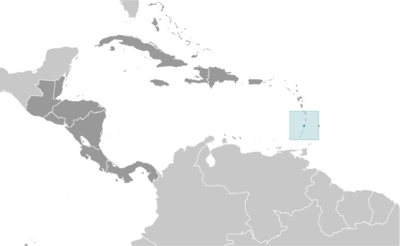
Central America N Caribbean · Kingstown · parliamentary democracy under a constitutional monarchy; a Commonwealth realm
What Saint Vincent and the Grenadines means for your money, the prices you pay, the tariffs in motion, and where U.S. policy could change both.
$6M
U.S. imports, 2025
-23%
change in one year
$145M
U.S. exports, 2025
101K
Population
$1.2B
GDP
In your house
What you buy that Saint Vincent and the Grenadines makes
America bought $6M in goods from Saint Vincent and the Grenadines in 2025, down 23% in a single year. Of every $100 of it, here's where the money went.
Nonmonetary gold
Fish and shellfish
fish, shrimp, shellfish
U.s. goods returned, and reimports
Copper
copper for wiring
Minimum value shipments
Alcoholic beverages, excluding wine
spirits and liquor
Artwork, antiques, stamps, etc.
Bauxite and aluminum
aluminum for cans and autos
Pharmaceutical preparations
medicines and pharmacy items
Tea, spices, etc.
tea and spices
2026 so far (through July): $6M in imports. Source: U.S. Census Bureau, International Trade in Goods (customs basis).
The other direction
What America sells to Saint Vincent and the Grenadines
$145M in 2025, a trade rupture cuts both ways, for American producers as well as American prices.
Fuel oil
$21MMinimum value shipments
$16MMeat, poultry, etc.
$16MPetroleum products, other
$7MLogs and lumber
$7MWheat
$6Mgreen coffee for roasters
Finished metal shapes
$3MOther foods
$3MPassenger cars, new and used
$2Mnew and used cars
Where you stand
U.S. tariff posture toward Saint Vincent and the Grenadines
No U.S. tariff action singles this country out. Its goods face the universal 10% temporary import surcharge under Section 122 of the Trade Act (which replaced the IEEPA reciprocal baseline in February 2026) plus the sectoral Section 232 duties — steel and aluminum at 50% — that apply to all countries. The Section 122 surcharge is statutorily temporary — scheduled to lapse on or about July 23, 2026 (a 150-day cap) unless extended or replaced.
Reciprocal tariff (universal baseline)
10%
The universal 10% floor, a Section 122 import surcharge since February 2026, previously the EO 14257 reciprocal baseline, applies to nearly all U.S. imports. This country has no higher assigned rate of its own.
Policy in motion
Tariff status: a moving target
No U.S. tariff action names Saint Vincent and the Grenadines. These are the universal measures, applied to every country without a country-specific arrangement, that set its treatment.
2026-04-06
Section 232 metals coverage expanded
In effectThe April 2026 proclamation strengthening Section 232 actions on aluminum, steel, and copper expanded derivative-product coverage for all countries, keeping the general metals rate at 50%.
91 FR 18201 →2026-02-24
IEEPA reciprocal tariffs terminated — replaced by 10% Section 122 surcharge
In effectExecutive Order 14389 (Ending Certain Tariff Actions) terminated the IEEPA tariff duties — including the EO 14257 reciprocal baseline — effective February 24, 2026. A flat 10% Section 122 temporary import surcharge (Proclamation 11012 of February 20, 2026) replaced them, leaving the universal rate unchanged at 10% on a different statutory basis. Section 122 caps such surcharges at 150 days, so this 10% surcharge is scheduled to lapse on or about July 23, 2026 absent further action (the administration has signaled it could raise the rate toward the 15% statutory maximum).
91 FR 9437 →2025-11-13
Agricultural products exempted from reciprocal tariffs
In effectExecutive Order 14360 of November 14, 2025 removed reciprocal duties from certain agricultural products listed in its annexes (coffee, cocoa, bananas, and other goods the U.S. does not produce in sufficient quantity), retroactive to November 13, 2025 — for all countries subject to the reciprocal tariff.
90 FR 54091 →2025-06-04
Section 232 steel and aluminum duties doubled to 50%
In effectThe June 3, 2025 proclamation raised Section 232 duties on steel and aluminum articles and derivatives from 25% to 50% for all countries, effective June 4, 2025.
90 FR 24199 →2025-04-05
Universal 10% reciprocal baseline takes effect
In effectExecutive Order 14257 (signed April 2, 2025) imposed a 10% ad valorem reciprocal duty on imports from all trading partners, effective April 5, 2025. Countries without a higher Annex I rate remain at this baseline.
Federal Register · 2025-06063 →2025-03-12
Section 232 steel and aluminum duties set at 25% for all countries
In effectProclamations of February 10, 2025 terminated all country exemptions and quota arrangements and applied 25% Section 232 duties to steel and aluminum imports from every country, effective March 12, 2025.
90 FR 9817 →
Reference
The country itself
Central America N Caribbean · Geography, people, economy, and government, public-domain data from the CIA World Factbook.
Resistance from native Caribs prevented colonization on Saint Vincent until 1719. France and England disputed the island for most of the 18th century, but it was ceded to England in 1783. The British prized Saint Vincent because of its fertile soil, which allowed for thriving slave-run plantations of sugar, coffee, indigo, tobacco, cotton, and cocoa. In 1834, the British abolished slavery. Immigration of indentured servants eased the ensuing labor shortage, as did subsequent immigrant waves from Portugal and East India. Conditions remained harsh for both former slaves and immigrant agricultural workers, however, as depressed world sugar prices kept the economy stagnant until the early 1900s. The economy then went into a period of decline, with many landowners abandoning their estates and leaving the land to be cultivated by liberated slaves. Between 1960 and 1962, Saint Vincent and the Grenadines was a separate administrative unit of the Federation of the West Indies. Autonomy was granted in 1969 and independence in 1979. In 2021, the eruption of the La Soufrière volcano in the north of Saint Vincent destroyed much of Saint Vincent’s most productive agricultural lands. Unlike most of its tourism-dependent neighbors, the Vincentian economy is primarily agricultural.
Geography
- Location
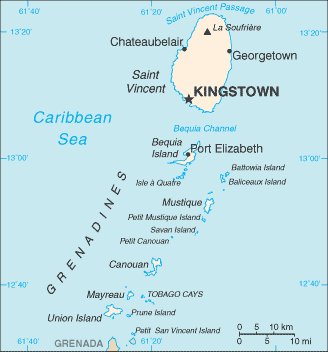
- Caribbean, islands between the Caribbean Sea and North Atlantic Ocean, north of Trinidad and Tobago
- Area
- 389 sq km (Saint Vincent 344 sq km)
- Climate
- tropical; little seasonal temperature variation; rainy season (May to November)
- Terrain
- volcanic, mountainous
- Natural resources
- hydropower, arable land
- Coastline
- 84 km
- Natural hazards
- hurricanes; La Soufrière volcano on the island of Saint Vincent is a constant threat volcanism: La Soufrière (1,234 m) last erupted in 1979; the island of Saint Vincent is part of the volcanic-island arc of the Lesser Antilles that extends from Saba in the north to Grenada in the south
People & society
- Population
- 100,647 (2024 est.)
- Nationality
- Saint Vincentian(s) or Vincentian(s)
- Ethnic groups
- African descent 71.2%, mixed 23%, Indigenous 3%, East Indian/Indian 1.1%, European 1.5%, other 0.2% (2012 est.)
- Languages
- English, Vincentian Creole English, French patois
- Religions
- Protestant 75% (Pentecostal 27.6%, Anglican 13.9%, Seventh Day Adventist 11.6%, Baptist 8.9%, Methodist 8.7%, Evangelical 3.8%, Salvation Army 0.3%, Presbyterian/Congregational 0.3%), Roman Catholic 6.3%, Rastafarian 1.1%, Jehovah's Witness 0.8%, other 4.7%, none 7.5%, unspecified 4.7% (2012 est.)
- Median age
- 38.1 years (2025 est.)
- Life expectancy at birth
- 77.2 years (2024 est.)
Economy
- Economic overview
- upper middle-income Caribbean island economy; key agriculture and tourism sectors; environmentally fragile; diversifying economy across services, science and knowledge, and creative industries; CARICOM member and US Caribbean Basin Initiative beneficiary
- Industries
- tourism; food processing, cement, furniture, clothing, starch
- Agricultural products
- bananas, root vegetables, plantains, spices, coconuts, fruits, apples, vegetables, mangoes/guavas, sweet potatoes (2023)
- Exports - partners
- Croatia 16%, Barbados 14%, USA 10%, St. Lucia 10%, St. Kitts & Nevis 8% (2023)
- Imports - partners
- USA 37%, Italy 7%, Trinidad & Tobago 7%, China 6%, UK 6% (2023)
Government
- Government type
- parliamentary democracy under a constitutional monarchy; a Commonwealth realm
- Capital
- Kingstown
- Independence
- 27 October 1979 (from the UK)
- Constitution
- previous 1969, 1975; latest drafted 26 July 1979, effective 27 October 1979 (The Saint Vincent Constitution Order 1979)
- Executive branch
- King CHARLES III (since 8 September 2022); represented by Governor General Stanley JOHN (since 6 January 2026)
- Legislative branch
- House of Assembly
Full reference data
Every field, by section, CIA World Factbook. Open a topic to expand it.
Introduction
Travel Facts
Please visit the following links to find further information about your desired destination.
World Health Organization (WHO) - To learn what vaccines and health precautions to take while visiting your destination.
US State Dept Travel Information - Overall information about foreign travel for US citizens.
To obtain an international driving permit (IDP). Only two organizations in the US issue IDPs: American Automobile Association (AAA) and American Automobile Touring Alliance (AATA)
How to get help in an emergency? Contact the nearest US embassy or consulate, or call one of these numbers: from the US or Canada - 1-888-407-4747 or from Overseas - +1 202-501-4444
Page last updated: Wednesday, October 05, 2022