
Country exposure · WS

Samoa (Western Samoa)
Australia Oceania · Apia · parliamentary republic
What Samoa (Western Samoa) means for your money, the prices you pay, the tariffs in motion, and where U.S. policy could change both.
$18M
U.S. imports, 2025
+216.1%
change in one year
$40M
U.S. exports, 2025
210K
Population
$1.1B
GDP
In your house
What you buy that Samoa (Western Samoa) makes
America bought $18M in goods from Samoa (Western Samoa) in 2025, up 216.1% in a single year. Of every $100 of it, here's where the money went.
Industrial machines, other
Food oils, oilseeds
Numismatic coins
Toys, games, and sporting goods
toys, games, sporting goods
Fruits, frozen juices
fruit and frozen juices
Telecommunications equipment
phones, routers, networking gear
Vegetables
vegetables
Finished textile supplies
Feedstuff and foodgrains
Electric apparatus
2026 so far (through July): $3M in imports. Source: U.S. Census Bureau, International Trade in Goods (customs basis).
The other direction
What America sells to Samoa (Western Samoa)
$40M in 2025, a trade rupture cuts both ways, for American producers as well as American prices.
Meat, poultry, etc.
$27MOther foods
$2MMinimum value shipments
$2MDrilling & oilfield equipment
$1MPhoto, service industry machinery
$606KBakery products
$488KToiletries and cosmetics
$485Ktoiletries and cosmetics
Civilian aircraft, engines, equipment, and parts
$472KApparel, household goods - textile
$422Kcotton clothing and linens
Where you stand
U.S. tariff posture toward Samoa (Western Samoa)
No U.S. tariff action singles this country out. Its goods face the universal 10% temporary import surcharge under Section 122 of the Trade Act (which replaced the IEEPA reciprocal baseline in February 2026) plus the sectoral Section 232 duties — steel and aluminum at 50% — that apply to all countries. The Section 122 surcharge is statutorily temporary — scheduled to lapse on or about July 23, 2026 (a 150-day cap) unless extended or replaced.
Reciprocal tariff (universal baseline)
10%
The universal 10% floor, a Section 122 import surcharge since February 2026, previously the EO 14257 reciprocal baseline, applies to nearly all U.S. imports. This country has no higher assigned rate of its own.
Policy in motion
Tariff status: a moving target
No U.S. tariff action names Samoa (Western Samoa). These are the universal measures, applied to every country without a country-specific arrangement, that set its treatment.
2026-04-06
Section 232 metals coverage expanded
In effectThe April 2026 proclamation strengthening Section 232 actions on aluminum, steel, and copper expanded derivative-product coverage for all countries, keeping the general metals rate at 50%.
91 FR 18201 →2026-02-24
IEEPA reciprocal tariffs terminated — replaced by 10% Section 122 surcharge
In effectExecutive Order 14389 (Ending Certain Tariff Actions) terminated the IEEPA tariff duties — including the EO 14257 reciprocal baseline — effective February 24, 2026. A flat 10% Section 122 temporary import surcharge (Proclamation 11012 of February 20, 2026) replaced them, leaving the universal rate unchanged at 10% on a different statutory basis. Section 122 caps such surcharges at 150 days, so this 10% surcharge is scheduled to lapse on or about July 23, 2026 absent further action (the administration has signaled it could raise the rate toward the 15% statutory maximum).
91 FR 9437 →2025-11-13
Agricultural products exempted from reciprocal tariffs
In effectExecutive Order 14360 of November 14, 2025 removed reciprocal duties from certain agricultural products listed in its annexes (coffee, cocoa, bananas, and other goods the U.S. does not produce in sufficient quantity), retroactive to November 13, 2025 — for all countries subject to the reciprocal tariff.
90 FR 54091 →2025-06-04
Section 232 steel and aluminum duties doubled to 50%
In effectThe June 3, 2025 proclamation raised Section 232 duties on steel and aluminum articles and derivatives from 25% to 50% for all countries, effective June 4, 2025.
90 FR 24199 →2025-04-05
Universal 10% reciprocal baseline takes effect
In effectExecutive Order 14257 (signed April 2, 2025) imposed a 10% ad valorem reciprocal duty on imports from all trading partners, effective April 5, 2025. Countries without a higher Annex I rate remain at this baseline.
Federal Register · 2025-06063 →2025-03-12
Section 232 steel and aluminum duties set at 25% for all countries
In effectProclamations of February 10, 2025 terminated all country exemptions and quota arrangements and applied 25% Section 232 duties to steel and aluminum imports from every country, effective March 12, 2025.
90 FR 9817 →
Reference
The country itself
Australia Oceania · Geography, people, economy, and government, public-domain data from the CIA World Factbook.
The first Austronesian settlers arrived in Samoa around 1000 B.C., and early Samoans traded and intermarried with Fijian and Tongan nobility. The fa’amatai system of titles and nobility developed, which dominates Samoan politics to this day; all but two seats in the legislature are reserved for matai, or heads of families. A Dutch explorer was the first European to spot the islands in 1722. Christian missionaries arrived in the 1830s and were followed by an influx of American and European settlers and influence. By the 1880s, Germany, the UK, and the US had trading posts and claimed parts of the kingdom. In 1886, an eight-year civil war broke out, with rival matai factions fighting over royal succession and the three foreign powers providing support to the factions. Germany, the UK, and the US all sent warships to Apia in 1889 and came close to conflict, but a cyclone damaged or destroyed the ships of all three navies. At the end of the civil war in 1894, Malietoa LAUPEPA was installed as king, but upon his death in 1898, a second civil war over succession broke out. When the war ended in 1899, the Western powers abolished the monarchy, giving the western Samoan islands to Germany and the eastern Samoan islands to the US. The UK abandoned claims in Samoa and received former German territory in the Solomon Islands. New Zealand occupied Samoa during World War I but was accused of negligence and opposed by many Samoans, particularly an organized political movement called the Mau (“Strongly Held View”) that advocated for independence. During the 1918-1919 influenza pandemic, about 20% of the population died. In 1929, New Zealand police shot into a crowd of peaceful Mau protestors, killing 11, in an event known as Black Sunday. In 1962, Samoa became the first Polynesian nation to reestablish its independence as Western Samoa but dropped the “Western” from its name in 1997. The Human Rights Protection Party dominated politics from 1982 until Prime Minister FIAME Naomi Mata'afa's Fa'atuatua i le Atua Samoa ua Tasi (FAST) party gained a majority in elections in 2021.
Geography
- Location
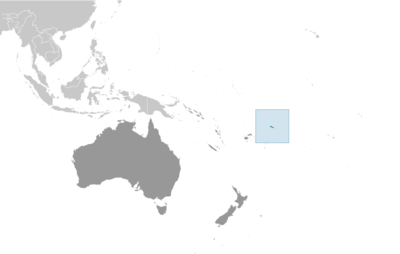
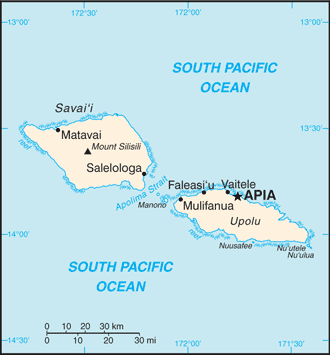
- Oceania, group of islands in the South Pacific Ocean, about halfway between Hawaii and New Zealand
- Area
- 2,831 sq km
- Climate
- tropical; rainy season (November to April), dry season (May to October)
- Terrain
- two main islands (Savaii, Upolu) and several smaller islands and uninhabited islets; narrow coastal plain with volcanic, rugged mountains in interior
- Natural resources
- hardwood forests, fish, hydropower
- Coastline
- 403 km
- Natural hazards
- occasional cyclones; active volcanism volcanism: Savai'I Island (1,858 m) is historically active
People & society
- Population
- 210,223 (2025 est.)
- Nationality
- Samoan(s)
- Ethnic groups
- Samoan 96%, Samoan/New Zealander 2%, other 1.9% (2011 est.)
- Languages
- Samoan (Polynesian) (official) 91.1%, Samoan/English 6.7%, English (official) 0.5%, other 0.2%, unspecified 1.6% (2006 est.)
- Religions
- Protestant 54.9% (Congregationalist 29%, Methodist 12.4%, Assembly of God 6.8%, Seventh Day Adventist 4.4%, other Protestant 2.3%), Roman Catholic 18.8%, Church of Jesus Christ 16.9%, Worship Centre 2.8%, other Christian 3.6%, other 2.9% (includes Baha'i, Muslim), none 0.2% (2016 est.)
- Median age
- 27.8 years (2025 est.)
- Life expectancy at birth
- 75.7 years (2024 est.)
- Literacy
- 98% (2019 est.)
Economy
- Economic overview
- ower middle-income Pacific island economy; enormous fishing and agriculture industries; significant remittances; growing offshore financial hub; recently hosted Pacific Games to drive tourism and infrastructure growth
- Industries
- food processing, building materials, auto parts
- Agricultural products
- coconuts, bananas, taro, tropical fruits, pineapples, mangoes/guavas, papayas, root vegetables, milk, avocados (2023)
- Exports - partners
- India 26%, NZ 14%, USA 12%, American Samoa 10%, Australia 9% (2023)
- Imports - partners
- NZ 20%, Singapore 19%, China 17%, Australia 10%, Fiji 9% (2023)
Government
- Government type
- parliamentary republic
- Capital
- Apia
- Independence
- 1 January 1962 (from New Zealand-administered UN trusteeship)
- Constitution
- several previous (pre-independence); latest 1 January 1962
- Executive branch
- TUIMALEALI'IFANO Va’aletoa Sualauvi II (since 21 July 2017)
- Legislative branch
- Legislative Assembly (Fono)
Full reference data
Every field, by section, CIA World Factbook. Open a topic to expand it.
Introduction
Travel Facts
Please visit the following links to find further information about your desired destination.
World Health Organization (WHO) - To learn what vaccines and health precautions to take while visiting your destination.
US State Dept Travel Information - Overall information about foreign travel for US citizens.
To obtain an international driving permit (IDP). Only two organizations in the US issue IDPs: American Automobile Association (AAA) and American Automobile Touring Alliance (AATA)
How to get help in an emergency? Contact the nearest US embassy or consulate, or call one of these numbers: from the US or Canada - 1-888-407-4747 or from Overseas - +1 202-501-4444
Page last updated: Wednesday, July 20, 2022