
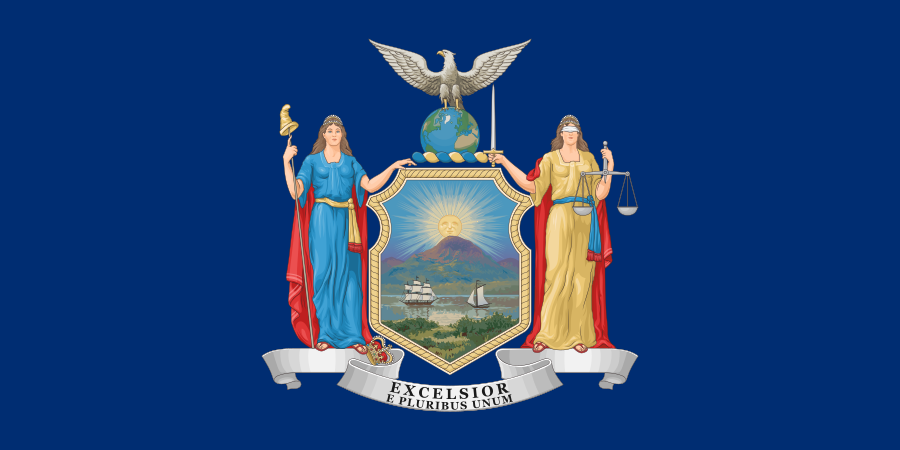
State of · NY
New York
Kathy Hochul
Governor
DemocratState Government 101
How New York’s Government Works
New York concentrates power in a strong governor, especially over the budget, backed by a full-time, well-paid legislature and only a short list of other statewide elected officials. Its court system is also famous for confusing names: the trial court is called the "Supreme Court," while the highest court is the Court of Appeals.
- Governor term
- 4 years
- Governor term limit
- None
- Legislature
- New York State Legislature
- State Senate
- 63 seats · 2-yr terms
- State Assembly
- 150 seats · 2-yr terms
- Legislator term limit
- None
- Sessions
- Annual (convenes January)
- Session length
- Full-time / no fixed cap
- Legislature type
- Full-time / professional
- Legislator pay
- $142,000/yr base (highest in the nation)
- Veto override
- Two-thirds of each chamber
- Line-item veto
- Yes (appropriations)
The Executive Branch, Who Runs the State
New York elects a relatively short slate of statewide officials, which helps make its Governor one of the strongest in the country. Only four offices are elected statewide: the Governor, the Lieutenant Governor, the Attorney General, and the Comptroller (the state’s independently elected fiscal watchdog and auditor). Everything else in the executive branch, agency commissioners, the budget director, and so on, is appointed by the Governor.
The Governor and Lieutenant Governor are nominated separately in party primaries but then run together as a single ticket in the general election, so they always end up from the same party. The Comptroller and Attorney General, elected on their own, are the main independently elected checks inside the executive branch.
The result is a concentrated executive: with few rival elected officials and command of the agencies, the New York Governor sets the agenda for the whole branch.
The Legislature, Who Writes the Laws
The New York State Legislature is bicameral: a 63-seat State Senate and a 150-seat State Assembly, for 213 members, all serving two-year terms with no term limits. It is a full-time, professional body, among the highest-paid in the country, with a base salary around $142,000 a year, supported by substantial staff.
The Legislature convenes every January and works through much of the year. Despite its size and professionalism, it operates in the shadow of an unusually powerful executive budget process, which shapes how and when much of its most important work gets done.
How a Bill Becomes Law
An ordinary bill is introduced, sent to committee, and, if it advances, voted on the floor of each chamber before going to the Governor, who may sign it, veto it, or (in New York’s version) see it become law if not acted on. The Legislature can override a veto with two-thirds of each chamber.
The budget is where New York is distinctive. Under a strong "executive budget" system reinforced by the state’s highest court, the Governor drafts the budget and the Legislature has only limited power to change it, lawmakers can cut or strike items but generally cannot add or rewrite spending as freely as in other states. That hands the Governor enormous leverage, because unrelated policy is often folded into the must-pass budget bills. New York has no citizen initiative: voters cannot write statutes directly. Constitutional amendments must pass two separately elected Legislatures and then be ratified by the voters, and every twenty years New Yorkers are asked whether to hold a constitutional convention.
What the Governor Can (and Can’t) Do
The New York Governor appoints the heads of essentially the entire executive branch, names judges to the state’s highest court, can call special sessions, holds broad emergency powers, and wields a line-item veto over appropriations. Above all, the executive budget power makes the Governor the dominant force in state fiscal policy.
The Governor also holds full clemency power, pardons, commutations, and reprieves, without needing a board’s approval, in contrast to states like Georgia, Texas, and Florida. The principal checks are the two independently elected fiscal and legal officers (the Comptroller and Attorney General) and the two-thirds legislative override, rather than a crowded field of rival executives.
The Courts
New York’s court names are famously backwards compared to the rest of the country. The trial court of general jurisdiction is called the "Supreme Court," while the state’s actual highest court is the Court of Appeals. Judges of the Court of Appeals are appointed by the Governor from a list prepared by a nominating commission and confirmed by the State Senate, serving 14-year terms; many lower-court judges, including Supreme Court justices, are elected. Knowing that the "Supreme Court" is the bottom, not the top, is the key to reading anything about New York courts.
What makes New York’s government distinctive
- A strong "executive budget" system: the Governor drafts the budget and the Legislature can largely only cut, not rewrite it, making the New York Governor one of the most powerful in the country.
- Only four statewide elected executives (Governor, Lieutenant Governor, Attorney General, Comptroller); the Governor appoints everyone else.
- Confusing court names: the trial court is the "Supreme Court," and the highest court is the Court of Appeals.
- A full-time legislature whose members are among the highest-paid in the nation, with no term limits.
- No citizen initiative, and every twenty years voters are automatically asked whether to hold a constitutional convention.
See how New York is governed right now
Jump from the explainer into the live record for New York.
Executive branch
Orders, rulemaking & official actions
Recent activity
View all →- Press Release·Oct 19, 2026Open ↗
La Gobernadora Hochul y el Alcalde Mamdani Presentan la Segunda Fase de la Expansión del Programa “2-K”, Elevando el Número Total de Plazas a 12,000 en Toda la Ciudad
- Press Release·Oct 19, 2026Open ↗
Video, Audio, Photos & Rush Transcript: Governor Hochul and Mayor Mamdani Unveil Phase Two of 2-K Expansion, Bringing Total Number of Seats to 12,000 Citywide
- Press Release·Oct 19, 2026Open ↗
Video, Audio & Rush Transcript: Governor Hochul Convenes First Meeting to Advance Evaluation of 2042 Olympic and Paralympic Winter Games
- Press Release·Oct 19, 2026Open ↗
Governor Hochul and Mayor Mamdani Unveil Phase Two of 2-K Expansion, Bringing Total Number of Seats to 12,000 Citywide
- Press Release·Oct 19, 2026Open ↗
Governor Hochul Convenes First Meeting to Advance Evaluation of 2042 Olympic and Paralympic Winter Games
- Press Release·Oct 19, 2026Open ↗
Attorney General James Urges New Yorkers to Vote by Mail with Confidence as Key Deadlines Approach
- Press Release·Oct 19, 2026Open ↗
Attorney General James Protects Access to Affordable Road Repair Services in Western and Central New York
- Press Release·Oct 18, 2026Open ↗
Governor Hochul Signs Legislation to Establish Little Yemen as a Cultural District
Legislative branch
Constitution, statutes & bills
25,520 bills tracked · 2025-2026 Regular Session
Foundational
New York Constitution
20 articles · 160 sections · 0 paragraphs
Codified
New York Statutes
137 titles · 40,456 sections
- A 6790signed
Relates to tax credits for volunteer firefighters and volunteer ambulance workers
Karen McMahonDemocrat
Last action Oct 19, 2026
- A 7033signed
Empowers the council on the arts to designate Little Yemen as a cultural district
John Zaccaro Jr.Democrat
Last action Oct 19, 2026
- A 10343to governor
Relates to fees and expenses in unemployment insurance proceedings; extending effectiveness
Al TaylorDemocrat
Last action Oct 16, 2026
- A 11377to governor
Extends provisions related to the regulation of the amount of Jonah crabs that may be taken
Judy GriffinDemocrat
Last action Oct 16, 2026
- A 11437to governor
Relates to license fees required to be paid by wholesale beer licensees to sell cider
Albert A. Stirpe
Last action Oct 16, 2026
- A 11443to governor
Relates to commercial food fish licenses
Deborah GlickDemocrat
Last action Oct 16, 2026
- A 10744to governor
Permanently authorizes the pilot residential parking permit system in the city of Buffalo
Crystal Peoples-StokesDemocrat
Last action Oct 16, 2026
- A 10344to governor
Extends certain provisions relating to supermarkets providing excess edible food to food relief organizations
Paula KayDemocrat
Last action Oct 16, 2026
Frequently asked questions
Why is New York’s highest court called the Court of Appeals, not the Supreme Court?
New York uses its court names in the opposite way from most states. The "Supreme Court" is actually the main trial court, while the Court of Appeals is the highest court in the state. It is a historical quirk of New York’s constitution, and it routinely confuses people from other states.
How powerful is the governor of New York?
Very. New York has one of the strongest governorships in the country, largely because of the executive budget system: the Governor drafts the state budget and the Legislature can mostly only cut items, not add or rewrite them. The Governor also appoints nearly the entire executive branch and holds full clemency power.
Does the governor of New York have term limits?
No. New York places no limit on how many four-year terms a governor may serve.
Can New York voters pass laws by ballot initiative?
No. New York has no citizen initiative for statutes. Constitutional amendments must be passed by two separately elected Legislatures and then approved by voters, and every twenty years voters are asked whether to convene a constitutional convention.
Which officials are elected statewide in New York?
Just four: the Governor, the Lieutenant Governor (who runs on a joint ticket with the Governor in the general election), the Attorney General, and the Comptroller. Every other executive-branch leader is appointed by the Governor.