Preliminary statement
The European Union's (EU) evolution is unprecedented in history, transforming from a regional economic agreement among six neighboring states in 1951 to today's hybrid intergovernmental and supranational organization of 27 countries across the European continent. Such a large number of nation-states ceding some of their sovereignty to an overarching entity is unique. Dynastic unions for territorial consolidation were long the norm in Europe, although country-level unions were sometimes arranged, such as the Polish-Lithuanian Commonwealth and the Austro-Hungarian Empire. The EU is not a federation in the strict sense, but it is far more than a free-trade association such as ASEAN or Mercosur. It has certain attributes associated with independent nations: its own flag, currency (for some members), and law-making abilities, as well as diplomatic representation and a common foreign and security policy in its dealings with external partners. For these reasons, The World Factbook includes basic information on the EU as a separate entity.
Background
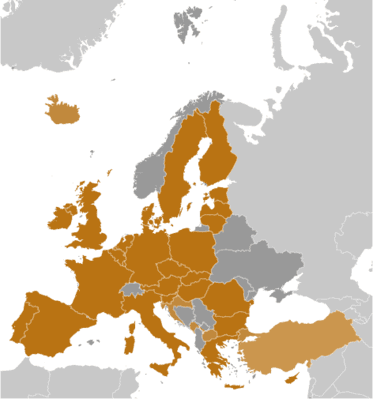
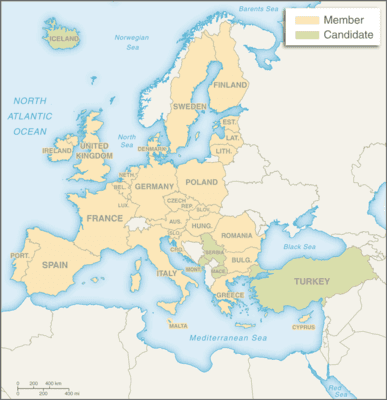
In the aftermath and devastation of the two World Wars, a number of far-sighted European leaders in the late 1940s sought to respond to the overwhelming desire for peace and reconciliation on the continent. In 1950, French Foreign Minister Robert SCHUMAN proposed pooling the production of coal and steel in Western Europe, which would bring France and West Germany together and be open to other countries as well. The following year, the European Coal and Steel Community (ECSC) was set up when six members -- Belgium, France, West Germany, Italy, Luxembourg, and the Netherlands -- signed the Treaty of Paris. Within a few years, the ECSC was so successful that member states decided to further integrate their economies. In 1957, envisioning an "ever closer union," the Treaties of Rome created the European Economic Community (EEC) and the European Atomic Energy Community (Euratom), which eliminated trade barriers among the six member states to create a common market. In 1967, the institutions of all three communities were formally merged into the European Community (EC), creating a single Commission, a single Council of Ministers, and a legislative body known today as the European Parliament. Members of the European Parliament were initially selected by national parliaments, but direct elections began in 1979 and have been held every five years since. In 1973, the first enlargement of the EC added Denmark, Ireland, and the UK. The 1980s saw further membership expansion, with Greece joining in 1981 and Spain and Portugal in 1986. The 1992 Treaty of Maastricht laid the basis for further cooperation in foreign and defense policy and judicial and internal affairs, as well as the creation of an economic and monetary union -- including a common currency. The Maastricht Treaty created the European Union (EU), at the time standing alongside the EC. In 1995, Austria, Finland, and Sweden joined the EU/EC, raising the total number of member states to 15. On 1 January 1999, the new euro currency was launched in world markets and became the unit of exchange for all EU member states except Denmark, Sweden, and the UK. In 2002, citizens of the 12 participating member states began using euro banknotes and coins. In an effort to ensure that the EU could function efficiently with an expanded membership, the Treaty of Nice in 2000 set forth rules to streamline the size and procedures of the EU's institutions. An effort to establish a "Constitution for Europe," growing out of a Convention held in 2002-2003, foundered when it was rejected in referenda in France and the Netherlands in 2005. A subsequent effort in 2007 incorporated many features of the rejected draft Constitutional Treaty, while also making a number of substantive as well as symbolic changes. The new treaty, referred to as the Treaty of Lisbon, sought to amend existing treaties rather than replace them. The treaty was approved at a conference of member states, and after all member states ratified, the Lisbon Treaty came into force on 1 December 2009, at which point the EU officially replaced and succeeded the EC. Ten new countries joined the EU in 2004 -- Cyprus, the Czech Republic, Estonia, Hungary, Latvia, Lithuania, Malta, Poland, Slovakia, and Slovenia. Bulgaria and Romania joined in 2007 and Croatia in 2013. UK citizens on 23 June 2016 narrowly voted to leave the EU; the formal exit, widely known as "Brexit," took place on 31 January 2020. The EU and the UK negotiated a withdrawal agreement that included a status quo transition period through December 2020, when the follow-on EU-UK Trade and Cooperation Agreement was concluded. Current EU membership stands at 27. Eight of the newer member states -- Croatia, Cyprus, Estonia, Latvia, Lithuania, Malta, Slovakia, and Slovenia -- have now adopted the euro, bringing total euro-zone membership to 20.