Country exposure · AM

Flag of Armenia

Armenia

Middle East · Yerevan · parliamentary democracy; note - constitutional changes adopted in December 2015 transformed the government to a parliamentary system

What Armenia means for your money — the prices you pay, the tariffs in motion, and where U.S. policy could change both.
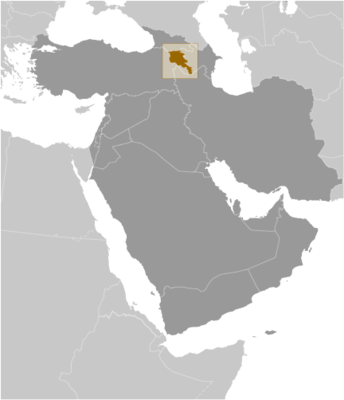
Map showing the location of Armenia

$65M

U.S. imports, 2025

-46.8%

change in one year

$133M

U.S. exports, 2025

3M

Population

$25.8B

GDP

In your house

What you buy that Armenia makes

America bought $65M in goods from Armenia in 2025 — down 46.8% in a single year. Of every $100 of it, here's where the money went.

Gem diamonds

$20M31.6%

Apparel, textiles, nonwool or cotton

synthetic and performance apparel

$8M12.6%

Steelmaking materials

$4M6.8%

Jewelry

jewelry

$3M5.2%

Other foods

$3M4.7%

Alcoholic beverages, excluding wine

spirits and liquor

$3M4.6%

Wine, beer, and related products

wine and beer

$2M3.8%

Vegetables

vegetables

$2M3.5%

Fruits, frozen juices

fruit and frozen juices

$2M3.4%

Dairy products and eggs

dairy and eggs

$2M2.8%

2026 so far (through April): $18M in imports. Source: U.S. Census Bureau, International Trade in Goods (customs basis).

The other direction

What America sells to Armenia

$133M in 2025 — a trade rupture cuts both ways, for American producers as well as American prices.

Passenger cars, new and used

$50M

new and used cars

Other parts and accessories of vehicles

$29M

car parts and accessories

Other foods

$7M

Medicinal equipment

$4M

medical devices and equipment

Telecommunications equipment

$4M

phones, routers, networking gear

Pharmaceutical preparations

$3M

medicines and pharmacy items

Nonmonetary gold

$2M

Laboratory testing instruments

$2M

Civilian aircraft, engines, equipment, and parts

$2M

Where you stand

U.S. tariff posture toward Armenia

No U.S. tariff action singles this country out. Its goods face the universal 10% temporary import surcharge under Section 122 of the Trade Act (which replaced the IEEPA reciprocal baseline in February 2026) plus the sectoral Section 232 duties — steel and aluminum at 50% — that apply to all countries. The Section 122 surcharge is statutorily temporary — scheduled to lapse on or about July 23, 2026 (a 150-day cap) unless extended or replaced.

Reciprocal tariff (universal baseline)

10%

The universal 10% floor — a Section 122 import surcharge since February 2026, previously the EO 14257 reciprocal baseline — applies to nearly all U.S. imports. This country has no higher assigned rate of its own.

Policy in motion

Tariff status: a moving target

No U.S. tariff action names Armenia. These are the universal measures — applied to every country without a country-specific arrangement — that set its treatment.

  1. 2026-04-06

    Section 232 metals coverage expanded

    In effect

    The April 2026 proclamation strengthening Section 232 actions on aluminum, steel, and copper expanded derivative-product coverage for all countries, keeping the general metals rate at 50%.

    91 FR 18201
  2. 2026-02-24

    IEEPA reciprocal tariffs terminated — replaced by 10% Section 122 surcharge

    In effect

    Executive Order 14389 (Ending Certain Tariff Actions) terminated the IEEPA tariff duties — including the EO 14257 reciprocal baseline — effective February 24, 2026. A flat 10% Section 122 temporary import surcharge (Proclamation 11012 of February 20, 2026) replaced them, leaving the universal rate unchanged at 10% on a different statutory basis. Section 122 caps such surcharges at 150 days, so this 10% surcharge is scheduled to lapse on or about July 23, 2026 absent further action (the administration has signaled it could raise the rate toward the 15% statutory maximum).

    91 FR 9437
  3. 2025-11-13

    Agricultural products exempted from reciprocal tariffs

    In effect

    Executive Order 14360 of November 14, 2025 removed reciprocal duties from certain agricultural products listed in its annexes (coffee, cocoa, bananas, and other goods the U.S. does not produce in sufficient quantity), retroactive to November 13, 2025 — for all countries subject to the reciprocal tariff.

    90 FR 54091
  4. 2025-06-04

    Section 232 steel and aluminum duties doubled to 50%

    In effect

    The June 3, 2025 proclamation raised Section 232 duties on steel and aluminum articles and derivatives from 25% to 50% for all countries, effective June 4, 2025.

    90 FR 24199
  5. 2025-04-05

    Universal 10% reciprocal baseline takes effect

    In effect

    Executive Order 14257 (signed April 2, 2025) imposed a 10% ad valorem reciprocal duty on imports from all trading partners, effective April 5, 2025. Countries without a higher Annex I rate remain at this baseline.

    Federal Register · 2025-06063
  6. 2025-03-12

    Section 232 steel and aluminum duties set at 25% for all countries

    In effect

    Proclamations of February 10, 2025 terminated all country exemptions and quota arrangements and applied 25% Section 232 duties to steel and aluminum imports from every country, effective March 12, 2025.

    90 FR 9817

Made for America

What Armenia makes for America

Armenia is a direct U.S. source of 3 essential goods Americans rely on — the items themselves, shipped finished off the line.

Go deeper

The supply chain view

Armenia sits upstream of 1 essential American goods through 1 tracked inputs.

Full supply-map profile →

Reference

The country itself

Middle East · Geography, people, economy, and government — public-domain data from the CIA World Factbook.

Armenia prides itself on being the first state to formally adopt Christianity (early 4th century). Armenia has existed as a political entity for centuries, but for much of its history it was under the sway of various empires, including the Roman, Byzantine, Arab, Persian, Ottoman, and Russian. During World War I, the Ottoman Empire instituted a policy of forced resettlement that, coupled with other harsh practices targeting its Armenian subjects, resulted in at least 1 million deaths; these actions have been widely recognized as constituting genocide. During the early 19th century, significant Armenian populations fell under Russian rule. Armenia declared its independence in 1918 in the wake of the Bolshevik Revolution in Russia, but it was conquered by the Soviet Red Army in 1920. Armenia, along with Azerbaijan and Georgia, was initially incorporated into the USSR as part of the Transcaucasian Federated Soviet Socialist Republic; in 1936, the republic was separated into its three constituent entities, which were maintained until the dissolution of the Soviet Union in 1991. For over three decades, Armenia had a longstanding conflict with neighboring Azerbaijan about the status of the Nagorno-Karabakh region, which historically had a mixed Armenian and Azerbaijani population, although ethnic Armenians have constituted the majority since the late 19th century. In 1921, Moscow placed Nagorno-Karabakh within Soviet Azerbaijan as an autonomous oblast. In the late Soviet period, a separatist movement developed that sought to end Azerbaijani control over the region. Fighting over Nagorno-Karabakh began in 1988 and escalated after Armenia and Azerbaijan declared independence from the Soviet Union in 1991. By the time a cease-fire took effect in 1994, separatists with Armenian support controlled Nagorno‑Karabakh and seven surrounding Azerbaijani territories. Armenia and Azerbaijan engaged in a second military conflict over Nagorno-Karabakh in 2020; Armenia lost control over much of the territory it had previously captured, returning the southern part of Nagorno-Karabakh and the territories around it to Azerbaijan. In September 2023, Azerbaijan took military action to regain control over Nagorno-Karabakh; after an armed conflict that lasted only one day, nearly the entire ethnic Armenian population of Nagorno-Karabakh fled to Armenia. Turkey closed its border with Armenia in 1993 in support of Azerbaijan during the first period of conflict with Armenia and has since maintained a closed border, leaving Armenia with closed borders both in the west (with Turkey) and east (with Azerbaijan). Armenia and Turkey engaged in intensive diplomacy to normalize relations and open the border in 2009, but the signed agreement was not ratified in either country. In 2015, Armenia joined the Eurasian Economic Union alongside Russia, Belarus, Kazakhstan, and Kyrgyzstan. In 2017, Armenia signed a Comprehensive and Enhanced Partnership Agreement (CEPA) with the EU. In 2018, former President of Armenia (2008-18) Serzh SARGSIAN of the Republican Party of Armenia (RPA) tried to extend his time in power, prompting protests that became known as the “Velvet Revolution.” After SARGSIAN resigned, the National Assembly elected the leader of the protests, Civil Contract party chief Nikol PASHINYAN, as the new prime minister. PASHINYAN’s party has prevailed in subsequent legislative elections, most recently in 2021.
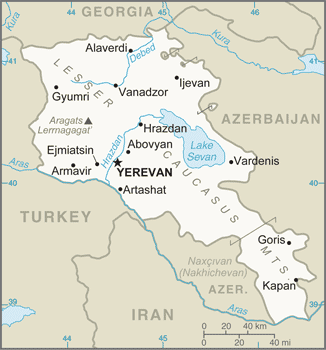
Regional map of Armenia

Geography

Location
Southwestern Asia, between Turkey (to the west) and Azerbaijan; note - Armenia views itself as part of Europe; geopolitically, it can be classified as falling within Europe, the Middle East, or both
Area
29,743 sq km
Climate
highland continental, hot summers, cold winters
Terrain
Armenian Highland with mountains; little forest land; fast flowing rivers; good soil in Aras River valley
Natural resources
small deposits of gold, copper, molybdenum, zinc, bauxite
Coastline
0 km (landlocked)
Natural hazards
occasionally severe earthquakes; droughts

People & society

Population
2,963,837 (2025 est.)
Nationality
Armenian(s)
Ethnic groups
Armenian 98.1%, Yezidi 1.1%; less than 1%: Russian, other, Assyrian, Kurd, Ukrainian, Greek (2022 est.)
Languages
Armenian 97.2%, Russian 1.4%, Ezidian 1.0%; less than 1%: other, unknown (2022)
Religions
Armenian Apostolic 95.2%, not stated 1.7%; less than 1%: Catholic, no religion, Evangelical, Shar-fadinian, other, Armenian Orthodox, Jehovah's Witness, Pagan, Molokan (2022 est.)
Median age
39.5 years (2025 est.)
Life expectancy at birth
76.7 years (2024 est.)
Literacy
99.8% (2023 est.)

Economy

Economic overview
upper-middle income, fast-growing Caucasus economy; stable fiscal and monetary regime but vulnerable to geopolitical shocks; economic and energy ties to Russia but seeking more EU and US trade; key copper and gold exporter; business-friendly and anti-corruption reforms; persistent unemployment; influx of migrants from Ukraine war easing
Industries
brandy, mining, diamond processing, metal-cutting machine tools, forging and pressing machines, electric motors, knitted wear, hosiery, shoes, silk fabric, chemicals, trucks, instruments, microelectronics, jewelry, software, food processing
Agricultural products
milk, potatoes, grapes, vegetables, wheat, tomatoes, watermelons, apricots, apples, barley (2023)
Exports - partners
Russia 37%, UAE 25%, Hong Kong 7%, China 5%, Georgia 4% (2023)
Imports - partners
Russia 29%, China 12%, Vietnam 6%, Georgia 5%, Iran 4% (2023)

Government

Government type
parliamentary democracy; note - constitutional changes adopted in December 2015 transformed the government to a parliamentary system
Capital
Yerevan
Independence
21 September 1991 (from the Soviet Union); notable earlier dates: 321 B.C. (Kingdom of Armenia established under the Orontid Dynasty), A.D. 884 (Armenian Kingdom reestablished under the Bagratid Dynasty); 1198 (Cilician Kingdom established); 28 May 1918 (Democratic Republic of Armenia declared)
Constitution
previous 1915, 1978; latest adopted 5 July 1995
Executive branch
President Vahagn KHACHATURYAN (since 13 March 2022)
Legislative branch
National Assembly (Azgayin Zhoghov)

Full reference data

Every field, by section — CIA World Factbook. Open a topic to expand it.

Introduction
Background
Armenia prides itself on being the first state to formally adopt Christianity (early 4th century). Armenia has existed as a political entity for centuries, but for much of its history it was under the sway of various empires, including the Roman, Byzantine, Arab, Persian, Ottoman, and Russian. During World War I, the Ottoman Empire instituted a policy of forced resettlement that, coupled with other harsh practices targeting its Armenian subjects, resulted in at least 1 million deaths; these actions have been widely recognized as constituting genocide. During the early 19th century, significant Armenian populations fell under Russian rule. Armenia declared its independence in 1918 in the wake of the Bolshevik Revolution in Russia, but it was conquered by the Soviet Red Army in 1920. Armenia, along with Azerbaijan and Georgia, was initially incorporated into the USSR as part of the Transcaucasian Federated Soviet Socialist Republic; in 1936, the republic was separated into its three constituent entities, which were maintained until the dissolution of the Soviet Union in 1991. For over three decades, Armenia had a longstanding conflict with neighboring Azerbaijan about the status of the Nagorno-Karabakh region, which historically had a mixed Armenian and Azerbaijani population, although ethnic Armenians have constituted the majority since the late 19th century. In 1921, Moscow placed Nagorno-Karabakh within Soviet Azerbaijan as an autonomous oblast. In the late Soviet period, a separatist movement developed that sought to end Azerbaijani control over the region. Fighting over Nagorno-Karabakh began in 1988 and escalated after Armenia and Azerbaijan declared independence from the Soviet Union in 1991. By the time a cease-fire took effect in 1994, separatists with Armenian support controlled Nagorno‑Karabakh and seven surrounding Azerbaijani territories. Armenia and Azerbaijan engaged in a second military conflict over Nagorno-Karabakh in 2020; Armenia lost control over much of the territory it had previously captured, returning the southern part of Nagorno-Karabakh and the territories around it to Azerbaijan. In September 2023, Azerbaijan took military action to regain control over Nagorno-Karabakh; after an armed conflict that lasted only one day, nearly the entire ethnic Armenian population of Nagorno-Karabakh fled to Armenia. Turkey closed its border with Armenia in 1993 in support of Azerbaijan during the first period of conflict with Armenia and has since maintained a closed border, leaving Armenia with closed borders both in the west (with Turkey) and east (with Azerbaijan). Armenia and Turkey engaged in intensive diplomacy to normalize relations and open the border in 2009, but the signed agreement was not ratified in either country. In 2015, Armenia joined the Eurasian Economic Union alongside Russia, Belarus, Kazakhstan, and Kyrgyzstan. In 2017, Armenia signed a Comprehensive and Enhanced Partnership Agreement (CEPA) with the EU. In 2018, former President of Armenia (2008-18) Serzh SARGSIAN of the Republican Party of Armenia (RPA) tried to extend his time in power, prompting protests that became known as the “Velvet Revolution.” After SARGSIAN resigned, the National Assembly elected the leader of the protests, Civil Contract party chief Nikol PASHINYAN, as the new prime minister. PASHINYAN’s party has prevailed in subsequent legislative elections, most recently in 2021.
Travel Facts
US State Dept Travel Advisory
For the latest travel advisories for this country, please consult the U.S. State Department's website, available through the link below. https://travel.state.gov/content/travel/en/traveladvisories/traveladvisories.html
Passport/Visa Requirements
For the latest passport and visa requirements for this country, please consult the U.S. State Department’s “Learn About Your Destination” search tool, available through the link below. https://travel.state.gov/content/travel/en/international-travel/International-Travel-Country-Information-Pages.html
US Embassy/Consulate
[374](10) 464-700; US Embassy in Yerevan, 1 American Avenue, Yerevan 0082, Republic of Armenia; https://am.usembassy.gov/; acsyerevan@state.gov
LGBTQIA+, Women, and Special Needs Travelers
Additional travel considerations can be found on the US State Department's International Travel page. https://travel.state.gov/content/travel/en/international-travel/before-you-go/travelers-with-special-considerations.html
Telephone Code
374
Local Emergency Phone
Ambulance: 103; Fire: 101; Police: 102
Vaccinations
For the latest information on required or recommended vaccines, please visit the CDC's website, available through the link below. https://wwwnc.cdc.gov/travel/destinations/list
Climate
Highland continental, hot summers, cold winters
Currency (Code)
Drams (AMD)
Electricity/Voltage/Plug Type(s)
230 V / 50 Hz / plug types(s): C, F
Major Languages
Armenian (official), Russian
Time Difference
UTC+4 (9 hours ahead of Washington, DC, during Standard Time)
Potable Water
Yes
International Driving Permit
Suggested
Road Driving Side
Right
Souvenirs
Woven carpets, evil eye glass or bead jewelry, pottery, quilled picture art, silver jewelry and cameo jewelry/art
Traditional Cuisine
Harees — a dish of boiled, cracked, or coarsely-ground wheat, mixed with meat and seasoned
CIA source last updated
Wednesday, June 19, 2024
Travel resources

Please visit the following links to find further information about your desired destination.

CDC - To learn what vaccines and health precautions to take while visiting your destination.

US State Dept Travel Information - Overall information about foreign travel for US citizens.

To obtain an international driving permit (IDP). Only two organizations in the US issue IDPs: American Automobile Association (AAA) and American Automobile Touring Alliance (AATA)

How to get help in an emergency? Contact the nearest US embassy or consulate, or call one of these numbers: from the US or Canada - 1-888-407-4747 or from Overseas - +1 202-501-4444

Page last updated: Wednesday, June 19, 2024

Geography
Location
Southwestern Asia, between Turkey (to the west) and Azerbaijan; note - Armenia views itself as part of Europe; geopolitically, it can be classified as falling within Europe, the Middle East, or both
Geographic coordinates
40 00 N, 45 00 E
Map references
Asia
Area - total
29,743 sq km
Area - land
28,203 sq km
Area - water
1,540 sq km
Area - comparative
slightly smaller than Maryland
Land boundaries - total
1,570 km
Land boundaries - border countries
Azerbaijan 996 km; Georgia 219 km; Iran 44 km; Turkey 311 km
Coastline
0 km (landlocked)
Maritime claims
none (landlocked)
Climate
highland continental, hot summers, cold winters
Terrain
Armenian Highland with mountains; little forest land; fast flowing rivers; good soil in Aras River valley
Elevation - highest point
Aragats Lerrnagagat' 4,090 m
Elevation - lowest point
Debed River 400 m
Elevation - mean elevation
1,792 m
Natural resources
small deposits of gold, copper, molybdenum, zinc, bauxite
Land use - agricultural land
58.6% (2023 est.)
Land use - agricultural land: arable land
arable land: 15.7% (2023 est.)
Land use - agricultural land: permanent crops
permanent crops: 2.2% (2023 est.)
Land use - agricultural land: permanent pasture
permanent pasture: 41.5% (2023 est.)
Land use - forest
11.8% (2023 est.)
Land use - other
13.5% (2023 est.)
Irrigated land
1,559 sq km (2022)
Major lakes (area sq km) - fresh water lake(s)
Lake Sevan - 1,360 sq km
Population distribution
most of the population is located in the northern half of the country; the capital of Yerevan is home to more than five times as many people as Gyumri, the second-largest city in the country
Natural hazards
occasionally severe earthquakes; droughts
Geography - note
landlocked in the Lesser Caucasus Mountains; Sevana Lich (Lake Sevan) is the largest lake in this mountain range
People and Society
Population - total
2,963,837 (2025 est.)
Population - male
1,451,842
Population - female
1,511,995
Nationality - noun
Armenian(s)
Nationality - adjective
Armenian
Ethnic groups
Armenian 98.1%, Yezidi 1.1%; less than 1%: Russian, other, Assyrian, Kurd, Ukrainian, Greek (2022 est.)
Languages - Languages
Armenian 97.2%, Russian 1.4%, Ezidian 1.0%; less than 1%: other, unknown (2022)
Languages - major-language sample(s)
Աշխարհի Փաստագիրք, Անփոխարինելի Աղբյւր Հիմնական Տեղեկատվւթյան. (Armenian) The World Factbook, the indispensable source for basic information.
Religions
Armenian Apostolic 95.2%, not stated 1.7%; less than 1%: Catholic, no religion, Evangelical, Shar-fadinian, other, Armenian Orthodox, Jehovah's Witness, Pagan, Molokan (2022 est.)
Age structure - 0-14 years
17.7% (male 275,589/female 250,630)
Age structure - 15-64 years
67% (male 991,490/female 1,004,101)
Age structure - 65 years and over
15.3% (2024 est.) (male 189,336/female 265,619)
Dependency ratios - total dependency ratio
50.4 (2025 est.)
Dependency ratios - youth dependency ratio
26.1 (2025 est.)
Dependency ratios - elderly dependency ratio
24.3 (2025 est.)
Dependency ratios - potential support ratio
4.1 (2025 est.)
Median age - total
39.5 years (2025 est.)
Median age - male
37.6 years
Median age - female
40.3 years
Population growth rate
-0.45% (2025 est.)
Birth rate
10.24 births/1,000 population (2025 est.)
Death rate
9.6 deaths/1,000 population (2025 est.)
Net migration rate
-5.1 migrant(s)/1,000 population (2025 est.)
Population distribution
most of the population is located in the northern half of the country; the capital of Yerevan is home to more than five times as many people as Gyumri, the second-largest city in the country
Urbanization - urban population
63.7% of total population (2023)
Urbanization - rate of urbanization
0.23% annual rate of change (2020-25 est.)
Major urban areas - population
1.095 million YEREVAN (capital) (2023)
Sex ratio - at birth
1.07 male(s)/female
Sex ratio - 0-14 years
1.1 male(s)/female
Sex ratio - 15-64 years
0.99 male(s)/female
Sex ratio - 65 years and over
0.71 male(s)/female
Sex ratio - total population
0.96 male(s)/female (2024 est.)
Mother's mean age at first birth
25.2 years (2019 est.)
Maternal mortality ratio
19 deaths/100,000 live births (2023 est.)
Infant mortality rate - total
11.3 deaths/1,000 live births (2025 est.)
Infant mortality rate - male
13.1 deaths/1,000 live births
Infant mortality rate - female
10 deaths/1,000 live births
Life expectancy at birth - total population
76.7 years (2024 est.)
Life expectancy at birth - male
73.4 years
Life expectancy at birth - female
80.1 years
Total fertility rate
1.66 children born/woman (2025 est.)
Gross reproduction rate
0.8 (2025 est.)
Drinking water source - improved: urban
urban: 100% of population (2022 est.)
Drinking water source - improved: rural
rural: 100% of population (2022 est.)
Drinking water source - improved: total
total: 100% of population (2022 est.)
Drinking water source - unimproved: urban
urban: 0% of population (2022 est.)
Drinking water source - unimproved: rural
rural: 0% of population (2022 est.)
Drinking water source - unimproved: total
total: 0% of population (2022 est.)
Health expenditure - Health expenditure (as % of GDP)
12.3% of GDP (2021)
Health expenditure - Health expenditure (as % of national budget)
6.5% of national budget (2022 est.)
Physician density
3.36 physicians/1,000 population (2022)
Hospital bed density
4.6 beds/1,000 population (2020 est.)
Sanitation facility access - improved: urban
urban: 100% of population (2022 est.)
Sanitation facility access - improved: rural
rural: 84.6% of population (2022 est.)
Sanitation facility access - improved: total
total: 94.4% of population (2022 est.)
Sanitation facility access - unimproved: urban
urban: 0% of population (2022 est.)
Sanitation facility access - unimproved: rural
rural: 15.4% of population (2022 est.)
Sanitation facility access - unimproved: total
total: 5.6% of population (2022 est.)
Obesity - adult prevalence rate
20.2% (2016)
Alcohol consumption per capita - total
3.77 liters of pure alcohol (2019 est.)
Alcohol consumption per capita - beer
0.52 liters of pure alcohol (2019 est.)
Alcohol consumption per capita - wine
0.46 liters of pure alcohol (2019 est.)
Alcohol consumption per capita - spirits
2.78 liters of pure alcohol (2019 est.)
Alcohol consumption per capita - other alcohols
0.01 liters of pure alcohol (2019 est.)
Tobacco use - total
21.5% (2025 est.)
Tobacco use - male
47.6% (2025 est.)
Tobacco use - female
1.6% (2025 est.)
Children under the age of 5 years underweight
2.6% (2016 est.)
Currently married women (ages 15-49)
61.5% (2022 est.)
Child marriage - women married by age 15
0% (2016)
Child marriage - women married by age 18
5.3% (2016)
Child marriage - men married by age 18
0.4% (2016)
Education expenditure - Education expenditure (% GDP)
2.4% of GDP (2023 est.)
Education expenditure - Education expenditure (% national budget)
8.7% national budget (2025 est.)
Literacy - total population
99.8% (2023 est.)
Literacy - male
99.8% (2023 est.)
Literacy - female
99.9% (2023 est.)
School life expectancy (primary to tertiary education) - total
14 years (2023 est.)
School life expectancy (primary to tertiary education) - male
14 years (2023 est.)
School life expectancy (primary to tertiary education) - female
14 years (2023 est.)
Government
Country name - conventional long form
Republic of Armenia
Country name - conventional short form
Armenia
Country name - local long form
Hayastani Hanrapetut'yun
Country name - local short form
Hayastan
Country name - former
Armenian Soviet Socialist Republic, Armenian Republic
Country name - etymology
the etymology of the country's name remains obscure; according to tradition, the local name for the country, Hayastan, comes from Hayk, the legendary patriarch of the Armenians and the great-great-grandson of Noah; the name Armenia was first recorded in a rock inscription from A.D. 521 in modern-day Iran
Government type
parliamentary democracy; note - constitutional changes adopted in December 2015 transformed the government to a parliamentary system
Capital - name
Yerevan
Capital - geographic coordinates
40 10 N, 44 30 E
Capital - time difference
UTC+4 (9 hours ahead of Washington, DC, during Standard Time)
Capital - etymology
name origin is unclear; it may derive from the name of a local ethnic group, or from the ancient fortress of Erebuni that was built on the current site of Yerevan in 782 B.C.
Administrative divisions
11 provinces ( marzer , singular - marz ); Aragatsotn, Ararat, Armavir, Geghark'unik', Kotayk', Lorri, Shirak, Syunik', Tavush, Vayots' Dzor, Yerevan
Legal system
civil law system
Constitution - history
previous 1915, 1978; latest adopted 5 July 1995
Constitution - amendment process
proposed by the president of the republic or by the National Assembly; passage requires approval by the president, the National Assembly, and a referendum with at least 25% registered-voter participation and more than 50% of votes; constitutional articles on the form of government and democratic procedures are not amendable
International law organization participation
has not submitted an ICJ jurisdiction declaration; non-party state to the ICCt
Citizenship - citizenship by birth
no
Citizenship - citizenship by descent only
at least one parent must be a citizen of Armenia
Citizenship - dual citizenship recognized
yes
Citizenship - residency requirement for naturalization
3 years
Suffrage
18 years of age; universal
Executive branch - chief of state
President Vahagn KHACHATURYAN (since 13 March 2022)
Executive branch - head of government
Prime Minister Nikol PASHINYAN (since 10 September 2021)
Executive branch - cabinet
Council of Ministers appointed by the prime minister
Executive branch - election/appointment process
president indirectly elected by the National Assembly in 3 rounds, if needed, for a single 7-year term; prime minister indirectly elected by majority vote in two rounds, if needed, by the National Assembly
Executive branch - most recent election date
3 March 2022
Executive branch - election results
2022: Vahagn KHACHATURYAN elected president in second round; note - Vahagn KHACHATURYAN (independent) ran unopposed and won the Assembly vote 71-0 2018: Armen SARKISSIAN elected president in first round; note - Armen SARKISSIAN (indpendent) ran unopposed and won the Assembly vote 90-10
Executive branch - expected date of next election
2029
Legislative branch - legislature name
National Assembly (Azgayin Zhoghov)
Legislative branch - legislative structure
unicameral
Legislative branch - number of seats
107 (all directly elected)
Legislative branch - electoral system
proportional representation
Legislative branch - scope of elections
full renewal
Legislative branch - term in office
5 years
Legislative branch - most recent election date
6/20/2021
Legislative branch - parties elected and seats per party
Civil Contract Party (71); Armenia Alliance (29); I Have the Honour Alliance (7)
Legislative branch - percentage of women in chamber
38.3%
Legislative branch - expected date of next election
June 2026
Legislative branch - note
note 1: additional seats allocated as necessary; the numbers usually change with each parliamentary convocation note 2: four mandates are reserved for national minorities; no more than 70% of the top membership of a party list can belong to the same sex; political parties must meet a 5% threshold and alliances a 7% threshold to win seats; at least three parties must be seated in the Parliament
Judicial branch - highest court(s)
Court of Cassation or Appeals Court (consists of the Criminal Chamber with a chairman and 5 judges and the Civil and Administrative Chamber with a chairman and 10 judges – with both civil and administrative specializations); Constitutional Court (consists of 9 judges)
Judicial branch - judge selection and term of office
Court of Cassation judges nominated by the Supreme Judicial Council, a 10-member body of selected judges and legal scholars; judges appointed by the president; judges can serve until age 65; Constitutional Court judges - 4 appointed by the president, and 5 elected by the National Assembly; judges can serve until age 70
Judicial branch - subordinate courts
criminal and civil appellate courts; administrative appellate court; first instance courts; specialized administrative and bankruptcy courts
Political parties
Armenia Alliance or HD Armenian National Congress or ANC Bright Armenia or BA Civil Contract or KP Hanrapetutyun Party or HP Heritage I Have Honor Alliance (formerly known as the Republican Party of Armenia) PUD Orinats Yerkir or OY Prosperous Armenia or PAP
Diplomatic representation in the US - chief of mission
Ambassador Narek MKRTCHYAN (since 19 September 2025)
Diplomatic representation in the US - chancery
2225 R Street NW, Washington, DC 20008
Diplomatic representation in the US - telephone
[1] (202) 319-1976
Diplomatic representation in the US - FAX
[1] (202) 319-2982
Diplomatic representation in the US - email address and website
Diplomatic representation in the US - consulate(s) general
Glendale (CA)
Diplomatic representation from the US - chief of mission
Ambassador Kristina A. KVIEN (since 21 February 2023)
Diplomatic representation from the US - embassy
1 American Ave., Yerevan 0082
Diplomatic representation from the US - mailing address
7020 Yerevan Place, Washington, DC 20521-7020
Diplomatic representation from the US - telephone
[374] (10) 464-700
Diplomatic representation from the US - FAX
[374] (10) 464-742
Diplomatic representation from the US - email address and website
International organization participation
ADB, BSEC, CD, CE, CIS, CSTO, EAEC (observer), EAEU, EAPC, EBRD, FAO, GCTU, IAEA, IBRD, ICAO, ICC, ICRM, IDA, IFAD, IFC, IFRCS, ILO, IMF, Interpol, IOC, IOM, IPU, ISO, ITSO, ITU, MIGA, NAM (observer), OAS (observer), OIF, OPCW, OSCE, PFP, UN, UNCTAD, UNESCO, UNIDO, UNIFIL, UNOOSA, UNWTO, UPU, WCO, WFTU (NGOs), WHO, WIPO, WMO, WTO
Independence
21 September 1991 (from the Soviet Union); notable earlier dates: 321 B.C. (Kingdom of Armenia established under the Orontid Dynasty), A.D. 884 (Armenian Kingdom reestablished under the Bagratid Dynasty); 1198 (Cilician Kingdom established); 28 May 1918 (Democratic Republic of Armenia declared)
National holiday
Independence Day, 21 September (1991)
Flag
description: three equal horizontal bands of red (top), blue, and orange meaning: red stands for the blood shed for liberty, blue for the Armenian skies and hope, and orange for the land and the courage of the workers who farm it
National symbol(s)
Mount Ararat, eagle, lion
National color(s)
red, blue, orange
National anthem(s) - title
"Mer Hayrenik" (Our Fatherland)
National anthem(s) - lyrics/music
Mikael NALBANDIAN/Barsegh KANACHYAN
National anthem(s) - history
adopted 1991; based on the anthem of the Democratic Republic of Armenia (1918-1922), but with different lyrics
National heritage - total World Heritage Sites
3 (3 cultural)
National heritage - selected World Heritage Site locales
Monasteries of Haghpat and Sanahin; Monastery of Geghard and the Upper Azat Valley; Cathedral and Churches of Echmiatsin
Economy
Economic overview
upper-middle income, fast-growing Caucasus economy; stable fiscal and monetary regime but vulnerable to geopolitical shocks; economic and energy ties to Russia but seeking more EU and US trade; key copper and gold exporter; business-friendly and anti-corruption reforms; persistent unemployment; influx of migrants from Ukraine war easing
Real GDP (purchasing power parity) - Real GDP (purchasing power parity) 2024
$60.909 billion (2024 est.)
Real GDP (purchasing power parity) - Real GDP (purchasing power parity) 2023
$57.516 billion (2023 est.)
Real GDP (purchasing power parity) - Real GDP (purchasing power parity) 2022
$53.108 billion (2022 est.)
Real GDP (purchasing power parity) - note
note: data in 2021 dollars
Real GDP growth rate - Real GDP growth rate 2024
5.9% (2024 est.)
Real GDP growth rate - Real GDP growth rate 2023
8.3% (2023 est.)
Real GDP growth rate - Real GDP growth rate 2022
12.6% (2022 est.)
Real GDP growth rate - note
note: annual GDP % growth based on constant local currency
Real GDP per capita - Real GDP per capita 2024
$20,100 (2024 est.)
Real GDP per capita - Real GDP per capita 2023
$19,400 (2023 est.)
Real GDP per capita - Real GDP per capita 2022
$17,900 (2022 est.)
Real GDP per capita - note
note: data in 2021 dollars
GDP (official exchange rate)
$25.787 billion (2024 est.)
GDP (official exchange rate) - note
note: data in current dollars at official exchange rate
Inflation rate (consumer prices) - Inflation rate (consumer prices) 2024
0.3% (2024 est.)
Inflation rate (consumer prices) - Inflation rate (consumer prices) 2023
2% (2023 est.)
Inflation rate (consumer prices) - Inflation rate (consumer prices) 2022
8.6% (2022 est.)
Inflation rate (consumer prices) - note
note: annual % change based on consumer prices
GDP - composition, by sector of origin - agriculture
7.9% (2024 est.)
GDP - composition, by sector of origin - industry
23.2% (2024 est.)
GDP - composition, by sector of origin - services
61.5% (2024 est.)
GDP - composition, by sector of origin - note
note: figures may not total 100% due to non-allocated consumption not captured in sector-reported data
GDP - composition, by end use - household consumption
66.5% (2024 est.)
GDP - composition, by end use - government consumption
10.7% (2024 est.)
GDP - composition, by end use - investment in fixed capital
21.7% (2024 est.)
GDP - composition, by end use - investment in inventories
0.5% (2024 est.)
GDP - composition, by end use - exports of goods and services
76.3% (2024 est.)
GDP - composition, by end use - imports of goods and services
-75.8% (2024 est.)
GDP - composition, by end use - note
note: figures may not total 100% due to rounding or gaps in data collection
Agricultural products
milk, potatoes, grapes, vegetables, wheat, tomatoes, watermelons, apricots, apples, barley (2023)
Agricultural products - note
note: top ten agricultural products based on tonnage
Industries
brandy, mining, diamond processing, metal-cutting machine tools, forging and pressing machines, electric motors, knitted wear, hosiery, shoes, silk fabric, chemicals, trucks, instruments, microelectronics, jewelry, software, food processing
Industrial production growth rate
6.2% (2024 est.)
Industrial production growth rate - note
note: annual % change in industrial value added based on constant local currency
Labor force
1.51 million (2024 est.)
Labor force - note
note: number of people ages 15 or older who are employed or seeking work
Unemployment rate - Unemployment rate 2024
13.4% (2024 est.)
Unemployment rate - Unemployment rate 2023
13.3% (2023 est.)
Unemployment rate - Unemployment rate 2022
13.4% (2022 est.)
Unemployment rate - note
note: % of labor force seeking employment
Youth unemployment rate (ages 15-24) - total
26.2% (2024 est.)
Youth unemployment rate (ages 15-24) - male
24.8% (2024 est.)
Youth unemployment rate (ages 15-24) - female
27.9% (2024 est.)
Youth unemployment rate (ages 15-24) - note
note: % of labor force ages 15-24 seeking employment
Population below poverty line
24.8% (2022 est.)
Population below poverty line - note
note: % of population with income below national poverty line
Gini Index coefficient - distribution of family income - Gini Index coefficient - distribution of family income 2023
27.2 (2023 est.)
Gini Index coefficient - distribution of family income - note
note: index (0-100) of income distribution; higher values represent greater inequality
Household income or consumption by percentage share - lowest 10%
4% (2023 est.)
Household income or consumption by percentage share - highest 10%
22.9% (2023 est.)
Household income or consumption by percentage share - note
note: % share of income accruing to lowest and highest 10% of population
Remittances - Remittances 2024
4.6% of GDP (2024 est.)
Remittances - Remittances 2023
6% of GDP (2023 est.)
Remittances - Remittances 2022
10.4% of GDP (2022 est.)
Remittances - note
note: personal transfers and compensation between resident and non-resident individuals/households/entities
Budget - revenues
$5.812 billion (2023 est.)
Budget - expenditures
$6.27 billion (2023 est.)
Budget - note
note: central government revenues (excluding grants) and expenditures converted to US dollars at average official exchange rate for year indicated
Public debt - Public debt 2023
48.3% of GDP (2023 est.)
Public debt - note
note: central government debt as a % of GDP
Taxes and other revenues
22.5% (of GDP) (2023 est.)
Taxes and other revenues - note
note: central government tax revenue as a % of GDP
Current account balance - Current account balance 2024
-$997.086 million (2024 est.)
Current account balance - Current account balance 2023
-$556.329 million (2023 est.)
Current account balance - Current account balance 2022
$64.725 million (2022 est.)
Current account balance - note
note: balance of payments - net trade and primary/secondary income in current dollars
Exports - Exports 2024
$18.618 billion (2024 est.)
Exports - Exports 2023
$14.338 billion (2023 est.)
Exports - Exports 2022
$10.118 billion (2022 est.)
Exports - note
note: balance of payments - exports of goods and services in current dollars
Exports - partners
Russia 37%, UAE 25%, Hong Kong 7%, China 5%, Georgia 4% (2023)
Exports - partners - note
note: top five export partners based on percentage share of exports
Exports - commodities
gold, diamonds, copper ore, broadcasting equipment, jewelry (2023)
Exports - commodities - note
note: top five export commodities based on value in dollars
Imports - Imports 2024
$19.087 billion (2024 est.)
Imports - Imports 2023
$14.532 billion (2023 est.)
Imports - Imports 2022
$10.265 billion (2022 est.)
Imports - note
note: balance of payments - imports of goods and services in current dollars
Imports - partners
Russia 29%, China 12%, Vietnam 6%, Georgia 5%, Iran 4% (2023)
Imports - partners - note
note: top five import partners based on percentage share of imports
Imports - commodities
cars, gold, diamonds, broadcasting equipment, natural gas (2023)
Imports - commodities - note
note: top five import commodities based on value in dollars
Reserves of foreign exchange and gold - Reserves of foreign exchange and gold 2024
$3.685 billion (2024 est.)
Reserves of foreign exchange and gold - Reserves of foreign exchange and gold 2023
$3.607 billion (2023 est.)
Reserves of foreign exchange and gold - Reserves of foreign exchange and gold 2022
$4.112 billion (2022 est.)
Reserves of foreign exchange and gold - note
note: holdings of gold (year-end prices)/foreign exchange/special drawing rights in current dollars
Debt - external - Debt - external 2023
$6.002 billion (2023 est.)
Debt - external - note
note: present value of external debt in current US dollars
Exchange rates - Currency
drams (AMD) per US dollar -
Exchange rates - Exchange rates 2024
392.73 (2024 est.)
Exchange rates - Exchange rates 2023
392.476 (2023 est.)
Exchange rates - Exchange rates 2022
435.666 (2022 est.)
Exchange rates - Exchange rates 2021
503.77 (2021 est.)
Exchange rates - Exchange rates 2020
489.009 (2020 est.)
Energy
Electricity access - electrification - total population
100% (2022 est.)
Electricity - installed generating capacity
4.265 million kW (2023 est.)
Electricity - consumption
7.012 billion kWh (2023 est.)
Electricity - exports
1.3 billion kWh (2023 est.)
Electricity - imports
194.045 million kWh (2023 est.)
Electricity - transmission/distribution losses
530.327 million kWh (2023 est.)
Electricity generation sources - fossil fuels
43% of total installed capacity (2023 est.)
Electricity generation sources - nuclear
29% of total installed capacity (2023 est.)
Electricity generation sources - solar
8.9% of total installed capacity (2023 est.)
Electricity generation sources - hydroelectricity
19% of total installed capacity (2023 est.)
Nuclear energy - Number of operational nuclear reactors
1 (2025)
Nuclear energy - Net capacity of operational nuclear reactors
0.42GW (2025 est.)
Nuclear energy - Percent of total electricity production
31.1% (2023 est.)
Nuclear energy - Number of nuclear reactors permanently shut down
1 (2025)
Coal - production
300 metric tons (2023 est.)
Coal - consumption
19,000 metric tons (2023 est.)
Coal - exports
24 metric tons (2023 est.)
Coal - imports
23,000 metric tons (2023 est.)
Coal - proven reserves
317 million metric tons (2023 est.)
Petroleum - refined petroleum consumption
15,000 bbl/day (2023 est.)
Natural gas - consumption
2.631 billion cubic meters (2023 est.)
Natural gas - imports
2.631 billion cubic meters (2023 est.)
Energy consumption per capita - Total energy consumption per capita 2023
54.689 million Btu/person (2023 est.)
Communications
Telephones - fixed lines - total subscriptions
297,000 (2024 est.)
Telephones - fixed lines - subscriptions per 100 inhabitants
10 (2024 est.)
Telephones - mobile cellular - total subscriptions
4.01 million (2024 est.)
Telephones - mobile cellular - subscriptions per 100 inhabitants
135 (2024 est.)
Broadcast media
government-run Public Television network operates alongside 100 privately owned TV stations that provide local to near-nationwide coverage; three Russian TV companies are broadcast under interstate agreements; subscription cable TV services are available in most regions; several major international broadcasters are available, including CNN; Armenian TV completed conversion from analog to digital broadcasting in 2016; Public Radio of Armenia is a national, state-run broadcast network that operates alongside 18 privately owned radio stations (2024)
Internet country code
.am
Internet users - percent of population
80% (2023 est.)
Broadband - fixed subscriptions - total
546,000 (2023 est.)
Broadband - fixed subscriptions - subscriptions per 100 inhabitants
19 (2023 est.)
Transportation
Civil aircraft registration country code prefix
EK
Airports
11 (2025)
Heliports
1 (2025)
Railways - total
686 km (2017)
Military and Security
Military and security forces
Armenian Republic Armed Forces: Armenian Army (includes land, air, air defense forces) (2025)
Military and security forces - note
note: the Police of the Republic of Armenia is responsible for internal security, while the National Security Service is responsible for national security, intelligence activities, and border control
Military expenditures - Military Expenditures 2024
5.5% of GDP (2024 est.)
Military expenditures - Military Expenditures 2023
5.5% of GDP (2023 est.)
Military expenditures - Military Expenditures 2022
4.3% of GDP (2022 est.)
Military expenditures - Military Expenditures 2021
4.4% of GDP (2021 est.)
Military expenditures - Military Expenditures 2020
5% of GDP (2020 est.)
Military and security service personnel strengths
approximately 40-50,000 active Armenian Armed Forces (2025)
Military equipment inventories and acquisitions
the military's inventory includes mostly Russian and Soviet-era equipment; in recent years however, Armenia has looked to other countries besides Russia to provide military hardware, including France and India (2025)
Military service age and obligation
18-27 for voluntary (men and women), contract (men and women) or compulsory (men) military service; contract military service is 3-12 months or up to 5 years; conscripts serve 24 months; all citizens aged 27-50 are registered in the military reserve and may be called to serve if mobilization is declared (2025)
Military service age and obligation - note
note: in 2023, Armenia approved six-month voluntary service for women, after which they have the option to switch to a five-year contract; previously, women served on a contract basis; as of 2021, women made up about 10% of the active-duty military
Military - note
the Armenian Armed Forces were officially established in 1992, although their origins go back to 1918; the modern military’s missions include deterrence, territorial defense, crisis management, humanitarian assistance, and disaster response, as well as socio-economic development projects; territorial defense is its primary focus, particularly in regards to tensions with neighboring Azerbaijan; Armenia and Azerbaijan engaged in open conflicts over the disputed Nagorno-Karabakh enclave in 1991-94 and 2020; Azerbaijan seized the entire enclave in 2023 Armenia has traditionally had close military ties with Russia; it has been a member of the Russian-led Collective Security Treaty Organization (CSTO) since 1994 and committed troops to CSTO's rapid reaction force until suspending its engagement in 2024; Armenia has relations with NATO going back to 1992 when Armenia joined the North Atlantic Cooperation Council; in 1994, it joined NATO’s Partnership for Peace program and has contributed to the NATO force in Kosovo, as well as the former NATO deployment in Afghanistan (2025)
Transnational Issues
Refugees and internally displaced persons - refugees
145,354 (2024 est.)
Refugees and internally displaced persons - IDPs
4 (2024 est.)
Refugees and internally displaced persons - stateless persons
373 (2024 est.)
Environment
Environmental issues
soil pollution from toxic chemicals; deforestation; river pollution; threats to drinking water supplies from use of hydropower; nuclear power plant located in earthquake zone
International environmental agreements - party to
Air Pollution, Biodiversity, Climate Change, Climate Change-Kyoto Protocol, Climate Change-Paris Agreement, Comprehensive Nuclear Test Ban, Desertification, Endangered Species, Environmental Modification, Hazardous Wastes, Law of the Sea, Nuclear Test Ban, Ozone Layer Protection, Wetlands
International environmental agreements - signed, but not ratified
Air Pollution-Heavy Metals, Air Pollution-Multi-effect Protocol, Air Pollution-Persistent Organic Pollutants
Climate
highland continental, hot summers, cold winters
Land use - agricultural land
58.6% (2023 est.)
Land use - agricultural land: arable land
arable land: 15.7% (2023 est.)
Land use - agricultural land: permanent crops
permanent crops: 2.2% (2023 est.)
Land use - agricultural land: permanent pasture
permanent pasture: 41.5% (2023 est.)
Land use - forest
11.8% (2023 est.)
Land use - other
13.5% (2023 est.)
Urbanization - urban population
63.7% of total population (2023)
Urbanization - rate of urbanization
0.23% annual rate of change (2020-25 est.)
Carbon dioxide emissions - total emissions
7.144 million metric tonnes of CO2 (2023 est.)
Carbon dioxide emissions - from coal and metallurgical coke
48,000 metric tonnes of CO2 (2023 est.)
Carbon dioxide emissions - from petroleum and other liquids
1.934 million metric tonnes of CO2 (2023 est.)
Carbon dioxide emissions - from consumed natural gas
5.162 million metric tonnes of CO2 (2023 est.)
Particulate matter emissions
28.4 micrograms per cubic meter (2019 est.)
Waste and recycling - municipal solid waste generated annually
492,800 tons (2024 est.)
Waste and recycling - percent of municipal solid waste recycled
13.5% (2022 est.)
Total water withdrawal - municipal
542 million cubic meters (2022)
Total water withdrawal - industrial
150 million cubic meters (2022)
Total water withdrawal - agricultural
2.38 billion cubic meters (2022)
Total renewable water resources
7.769 billion cubic meters (2022 est.)