
Country exposure · AO
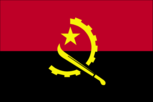
Angola
Africa · Luanda · presidential republic
What Angola means for your money, the prices you pay, the tariffs in motion, and where U.S. policy could change both.
$871M
U.S. imports, 2025
-53.4%
change in one year
$1.2B
U.S. exports, 2025
39M
Population
$80.4B
GDP
In your house
What you buy that Angola makes
America bought $871M in goods from Angola in 2025, down 53.4% in a single year. Of every $100 of it, here's where the money went.
Crude oil
Liquefied petroleum gases
Petroleum products, other
gasoline and petroleum products
Steelmaking materials
Gem diamonds
Nonferrous metals, other
Iron and steel, advanced
Iron and steel products, n.e.c.
Green coffee
green coffee for roasters
Lumber
lumber for homebuilding
2026 so far (through July): $481M in imports. Source: U.S. Census Bureau, International Trade in Goods (customs basis).
The other direction
What America sells to Angola
$1.2B in 2025, a trade rupture cuts both ways, for American producers as well as American prices.
Civilian aircraft, engines, equipment, and parts
$491MMeat, poultry, etc.
$128MDrilling & oilfield equipment
$126MIndustrial machines, other
$74MIndustrial engines
$55MChemicals-other
$28MElectric apparatus
$22MPlastic materials
$20Mplastics for packaging and goods
Measuring, testing, control instruments
$19MWhere you stand
U.S. tariff posture toward Angola
Angola was assigned 32% in April 2025, but its dominant oil and gas exports fall under the energy carve-out, limiting real exposure. The rate was reduced to 15% in August 2025 — a relatively favorable outcome attributed to Angola's strategic importance to the U.S., notably the Lobito Corridor and critical-mineral supply diversification. AGOA was renewed short-term on February 2, 2026 through year-end. Executive Order 14389 (Ending Certain Tariff Actions, Feb 20, 2026) terminated the IEEPA reciprocal duties, and Proclamation 11012 replaced it with a 10% Section 122 temporary import surcharge effective February 24, 2026; energy imports remain exempt. Angola has no Section 232 steel/aluminum exposure.
Reciprocal tariff (assigned, terminated)
32%
The rate this country was assigned under the EO 14257 reciprocal Annex, no longer in force. The Supreme Court struck down the IEEPA tariffs and they were terminated February 24, 2026 (EO 14389), replaced by a universal ~10% Section 122 surcharge. See the timeline below for the current effective rate.
Policy in motion
Tariff status: a moving target
U.S. tariff policy toward Angola has changed 4 times since 2025. This page tracks it.
2026-02-24
IEEPA reciprocal tariffs terminated — replaced by 10% Section 122
In effectExecutive Order 14389 (Ending Certain Tariff Actions) terminated the IEEPA tariff duties effective February 24, 2026, replacing Angola's 15% reciprocal rate with a 10% Section 122 temporary import surcharge under Proclamation 11012 (capped at 150 days); energy imports remain exempt.
91 FR 9437 →2025-08-07
Rate reduced to 15%
In effectExecutive Order 14326 set the post-pause Annex I reciprocal rates; Angola's rate was lowered from 32% to 15% effective August 7, 2025 — a relatively favorable outcome tied to its strategic value to the U.S., including the Lobito Corridor and critical minerals.
90 FR 37963 →2025-04-10
Elevated reciprocal rates paused to 10% for 90 days
In effectExecutive Order 14266 suspended the higher country-specific reciprocal rates — including Angola's 32% — back to the 10% baseline for 90 days.
90 FR 15625 →2025-04-05
Reciprocal tariff regime begins — Angola assigned 32% (oil exempt)
In effectExecutive Order 14257 imposed a 10% universal reciprocal duty effective April 5 and a 32% country-specific rate for Angola scheduled to take effect April 9 — but oil and gas, the bulk of Angola's exports, fell under the energy carve-out.
90 FR 15041 →
Made for America
What Angola makes for America
Angola is a direct U.S. source of 2 essential goods Americans rely on, the items themselves, shipped finished off the line.
Go deeper
The supply chain view
Angola sits upstream of 2 essential American goods through 1 tracked inputs.
Full supply-map profile →Reference
The country itself
Africa · Geography, people, economy, and government, public-domain data from the CIA World Factbook.
Bantu-speaking people settled in the area now called Angola in 6th century A.D.; by the 10th century various Bantu groups had established kingdoms, of which Kongo became the most powerful. From the late-14th to the mid-19th century, a Kingdom of Kongo stretched across central Africa from present-day northern Angola into the current Congo republics. It traded heavily with the Portuguese who, beginning in the 16th century, established coastal colonies and trading posts and introduced Christianity. Angola became a major hub of the transatlantic slave trade conducted by the Portuguese and other European powers -- often in collaboration with local kingdoms, including the Kongo. The Angola area is estimated to have lost as many as 4 million people as a result of the slave trade. The Kingdom of Kongo’s main rival was the Kingdom of Ndongo to its south, whose most famous leader was Nzingha Mbande, the 17th century diplomat to the Portuguese and later Queen, who successfully fought off Portuguese encroachment during her nearly 40-year reign. Smaller kingdoms, such as the Matamba and Ngoyo, often came under the control of the Kongo or Ndongo Kingdoms. During the Berlin Conference of 1884-85, Portugal and other European powers set Angola’s modern borders, but the Portuguese did not fully control large portions of the territory. Portugal gained control of the Kingdom of Kongo in 1888 when Kongo’s King Pedro V sought Portuguese military assistance in exchange for becoming a vassal. After a revolt in 1914, Portugal imposed direct rule over the colony and abolished the Kongo Kingdom. The Angolan National Revolution began in 1961, and in 1975, Angola won its independence when Portugal’s dictatorship fell, a collapse that occurred in part because of growing discontent over conflict in Angola and other colonies. Angola’s multiple independence movements soon clashed, with the Popular Movement for Liberation of Angola (MPLA), led by Agostinho NETO, taking power and the National Union for the Total Independence of Angola (UNITA), led by Jonas SAVIMBI, emerging as its main competitor. After NETO’s death in 1979, Jose Eduardo DOS SANTOS, also of the MPLA, became president. Over time, the Angolan civil war escalated and became a major Cold War conflict, with the Soviet Union and Cuba supporting the MPLA and the US and South Africa supporting UNITA. Up to 1.5 million lives may have been lost -- and 4 million people displaced -- during the more than a quarter-century of fighting. SAVIMBI's death in 2002 ended UNITA's insurgency and cemented the MPLA's hold on power. DOS SANTOS did not seek reelection in 2017 and supported Joao LOURENCO’s successful bid to become president. LOURENCO was reelected in 2022. Angola scores low on human development indexes despite using its large oil reserves to rebuild since 2002.
Geography
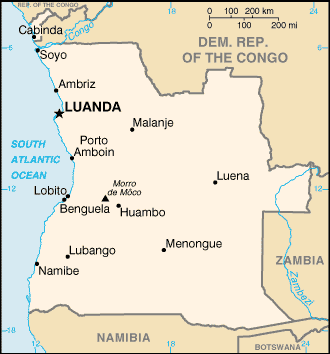
- Location
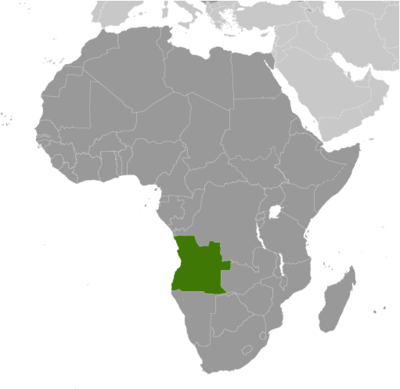
- Southern Africa, bordering the South Atlantic Ocean, between Namibia and Democratic Republic of the Congo
- Area
- 1,246,700 sq km
- Climate
- semiarid in south and along coast to Luanda; north has cool, dry season (May to October) and hot, rainy season (November to April)
- Terrain
- narrow coastal plain rises abruptly to vast interior plateau
- Natural resources
- petroleum, diamonds, iron ore, phosphates, copper, feldspar, gold, bauxite, uranium
- Coastline
- 1,600 km
- Natural hazards
- locally heavy rainfall causes periodic flooding on the plateau
People & society
- Population
- 38,984,796 (2025 est.)
- Nationality
- Angolan(s)
- Ethnic groups
- Ovimbundu 37%, Kimbundu 25%, Bakongo 13%, Mestico (mixed European and native African) 2%, European 1%, other 22%
- Languages
- Portuguese 71.2% (official), Umbundu 23%, Kikongo 8.2%, Kimbundu 7.8%, Chokwe 6.5%, Nhaneca 3.4%, Nganguela 3.1%, Fiote 2.4%, Kwanhama 2.3%, Muhumbi 2.1%, Luvale 1%, other 3.6% (2014 est.)
- Religions
- Roman Catholic 41.1%, Protestant 38.1%, other 8.6%, none 12.3% (2014 est.)
- Median age
- 16.6 years (2025 est.)
- Life expectancy at birth
- 62.9 years (2024 est.)
- Literacy
- 66.2% (2015 est.)
Economy
- Economic overview
- middle-income, oil-dependent African economy; widespread poverty; rising inflation and currency depreciation; seeking diversification through agricultural production; significant corruption in public institutions; major infrastructure investments from China and US; exited OPEC in 2023
- Industries
- petroleum; diamonds, iron ore, phosphates, feldspar, bauxite, uranium, and gold; cement; basic metal products; fish processing; food processing, brewing, tobacco products, sugar; textiles; ship repair
- Agricultural products
- cassava, bananas, maize, sweet potatoes, sugarcane, tomatoes, pineapples, onions, potatoes, citrus fruits (2023)
- Exports - partners
- China 40%, India 9%, UAE 6%, Spain 6%, Netherlands 5% (2023)
- Imports - partners
- China 19%, Portugal 10%, UAE 7%, India 6%, USA 5% (2023)
Government
- Government type
- presidential republic
- Capital
- Luanda
- Independence
- 11 November 1975 (from Portugal)
- Constitution
- previous 1975, 1992; latest passed by National Assembly 21 January 2010, adopted 5 February 2010
- Executive branch
- President Joao Manuel Goncalves LOURENCO (since 26 September 2017)
- Legislative branch
- National Assembly (Assembleia nacional)
Full reference data
Every field, by section, CIA World Factbook. Open a topic to expand it.
Introduction
Travel Facts
Please visit the following links to find further information about your desired destination.
CDC - To learn what vaccines and health precautions to take while visiting your destination.
US State Dept Travel Information - Overall information about foreign travel for US citizens.
To obtain an international driving permit (IDP). Only two organizations in the US issue IDPs: American Automobile Association (AAA) and American Automobile Touring Alliance (AATA)
How to get help in an emergency? Contact the nearest US embassy or consulate, or call one of these numbers: from the US or Canada - 1-888-407-4747 or from Overseas - +1 202-501-4444
Page last updated: Monday, September 23, 2024