
Country exposure · HT
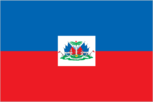
Haiti
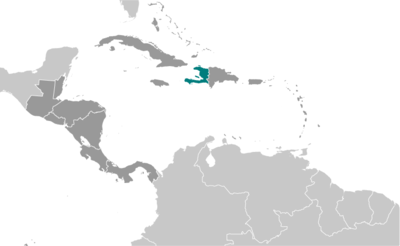
Central America N Caribbean · Port-au-Prince · semi-presidential republic
What Haiti means for your money, the prices you pay, the tariffs in motion, and where U.S. policy could change both.
$536M
U.S. imports, 2025
-11.8%
change in one year
$1.3B
U.S. exports, 2025
12M
Population
$25.2B
GDP
In your house
What you buy that Haiti makes
America bought $536M in goods from Haiti in 2025. Of every $100 of it, here's where the money went.
Apparel, textiles, nonwool or cotton
synthetic and performance apparel
Apparel, household goods - cotton
cotton clothing and linens
Camping apparel and gear
camping gear and outdoor apparel
Alcoholic beverages, excluding wine
spirits and liquor
Tobacco, waxes, etc.
U.s. goods returned, and reimports
Toys, games, and sporting goods
toys, games, sporting goods
Other foods
Minimum value shipments
Apparel,household goods-nontextile
leather goods and accessories
2026 so far (through July): $283M in imports. Source: U.S. Census Bureau, International Trade in Goods (customs basis).
The other direction
What America sells to Haiti
$1.3B in 2025, a trade rupture cuts both ways, for American producers as well as American prices.
Petroleum products, other
$280MRice
$239Mcocoa for chocolate
Fuel oil
$223MMeat, poultry, etc.
$101MWheat
$90Mgreen coffee for roasters
Minimum value shipments
$59MOther foods
$25MTobacco, manufactured
$21MManmade cloth
$17MWhere you stand
U.S. tariff posture toward Haiti
No U.S. tariff action singles this country out. Its goods face the universal 10% temporary import surcharge under Section 122 of the Trade Act (which replaced the IEEPA reciprocal baseline in February 2026) plus the sectoral Section 232 duties — steel and aluminum at 50% — that apply to all countries. The Section 122 surcharge is statutorily temporary — scheduled to lapse on or about July 23, 2026 (a 150-day cap) unless extended or replaced.
Reciprocal tariff (universal baseline)
10%
The universal 10% floor, a Section 122 import surcharge since February 2026, previously the EO 14257 reciprocal baseline, applies to nearly all U.S. imports. This country has no higher assigned rate of its own.
Policy in motion
Tariff status: a moving target
No U.S. tariff action names Haiti. These are the universal measures, applied to every country without a country-specific arrangement, that set its treatment.
2026-04-06
Section 232 metals coverage expanded
In effectThe April 2026 proclamation strengthening Section 232 actions on aluminum, steel, and copper expanded derivative-product coverage for all countries, keeping the general metals rate at 50%.
91 FR 18201 →2026-02-24
IEEPA reciprocal tariffs terminated — replaced by 10% Section 122 surcharge
In effectExecutive Order 14389 (Ending Certain Tariff Actions) terminated the IEEPA tariff duties — including the EO 14257 reciprocal baseline — effective February 24, 2026. A flat 10% Section 122 temporary import surcharge (Proclamation 11012 of February 20, 2026) replaced them, leaving the universal rate unchanged at 10% on a different statutory basis. Section 122 caps such surcharges at 150 days, so this 10% surcharge is scheduled to lapse on or about July 23, 2026 absent further action (the administration has signaled it could raise the rate toward the 15% statutory maximum).
91 FR 9437 →2025-11-13
Agricultural products exempted from reciprocal tariffs
In effectExecutive Order 14360 of November 14, 2025 removed reciprocal duties from certain agricultural products listed in its annexes (coffee, cocoa, bananas, and other goods the U.S. does not produce in sufficient quantity), retroactive to November 13, 2025 — for all countries subject to the reciprocal tariff.
90 FR 54091 →2025-06-04
Section 232 steel and aluminum duties doubled to 50%
In effectThe June 3, 2025 proclamation raised Section 232 duties on steel and aluminum articles and derivatives from 25% to 50% for all countries, effective June 4, 2025.
90 FR 24199 →2025-04-05
Universal 10% reciprocal baseline takes effect
In effectExecutive Order 14257 (signed April 2, 2025) imposed a 10% ad valorem reciprocal duty on imports from all trading partners, effective April 5, 2025. Countries without a higher Annex I rate remain at this baseline.
Federal Register · 2025-06063 →2025-03-12
Section 232 steel and aluminum duties set at 25% for all countries
In effectProclamations of February 10, 2025 terminated all country exemptions and quota arrangements and applied 25% Section 232 duties to steel and aluminum imports from every country, effective March 12, 2025.
90 FR 9817 →
Made for America
What Haiti makes for America
Haiti is a direct U.S. source of 3 essential goods Americans rely on, the items themselves, shipped finished off the line.
Reference
The country itself
Central America N Caribbean · Geography, people, economy, and government, public-domain data from the CIA World Factbook.
The native Taino -- who inhabited the island of Hispaniola when Christopher COLUMBUS first landed in 1492 -- were virtually wiped out by Spanish settlers within 25 years. In the early 17th century, the French established a presence on Hispaniola. In 1697, Spain ceded to the French the western third of the island, which later became Haiti. The French colony, based on forestry and sugar-related industries, became one of the wealthiest in the Caribbean but relied heavily on the forced labor of enslaved Africans and environmentally degrading practices. In the late 18th century, Toussaint L'OUVERTURE led a revolution of Haiti's nearly half a million slaves that ended France's rule on the island. After a prolonged struggle, and under the leadership of Jean-Jacques DESSALINES, Haiti became the first country in the world led by former slaves after declaring its independence in 1804, but it was forced to pay an indemnity of 100 million francs (equivalent to $22 billion USD in March 2023) to France for more than a century and was shunned by other countries for nearly 40 years. In 1862, the US officially recognized Haiti, but foreign economic influence and internal political instability induced the US to occupy Haiti from 1915 to 1934. Francois "Papa Doc" DUVALIER and then his son Jean-Claude "Baby Doc" DUVALIER led repressive and corrupt regimes that ruled Haiti in 1957-1971 and 1971-1986, respectively. Jean-Bertrand ARISTIDE was Haiti's first democratically elected president in 1991 and was elected a second time in 2000, but coups interrupted his first term after only a few months and ended his second term in 2004. President Jovenel MOÏSE was assassinated in 2021, leading the country further into an extra-constitutional governance structure and contributing to the country’s growing fragility. The Government of Haiti then installed Ariel HENRY -- whom President MOÏSE had nominated shortly before his death -- as prime minister. On 29 February 2024, a significant escalation of gang violence occurred on the 20th anniversary of ARISTIDE's second overthrow, after the announcement that HENRY would not hold elections until August 2025. HENRY’s return from an overseas trip was diverted to Puerto Rico when the airport closed due to gang violence. With control of much of the capital, Port-au-Prince, gang leaders called for the ouster of HENRY’S government. By mid-March, Haiti’s continued violence, HENRY’S inability to return to the country, and increasing pressure from the international community led HENRY to pledge to resign. On 25 April 2024, HENRY formally submitted his resignation as a nine-member Transitional Presidential Council assumed control, tasked with returning stability to the country and preparing elections. Since January 2023, Haiti has had no sitting elected officials. The country has long been plagued by natural disasters. In 2010, a major 7.0 magnitude earthquake struck Haiti with an epicenter about 25 km (15 mi) west of the capital, Port-au-Prince. An estimated 300,000 people were killed, and some 1.5 million left homeless. The earthquake was assessed as the worst in this region in 200 years. A 7.2 magnitude earthquake hit Haiti’s southern peninsula in 2021, causing well over 2,000 deaths; an estimated 500,000 required emergency humanitarian aid. Haiti is the poorest country in the Western Hemisphere, as well as one of the most unequal in wealth distribution.
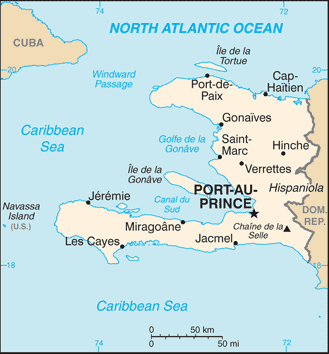
Geography
- Location
- Caribbean, western one-third of the island of Hispaniola, between the Caribbean Sea and the North Atlantic Ocean, west of the Dominican Republic
- Area
- 27,750 sq km
- Climate
- tropical; semiarid where mountains in east cut off trade winds
- Terrain
- mostly rough and mountainous
- Natural resources
- bauxite, copper, calcium carbonate, gold, marble, hydropower, arable land
- Coastline
- 1,771 km
- Natural hazards
- lies in the middle of the hurricane belt and subject to severe storms from June to October; occasional flooding and earthquakes; periodic droughts
People & society
- Population
- 11,898,812 (2025 est.)
- Nationality
- Haitian(s)
- Ethnic groups
- Black 95%, mixed and White 5%
- Languages
- French (official), Creole (official)
- Religions
- Catholic 55%, Protestant 29%, Vodou 2.1%, other 4.6%, none 10% (2018 est.)
- Median age
- 25.3 years (2025 est.)
- Life expectancy at birth
- 65.6 years (2024 est.)
- Literacy
- 68% (2017 est.)
Economy
- Economic overview
- small Caribbean island economy and OECS-member state; extreme poverty and inflation; enormous income inequality; ongoing civil unrest due to recent presidential assassination; US preferential market access; very open to foreign direct investment
- Industries
- textiles, sugar refining, flour milling, cement, light assembly using imported parts
- Agricultural products
- sugarcane, cassava, plantains, bananas, mangoes/guavas, avocados, maize, tropical fruits, rice, vegetables (2023)
- Exports - partners
- USA 82%, Canada 4%, Mexico 2%, France 2%, India 2% (2023)
- Imports - partners
- USA 31%, Dominican Republic 23%, China 14%, Indonesia 4%, India 3% (2023)
Government
- Government type
- semi-presidential republic
- Capital
- Port-au-Prince
- Independence
- 1 January 1804 (from France)
- Constitution
- many previous; latest adopted 10 March 1987, with substantial revisions in June 2012
- Executive branch
- President (vacant)
- Legislative branch
- National Assembly (Assemblée nationale)
Full reference data
Every field, by section, CIA World Factbook. Open a topic to expand it.
Introduction
Travel Facts
Please visit the following links to find further information about your desired destination.
CDC - To learn what vaccines and health precautions to take while visiting your destination.
US State Dept Travel Information - Overall information about foreign travel for US citizens.
To obtain an international driving permit (IDP). Only two organizations in the US issue IDPs: American Automobile Association (AAA) and American Automobile Touring Alliance (AATA)
How to get help in an emergency? Contact the nearest US embassy or consulate, or call one of these numbers: from the US or Canada - 1-888-407-4747 or from Overseas - +1 202-501-4444
Page last updated: Wednesday, September 18, 2024