
Country exposure · LR
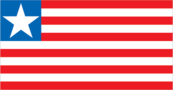
Liberia
Africa · Monrovia · presidential republic
What Liberia means for your money, the prices you pay, the tariffs in motion, and where U.S. policy could change both.
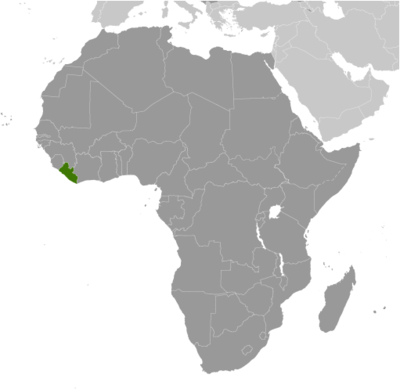
$72M
U.S. imports, 2025
-0.4%
change in one year
$109M
U.S. exports, 2025
6M
Population
$4.8B
GDP
In your house
What you buy that Liberia makes
America bought $72M in goods from Liberia in 2025. Of every $100 of it, here's where the money went.
Natural rubber
natural rubber for tires
Nonmonetary gold
Food oils, oilseeds
Gem diamonds
Cell phones and other household goods, n.e.c.
cell phones and home electronics
Minimum value shipments
Engines-civilian aircraft
Telecommunications equipment
phones, routers, networking gear
Numismatic coins
Artwork, antiques, stamps, etc.
2026 so far (through July): $25M in imports. Source: U.S. Census Bureau, International Trade in Goods (customs basis).
The other direction
What America sells to Liberia
$109M in 2025, a trade rupture cuts both ways, for American producers as well as American prices.
Passenger cars, new and used
$17Mnew and used cars
Cell phones and other household goods, n.e.c.
$11Mcell phones and home electronics
Drilling & oilfield equipment
$8MApparel, household goods - textile
$7Mcotton clothing and linens
Other foods
$6MPlastic materials
$6Mplastics for packaging and goods
Materials handling equipment
$6MMinimum value shipments
$5MOther parts and accessories of vehicles
$4Mcar parts and accessories
Where you stand
U.S. tariff posture toward Liberia
No U.S. tariff action singles this country out. Its goods face the universal 10% temporary import surcharge under Section 122 of the Trade Act (which replaced the IEEPA reciprocal baseline in February 2026) plus the sectoral Section 232 duties — steel and aluminum at 50% — that apply to all countries. The Section 122 surcharge is statutorily temporary — scheduled to lapse on or about July 23, 2026 (a 150-day cap) unless extended or replaced.
Reciprocal tariff (universal baseline)
10%
The universal 10% floor, a Section 122 import surcharge since February 2026, previously the EO 14257 reciprocal baseline, applies to nearly all U.S. imports. This country has no higher assigned rate of its own.
Policy in motion
Tariff status: a moving target
No U.S. tariff action names Liberia. These are the universal measures, applied to every country without a country-specific arrangement, that set its treatment.
2026-04-06
Section 232 metals coverage expanded
In effectThe April 2026 proclamation strengthening Section 232 actions on aluminum, steel, and copper expanded derivative-product coverage for all countries, keeping the general metals rate at 50%.
91 FR 18201 →2026-02-24
IEEPA reciprocal tariffs terminated — replaced by 10% Section 122 surcharge
In effectExecutive Order 14389 (Ending Certain Tariff Actions) terminated the IEEPA tariff duties — including the EO 14257 reciprocal baseline — effective February 24, 2026. A flat 10% Section 122 temporary import surcharge (Proclamation 11012 of February 20, 2026) replaced them, leaving the universal rate unchanged at 10% on a different statutory basis. Section 122 caps such surcharges at 150 days, so this 10% surcharge is scheduled to lapse on or about July 23, 2026 absent further action (the administration has signaled it could raise the rate toward the 15% statutory maximum).
91 FR 9437 →2025-11-13
Agricultural products exempted from reciprocal tariffs
In effectExecutive Order 14360 of November 14, 2025 removed reciprocal duties from certain agricultural products listed in its annexes (coffee, cocoa, bananas, and other goods the U.S. does not produce in sufficient quantity), retroactive to November 13, 2025 — for all countries subject to the reciprocal tariff.
90 FR 54091 →2025-06-04
Section 232 steel and aluminum duties doubled to 50%
In effectThe June 3, 2025 proclamation raised Section 232 duties on steel and aluminum articles and derivatives from 25% to 50% for all countries, effective June 4, 2025.
90 FR 24199 →2025-04-05
Universal 10% reciprocal baseline takes effect
In effectExecutive Order 14257 (signed April 2, 2025) imposed a 10% ad valorem reciprocal duty on imports from all trading partners, effective April 5, 2025. Countries without a higher Annex I rate remain at this baseline.
Federal Register · 2025-06063 →2025-03-12
Section 232 steel and aluminum duties set at 25% for all countries
In effectProclamations of February 10, 2025 terminated all country exemptions and quota arrangements and applied 25% Section 232 duties to steel and aluminum imports from every country, effective March 12, 2025.
90 FR 9817 →
Go deeper
The supply chain view
Liberia sits upstream of 1 essential American goods through 1 tracked inputs.
Full supply-map profile →Reference
The country itself
Africa · Geography, people, economy, and government, public-domain data from the CIA World Factbook.
With 28 ethnic groups and languages, Liberia is one of the most ethnically diverse countries in the world. For hundreds of years, the Mali and Songhai Empires claimed most of Liberia. Beginning in the 15th century, European traders began establishing outposts along the Liberian coast. Unlike its neighbors, however, Liberia did not fall under European colonial rule. In the early 19th century, the US began sending freed enslaved people and other people of color to Liberia to establish settlements. In 1847, these settlers declared independence from the US, writing their own constitution and establishing Africa’s first republic. Early in Liberia’s history, tensions arose between the Americo-Liberian settlers and the indigenous population. In 1980, Samuel DOE, who was from the indigenous population, led a military coup and ushered in a decade of authoritarian rule. In 1989, Charles TAYLOR launched a rebellion that led to a prolonged civil war in which DOE was killed. A period of relative peace in 1997 permitted an election that brought TAYLOR to power. In 2000, fighting resumed. A 2003 peace agreement ended the war and prompted TAYLOR’s resignation. He was later convicted by the UN-backed Special Court for Sierra Leone in The Hague for his involvement in Sierra Leone's civil war. In 2005, Ellen JOHNSON SIRLEAF became president after two years of transitional governments; she was the first female head of state in Africa. In 2011, JOHNSON SIRLEAF won reelection but struggled to rebuild Liberia's economy -- particularly after the 2014-15 Ebola epidemic -- and to reconcile a nation still recovering from 14 years of fighting. In 2017, former soccer star George WEAH won the presidential runoff election, marking the first successful transfer of power from one democratically elected government to another since the end of Liberia’s civil wars. Like his predecessor, WEAH struggled to improve the country’s economy. In 2023, former Vice President Joseph BOAKAI was elected president, edging out WEAH by a thin margin, the first time since 1927 that an incumbent was not re-elected after one term.
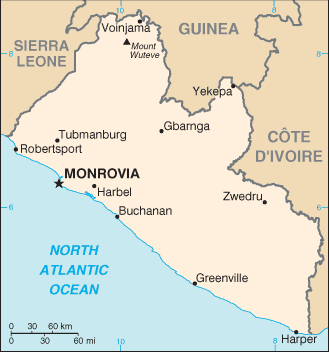
Geography
- Location
- Western Africa, bordering the North Atlantic Ocean, between Cote d'Ivoire and Sierra Leone
- Area
- 111,369 sq km
- Climate
- tropical; hot, humid; dry winters with hot days and cool to cold nights; wet, cloudy summers with frequent heavy showers
- Terrain
- mostly flat to rolling coastal plains rising to rolling plateau and low mountains in northeast
- Natural resources
- iron ore, timber, diamonds, gold, hydropower
- Coastline
- 579 km
- Natural hazards
- dust-laden harmattan winds blow from the Sahara (December to March)
People & society
- Population
- 5,563,541 (2025 est.)
- Nationality
- Liberian(s)
- Ethnic groups
- Kpelle 20.2%, Bassa 13.6%, Grebo 9.9%, Gio 7.9%, Mano 7.2%, Kru 5.5%, Lorma 4.8%, Krahn 4.5%, Kissi, 4.3%, Mandingo 4.2%, Vai 3.8%, Gola 3.8%, Gbandi 2.9%, Mende 1.7%, Sapo 1%, Belle 0.7%, Dey 0.3%, other Liberian ethnic group 0.4%, other African 3%, non-African 0.2% (2022 est.)
- Languages
- English 20% (official) and 27 indigenous languages, including Liberian English variants
- Religions
- Christian 84.9%, Muslim 12%, Traditional 0.5%, other 0.1%, none 2.6% (2022 est.)
- Median age
- 20.1 years (2025 est.)
- Life expectancy at birth
- 61.6 years (2024 est.)
Economy
- Economic overview
- low-income West African economy; food scarcity, especially in rural areas; high poverty and inflation; bad recession prior to COVID-19 due to Ebola crisis; growing government debt; longest continuously operated rubber plantation; large informal economy
- Industries
- mining (iron ore and gold), rubber processing, palm oil processing, diamonds
- Agricultural products
- cassava, sugarcane, rice, oil palm fruit, bananas, rubber, vegetables, plantains, taro, maize (2023)
- Exports - partners
- Switzerland 30%, UK 13%, France 8%, Germany 7%, Lebanon 4% (2023)
- Imports - partners
- China 48%, Japan 21%, Germany 8%, Brazil 3%, Cote d'Ivoire 3% (2023)
Government
- Government type
- presidential republic
- Capital
- Monrovia
- Independence
- 26 July 1847
- Constitution
- previous 1847 (at independence); latest drafted 19 October 1983, revision adopted by referendum 3 July 1984, effective 6 January 1986
- Executive branch
- President Joseph BOAKAI (since 22 January 2024)
- Legislative branch
- Legislature
Full reference data
Every field, by section, CIA World Factbook. Open a topic to expand it.
Introduction
Travel Facts
Please visit the following links to find further information about your desired destination.
World Health Organization (WHO) - To learn what vaccines and health precautions to take while visiting your destination.
US State Dept Travel Information - Overall information about foreign travel for US citizens.
To obtain an international driving permit (IDP). Only two organizations in the US issue IDPs: American Automobile Association (AAA) and American Automobile Touring Alliance (AATA)
How to get help in an emergency? Contact the nearest US embassy or consulate, or call one of these numbers: from the US or Canada - 1-888-407-4747 or from Overseas - +1 202-501-4444
Page last updated: Wednesday, July 20, 2022