
Country exposure · LY
Libya
Africa · Tripoli (Tarabulus) · in transition
What Libya means for your money, the prices you pay, the tariffs in motion, and where U.S. policy could change both.
$1.4B
U.S. imports, 2025
-3.3%
change in one year
$726M
U.S. exports, 2025
7M
Population
$46.6B
GDP
In your house
What you buy that Libya makes
America bought $1.4B in goods from Libya in 2025. Of every $100 of it, here's where the money went.
Crude oil
Fuel oil
fuel oil
U.s. goods returned, and reimports
Artwork, antiques, stamps, etc.
Fruits, frozen juices
fruit and frozen juices
Numismatic coins
Medicinal equipment
medical devices and equipment
Furniture, household goods, etc.
furniture, mattresses, lamps
Minimum value shipments
Fish and shellfish
fish, shrimp, shellfish
2026 so far (through July): $915M in imports. Source: U.S. Census Bureau, International Trade in Goods (customs basis).
The other direction
What America sells to Libya
$726M in 2025, a trade rupture cuts both ways, for American producers as well as American prices.
Passenger cars, new and used
$257Mnew and used cars
Pharmaceutical preparations
$45Mmedicines and pharmacy items
Other parts and accessories of vehicles
$32Mcar parts and accessories
Generators, accessories
$31MCivilian aircraft, engines, equipment, and parts
$28MNuts
$25MElectric apparatus
$24MIndustrial engines
$23MVegetables
$23MWhere you stand
U.S. tariff posture toward Libya
Libya was assigned 31% in April 2025, trimmed to 30% in August, but the figure is largely symbolic: oil, gas, and refined products — nearly all of Libya's roughly $1.6 billion in exports to the U.S. — are exempt from the reciprocal tariff. No bilateral deal was reached. Executive Order 14389 (Ending Certain Tariff Actions, Feb 20, 2026) terminated the IEEPA reciprocal duties, and Proclamation 11012 replaced it with a 10% Section 122 temporary import surcharge effective February 24, 2026; energy imports remain exempt. Libya has no Section 232 steel/aluminum exposure.
Reciprocal tariff (assigned, terminated)
31%
The rate this country was assigned under the EO 14257 reciprocal Annex, no longer in force. The Supreme Court struck down the IEEPA tariffs and they were terminated February 24, 2026 (EO 14389), replaced by a universal ~10% Section 122 surcharge. See the timeline below for the current effective rate.
Policy in motion
Tariff status: a moving target
U.S. tariff policy toward Libya has changed 4 times since 2025. This page tracks it.
2026-02-24
IEEPA reciprocal tariffs terminated — replaced by 10% Section 122
In effectExecutive Order 14389 (Ending Certain Tariff Actions) terminated the IEEPA tariff duties effective February 24, 2026, replacing Libya's 30% reciprocal rate with a 10% Section 122 temporary import surcharge under Proclamation 11012 (capped at 150 days); energy imports remain exempt.
91 FR 9437 →2025-08-07
Rate trimmed to 30% — no deal reached
In effectExecutive Order 14326 set the post-pause Annex I reciprocal rates; Libya's rate was set at 30% effective August 7, 2025 as part of the broader recalculation rather than a negotiated agreement, with the oil exemption intact.
90 FR 37963 →2025-04-10
Elevated reciprocal rates paused to 10% for 90 days
In effectExecutive Order 14266 suspended the higher country-specific reciprocal rates — including Libya's 31% — back to the 10% baseline for 90 days.
90 FR 15625 →2025-04-05
Reciprocal tariff regime begins — Libya assigned 31% (oil exempt)
In effectExecutive Order 14257 imposed a 10% universal reciprocal duty effective April 5 and a 31% country-specific rate for Libya scheduled to take effect April 9 — but oil, gas, and refined products, nearly all of Libya's exports, were carved out.
90 FR 15041 →
Made for America
What Libya makes for America
Libya is a direct U.S. source of 1 essential good Americans rely on, the items themselves, shipped finished off the line.
Go deeper
The supply chain view
Libya sits upstream of 3 essential American goods through 3 tracked inputs.
energy
1%Crude Oil Feedstock
energy
1%Canadian crude oil imports
energy
1%Gulf Coast crude oil feedstock (jet fraction)
Reference
The country itself
Africa · Geography, people, economy, and government, public-domain data from the CIA World Factbook.
Berbers have inhabited central north Africa since ancient times, but Phoenicians, Greeks, Carthaginians, Persians, Egyptians, Romans, and Vandals have all settled and ruled the region. In the 7th century, Islam spread through the area. In the mid-16th century, Ottoman rule began; the Italians supplanted the Ottoman Turks in the area around Tripoli in 1911 and held it until 1943, when they were defeated in World War II. Libya then came under UN administration and achieved independence in 1951. Col. Muammar al-QADHAFI assumed leadership with a military coup in 1969 and began to espouse a political system that combined socialism and Islam. During the 1970s, QADHAFI used oil revenues to promote his ideology outside Libya, supporting subversive and terrorist activities that included the downing of two airliners -- one over Scotland and another in Northern Africa -- and a discotheque bombing in Berlin. UN sanctions in 1992 isolated QADHAFI politically and economically; the sanctions were lifted in 2003 when Libya accepted responsibility for the bombings and agreed to claimant compensation. QADHAFI also agreed to end Libya's program to develop weapons of mass destruction, and he made significant strides in normalizing relations with Western nations. Unrest that began in several Middle Eastern and North African countries in 2010 erupted in Libyan cities in 2011. QADHAFI's brutal crackdown on protesters spawned an eight-month civil war that saw the emergence of a National Transitional Council (NTC), UN authorization of air and naval intervention by the international community, and the toppling of the QADHAFI regime. In 2012, the NTC handed power to an elected parliament, the General National Congress (GNC), which was replaced two years later with the House of Representatives (HoR). In 2015, the UN brokered the Libyan Political Agreement (LPA) among a broad array of political parties and social groups, establishing an interim executive body. However, hardliners continued to oppose and hamper the LPA implementation, leaving Libya with eastern and western-based rival governments. In 2018, the international community supported a recalibrated plan that aimed to break the political deadlock with a National Conference in 2019. These plans, however, were derailed when the eastern-based, self-described Libyan National Army (LNA) launched an offensive to seize Tripoli. The LNA offensive collapsed in 2020, and a subsequent UN-sponsored cease-fire helped formalize the pause in fighting between rival camps. In 2021, the UN-facilitated Libyan Political Dialogue Forum selected a new prime minister for an interim government -- the Government of National Unity (GNU) -- and a new presidential council charged with preparing for elections and uniting the country’s state institutions. The HoR approved the GNU and its cabinet the same year, providing Libya with its first unified government since 2014, but the parliament then postponed the planned presidential election to an undetermined date in the future. In 2022, the HoR voted to replace GNU interim Prime Minister, Abdul Hamid DUBAYBAH, with another government led by Fathi BASHAGHA. GNU allegations of an illegitimate HoR vote allowed DUBAYBAH to remain in office and rebuff BASHAGHA's attempts to seat his government in Tripoli. In 2023, the HoR voted to replace BASHAGHA with Osma HAMAD. Special Representative of the UN Security-General for Libya, Abdoulaye BATHILY, is leading international efforts to persuade key Libyan political actors to resolve the core issues impeding elections.
Geography
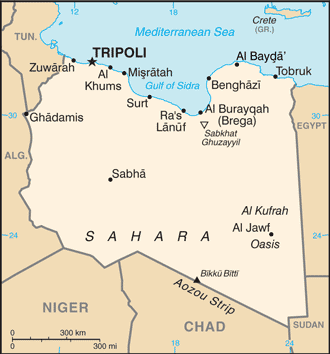
- Location
- Northern Africa, bordering the Mediterranean Sea, between Egypt, Tunisia, and Algeria
- Area
- 1,759,540 sq km
- Climate
- Mediterranean along coast; dry, extreme desert interior
- Terrain
- mostly barren, flat to undulating plains, plateaus, depressions
- Natural resources
- petroleum, natural gas, gypsum
- Coastline
- 1,770 km
- Natural hazards
- hot, dry, dust-laden ghibli is a southern wind lasting one to four days in spring and fall; dust storms, sandstorms
People & society
- Population
- 7,361,263 (2024 est.)
- Nationality
- Libyan(s)
- Ethnic groups
- Amazigh and Arab 97%, other 3% (includes Egyptian, Greek, Indian, Italian, Maltese, Pakistani, Tunisian, and Turkish)
- Languages
- Arabic (official), Italian, English (all widely understood in the major cities); Tamazight (Nafusi, Ghadamis, Suknah, Awjilah, Tamasheq)
- Religions
- Muslim (official; virtually all Sunni) 96.6%, Christian 2.7%, Buddhist <1%, Hindu <1%, Jewish <1%, folk religion <1%, other <1%, unaffiliated <1% (2020 est.)
- Median age
- 26.4 years (2025 est.)
- Life expectancy at birth
- 77.7 years (2024 est.)
Economy
- Economic overview
- upper middle-income, fossil fuel-based North African economy; 31% economic contraction due to COVID-19 and 2020 oil blockade; reduced government spending; central bank had to devalue currency; public wages are over 60% of expenditures
- Industries
- petroleum, petrochemicals, aluminum, iron and steel, food processing, textiles, handicrafts, cement
- Agricultural products
- potatoes, onions, watermelons, tomatoes, dates, olives, milk, chicken, wheat, vegetables (2023)
- Exports - partners
- Italy 23%, Germany 15%, Spain 9%, France 7%, China 6% (2023)
- Imports - partners
- China 17%, Turkey 15%, Italy 8%, UAE 8%, Egypt 8% (2023)
Government
- Government type
- in transition
- Capital
- Tripoli (Tarabulus)
- Independence
- 24 December 1951 (from UN trusteeship)
- Constitution
- previous 1951, 1977, 2011 (interim)
- Executive branch
- President, Presidential Council, Mohammed al-MANFI (since 5 February 2021)
- Legislative branch
- unicameral
Full reference data
Every field, by section, CIA World Factbook. Open a topic to expand it.
Introduction
Travel Facts
Please visit the following links to find further information about your desired destination.
World Health Organization (WHO) - To learn what vaccines and health precautions to take while visiting your destination.
US State Dept Travel Information - Overall information about foreign travel for US citizens.
To obtain an international driving permit (IDP). Only two organizations in the US issue IDPs: American Automobile Association (AAA) and American Automobile Touring Alliance (AATA)
How to get help in an emergency? Contact the nearest US embassy or consulate, or call one of these numbers: from the US or Canada - 1-888-407-4747 or from Overseas - +1 202-501-4444
Page last updated: Wednesday, October 19, 2022