
Country exposure · ME
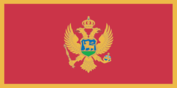
Montenegro
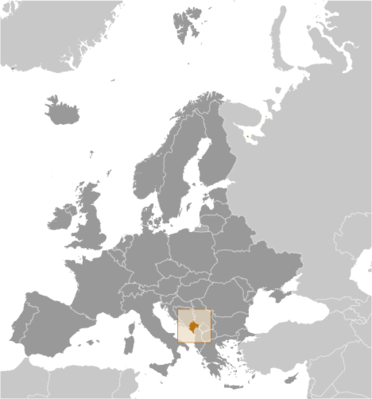
Europe · Podgorica · parliamentary republic
What Montenegro means for your money, the prices you pay, the tariffs in motion, and where U.S. policy could change both.
$11M
U.S. imports, 2025
-29.6%
change in one year
$40M
U.S. exports, 2025
600K
Population
$8.1B
GDP
In your house
What you buy that Montenegro makes
America bought $11M in goods from Montenegro in 2025, down 29.6% in a single year. Of every $100 of it, here's where the money went.
Alcoholic beverages, excluding wine
spirits and liquor
Telecommunications equipment
phones, routers, networking gear
Electric apparatus
Wine, beer, and related products
wine and beer
Semiconductors
semiconductors and chips
Furniture, household goods, etc.
furniture, mattresses, lamps
Minimum value shipments
Industrial machines, other
Sulfur, nonmetallic minerals
Vegetables
vegetables
2026 so far (through July): $7M in imports. Source: U.S. Census Bureau, International Trade in Goods (customs basis).
The other direction
What America sells to Montenegro
$40M in 2025, a trade rupture cuts both ways, for American producers as well as American prices.
Telecommunications equipment
$5Mphones, routers, networking gear
Passenger cars, new and used
$4Mnew and used cars
Minimum value shipments
$4MSports apparel and gear
$3Mcamping gear and outdoor apparel
Household appliances
$2Mhousehold appliances
Trucks, buses, and special purpose vehicles
$2Mtrucks, buses, SUVs
Finished metal shapes
$2MFish and shellfish
$2Mfish, shrimp, shellfish
Plastic materials
$1Mplastics for packaging and goods
Where you stand
U.S. tariff posture toward Montenegro
No U.S. tariff action singles this country out. Its goods face the universal 10% temporary import surcharge under Section 122 of the Trade Act (which replaced the IEEPA reciprocal baseline in February 2026) plus the sectoral Section 232 duties — steel and aluminum at 50% — that apply to all countries. The Section 122 surcharge is statutorily temporary — scheduled to lapse on or about July 23, 2026 (a 150-day cap) unless extended or replaced.
Reciprocal tariff (universal baseline)
10%
The universal 10% floor, a Section 122 import surcharge since February 2026, previously the EO 14257 reciprocal baseline, applies to nearly all U.S. imports. This country has no higher assigned rate of its own.
Policy in motion
Tariff status: a moving target
No U.S. tariff action names Montenegro. These are the universal measures, applied to every country without a country-specific arrangement, that set its treatment.
2026-04-06
Section 232 metals coverage expanded
In effectThe April 2026 proclamation strengthening Section 232 actions on aluminum, steel, and copper expanded derivative-product coverage for all countries, keeping the general metals rate at 50%.
91 FR 18201 →2026-02-24
IEEPA reciprocal tariffs terminated — replaced by 10% Section 122 surcharge
In effectExecutive Order 14389 (Ending Certain Tariff Actions) terminated the IEEPA tariff duties — including the EO 14257 reciprocal baseline — effective February 24, 2026. A flat 10% Section 122 temporary import surcharge (Proclamation 11012 of February 20, 2026) replaced them, leaving the universal rate unchanged at 10% on a different statutory basis. Section 122 caps such surcharges at 150 days, so this 10% surcharge is scheduled to lapse on or about July 23, 2026 absent further action (the administration has signaled it could raise the rate toward the 15% statutory maximum).
91 FR 9437 →2025-11-13
Agricultural products exempted from reciprocal tariffs
In effectExecutive Order 14360 of November 14, 2025 removed reciprocal duties from certain agricultural products listed in its annexes (coffee, cocoa, bananas, and other goods the U.S. does not produce in sufficient quantity), retroactive to November 13, 2025 — for all countries subject to the reciprocal tariff.
90 FR 54091 →2025-06-04
Section 232 steel and aluminum duties doubled to 50%
In effectThe June 3, 2025 proclamation raised Section 232 duties on steel and aluminum articles and derivatives from 25% to 50% for all countries, effective June 4, 2025.
90 FR 24199 →2025-04-05
Universal 10% reciprocal baseline takes effect
In effectExecutive Order 14257 (signed April 2, 2025) imposed a 10% ad valorem reciprocal duty on imports from all trading partners, effective April 5, 2025. Countries without a higher Annex I rate remain at this baseline.
Federal Register · 2025-06063 →2025-03-12
Section 232 steel and aluminum duties set at 25% for all countries
In effectProclamations of February 10, 2025 terminated all country exemptions and quota arrangements and applied 25% Section 232 duties to steel and aluminum imports from every country, effective March 12, 2025.
90 FR 9817 →
Made for America
What Montenegro makes for America
Montenegro is a direct U.S. source of 1 essential good Americans rely on, the items themselves, shipped finished off the line.
Reference
The country itself
Europe · Geography, people, economy, and government, public-domain data from the CIA World Factbook.
The use of the name Crna Gora or Black Mountain (Montenegro) began in the 13th century in reference to a highland region in the Serbian province of Zeta. Under Ottoman control beginning in 1496, Montenegro was a semi-autonomous theocracy ruled by a series of bishop princes until 1852, when it became a secular principality. Montenegro fought a series of wars with the Ottomans and eventually won recognition as an independent sovereign principality at the Congress of Berlin in 1878. In 1918, the country was absorbed by the Kingdom of Serbs, Croats, and Slovenes, which became the Kingdom of Yugoslavia in 1929. At the end of World War II, Montenegro joined the Socialist Federal Republic of Yugoslavia (SFRY). When the SFRY dissolved in 1992, Montenegro and Serbia created the Federal Republic of Yugoslavia (FRY), which shifted in 2003 to a looser State Union of Serbia and Montenegro. Montenegro voted to restore its independence on 3 June 2006. Montenegro became an official EU candidate in 2010 and joined NATO in 2017.
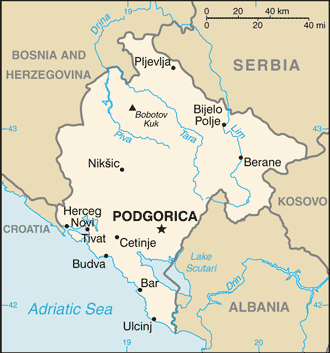
Geography
- Location
- Southeastern Europe, between the Adriatic Sea and Serbia
- Area
- 13,812 sq km
- Climate
- Mediterranean climate, hot dry summers and autumns and relatively cold winters with heavy snowfalls inland
- Terrain
- highly indented coastline with narrow coastal plain backed by rugged high limestone mountains and plateaus
- Natural resources
- bauxite, hydroelectricity
- Coastline
- 293.5 km
- Natural hazards
- destructive earthquakes
People & society
- Population
- 599,849 (2024 est.)
- Nationality
- Montenegrin(s)
- Ethnic groups
- Montenegrin 45%, Serbian 28.7%, Bosniak 8.7%, Albanian 4.9%, Muslim 3.3%, Romani 1%, Croat 1%, other 2.6%, unspecified 4.9% (2011 est.)
- Languages
- Serbian 42.9%, Montenegrin (official) 37%, Bosnian 5.3%, Albanian 5.3%, Serbo-Croat 2%, other 3.5%, unspecified 4% (2011 est.)
- Religions
- Orthodox 72.1%, Muslim 19.1%, Catholic 3.4%, atheist 1.2%, other 1.5%, unspecified 2.6% (2011 est.)
- Median age
- 41.5 years (2025 est.)
- Life expectancy at birth
- 78.2 years (2024 est.)
- Literacy
- 98.5% (2018 est.)
Economy
- Economic overview
- upper-middle-income, small Balkan economy; uses euro as de facto currency; reduced growth due to slowdown in tourism and industrial production; new impetus for EU accession under Europe Now government; energy price cap and declining food and services prices easing inflation rate
- Industries
- steelmaking, aluminum, agricultural processing, consumer goods, tourism
- Agricultural products
- milk, potatoes, watermelons, grapes, sheep milk, cabbages, oranges, eggs, goat milk, figs (2023)
- Exports - partners
- Italy 38%, Serbia 13%, Spain 6%, Slovenia 5%, Bosnia & Herzegovina 4% (2023)
- Imports - partners
- Serbia 21%, China 10%, Germany 8%, Croatia 6%, Italy 6% (2023)
Government
- Government type
- parliamentary republic
- Capital
- Podgorica
- Independence
- 3 June 2006 (from the State Union of Serbia and Montenegro); notable earlier dates: 13 March 1852 (Principality of Montenegro established); 13 July 1878 (Congress of Berlin recognizes Montenegrin independence); 28 August 1910 (Kingdom of Montenegro established)
- Constitution
- several previous; latest adopted 22 October 2007
- Executive branch
- President Jakov MILATOVIC (since 20 May 2023)
- Legislative branch
- Parliament (Skupstina)
Full reference data
Every field, by section, CIA World Factbook. Open a topic to expand it.
Introduction
Travel Facts
Please visit the following links to find further information about your desired destination.
World Health Organization (WHO) - To learn what vaccines and health precautions to take while visiting your destination.
US State Dept Travel Information - Overall information about foreign travel for US citizens.
To obtain an international driving permit (IDP). Only two organizations in the US issue IDPs: American Automobile Association (AAA) and American Automobile Touring Alliance (AATA)
How to get help in an emergency? Contact the nearest US embassy or consulate, or call one of these numbers: from the US or Canada - 1-888-407-4747 or from Overseas - +1 202-501-4444
Page last updated: Wednesday, November 09, 2022