
Country exposure · MG
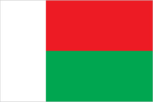
Madagascar
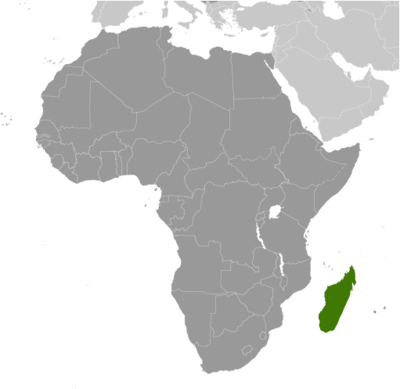
Africa · Antananarivo · semi-presidential republic
What Madagascar means for your money, the prices you pay, the tariffs in motion, and where U.S. policy could change both.
$695M
U.S. imports, 2025
-4.9%
change in one year
$60M
U.S. exports, 2025
31M
Population
$17.4B
GDP
In your house
What you buy that Madagascar makes
America bought $695M in goods from Madagascar in 2025. Of every $100 of it, here's where the money went.
Apparel, textiles, nonwool or cotton
synthetic and performance apparel
Apparel, household goods - cotton
cotton clothing and linens
Steelmaking materials
Tea, spices, etc.
tea and spices
Nonferrous metals, other
Gem stones, other
U.s. goods returned, and reimports
Sulfur, nonmetallic minerals
Apparel, household goods - wool
wool sweaters and coats
Camping apparel and gear
camping gear and outdoor apparel
2026 so far (through July): $322M in imports. Source: U.S. Census Bureau, International Trade in Goods (customs basis).
The other direction
What America sells to Madagascar
$60M in 2025, a trade rupture cuts both ways, for American producers as well as American prices.
Telecommunications equipment
$10Mphones, routers, networking gear
Civilian aircraft, engines, equipment, and parts
$8MOther foods
$7MPlastic materials
$5Mplastics for packaging and goods
Miscellaneous domestic exports and special transactions
$4MMedicinal equipment
$4Mmedical devices and equipment
Industrial engines
$2MDairy products and eggs
$2MSorghum, barley, oats
$2MWhere you stand
U.S. tariff posture toward Madagascar
Madagascar was assigned 47% in April 2025 — a severe blow to its vanilla and apparel exports, which depend heavily on the U.S. market and support some 60,000 textile jobs. The rate was cut to 15% in the August reshuffle without a formal deal, averting immediate factory closures. Madagascar's AGOA duty-free access lapsed on September 30, 2025, with a stopgap extension under lobbying. Executive Order 14389 (Ending Certain Tariff Actions, Feb 20, 2026) terminated the IEEPA reciprocal duties, and Proclamation 11012 replaced it with a 10% Section 122 temporary import surcharge effective February 24, 2026. Madagascar has no Section 232 steel/aluminum exposure.
Reciprocal tariff (assigned, terminated)
47%
The rate this country was assigned under the EO 14257 reciprocal Annex, no longer in force. The Supreme Court struck down the IEEPA tariffs and they were terminated February 24, 2026 (EO 14389), replaced by a universal ~10% Section 122 surcharge. See the timeline below for the current effective rate.
Policy in motion
Tariff status: a moving target
U.S. tariff policy toward Madagascar has changed 4 times since 2025. This page tracks it.
2026-02-24
IEEPA reciprocal tariffs terminated — replaced by 10% Section 122
In effectExecutive Order 14389 (Ending Certain Tariff Actions) terminated the IEEPA tariff duties effective February 24, 2026, replacing Madagascar's 15% reciprocal rate with a 10% Section 122 temporary import surcharge under Proclamation 11012 (capped at 150 days).
91 FR 9437 →2025-08-07
Rate cut from 47% to 15%
In effectExecutive Order 14326 set the post-pause Annex I reciprocal rates; Madagascar's rate was reduced from 47% to 15% without a formal agreement — substantial relief for its vanilla and textile exporters, though still a sharp increase over prior duty-free AGOA access.
90 FR 37963 →2025-04-10
Elevated reciprocal rates paused to 10% for 90 days
In effectExecutive Order 14266 suspended the higher country-specific reciprocal rates — including Madagascar's 47% — back to the 10% baseline for 90 days to allow negotiations.
90 FR 15625 →2025-04-05
Reciprocal tariff regime begins — Madagascar assigned 47%
In effectExecutive Order 14257 imposed a 10% universal reciprocal duty effective April 5 and a 47% country-specific rate for Madagascar scheduled to take effect April 9 — among the steepest rates assigned, driven by its vanilla- and apparel-led trade surplus.
90 FR 15041 →
Made for America
What Madagascar makes for America
Madagascar is a direct U.S. source of 2 essential goods Americans rely on, the items themselves, shipped finished off the line.
Go deeper
The supply chain view
Madagascar sits upstream of 6 essential American goods through 6 tracked inputs.
agricultural
40%Vanilla Beans
mineral
24%Cosmetic Mica / Pearlescent Pigment
mineral
18%Titanium mineral concentrates (ilmenite/rutile)
mineral
13%Natural graphite (flake)
mineral
4%Conductive Graphite / Carbon Black
mineral
1%Cobalt Ore (DRC)
Reference
The country itself
Africa · Geography, people, economy, and government, public-domain data from the CIA World Factbook.
Madagascar was one of the last major habitable landmasses on earth to be settled by humans. While there is some evidence of human presence on the island in the millennia B.C., large-scale settlement began between A.D. 350 and 550 with settlers from present-day Indonesia. The island attracted Arab and Persian traders as early as the 7th century, and migrants from Africa arrived around A.D. 1000. Madagascar was a pirate stronghold during the late 17th and early 18th centuries and served as a slave trading center into the 19th century. From the 16th to the late 19th century, a native Merina Kingdom dominated much of Madagascar. The French conquered the island in 1896 and made it a colony; independence was regained in 1960. Free presidential and National Assembly elections were held in 1992-93, ending 17 years of single-party rule. In 1997, in the second presidential race, Didier RATSIRAKA, the leader during the 1970s and 1980s, returned to the presidency. The 2001 presidential election was contested between the followers of RATSIRAKA and Marc RAVALOMANANA, nearly causing half the country to secede. In 2002, the High Constitutional Court announced RAVALOMANANA the winner. He won a second term in 2006 but, following protests in 2009, handed over power to the military, which then conferred the presidency on the mayor of Antananarivo, Andry RAJOELINA, in what amounted to a coup d'etat. After a lengthy mediation process, Madagascar held UN-supported presidential and parliamentary elections in 2013. Former de facto finance minister Hery RAJAONARIMAMPIANINA won in a runoff and was inaugurated in 2014. In 2019, RAJOELINA was declared the winner against RAVALOMANANA. In 2023, RAJOELINA won another term in an election that most of the opposition boycotted, including RAJAONARIMAMPIANINA and RAVALOMANANA, who claimed it was rigged in favor of RAJOELINA. International observers, however, saw no evidence of systemic fraud, leading the international community to accept the election results.
Geography
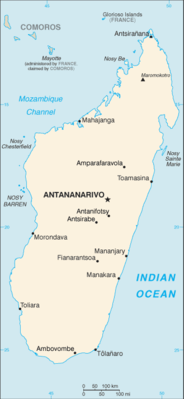
- Location
- Southern Africa, island in the Indian Ocean, east of Mozambique
- Area
- 587,041 sq km
- Climate
- tropical along coast, temperate inland, arid in south
- Terrain
- narrow coastal plain, high plateau and mountains in center
- Natural resources
- graphite, chromite, coal, bauxite, rare earth elements, salt, quartz, tar sands, semiprecious stones, mica, fish, hydropower
- Coastline
- 4,828 km
- Natural hazards
- periodic cyclones; drought; and locust infestation volcanism: Madagascar's volcanoes have not erupted in recorded history
People & society
- Population
- 31,345,040 (2025 est.)
- Nationality
- Malagasy (singular and plural)
- Ethnic groups
- Malayo-Indonesian (Merina and related Betsileo), Cotiers (mixed African, Malayo-Indonesian, and Arab ancestry - Betsimisaraka, Tsimihety, Antaisaka, Sakalava), French, Indian, Creole, Comoran
- Languages
- Malagasy (official) 99.9%, French (official) 23.6%, English 8.2%, other 0.6% (2018 est.)
- Religions
- Church of Jesus Christ in Madagascar/Malagasy Lutheran Church/Anglican Church 34%, Roman Catholic 32.3%, other Christian 8.1%, traditional/Animist 1.7%, Muslim 1.4%, other 0.6%, none 21.9% (2021 est.)
- Median age
- 20.5 years (2025 est.)
- Life expectancy at birth
- 68.8 years (2024 est.)
- Literacy
- 74.7% (2021 est.)
Economy
- Economic overview
- low-income East African island economy; natural resource rich; extreme poverty; return of political stability has helped growth; sharp tax revenue drop due to COVID-19; leading vanilla producer; environmentally fragile
- Industries
- meat processing, seafood, soap, beer, leather, sugar, textiles, glassware, cement, automobile assembly plant, paper, petroleum, tourism, mining
- Agricultural products
- rice, sugarcane, cassava, sweet potatoes, milk, bananas, vegetables, mangoes/guavas, maize, potatoes (2023)
- Exports - partners
- USA 16%, France 15%, Japan 8%, China 6%, S. Korea 6% (2023)
- Imports - partners
- China 19%, Oman 13%, France 10%, India 8%, South Africa 5% (2023)
Government
- Government type
- semi-presidential republic
- Capital
- Antananarivo
- Independence
- 26 June 1960 (from France)
- Constitution
- previous 1992; latest passed by referendum 17 November 2010, promulgated 11 December 2010
- Executive branch
- Michael RANDRIANIRINA (Col.)
- Legislative branch
- bicameral
Full reference data
Every field, by section, CIA World Factbook. Open a topic to expand it.
Introduction
Travel Facts
Please visit the following links to find further information about your desired destination.
World Health Organization (WHO) - To learn what vaccines and health precautions to take while visiting your destination.
US State Dept Travel Information - Overall information about foreign travel for US citizens.
To obtain an international driving permit (IDP). Only two organizations in the US issue IDPs: American Automobile Association (AAA) and American Automobile Touring Alliance (AATA)
How to get help in an emergency? Contact the nearest US embassy or consulate, or call one of these numbers: from the US or Canada - 1-888-407-4747 or from Overseas - +1 202-501-4444
Page last updated: Wednesday, July 20, 2022