
Country exposure · MU
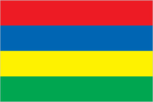
Mauritius
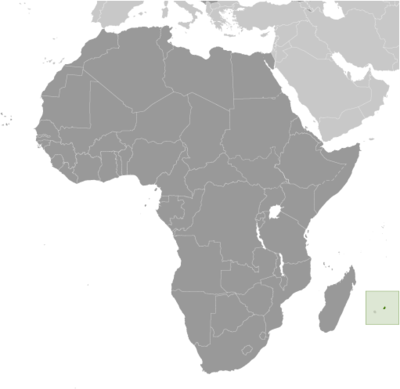
Africa · Port Louis · parliamentary republic
What Mauritius means for your money, the prices you pay, the tariffs in motion, and where U.S. policy could change both.
$191M
U.S. imports, 2025
-18.2%
change in one year
$49M
U.S. exports, 2025
1M
Population
$15.0B
GDP
In your house
What you buy that Mauritius makes
America bought $191M in goods from Mauritius in 2025, down 18.2% in a single year. Of every $100 of it, here's where the money went.
Other (movies, miscellaneous imports, and special transactions)
Fish and shellfish
fish, shrimp, shellfish
Apparel, household goods - cotton
cotton clothing and linens
Cane and beet sugar
cane and beet sugar
Apparel, textiles, nonwool or cotton
synthetic and performance apparel
Gem diamonds
Jewelry
jewelry
Other foods
U.s. goods returned, and reimports
Medicinal equipment
medical devices and equipment
2026 so far (through July): $121M in imports. Source: U.S. Census Bureau, International Trade in Goods (customs basis).
The other direction
What America sells to Mauritius
$49M in 2025, a trade rupture cuts both ways, for American producers as well as American prices.
Tobacco, manufactured
$10MTelecommunications equipment
$2Mphones, routers, networking gear
Industrial machines, other
$2MToiletries and cosmetics
$2Mtoiletries and cosmetics
Minimum value shipments
$2MPassenger cars, new and used
$2Mnew and used cars
Civilian aircraft, engines, equipment, and parts
$2MComputer accessories
$2Mkeyboards, drives, computer parts
Logs and lumber
$1MWhere you stand
U.S. tariff posture toward Mauritius
Mauritius was assigned 40% in April 2025 — a serious threat to its textile, sugar, and seafood exporters, which had long relied on AGOA duty-free access. Through negotiations the rate was lowered to 15% effective August 7, 2025, without a formal signed agreement. Executive Order 14389 (Ending Certain Tariff Actions, Feb 20, 2026) terminated the IEEPA reciprocal duties, and Proclamation 11012 replaced it with a 10% Section 122 temporary import surcharge effective February 24, 2026. Mauritius has no Section 232 steel/aluminum exposure.
Reciprocal tariff (assigned, terminated)
40%
The rate this country was assigned under the EO 14257 reciprocal Annex, no longer in force. The Supreme Court struck down the IEEPA tariffs and they were terminated February 24, 2026 (EO 14389), replaced by a universal ~10% Section 122 surcharge. See the timeline below for the current effective rate.
Policy in motion
Tariff status: a moving target
U.S. tariff policy toward Mauritius has changed 4 times since 2025. This page tracks it.
2026-02-24
IEEPA reciprocal tariffs terminated — replaced by 10% Section 122
In effectExecutive Order 14389 (Ending Certain Tariff Actions) terminated the IEEPA tariff duties effective February 24, 2026, replacing Mauritius's 15% reciprocal rate with a 10% Section 122 temporary import surcharge under Proclamation 11012 (capped at 150 days).
91 FR 9437 →2025-08-07
Rate reduced to 15%
In effectExecutive Order 14326 set the post-pause Annex I reciprocal rates; Mauritius's rate was lowered from 40% to 15% effective August 7, 2025 following negotiations, though without a formal signed agreement.
90 FR 37963 →2025-04-10
Elevated reciprocal rates paused to 10% for 90 days
In effectExecutive Order 14266 suspended the higher country-specific reciprocal rates — including Mauritius's 40% — back to the 10% baseline for 90 days to allow negotiations.
90 FR 15625 →2025-04-05
Reciprocal tariff regime begins — Mauritius assigned 40%
In effectExecutive Order 14257 imposed a 10% universal reciprocal duty effective April 5 and a 40% country-specific rate for Mauritius scheduled to take effect April 9, derived by halving an estimated 80% deficit-to-imports ratio.
90 FR 15041 →
Made for America
What Mauritius makes for America
Mauritius is a direct U.S. source of 4 essential goods Americans rely on, the items themselves, shipped finished off the line.
Reference
The country itself
Africa · Geography, people, economy, and government, public-domain data from the CIA World Factbook.
Although known to Arab and European sailors since at least the early 1500s, the island of Mauritius was uninhabited until 1638 when the Dutch established a settlement named in honor of Prince Maurits van NASSAU. Their presence led to the rapid disappearance of the flightless dodo bird that has since become one of the most well-known examples of extinction in modern times. The Dutch abandoned their financially distressed settlement in 1710, although a number of formerly enslaved people remained. In 1722, the French established what would become a highly profitable settlement focused on sugar cane plantations that were reliant on the labor of enslaved people brought to Mauritius from other parts of Africa. In the 1790s, the island had a brief period of autonomous rule when plantation owners rejected French control because of laws ending slavery that were temporarily in effect during the French Revolution. Britain captured the island in 1810 as part of the Napoleonic Wars but kept most of the French administrative structure, which remains to this day in the form of the country’s legal codes and widespread use of the French Creole language. The abolition of slavery in 1835 -- later than most other British colonies -- led to increased reliance on contracted laborers from the Indian subcontinent to work on plantations. Today their descendants form the majority of the population. Mauritius remained a strategically important British naval base and later an air station, and it played a role during World War II in anti-submarine and convoy operations, as well as in the collection of signals intelligence. Mauritius gained independence from the UK in 1968 as a Parliamentary Republic and has remained a stable democracy with regular free elections and a positive human rights record. The country also attracted considerable foreign investment and now has one of Africa's highest per capita incomes. Mauritius’ often-fractious coalition politics has been dominated by two prominent families, each of which has had father-son pairs who have been prime minister over multiple, often nonconsecutive, terms. Seewoosagur RAMGOOLAM (1968-76) was Mauritius’ first prime minister, and he was succeeded by Anerood JUGNAUTH (1982-95, 2000-03, 2014-17); his son Navin RAMGOOLAM (1995-2000, 2005-14); and Paul Raymond BERENGER (2003-05), the only non-Hindu prime minister of post-independence Mauritius. In 2017, Pravind JUGNAUTH became prime minister after his father stepped down short of completing his term, and he was elected in his own right in 2019. Mauritius claims the French island of Tromelin and the British Chagos Archipelago (British Indian Ocean Territory). Since 2017, Mauritius has secured favorable UN General Assembly resolutions and an International Court of Justice advisory opinion relating to its sovereignty dispute with the UK.
Geography
- Location
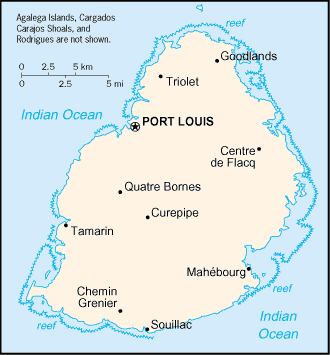
- Southern Africa, island in the Indian Ocean, about 800 km (500 mi) east of Madagascar
- Area
- 2,040 sq km
- Climate
- tropical, modified by southeast trade winds; warm, dry winter (May to November); hot, wet, humid summer (November to May)
- Terrain
- small coastal plain rising to discontinuous mountains encircling central plateau
- Natural resources
- arable land, fish
- Coastline
- 177 km
- Natural hazards
- cyclones (November to April); almost completely surrounded by reefs that may pose maritime hazards
People & society
- Population
- 1,311,375 (2025 est.)
- Nationality
- Mauritian(s)
- Ethnic groups
- Indo-Mauritian (compose approximately two thirds of the total population), Creole, Sino-Mauritian, Franco-Mauritian
- Languages
- Creole 86.5%, Bhojpuri 5.3%, French 4.1%, two languages 1.4%, other 2.6% (includes English, one of the two official languages of the National Assembly, which is spoken by less than 1% of the population), unspecified 0.1% (2011 est.)
- Religions
- Hindu 48.5%, Roman Catholic 26.3%, Muslim 17.3%, other Christian 6.4%, other 0.6%, none 0.7%, unspecified 0.1% (2011 est.)
- Median age
- 40 years (2025 est.)
- Life expectancy at birth
- 75.4 years (2024 est.)
- Literacy
- 94.3% (2023 est.)
Economy
- Economic overview
- upper middle-income Indian Ocean island economy; diversified portfolio; investing in maritime security; strong tourism sector decimated by COVID-19; expanding in information and financial services; environmentally fragile
- Industries
- food processing (largely sugar milling), textiles, clothing, mining, chemicals, metal products, transport equipment, nonelectrical machinery, tourism
- Agricultural products
- sugarcane, chicken, pumpkins/squash, tomatoes, eggs, potatoes, cabbages, bananas, onions, cucumbers/gherkins (2023)
- Exports - partners
- USA 11%, France 11%, Zimbabwe 10%, South Africa 7%, Zambia 7% (2023)
- Imports - partners
- China 15%, UAE 11%, India 10%, South Africa 9%, France 6% (2023)
Government
- Government type
- parliamentary republic
- Capital
- Port Louis
- Independence
- 12 March 1968 (from the UK)
- Constitution
- several previous; latest adopted 12 March 1968
- Executive branch
- President Dharam GOKHOOL (since 7 December 2024)
- Legislative branch
- National Assembly - Assemblée nationale
Full reference data
Every field, by section, CIA World Factbook. Open a topic to expand it.
Introduction
Travel Facts
Please visit the following links to find further information about your desired destination.
World Health Organization (WHO) - To learn what vaccines and health precautions to take while visiting your destination.
US State Dept Travel Information - Overall information about foreign travel for US citizens.
To obtain an international driving permit (IDP). Only two organizations in the US issue IDPs: American Automobile Association (AAA) and American Automobile Touring Alliance (AATA)
How to get help in an emergency? Contact the nearest US embassy or consulate, or call one of these numbers: from the US or Canada - 1-888-407-4747 or from Overseas - +1 202-501-4444
Page last updated: Tuesday, September 20, 2022